
Executive Overview
For decades, a peculiar paradox has haunted piano education: students can spend upwards of a decade taking weekly private lessons, successfully mastering complex repertoires like Chopin nocturnes and Beethoven sonatas, yet remain fundamentally unable to fluently read through a basic, level-one sight-reading book. This systemic failure points to a deeper, structural flaw in traditional music pedagogy. While sight-reading is universally acknowledged by master pedagogues as one of the most vital musicianship skills—acting as the gateway to musical independence, ensemble playing, and lifelong enjoyment—it is routinely sidelined in standard curricula.
The consequences of this educational oversight are far-reaching. Aspiring pianists and seasoned instrumentalists alike often feel trapped in a perpetual cycle of slow-progress frustration, performance anxiety, and reliance on rote memorization. Many mistakenly attribute their reading deficiencies to personal shortcomings, such as attention deficits or a lack of innate talent. However, recent insights from educators and researchers suggest the fault lies not with the student, but with the absence of a standardized, principle-driven framework for teaching the skill.
This investigative report examines the root causes of the sight-reading crisis in modern music education, drawing on the personal journey of pianist and educator Lara Mirinjian, academic findings from piano pedagogy research, and timeless educational principles. By shifting the focus from rote method-book memorization to foundational mechanical and cognitive principles—such as strict pacing, the "read-only-twice" rule, and starting with deceptively simple material—musicians at any level can unlock exponential growth. The findings detailed below outline a replicable blueprint for transforming how sight-reading is approached, taught, and mastered.
Detailed Chronology: The Journey from Confusion to Mastery
To understand how sight-reading can become a lifelong obstacle even for dedicated students, it is instructive to trace the developmental trajectory typical of traditional music instruction.
Phase One: The Illusion of Progress (Years 1–3)
In the early stages of piano instruction, students are introduced to basic note-reading alongside physical technique. Method books typically pair simple melodies with visual aids, encouraging students to decode notes one by one. During this honeymoon phase, pieces are short enough that students can easily memorize them after a few clumsy attempts. Because the ultimate goal of the lesson is a polished performance piece for a recital or a weekly check-in, teachers and students alike measure success by the final audio output rather than the cognitive decoding process. Consequently, the student relies heavily on tactile memory—remembering where the fingers go—rather than visual processing—reading the symbols on the page in real-time.

Phase Two: The Widening Gap (Years 4–7)
As the repertoire advances into intermediate territory, the volume of notes increases exponentially. Pieces feature complex rhythmic syncopation, ledger lines, shifting hand positions, and dense harmonies. For the student who has relied on memorization rather than true sight-reading, this is where progress grinds to a halt. Every new piece requires hours of painful, note-by-note decoding. Practicing feels like wading through wet cement. The student begins to avoid unfamiliar music, gravitating exclusively toward pieces they have already spent weeks learning. Frustration mounts, and the belief that "I am simply not a natural sight-reader" solidifies.
Phase Three: The Discovery of Pedagogical Principles (Adult Realization)
For Lara Mirinjian, this cycle of frustration lasted over ten years. Despite extensive formal training, fluent reading remained an elusive ideal. The turning point arrived only after years of struggle, when Mirinjian encountered a mentor who understood the mechanical and cognitive architecture of sight-reading.
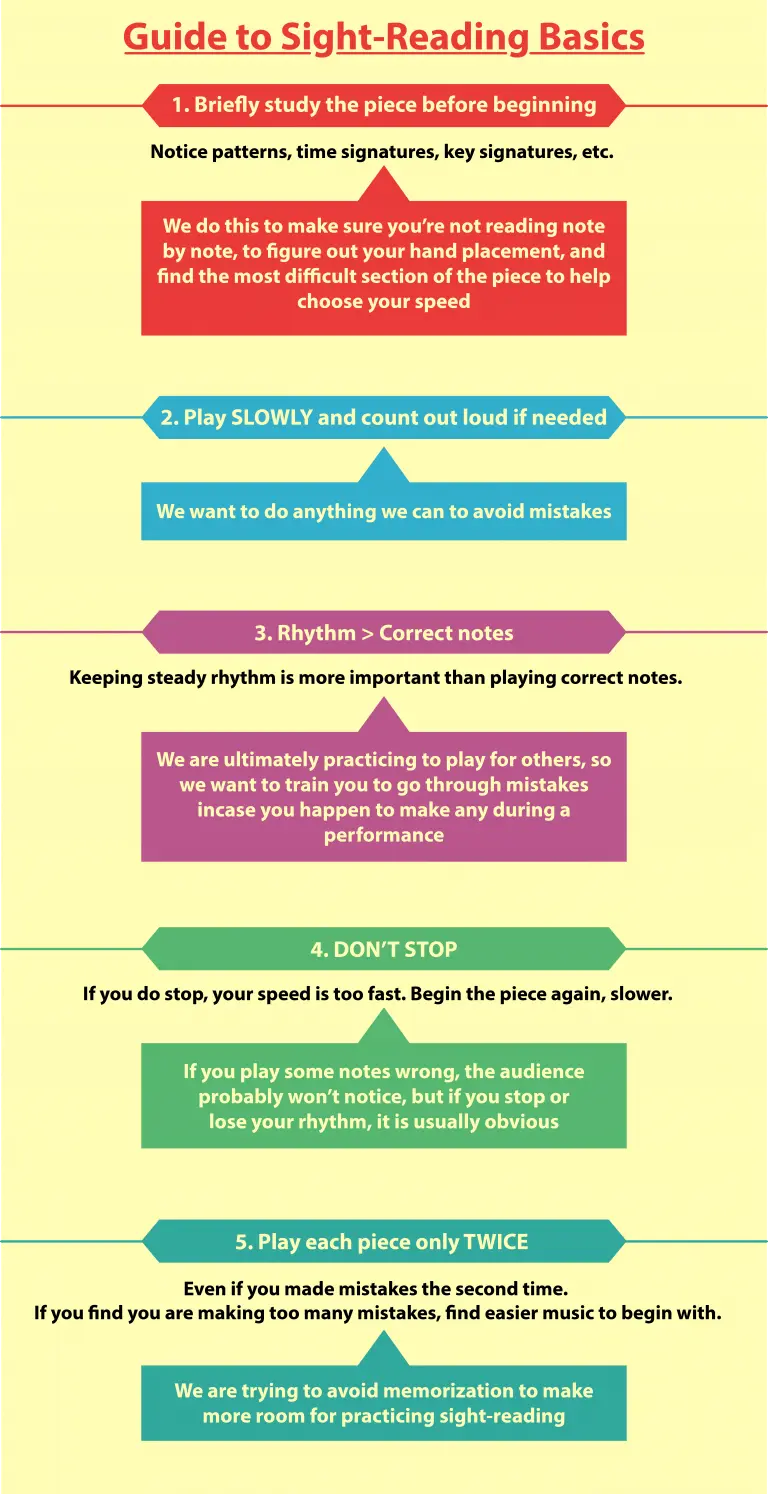
Instead of assigning increasingly difficult pieces to build reading skill—a counterproductive approach that triggers panic and frequent stopping—the new instructor stripped the curriculum down to its bare essentials. The breakthrough came through the application of immutable foundational rules:
- Radical Simplification: Dropping back to material far below the student’s technical playing level (often returning to beginner method books).
- The Two-Read Rule: Engaging with any given piece of sight-reading material exactly twice, and never dwelling on it longer.
- Uncompromising Continuity: Prioritizing steady, metronomic rhythm over note accuracy, enforcing the rule that the music must never stop.
By adhering strictly to these principles, Mirinjian experienced an exponential breakthrough. Not only did her personal reading fluency transform, but she was also able to replicate this success with her own students, proving that sight-reading mastery is a learnable mechanical skill rather than an innate genetic gift.
Supporting Context & Metrics: The Pedagogical Blind Spot
The anecdotal struggles of individual pianists are backed by formal academic research into institutional music teaching methods. A landmark study conducted by Dr. Dianne Hardy, Assistant Professor of Music Education and Piano at Dickinson State University, sheds light on why sight-reading remains so poorly taught across the broader educational landscape.

Key Findings from Dr. Dianne Hardy’s Pedagogical Research:
- Ignored Curricula: A significant majority of teachers surveyed by Dr. Hardy admitted that structured sight-reading was completely omitted from their lesson plans.
- The "How-To" Deficit: The primary reason cited by instructors for omitting sight-reading was a simple lack of training; they did not know how to teach the skill systematically.
- Method Book Silence: Many educators noted that the standardized piano method books they relied on failed to include instructional frameworks or progressive exercises dedicated specifically to sight-reading development.
- The Repertoire Fallacy: A notable segment of teachers did not recognize sight-reading as a distinct, specialized skill set. Instead, they operated under the assumption that reading ability would naturally improve as a byproduct of learning standard repertoire over the years.
- The Cycle of Incompetence: Perhaps most revealingly, several instructors confessed that they actively avoided teaching sight-reading because they themselves were poor sight-readers.
The Cost of Neglecting Principles
As philosopher Ralph Waldo Emerson famously noted: "As to methods there may be a million and then some, but principles are few. The man who grasps principles can successfully select his own methods. The man who tries methods, ignoring principles, is sure to have trouble."
In the context of piano pedagogy, ignoring the principles of sight-reading leads directly to the "cracks" in a musician’s foundation. Even advanced players often carry hidden reading deficiencies—such as the inability to instantly process rhythmic groupings or scan harmonic intervals ahead of the fingers—because they have spent their entire musical lives filling those gaps with hours of brute-force physical practice.
Official Statements and Frameworks
To bridge the gap between abstract theory and daily practice, educators who specialize in sight-reading have established actionable, step-by-step frameworks. The following system, adapted from Mirinjian’s instructional methodology, illustrates how any musician can execute a daily sight-reading routine.
The Step-by-Step Sight-Reading Protocol
Before beginning, it is assumed the student possesses basic literacy: the ability to recognize elementary note values (quarter and half notes) and fundamental treble clef notes (Middle C, D, and E). For absolute beginners, specialized visual guides should be utilized first.
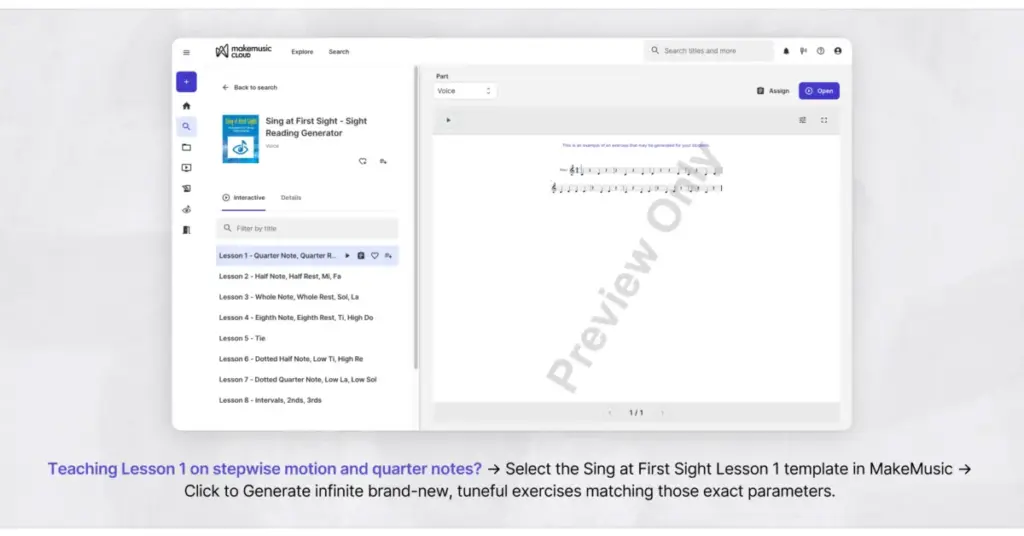
- Environmental Setup: Place the designated sight-reading piece—sourced from a book or displayed on a digital tablet—securely on the music stand. For this exercise, begin with an extremely simple piece, such as a basic five-note exercise centered around "Middle C."
- Visual Pacesetting and Pattern Recognition: Before playing a single note, scan the score. Identify structural patterns rather than isolated notes. For instance, notice if a note repeats, steps upward, or skips. Recognizing that a motif repeats three times primes the brain to anticipate physical movements.
- Rhythmic Initialization: Analyze the time signature and establish the counting framework. Count out loud at a steady, unchanging pulse (e.g., 1, 2, 3, 4, 1, 2, 3, 4).
- Physical Placement: Position the hands correctly on the keyboard, anchoring the thumb on the starting note (e.g., Middle C).
- Pre-Performance Mental Check: Remind yourself of the cardinal rule: Do not stop. A wrong note is a minor error; stopping is a fundamental breakdown of the process. If a reading lapse causes a major disruption, return to the beginning and restart at an even slower tempo.
- The First Pass (Slow and Steady): Initiate play at an exceptionally slow, meditative pace. Match every single beat to the voice counting out loud. Maintain forward momentum.
- The Second Pass (Refinement): Upon completing the piece once, immediately play it a second time. Incorporate the spatial and visual lessons learned during the first run-through, correcting minor note errors while preserving the slow, steady pulse.
- Progression: Move immediately to the next piece in sequence (e.g., "Stepping Up and Down") and repeat the cycle from Step 2.
Future Outlook: Rebuilding the Foundation
The future of music education is seeing a gradual, much-needed shift toward evidence-based pedagogical frameworks. As digital resources, specialized applications, and dedicated communities (such as SightReadingMastery) continue to democratize access to foundational training, the mystique surrounding sight-reading is beginning to dissolve.

For teachers and students alike, the path forward requires a humbling recalibration. True progress does not stem from tackling increasingly difficult pieces prematurely; it comes from returning to the absolute simplest material and filling in the micro-cracks left behind by years of rushed instruction. Whether an instrumentalist is an adult hobbyist battling focus issues, an intermediate student feeling stuck at a plateau, or a professional educator seeking a standardized teaching approach, the remedy remains the same.
By embracing the core principles of radical simplification, strict rhythmic continuity, and the two-read limit, musicians can finally close the gap between what their minds conceive and what their fingers can instantly unveil from an unseen score.