
Executive Overview
In an era where modern houses of worship invest heavily in immersive audio-visual technologies, dynamic lighting rigs, and architectural acoustics, a critical segment of the congregation is frequently overlooked: individuals experiencing hearing loss. For many churchgoers, Sunday services—traditionally spaces of profound spiritual connection, communal fellowship, and emotional uplift—can become isolating experiences characterized by strained listening, muffled announcements, and missed sermons.
The integration of an Assistive Listening System (ALS) is no longer merely an ADA compliance checkbox or an optional ministry perk; it is a fundamental pillar of radical hospitality and spiritual inclusion. By bridging the acoustic gap between the pulpit and the pew, houses of worship can reclaim an integral demographic of their community, ensuring that the spoken word, the richness of prayer, and the beauty of music are delivered with absolute clarity to every attendee.
However, implementing an ALS requires more than simply purchasing equipment off the shelf and plugging it into a soundboard. True success demands a strategic, multi-phased approach that encompasses congregation assessment, financial planning, comprehensive staff and volunteer training, and proactive community outreach. This authoritative guide explores the four critical phases of deploying an Assistive Listening System, providing church leadership teams, audio-visual (AV) technicians, and ministry directors with a comprehensive blueprint for fostering a truly inclusive worship environment.
Detailed Chronology: The Four-Step Implementation Framework
Successfully deploying an assistive listening infrastructure requires a deliberate, methodical journey. Drawing upon industry best practices and insights from integration experts, the deployment lifecycle can be broken down into four distinct, sequential milestones.
Phase 1: Assessment and Data-Driven Understanding
The foundational misstep many leadership teams make is procuring technology before diagnosing the specific needs of their people. An ALS that works brilliantly in one sanctuary may completely miss the mark in another if it fails to account for the unique demographics and acoustic profile of the congregation.
- Deploying Congregation Surveys: The most effective starting point is the creation and distribution of a targeted survey. Congregants should be directly asked about their personal experiences during services. Questions must explore whether they struggle to understand the sermon, if they currently utilize hearing aids, and crucially, whether those hearing aids are equipped with telecoils (t-coils).
- Analyzing Architectural and Demographic Data: Beyond self-reported surveys, leadership must analyze the age demographics of their active membership and evaluate the physical space. Large sanctuaries with high ceilings and reverberant acoustics present different challenges than intimate, carpeted chapels. Understanding these variables ensures that the chosen technology—whether Radio Frequency (RF), Infrared (IR), or Audio Induction Loop systems—directly addresses the physical and auditory realities of the attendees.
Phase 2: Financial Strategy and Technological Evaluation
Once the specific needs of the congregation have been quantified, leadership must navigate the complex landscape of hardware options, pricing structures, and budgetary alignment.
- Estimating Equipment Costs: Assistive listening packages vary widely in price based on the scale of the sanctuary, the number of receivers required, and the underlying transmission technology. Churches must look beyond the initial hardware purchase to factor in accessories, charging stations, and signage.
- Leveraging Expert Consultations: Navigating AV specifications can overwhelm even seasoned facility managers. Partnering with specialized integration providers—such as CCI Solutions—offers invaluable support through free consultations. These experts assist in mapping out expenses, aligning purchases with fiscal year budgets, and preventing costly misconfigurations.
- Creative Fundraising and Budget Allocation: Because an ALS directly impacts the spiritual well-being of congregants, many churches successfully fund these initiatives through targeted donations, memorial gifts, or dedicated capital campaigns. By framing the purchase as a ministry of inclusion rather than a technical upgrade, donor engagement rises significantly.
Phase 3: Operational Readiness and Staff Training
Even the most advanced assistive listening technology will fail if the internal team is unprepared to operate and maintain it. Operational friction is the primary reason ALS devices end up gathering dust in a backroom storage closet.
- Designating "Assistive Listening Ambassadors": Staff members and hospitality volunteers must be thoroughly trained not just on how the equipment works, but why it matters. These individuals act as ambassadors for inclusion, welcoming users with confidence and competence.
- Structured Check-Out Procedures: When a device is checked out to a congregant, the volunteer should take a brief moment to walk the user through its basic functions, volume controls, and earpiece options.
- Mitigating Friction with Quick-Reference Guides: To ensure consistency across different volunteer teams, churches should place a laminated copy of Frequently Asked Questions (FAQs) and step-by-step troubleshooting instructions directly at the reception desk or distribution counter.
Phase 4: Marketing, Awareness, and Community Outreach
Purchasing and installing an ALS is only half the battle; the congregation and the surrounding community must know it exists. Without deliberate awareness campaigns, utilization rates will remain low.
- Strategic Signage Placement: Clear, universally recognized symbols indicating that Assisted Listening Devices (ALDs) are available must be prominently displayed at all main entrances, welcome centers, and near the sound booth.
- Multi-Channel Promotion: Reminders should be woven into weekly print bulletins, digital newsletters, and pre-service multi-media slide presentations.
- Hosting Live Demonstrations: Consider organizing a brief, dedicated demonstration session during a fellowship hour. This allows curious congregants to try the technology in a low-pressure environment and demystifies the equipment for those who may feel hesitant about adopting new health aids.
- External Community Marketing: Extending outreach beyond current members can yield profound results. Local senior centers, retirement communities, and disability advocacy groups should be notified that the church offers an accessible worship environment. Many individuals drop out of active church life simply because they assume modern services are inaccessible to them; advertising an ALS can draw them back through the doors.
Supporting Context & Metrics: The Human and Acoustic Reality
To fully grasp the necessity of an Assistive Listening System, one must examine the broader socio-acoustic context of modern congregational life.
The Prevalence of Hearing Impairment
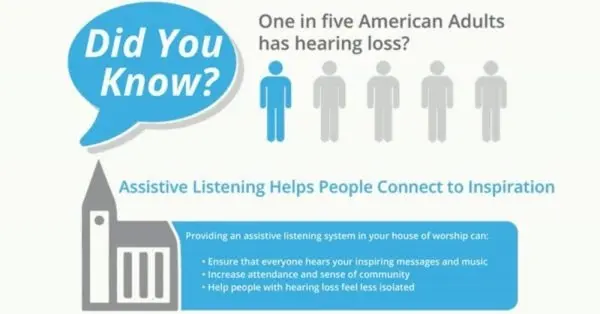
According to public health data, hearing loss is one of the most common conditions affecting older adults, though it frequently impacts individuals of all ages due to occupational noise, recreational sound exposure, and congenital factors. In a typical house of worship with an active membership of several hundred people, a significant percentage of the adult demographic experiences some degree of hearing difficulty.
The Limitations of Standard Amplification
A common misconception among church leadership is that a powerful public address (PA) system solves all listening problems. While increasing the overall volume makes sound louder, it does not make it clearer. In large, resonant worship spaces, high volume often exacerbates acoustic reflections, resulting in a muddy, unintelligible wall of sound. For an individual with sensorineural hearing loss, amplified mud remains mud. An Assistive Listening System bypasses acoustic reverberation entirely by transmitting the pristine, unmixed audio feed directly from the soundboard into the user’s personal receiver, hearing aid, or cochlear implant.

Economic and Retention Metrics
Churches that invest in comprehensive accessibility infrastructures consistently report higher retention rates among senior demographics and individuals with disabilities. Furthermore, families making decisions about where to worship often prioritize congregations that demonstrate holistic care for every member of their household. An inclusive audio environment directly correlates with long-term community engagement and sustained financial stewardship.
Official Statements and Industry Insights
Industry leaders and accessibility advocates emphasize that technology in worship should always serve a pastoral purpose.
"Reaching out to those who feel disconnected from your community due to hearing loss is central to sharing the message of inclusion. Genuinely compassionate service involves being aware of and caring for the needs of everyone, especially those dealing with impairments. Make sure they are able to hear the beauty and emotion of the spoken word in your church by providing them with the equipment they need to stay connected."
— Industry Accessibility Directive & Technical Guidance
Integration specialists point out that the transition from a non-accessible space to an inclusive one transforms the culture of a church. When a senior member who has sat in silence for years suddenly hears every nuance of the pastor’s voice and the lyrics of the congregation’s hymns, the emotional impact is immediate and profound. It restores dignity, autonomy, and full participation in communal worship.
To support facilities in this mission, organizations such as Listen Technologies have developed comprehensive educational resources. Detailed implementation tools—including sample surveys, signage templates, and worship bulletin announcements—are readily available in specialized guides such as the Listen Technologies Church Assistive Listening Toolkit.
Future Outlook: The Evolution of Accessible Worship
As acoustic engineering and assistive technology continue to converge, the future of accessible worship looks increasingly seamless and personalized. Several emerging trends are reshaping how houses of worship approach auditory inclusion:
- The Rise of Bluetooth Low Energy (LE) Audio and Auracast: Traditional RF and FM systems are steadily being complemented—and in some cases replaced—by next-generation streaming technologies like Auracast broadcast audio. This allows multiple users to stream pristine, zero-latency church audio directly to their Bluetooth-enabled hearing aids or smartphones using a simple app or standard broadcast channel, eliminating the need to manage physical receivers.
- Integration with Visual and Tactical Aids: Future-forward sanctuaries are moving toward holistic sensory integration, pairing assistive listening feeds with advanced real-time captioning displays on screens and architectural lighting cues, creating an environment that accommodates varied sensory needs simultaneously.
- Proactive Accessibility Audits: Increasingly, church building committees are treating acoustic accessibility with the same architectural rigor as wheelchair ramps and automatic doors, baking ALS integration into new construction and renovation blueprints from day one.
Conclusion
The mission of any vibrant house of worship is to proclaim a message of grace, connection, and belonging. Yet, when physical barriers like hearing loss go unaddressed, a silent wall is erected between the pulpit and the pew.
By understanding congregation needs, evaluating appropriate technological options, training dedicated staff ambassadors, and aggressively promoting the available systems, churches can dismantle these invisible barriers. Investing in an Assistive Listening System is far more than an upgrade to the sound booth; it is a profound declaration that every soul matters, every voice is valued, and everyone deserves to hear the inspiring message of the community loud and clear.
For more detailed information on choosing the right Assistive Listening System and tools to ensure your success—including sample surveys, signage, and announcements—please download a copy of the Listen Technologies Church Assistive Listening Toolkit.
Does your worship facility currently utilize assistive listening, or are you exploring ways to improve your acoustic accessibility? Reach out to your AV integration partners to discuss how your ministry can take the next step toward complete inclusion.