By Ian DeNolfo, Executive Director of The Voice Foundation
Executive Overview
Today, we stand at a definitive inflection point in voice science—a historical juncture where artificial intelligence is fundamentally reshaping how researchers conduct investigations, analyze complex biomedical data, and care for patients. For centuries, the human voice has served as our primary instrument of connection, emotional expression, and personal identity. It carries the microscopic signatures of our health, our neurological states, and our very selves in ways that few other biological signals can match. Yet, decoding the infinite subtleties of vocal acoustics has historically outpaced our technological capabilities.
Now, for the first time in history, we possess computational tools sophisticated enough to truly comprehend this physiological complexity. Artificial intelligence and machine learning are no longer speculative concepts on the horizon of medicine; they are active, transformative forces driving breakthroughs in diagnostic precision, clinical decision-making, and digital biomarker research. At the epicenter of this global revolution is The Journal of Voice and its parent organization, The Voice Foundation. Far from being a recent adopter of digital trends, the Foundation has spent decades quietly laying the groundwork for this exact moment. As we analyze the exponential trajectory of AI research within our field—where over 63% of all published AI-related papers have appeared in just the last three years—we recognize that we are not merely observing a technological shift; we are witnessing the dawn of a new era in interdisciplinary healthcare.
A Legacy of Interdisciplinary Innovation
To understand the magnitude of today’s technological transformation, one must look back at the visionary roots that made such progress possible. In 1969, Dr. Wilbur James Gould founded The Voice Foundation in New York City during an era when comprehensive, interdisciplinary care for the human voice was virtually non-existent. Dr. Gould possessed the rare foresight to recognize that the human voice sits at a complex crossroads of medicine, art, physics, and communication. To properly care for professional voice users—singers, actors, teachers, and orators—he realized he had to break down traditional academic silos.
Dr. Gould brought together an unprecedented coalition: otolaryngologists, aerodynamic scientists, speech-language pathologists, performing artists, and master vocal pedagogues. Together, they shared their distinct knowledge pools to elevate the standard of care for the professional voice. In 1972, the Foundation hosted its inaugural Annual Symposium—Care of the Professional Voice—which rapidly evolved into the premier international gathering for voice professionals. This was followed in 1973 by the first Foundation Gala, an event later celebrated as Voices of Summer. For over five decades, the organization has steadfastly built bridges between art and science, between the sterile environment of the clinic and the vibrant spotlight of the stage.
Since 1989, The Voice Foundation has flourished under the leadership of Dr. Robert Thayer Sataloff, an internationally renowned otolaryngologist who is simultaneously a professional singer and conductor. Dr. Sataloff’s monumental contributions to the field include authoring more than 1,200 publications, including 79 textbooks. Under his guidance, the Foundation relocated its headquarters to Philadelphia, expanding its global footprint and deepening its commitment to rigorous scientific research and education. Today, the Philadelphia Symposium draws hundreds of medical doctors, scientists, academics, speech-language pathologists, and performing artists from across the globe. Furthermore, the Foundation publishes The Journal of Voice—globally recognized as the premier peer-reviewed journal dedicated exclusively to voice science and medicine. It is within the pages of this historic publication that the marriage of artificial intelligence and voice science has quietly matured over three decades.
Three Decades of AI Research: The Historical Chronology
While the broader medical community has only recently awakened to the possibilities of generative AI and machine learning following the public explosion of large language models, the readership and contributors of The Journal of Voice have been pioneering this path for more than thirty years.
The integration of computational intelligence into voice science began much earlier than most realize. In 1994—thirty-one years ago—the journal published a landmark paper by Rihkanen and colleagues entitled “Spectral Pattern Recognition of Improved Voice Quality.” This foundational study utilized early neural networks to analyze voice metrics. To contextualize this achievement, 1994 was the very same year the World Wide Web was emerging into public consciousness, and consumer internet access was in its absolute infancy. The voice science community was publishing sophisticated neural network research before most professionals had ever sent a corporate email.
Publication Timeline of AI Research in The Journal of Voice:
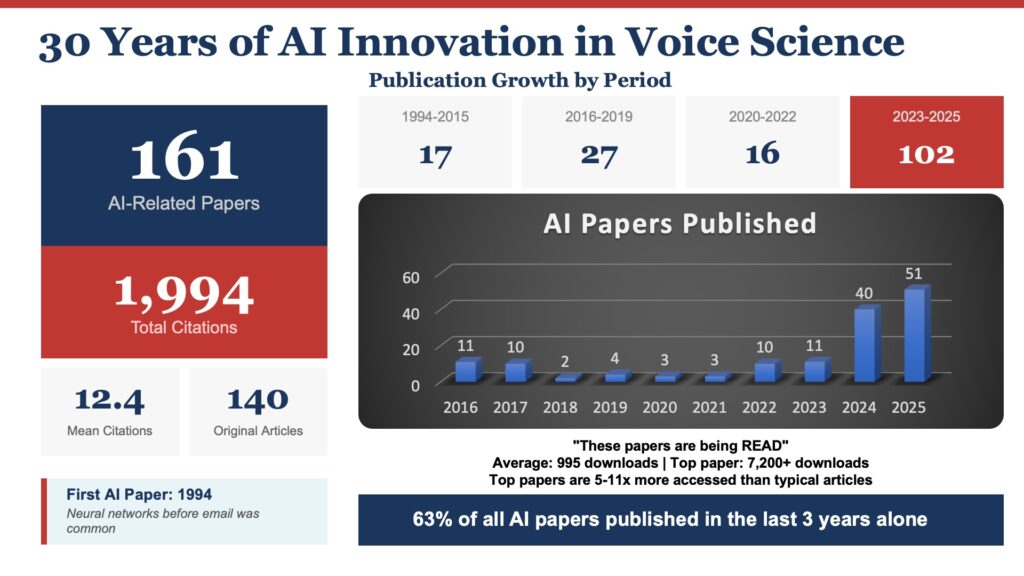
[ 1994 - 2015 ]: 17 papers  (Foundational Era)
[ 2016 - 2019 ]: 27 papers  (Deep Learning Expansion)
[ 2020 - 2022 ]: 16 papers  (Clinical Validation)
[ 2023 - 2025 ]: 102 papers (Exponential Surge)
For the first two decades following Rihkanen’s work, AI integration in voice research grew at a steady, methodical pace. Between 1994 and 2015, the journal published 17 AI-related studies. As computational power increased and deep learning architectures matured, the pace quickened: 27 papers were published between 2016 and 2019, followed by 16 papers during the global disruptions of 2020 to 2022.
Then came the exponential surge. Out of 161 total AI-related papers published in the journal’s history, an astonishing 102 papers—63 percent—were published in just the last three years (2023 to 2025). In the year 2025 alone, the journal published 51 AI-related papers—surpassing the cumulative output of the first twenty years of AI publishing combined. This is not gradual, linear growth; it represents a profound, exponential transformation of the discipline.
Supporting Context & Real-World Impact
Metrics and publication counts tell only part of the story. True academic and clinical impact is measured by how deeply these studies penetrate professional workflows and influence daily practice. Recent usage statistics demonstrate the extraordinary global reach of The Journal of Voice’s AI portfolio.
On average, an AI-focused paper published in the journal is downloaded nearly 1,000 times—a remarkable metric in specialized academic publishing. However, standout papers have achieved astronomical engagement. For instance, a seminal study investigating machine learning applications for COVID-19 detection via acoustic features has been downloaded over 7,200 times, eclipsing the median download rate for its issue by a factor of eleven.
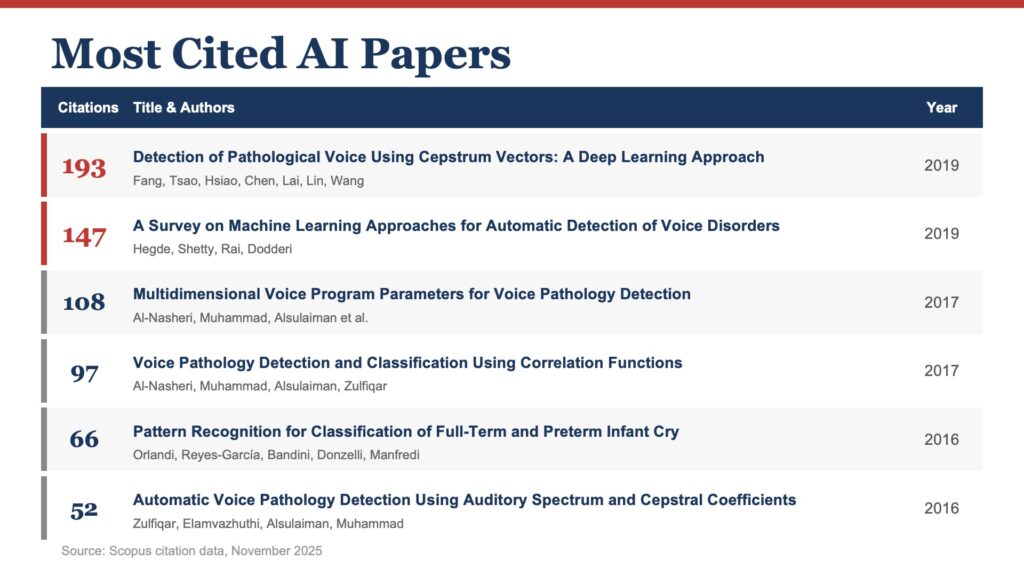
Similarly, the journal’s top-cited papers have transformed from academic curiosities into foundational literature. A deep learning study on voice pathology detection by Fang and colleagues has amassed 193 citations, while Hegde’s comprehensive machine learning survey has gathered 147 citations. Both articles were downloaded nearly 5,000 times each and dominated readership charts in their respective issues. These figures represent active engagement from practicing clinicians, biomedical researchers, and speech-language pathologists seeking practical, empirically validated tools to elevate patient care.
Landmark Research Reshaping Clinical Frontiers
The evolution of this research can be tracked through specific, paradigm-shifting publications:
Deep Learning for Voice Pathology Detection: Fang et al.’s 2019 study (“Detection of Pathological Voice Using Cepstrum Vectors: A Deep Learning Approach”) proved conclusively that deep neural networks could detect vocal fold pathologies with staggering accuracy by analyzing acoustic features entirely imperceptible to the human ear.
Methodological Roadmaps: Hegde’s survey paper mapped the chaotic landscape of machine learning algorithms for automatic voice disorder detection, providing a standardized taxonomy that remains essential reading for newcomers to the field. Other heavily cited contributions by Al-Nasheri et al. (2017) refined Multidimensional Voice Program parameters and correlation functions.
Advanced Neural Architectures: More recent milestones include Chen and Chen’s 2022 work on deep neural networks for advanced voice classification, Fujimura’s innovative use of one-dimensional convolutional neural networks (CNNs), and Cho and Choi’s rigorous comparative analysis of CNN models applied to complex laryngoscopic images.
Voice as a Digital Biomarker
Perhaps the single most transformative concept emerging from this body of research is the conceptualization of the human voice as a digital biomarker—a non-invasive, highly accessible window into systemic human health.
Groundbreaking studies published in the journal have demonstrated the efficacy of continuous voice analysis in detecting and monitoring neurodegenerative disorders such as Parkinson’s disease. For example, Hemmerling and Wójcik-Pędziwiatr’s 2022 paper on predicting Parkinson’s severity directly from acoustic voice signals rapidly accumulated 29 citations in three years, paving the way for real-time remote patient monitoring.
Beyond neurology, recent systematic reviews have explored voice quality as a digital biomarker for affective disorders, including clinical depression and bipolar disorder. The societal implications are profound: routine, automated voice screening during telehealth visits or via mobile applications could enable earlier psychiatric interventions, vastly improving patient outcomes while alleviating the crippling burdens placed on overstretched mental health care systems. Furthermore, machine learning models capable of assessing respiratory infections like COVID-19 through subtle acoustic shifts highlight the voice’s potential to act as an early-warning sentinel for pulmonary health.
The Rise of Conversational AI in Clinical Settings
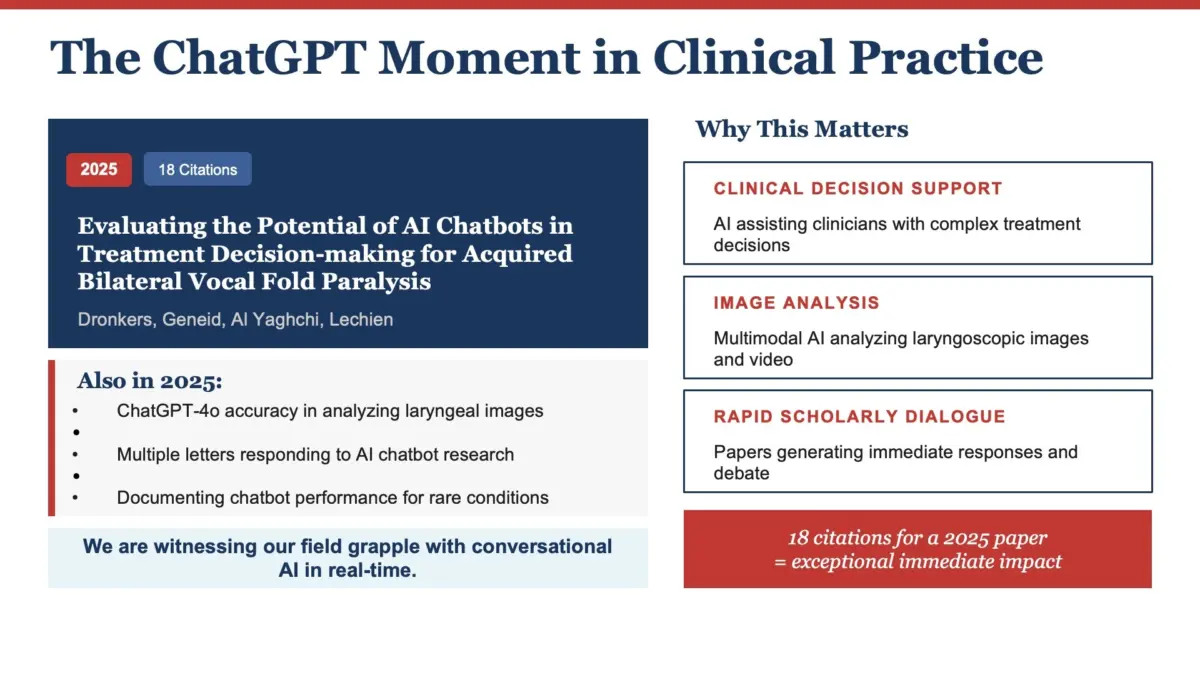
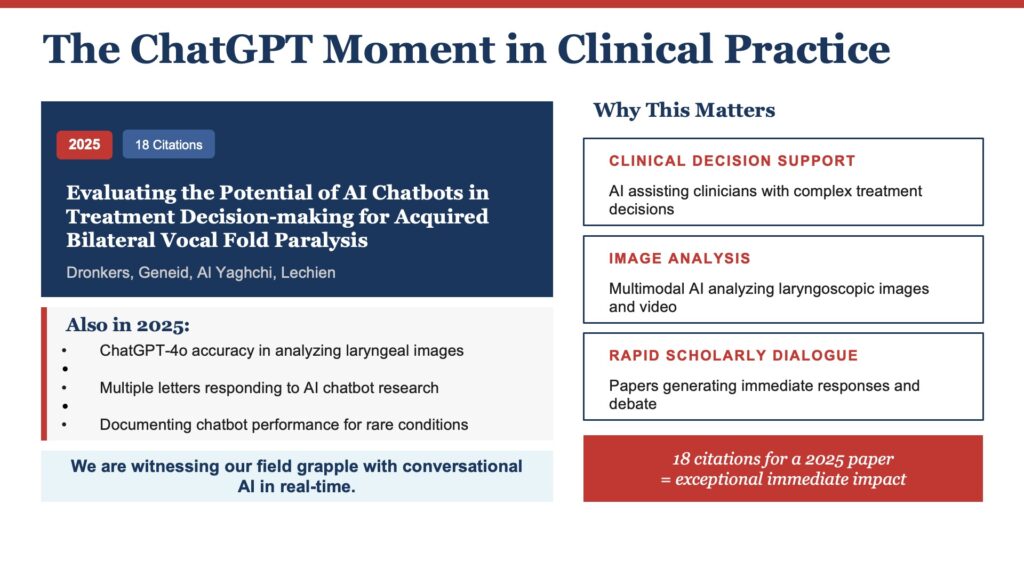
In 2025, The Journal of Voice pushed into uncharted territory by publishing pioneering research examining the integration of AI chatbots and large language models into clinical decision-making. A notable paper by Dronkers and colleagues—“Evaluating the Potential of AI Chatbots in Treatment Decision-making for Acquired Bilateral Vocal Fold Paralysis”—accumulated 18 citations almost immediately upon release, signaling intense scholarly urgency.
This work sparked robust academic discourse, including multi-author letters to the editor and investigative responses evaluating the diagnostic accuracy of systems like ChatGPT-4o in analyzing complex laryngeal imagery. The voice science community is actively grappling with the real-world liabilities, ethical boundaries, and clinical benefits of conversational AI in medical environments.
Official Expert Perspectives
To capture the nuanced reality of this transition, we turn to two prominent leaders in voice science who offer distinct computational and institutional viewpoints on the integration of artificial intelligence.
Dr. Mark Berardi: AI as a Tool for Managing Biological Complexity
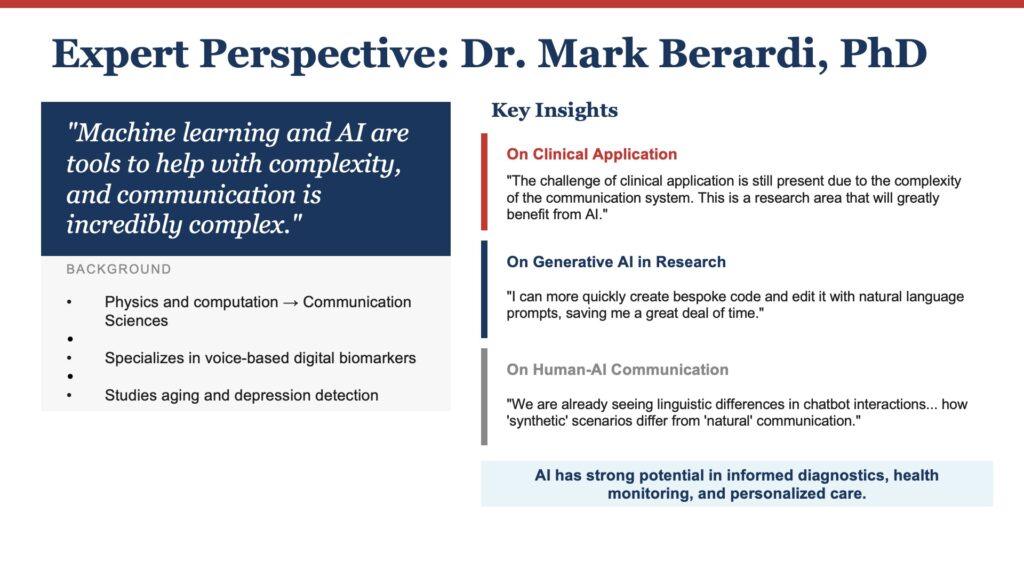
Dr. Mark Berardi brings a rare and valuable dual perspective to voice science, having transitioned into the field from an intensive background in physics and computation. Dr. Berardi views artificial intelligence not as a replacement for human intellect, but as an essential engine for managing biological complexity.
"Machine learning and AI are tools to help with complexity, and communication is incredibly complex in its neurobiological and physiological processes. So I think the application is warranted."
Dr. Berardi’s current research centers on developing voice-based digital biomarkers capable of tracking human aging and depressive states. "Acquiring speech and voice signals is relatively easy now, and we have shown potential for extracting meaningful health information," he observes. However, he acknowledges that the ultimate hurdle remains the inherent intricacy of the human communication apparatus—an obstacle that makes machine learning indispensable.
Addressing generative AI tools, Dr. Berardi offers a pragmatic assessment. While he notes they have not yet completely rewritten the foundational paradigms of basic science research, their utility in eliminating administrative and computational bottlenecks is undeniable. "I can now quickly create bespoke code and edit it with natural language prompts," he notes, highlighting how generative models streamline heavy data processing tasks.
Perhaps most fascinating is Dr. Berardi’s emerging work investigating human-AI communication itself. His lab is studying how human speech patterns adapt when interacting with conversational chatbots versus biological peers, contrasting synthetic communication mediums (such as video conferencing software) with traditional face-to-face interactions. "We are already seeing linguistic differences in chatbot interactions," he cautions. As synthetic agents become ubiquitous, voice science must expand its purview to understand not only the isolated human voice, but human vocal behavior in dynamic conversation with machines.
Dr. Eric Hunter: Embracing Technological Evolution with Ethical Clarity
Dr. Eric Hunter approaches the AI revolution from a structural and institutional vantage point, emphasizing that academic and clinical ecosystems must proactively adapt to these disruptive technologies.
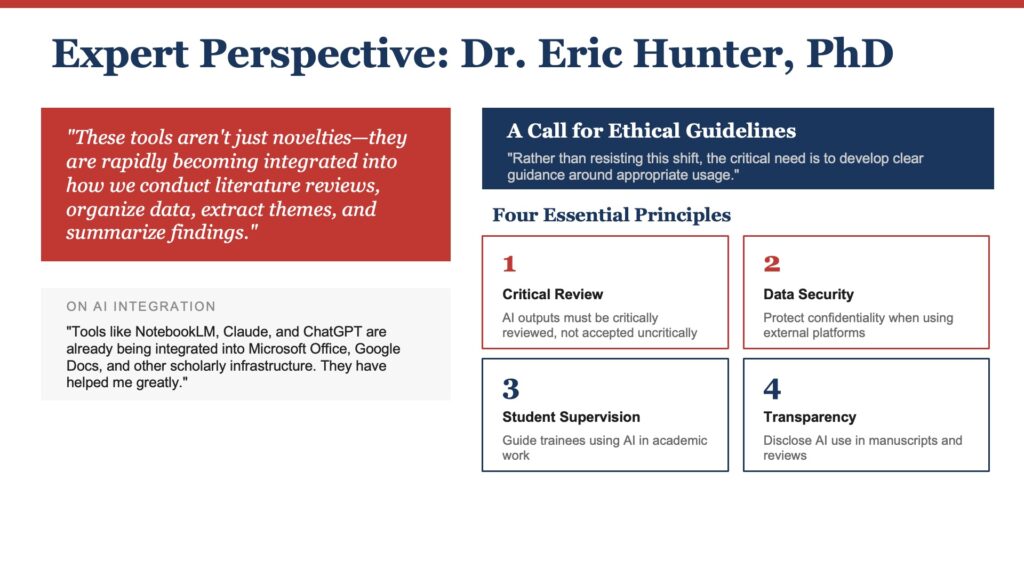
"These tools aren’t just novelties. They are rapidly becoming integrated into how we conduct literature reviews, organize data, extract themes from large bodies of text, and even summarize findings."
Dr. Hunter stresses the inescapable reality of this integration: large language models and autonomous analytical platforms are permanently embedding themselves into standard academic workflows, influencing everything from manuscript drafting and peer review to complex statistical analysis and collaborative writing. Software suites embedded within Microsoft Office, Google Workspace, and dedicated research platforms like NotebookLM and Claude are changing the daily rhythm of scholarship.
Rather than advocating for resistance or restrictive bans, Dr. Hunter issues a vital call to action for the global academic community:
"Rather than resisting this shift, the critical need is to develop clear guidance around appropriate usage—for both authors and reviewers."
To successfully navigate this transition, Dr. Hunter outlines four foundational principles that must govern academic publishing and research ethics:
Absolute Transparency: Authors must explicitly disclose whenever generative tools or automated algorithms are utilized in data compilation, coding, or manuscript preparation.
Human Accountability: Researchers must maintain absolute intellectual ownership and verify the factual integrity of all AI-assisted outputs, as algorithms remain prone to hallucinations and systemic biases.
Editorial Integrity: Peer review processes must preserve human critical thinking, ensuring that machine-generated summaries do not replace nuanced expert evaluation.
Equitable Access: The scientific community must ensure that advanced AI analytical tools do not create an insurmountable financial barrier between well-funded institutions and independent researchers.
"Our field will benefit most," Dr. Hunter concludes, "if we embrace the productivity these tools offer while also building a shared ethical framework for their responsible use."
A Global Research Community
The rapid acceleration of AI in voice science is driven not by isolated laboratories working in silos, but by a tightly connected, highly collaborative global research community. The pages of The Journal of Voice reflect contributions from visionary scholars spanning every continent.
Leading this charge are prolific authors such as Jérôme René Lechien (with 6 published papers), Dimitar Deliyski (5 papers), Stephanie Zacharias (5 papers), and Ahmed Yousef (4 papers as first author). They are joined by international luminaries including Paavo Alku, Leonardo Wanderley Lopes, and Maryam Naghibolhosseini (each contributing 4 papers). Supported by dozens of multidisciplinary research teams across Europe, the Americas, Asia, and the Middle East, these investigators are establishing the gold standards for applying machine learning to human vocal physiology. This borderless cooperation underscores a unified commitment: to decode the mysteries of the human voice through rigorous, empirically sound computational science.
The Path Forward: Challenges and Actionable Steps
As The Journal of Voice and The Voice Foundation look toward the next decade of discovery, our commitment to publishing peer-reviewed research that pushes the boundaries of human knowledge remains unwavering. However, the exponential rise of artificial intelligence introduces complex challenges that demand collective, institutional action.
First, we must engage with AI tools thoughtfully and deliberately. These technologies are advanced instruments for managing overwhelming complexity. Clinicians and researchers must invest the time to understand both the immense capabilities and the inherent limitations of machine learning, utilizing these models to amplify human clinical expertise rather than outsourcing medical judgment to algorithms.
Second, we must actively participate in forging unified ethical guidelines. Dr. Hunter’s urgent call for a shared ethical framework cannot be answered by a single journal or university. It requires an international coalition of otolaryngologists, speech-language pathologists, computer scientists, ethicists, and patient advocates working in concert.
Third, we must continue to share our discoveries openly. The 161 AI-focused papers published in our journal to date represent merely the foundation of a towering structure. Every practicing clinician, laboratory researcher, and vocal pedagogue possesses unique observational insights that can enrich our collective understanding.
An Extraordinary Moment in Voice Science
For hundreds of thousands of years, the human voice has stood as humanity’s ultimate vehicle for connection, emotional catharsis, and self-expression. It communicates our deepest joys, our acute sorrows, and the subtle physiological indicators of our physical health in ways that no synthetic instrument can replicate.
Now, for the first time in human history, we possess computational tools sophisticated enough to truly honor and decode that complexity. We have entered an era where machine learning can extend the diagnostic reach of expert clinicians, detect pathological changes before physical symptoms fully manifest, and democratize access to high-quality voice care for vulnerable populations worldwide.
This is an extraordinary moment in the history of medicine and the arts. The Journal of Voice and The Voice Foundation are honored to stand at the very center of this renaissance. The next decade promises breakthroughs that we can scarcely begin to imagine, and we look forward to sharing those historic discoveries with our global community as we chart the future of human communication together.
About the Author
Ian DeNolfo is Executive Director of The Voice Foundation, which publishes The Journal of Voice. A graduate of The Juilliard School and The Curtis Institute of Music, he formerly performed as a leading tenor at major opera houses worldwide before transitioning his professional dedication to leadership within The Voice Foundation.