By Ian DeNolfo Executive Director, The Voice Foundation
Executive Overview
Today, we stand at a definitive inflection point in the trajectory of voice science. Artificial intelligence is no longer an experimental auxiliary or a distant technological horizon; it is the fundamental architecture reshaping how researchers design studies, how data is processed, and how clinicians diagnose and care for patients.
For over half a century, The Voice Foundation and its premier publication, the Journal of Voice, have served as the intellectual epicenter of interdisciplinary voice research. From our origins in 1969—founded by Dr. Wilbur James Gould to bridge the gap between art and science—to our contemporary position at the forefront of digital health, our mission has remained anchored in understanding the complex mechanics of human vocalization.
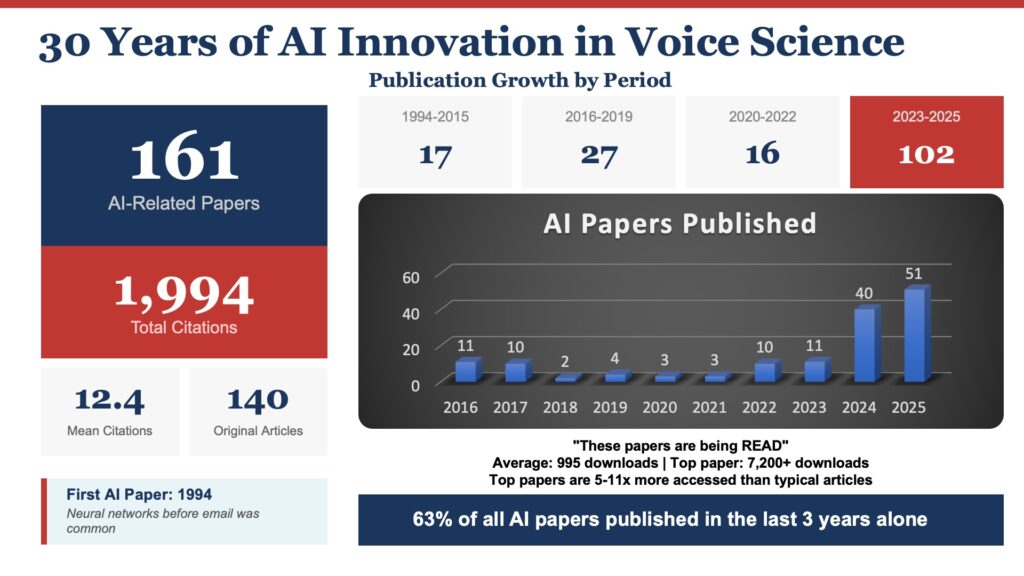
Yet, the velocity of innovation has radically accelerated. A retrospective analysis of the Journal of Voice reveals a striking historical milestone: our engagement with artificial intelligence predates the public consciousness of the commercial internet. In 1994, the journal published pioneering neural network research on voice quality. Fast-forward to the present day, and that trickle of computational curiosity has transformed into an exponential tidal wave. Of the 161 artificial intelligence and machine learning papers published in the journal’s history, an astounding 63 percent (102 papers) have been published in the last three years alone.
This is not merely incremental academic growth; it is a structural metamorphosis of an entire medical and scientific field. By treating the human voice as a sophisticated digital biomarker, modern researchers are unlocking unprecedented windows into systemic health—ranging from neurological disorders and respiratory illnesses to mental health conditions. As we navigate this paradigm shift, the imperative is clear: the voice science community must balance the transformative potential of artificial intelligence with rigorous ethical clarity and robust scientific stewardship.
Detailed Chronology: A Three-Decade Evolution of AI in Voice Science
To understand the magnitude of today’s AI-driven revolution, one must look backward to recognize how long the foundation for this moment has been under construction.
The Early Pioneers (1994–2015)
In 1994—the exact same year the World Wide Web began filtering into public awareness and before the vast majority of professionals had ever sent an electronic mail message—the Journal of Voice published a paper by Rihkanen and colleagues entitled "Spectral Pattern Recognition of Improved Voice Quality." Utilizing early neural networks to analyze acoustic parameters, this paper planted the flag for computational voice analysis.
During the subsequent two decades (1994–2015), the field saw cautious, deliberate exploration. Researchers published just 17 AI-related papers during this 21-year span. These foundational studies focused primarily on basic pattern recognition, laying the groundwork for automated acoustic measurement and classification.
The Accelerating Curve (2016–2022)
As computing power surged and machine learning algorithms matured, publication rates began to climb. Between 2016 and 2019, 27 AI-related papers entered the peer-reviewed ecosystem. This era was marked by the transition from traditional machine learning algorithms (such as support vector machines) to early deep learning architectures capable of handling multidimensional feature spaces.
Even amidst global disruption during the 2020–2022 window, 16 additional papers were published, expanding the scope of machine learning into automated pathology screening and remote health assessment.
The Exponential Explosion (2023–2025)
Then came the inflection point. Between 2023 and 2025, the publication landscape shifted dramatically. Authors contributed 102 AI-focused papers in this brief three-year window. To contextualize this growth: in the year 2025 alone, the Journal of Voice published 51 AI-related papers—surpassing the total output of the journal’s entire first two decades combined.
This exponential surge reflects both the broader technological explosion of generative and analytical AI tools and the specific readiness of voice science to ingest, process, and extract clinical meaning from massive datasets.
Supporting Context & Metrics: Beyond Citations to Real-World Impact
Academic research is frequently measured by citation counts, but the true metric of success in clinical science is utility—how frequently discoveries are read, downloaded, and applied by practitioners at the bedside and in the voice clinic.
Recent usage metrics from the Journal of Voice demonstrate the profound global footprint of its AI literature. The average AI-focused paper published in the journal has been downloaded nearly 1,000 times, significantly outpacing the baseline metrics for traditional acoustic research.
Furthermore, individual landmark papers have achieved extraordinary reach:
COVID-19 Detection: A landmark study investigating machine learning models for detecting COVID-19 through acoustic voice features has been downloaded over 7,200 times—eleven times the median download rate for articles in its respective issue.
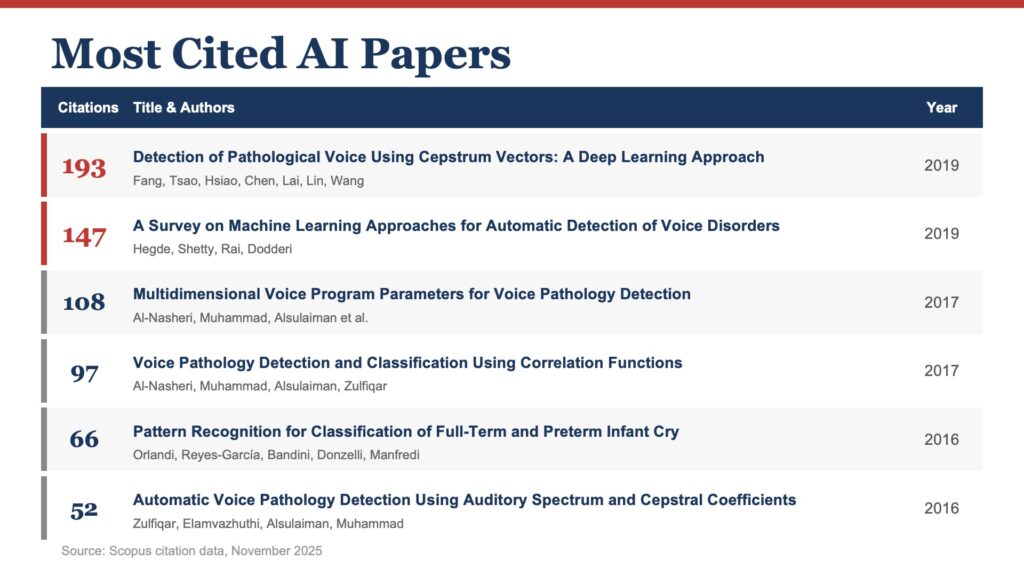
Deep Learning Benchmarks: Fang and colleagues’ 2019 deep learning study on pathological voice detection has garnered 193 citations, while Hegde’s comprehensive machine learning survey has accumulated 147 citations. Both articles achieved nearly 5,000 downloads each, ranking consistently among the most-accessed papers in their publishing cycles.
These figures represent more than academic vanity metrics; they signify a global community of clinicians, otolaryngologists, speech-language pathologists, and computational scientists actively seeking practical, technology-driven tools to elevate patient care.
Landmark Research Shaping the Field
Deep Learning for Voice Pathology Detection
The foundational work of Fang et al. (2019), "Detection of Pathological Voice Using Cepstrum Vectors: A Deep Learning Approach," proved that deep neural networks could identify vocal pathologies with exceptional accuracy—often utilizing subtle acoustic features entirely imperceptible to the unassisted human ear. This was complemented by comprehensive literature mapping, such as Hegde’s machine learning survey, and multi-parameter investigations by researchers like Al-Nasheri et al., which established standardized frameworks for automated disorder detection.
As the technology progressed, researchers transitioned from basic classification to advanced convolutional neural networks (CNNs). Studies by Chen and Chen, Fujimura, and Cho and Choi continuously pushed the boundaries of automated laryngoscopic image analysis and voice classification, creating robust digital diagnostic pipelines.
Voice as a Digital Biomarker
Perhaps the most conceptually profound development in recent voice science is the classification of the human voice as a digital biomarker—a non-invasive, continuous window into systemic human health.
In neurology, research into using voice analysis to detect and monitor Parkinson’s disease has yielded high-impact findings. Seminal works, such as Hemmerling and Wójcik-Pędziwiatr’s 2022 investigation into predicting Parkinson’s severity from voice signals, have rapidly accumulated citations and pushed clinical applications closer to reality.
Beyond neurology, systematic reviews now explore voice quality as a sentinel biomarker for psychiatric conditions, including depression and bipolar disorder. The clinical implications are staggering: routine, low-cost voice analysis could eventually screen for mental health fluctuations, enabling proactive interventions and alleviating the immense burdens carried by traditional healthcare infrastructure. Similar methodologies have been successfully deployed in evaluating respiratory integrity, transforming smartphones and clinical recording devices into diagnostic outposts.
AI Chatbots in Clinical Decision-Making
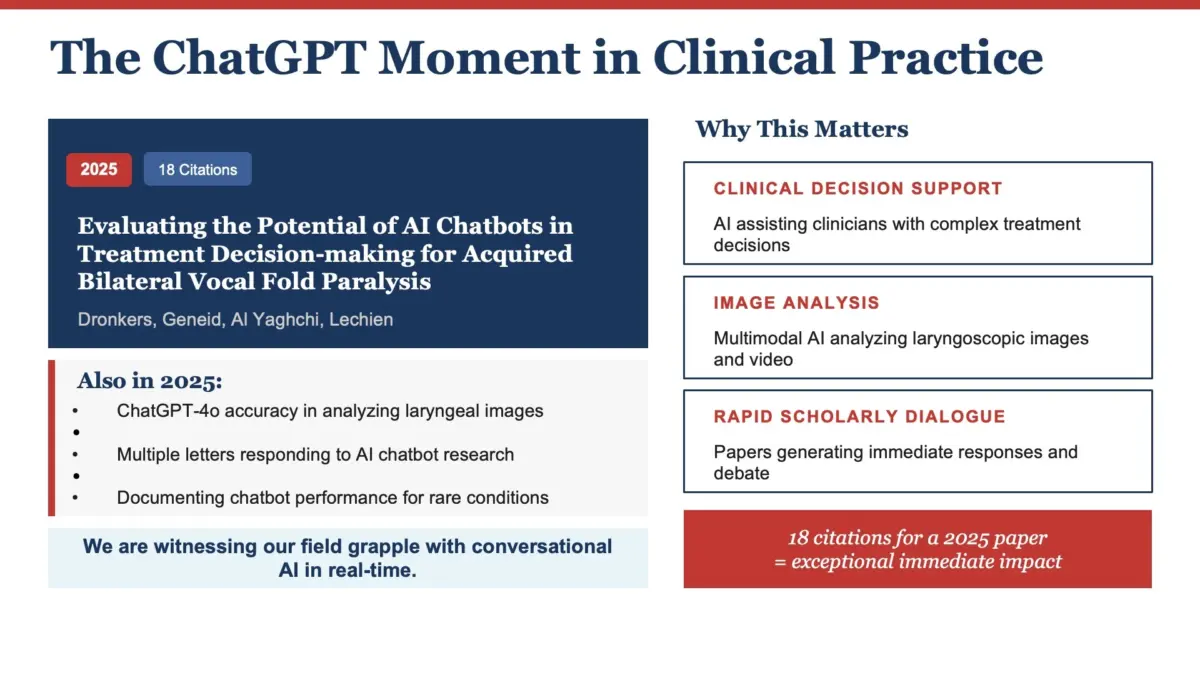
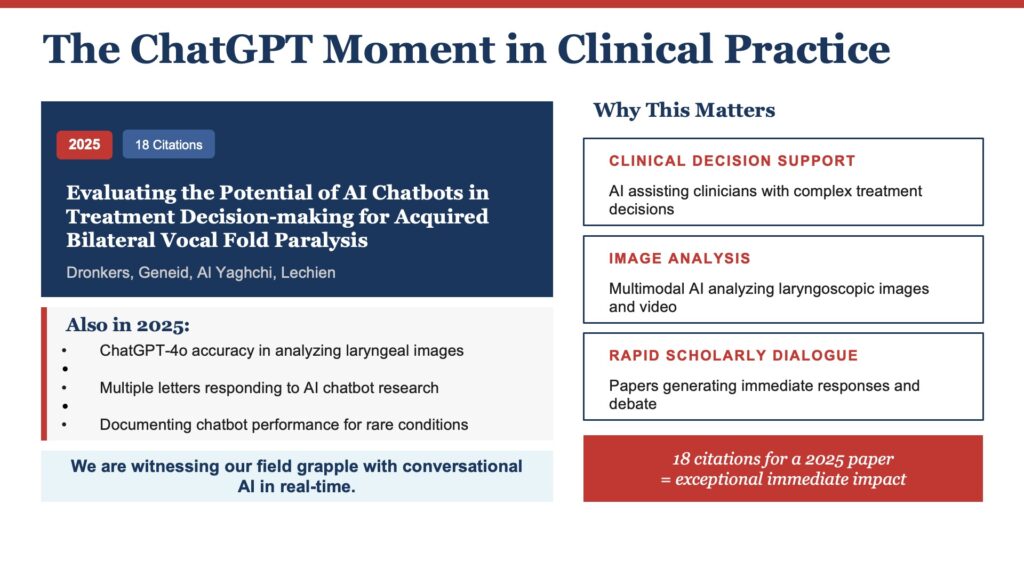
Entering 2025, the journal expanded its scope to examine conversational AI and large language models in clinical workflows. A prime example is Dronkers and colleagues’ paper, "Evaluating the Potential of AI Chatbots in Treatment Decision-making for Acquired Bilateral Vocal Fold Paralysis," which rapidly accumulated 18 citations within months of publication—an extraordinary velocity of scholarly engagement. Accompanied by rigorous letters to the editor and investigative responses regarding tools like ChatGPT-4o’s accuracy in analyzing laryngeal images, the field is actively and critically engaging with conversational AI in real-time.
Official Statements & Expert Perspectives
To navigate this rapidly evolving landscape, The Voice Foundation draws upon the wisdom of visionary leaders who bridge computational science, clinical medicine, and academic administration.
Dr. Mark Berardi: Managing Complexity and Synthetic Communication
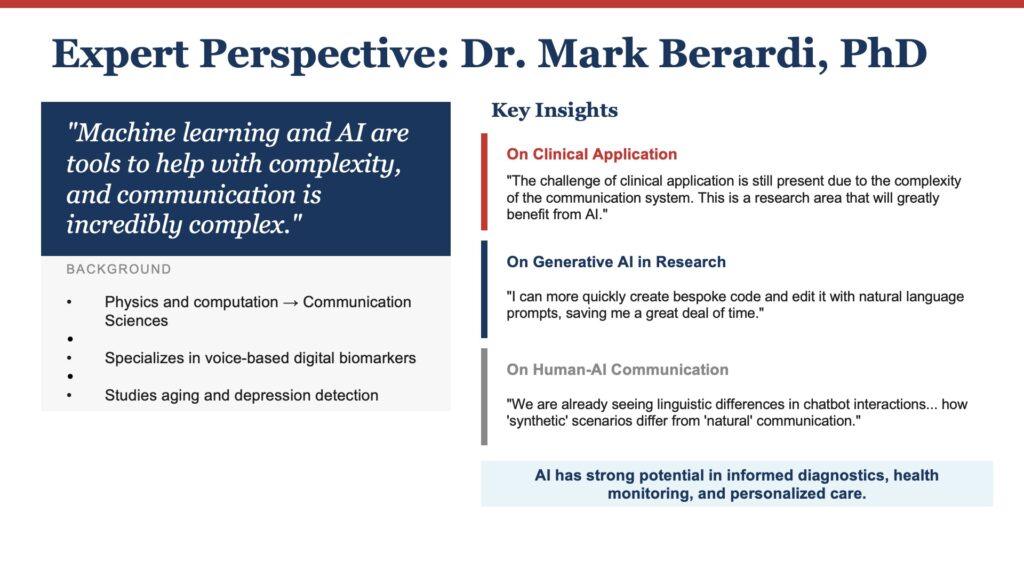
Dr. Mark Berardi brings a rare dual perspective rooted in physics and computation to voice science. He views artificial intelligence not as a replacement for human intellect, but as an essential engine for managing biological complexity.
"Machine learning and AI are tools to help with complexity, and communication is incredibly complex in its neurobiological and physiological processes. So I think the application is warranted."
Dr. Berardi’s research centers on extracting health biomarkers related to aging and depression from voice signals. "Acquiring speech and voice signals is relatively easy now, and we have shown potential for extracting meaningful health information," he notes. However, he cautions that the primary hurdle remains the intricate nature of the human communication apparatus itself—precisely the domain where AI excels.
Regarding generative AI, Dr. Berardi offers a pragmatic assessment. While generative tools have not radically rewritten the fundamental laws of academic research overnight, they have successfully dismantled persistent operational bottlenecks. "I can now quickly create bespoke code and edit it with natural language prompts," he explains, streamlining data processing and quantitative analysis.
Intriguingly, Dr. Berardi’s work also examines human-AI interaction dynamics: how human speech patterns adapt when communicating with chatbots versus real people, and how "synthetic" communication formats (such as video conferencing) alter interpersonal linguistics. As conversational agents become ubiquitous, voice science must expand its purview to analyze human vocal behavior not just in isolation, but in dialogue with machines.
Dr. Eric Hunter: Embracing Change with Ethical Clarity
Dr. Eric Hunter emphasizes that the integration of artificial intelligence carries profound institutional and methodological implications for academic publishing and clinical practice.
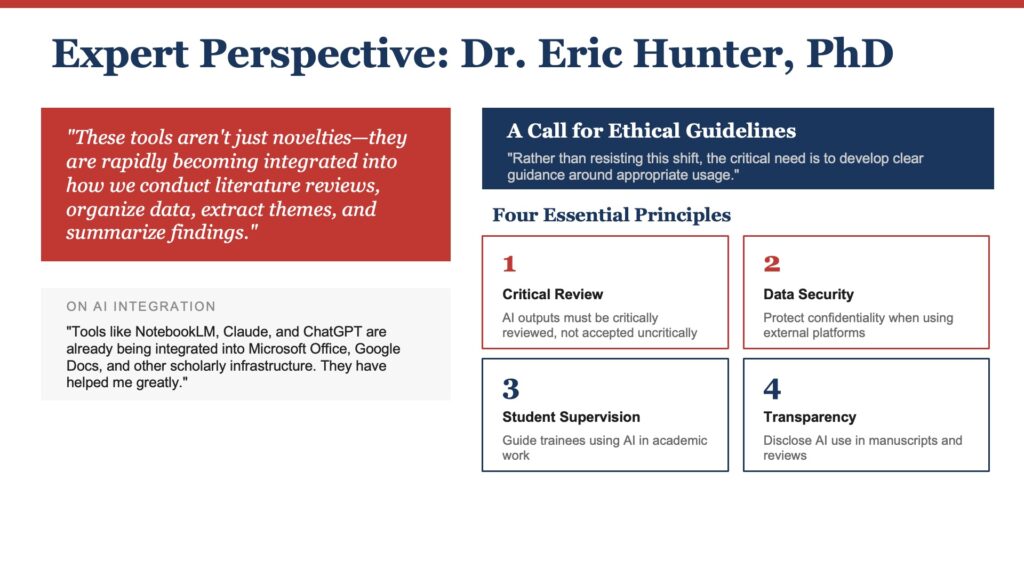
"These tools aren’t just novelties. They are rapidly becoming integrated into how we conduct literature reviews, organize data, extract themes from large bodies of text, and even summarize findings. Large language models and AI-driven platforms are not going away. In fact, we should expect them to become increasingly embedded within common academic workflows."
With AI tools natively embedded into productivity suites and scholarly infrastructure (such as NotebookLM, Claude, and ChatGPT), Dr. Hunter issues a definitive call to action: rather than resisting these technologies, the academic community must establish transparent frameworks for appropriate usage.
To safeguard academic integrity, Dr. Hunter outlines four essential principles for authors and reviewers navigating AI integration:
Absolute Transparency: Full disclosure regarding the use of AI tools in data processing, coding, and manuscript preparation.
Human Accountability: Ensuring that human authors retain absolute intellectual responsibility for the accuracy, validity, and ethical integrity of published work.
Protection of Confidentiality: Guarding patient data and proprietary research insights against improper exposure in third-party language models.
Methodological Rigor: Demanding that computational models be subjected to the same rigorous validation standards applied to traditional clinical trials.
"Our field will benefit most," Dr. Hunter concludes, "if we embrace the productivity these tools offer while also building a shared ethical framework for their responsible use."
A Global Research Community
The momentum behind this technological shift is propelled by a deeply collaborative international network. Leading contributors to AI research in the Journal of Voice span the globe, including prominent scholars such as Jérôme René Lechien, Dimitar Deliyski, Stephanie Zacharias, Ahmed Yousef, Paavo Alku, Leonardo Wanderley Lopes, and Maryam Naghibolhosseini. Supported by dozens of research laboratories across every inhabited continent, these investigators embody a unified global commitment to decoding the human voice through advanced computation.
Future Outlook & The Path Forward
As the Journal of Voice charts its course through the twenty-first century, it remains unequivocally committed to publishing rigorous, boundary-pushing research while upholding the highest standards of scientific integrity. However, realizing the full potential of AI in voice science requires addressing three core imperatives:
Thoughtful Engagement with Complexity: Researchers and clinicians must master AI not as a black-box oracle, but as a sophisticated instrument designed to manage biological complexity. Practitioners must understand both the immense computational power and the inherent limitations of these tools, using them to amplify clinical expertise rather than replace human judgment.
Collective Ethical Stewardship: Dr. Hunter’s call for a shared ethical framework cannot be answered by isolated institutions. Journals, academic societies, medical boards, and technology developers must collaborate to establish transparent guidelines that protect patient privacy, ensure algorithmic fairness, and maintain scholarly rigor.
Continuous Knowledge Sharing: The 161 AI papers published in our journal represent merely the opening chapter of a much larger story. Every clinician, speech-language pathologist, engineer, and educator possesses unique insights capable of advancing our collective understanding.
Conclusion: An Extraordinary Moment
For hundreds of thousands of years, the human voice has served as our primary instrument of connection, emotional expression, and personal identity. It transmits our inner states, our neurological health, and our deepest vulnerabilities in ways that no other biological signal can replicate.
Now, for the first time in human history, we possess analytical tools sophisticated enough to genuinely comprehend that complexity—to decode what the voice reveals about our brains, our bodies, and our overall wellbeing. We have arrived at an era where machine learning can extend the reach of expert clinicians, detect subtle pathology before clinical symptoms manifest, and democratize access to high-quality voice care across the globe.
This is an extraordinary moment in the history of science. At the center of it stands The Voice Foundation and the Journal of Voice, bridging our rich five-decade legacy of interdisciplinary care with the boundless possibilities of artificial intelligence. The next decade promises discoveries we are only just beginning to imagine—and we look forward to charting that remarkable future together.
About the Author
Ian DeNolfo is Executive Director of The Voice Foundation, which publishes the peer-reviewed Journal of Voice. A graduate of The Juilliard School and The Curtis Institute of Music, he formerly performed as a leading tenor at major opera houses worldwide before transitioning his career to arts administration, medical humanities, and executive leadership within The Voice Foundation.