
Executive Overview
We stand at a critical and profound inflection point in the history of voice science. For decades, the human voice has been studied through an interdisciplinary lens—bridging otolaryngology, speech-language pathology, performing arts, and computational physics. Today, that framework is experiencing an unprecedented acceleration. Artificial intelligence (AI) and machine learning (ML) are no longer peripheral novelties or futuristic speculation; they have fundamentally reshaped how researchers conduct investigations, analyze complex acoustic data, and deliver patient care.
At the center of this transformation is The Voice Foundation and its flagship publication, the Journal of Voice. While mainstream academic publishing has only recently grappled with the implications of generative and predictive AI, voice science has quietly pioneered computational approaches for over thirty years. A retrospective look at the literature reveals a staggering trajectory: of the hundreds of AI-related papers published in the journal throughout its history, an overwhelming majority have appeared within the last three years alone.
This article explores the historical foundations, exponential data growth, real-world clinical impacts, and expert perspectives defining this new era. As voice is increasingly recognized as a vital digital biomarker for systemic health—ranging from neurological disorders like Parkinson’s disease to psychiatric conditions and respiratory illnesses—the scientific community faces both remarkable opportunities and urgent ethical responsibilities.
Detailed Chronology: Three Decades of AI in Voice Science
The intersection of artificial intelligence and voice science is much older than contemporary public discourse suggests. Long before the advent of modern large language models, neural networks were already being deployed to parse the acoustic nuances of human speech.
The Genesis: 1994 and the First Neural Networks
In 1994—the same year the World Wide Web began entering public consciousness and long before standard email communication was ubiquitous—the Journal of Voice published a paper by Rihkanen and colleagues titled "Spectral Pattern Recognition of Improved Voice Quality." Utilizing early neural network architecture to analyze voice patterns, this publication planted the seed for a computational revolution in otolaryngology.
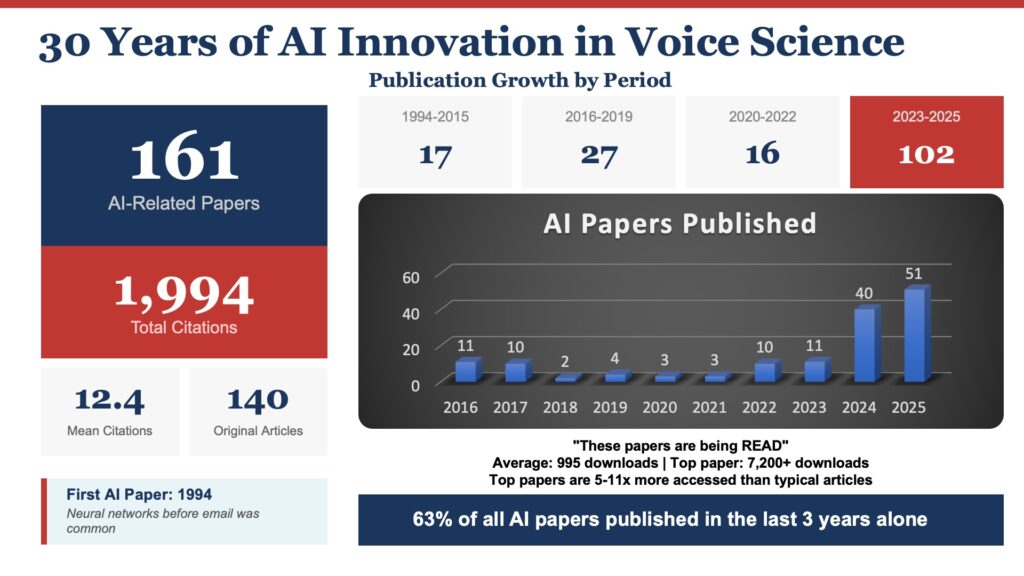
For the next two decades, AI research in voice science grew at a measured, exploratory pace. Between 1994 and 2015, a total of 17 papers touching upon machine learning or pattern recognition were published in the journal. These foundational years were characterized by proof-of-concept models, testing whether algorithms could reliably categorize acoustic features or assist human ears in detecting pathologies.
The Acceleration Phase: 2016–2022
As computing power expanded and deep learning architectures matured, the pace of publication quickened. Between 2016 and 2019, the Journal of Voice published 27 AI-related papers. Researchers began moving beyond simple pattern recognition into deep neural networks capable of processing complex cepstrum vectors.
The subsequent window, spanning 2020 through 2022, saw another 16 papers published, even as global research institutions pivoted toward pandemic-related health challenges. During this time, machine learning began showing immense promise not just in diagnosing localized laryngeal issues, but in analyzing vocal tract dynamics on a granular level.
The Exponential Explosion: 2023–2025
Nothing, however, compares to the current era. The publication timeline tells a dramatic story of exponential growth: out of 161 total AI-related papers indexed across this historical span, 102 papers—or 63 percent—were published in just the three-year window from 2023 to 2025.
In the single year of 2025, the journal published 51 AI-related papers. To put this in perspective, the output of 2025 alone surpasses the cumulative total of AI papers published during the first twenty years of the journal’s modern digital tracking. This is no longer gradual scientific progress; it is an exponential transformation that is actively redefining the boundaries of otolaryngology and speech science.
Supporting Context & Metrics: Beyond Citations to Real-World Impact
In academic publishing, raw citation counts are often treated as the ultimate metric of success. However, looking deeper into the usage statistics of AI research within the Journal of Voice reveals a much broader story of real-world utility among clinicians, researchers, and allied health professionals.
Global Reach and Download Statistics
The average AI-focused paper published in the journal has been downloaded nearly 1,000 times—a figure that indicates robust, active engagement from a specialized global readership. More telling, however, are the breakout papers addressing urgent public health concerns.
For instance, a prominent study exploring machine learning applications for COVID-19 detection via voice characteristics has been downloaded over 7,200 times, eclipsing the median download rate for its issue by a factor of eleven. Similarly, foundational review and research articles have achieved massive dissemination:
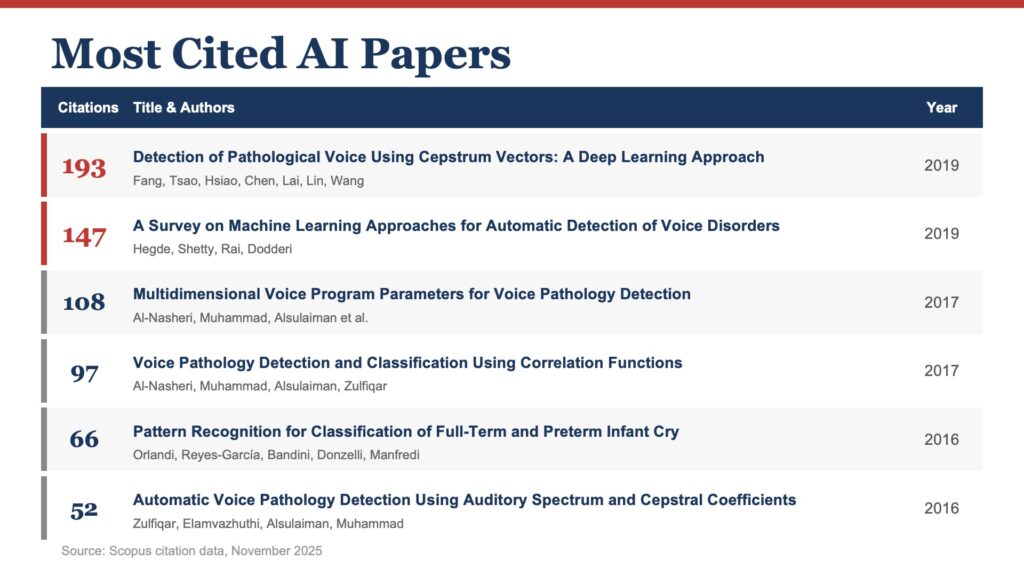
- Fang and colleagues’ 2019 deep learning study on pathological voice detection has garnered 193 citations and nearly 5,000 downloads.
- Hegde’s comprehensive survey on machine learning approaches for automatic voice disorder detection has accumulated 147 citations alongside nearly 5,000 downloads.
These numbers do not merely represent academic vanity metrics. They represent thousands of clinicians, researchers, and speech-language pathologists actively seeking actionable, practical tools to enhance diagnostic accuracy and improve patient outcomes at the bedside.
Landmark Research Reshaping the Field
The body of literature published over the last decade has established several core pillars of modern computational voice science.
Deep Learning for Voice Pathology Detection
The human ear is an extraordinary instrument, capable of discerning subtle shifts in pitch, timbre, and resonance. However, pathological changes in the vocal folds often manifest in acoustic features entirely imperceptible to human consciousness.
Fang and colleagues’ benchmark 2019 paper, "Detection of Pathological Voice Using Cepstrum Vectors: A Deep Learning Approach," demonstrated that deep neural networks could successfully isolate these hidden biomarkers. By analyzing cepstral coefficients, the algorithm achieved remarkable accuracy in flagging laryngeal pathologies long before they might present obvious visual symptoms during routine physical exams.
This work inspired a wave of methodological advancements. Researchers like Al-Nasheri (2017), Chen and Chen (2022), and Fujimura explored various iterations of convolutional neural networks (CNNs)—ranging from one-dimensional acoustic models to multi-layered image classifiers evaluating laryngoscopic photographs—each pushing the ceiling of automated diagnostic precision.
Voice as a Digital Biomarker for Systemic Health
Perhaps the most conceptually profound paradigm shift in modern medicine is the recognition of the human voice as a digital biomarker—a non-invasive, continuous window into systemic neurological, psychological, and physiological health.
- Neurological Monitoring: Groundbreaking work has demonstrated that subtle acoustic shifts can predict and monitor the progression of neurodegenerative diseases such as Parkinson’s disease. Studies like Hemmerling and Wójcik-Pędziwiatr’s 2022 paper have provided vital frameworks for quantifying Parkinson’s severity purely through vocal signal analysis.
- Mental Health Assessment: Systematic reviews published in recent years have begun evaluating voice quality as a digital biomarker for depression and bipolar disorder. The clinical implications are immense: routine, automated voice screening could one day flag early warning signs of mental health crises, enabling proactive intervention and reducing strain on overburdened healthcare infrastructures.
- Respiratory Sentinel Systems: The rapid pivot toward machine-learning models capable of identifying respiratory distress and viral signatures (such as COVID-19) from acoustic patterns highlights how the voice acts as an early warning system for pulmonary health.
AI Chatbots in Clinical Decision-Making
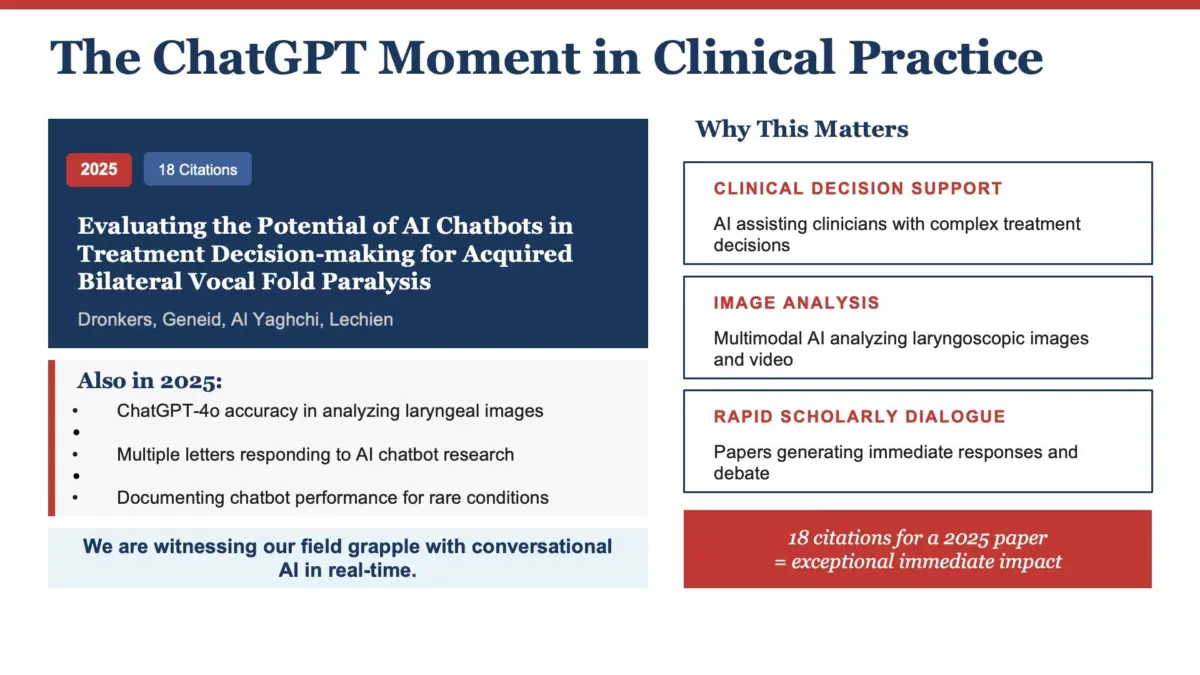
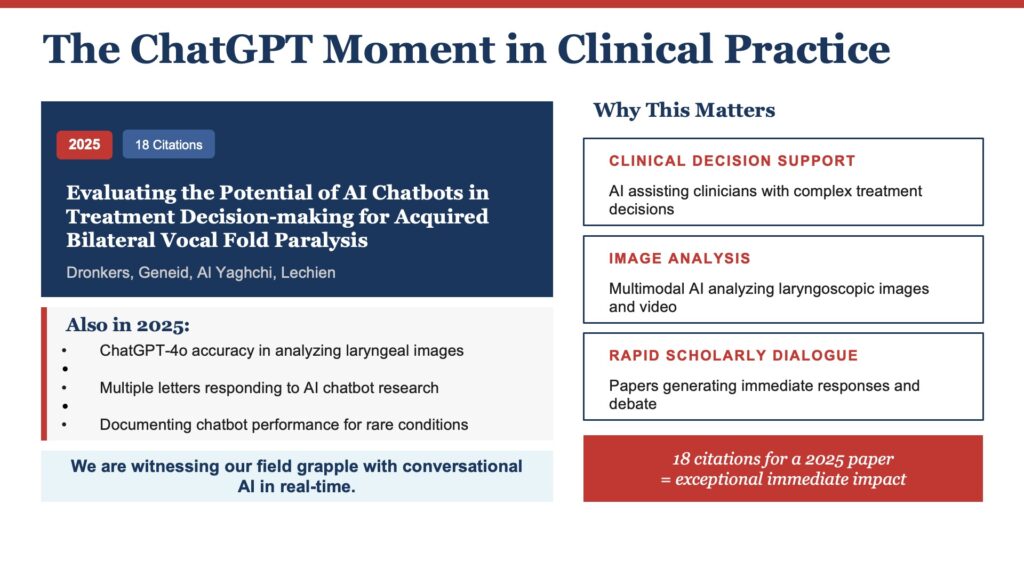
As conversational artificial intelligence enters the medical sphere, researchers are actively testing its boundaries and limitations. In 2025, the Journal of Voice published groundbreaking work by Dronkers and colleagues titled "Evaluating the Potential of AI Chatbots in Treatment Decision-making for Acquired Bilateral Vocal Fold Paralysis."

Accumulating 18 citations almost immediately upon release—an extraordinary velocity for scholarly impact—this paper sparked a robust series of responses, letters to the editor, and parallel studies analyzing the diagnostic accuracy of platforms like ChatGPT-4o in interpreting complex laryngeal imaging. The medical community is no longer pondering whether conversational AI will enter clinical workflows; it is actively stress-testing its safety, reliability, and ethics in real time.
Official Statements and Expert Perspectives
To fully contextualize this technological leap, the insights of leading voices in computation, otolaryngology, and academic governance provide essential guidance.
Dr. Mark Berardi: Managing Complexity and Synthetic Communication
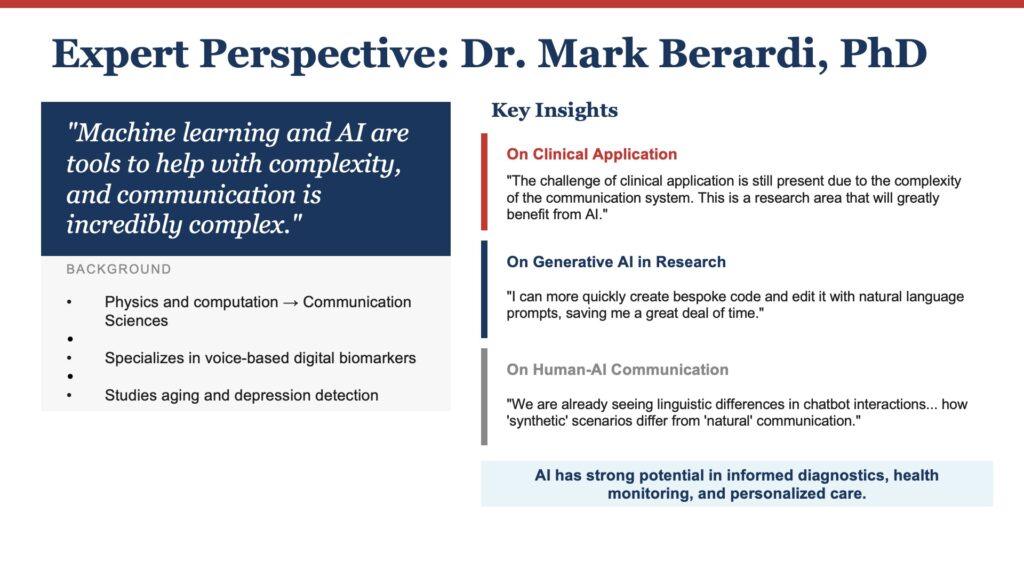
Dr. Mark Berardi brings a unique interdisciplinary background rooted in physics and computation to voice science. For Dr. Berardi, artificial intelligence is fundamentally a tool designed to manage systemic complexity.
"Machine learning and AI are tools to help with complexity, and communication is incredibly complex in its neurobiological and physiological processes. So I think the application is warranted."
Dr. Berardi notes that while acquiring clean speech and voice signals has become relatively straightforward, the true challenge lies in decoding the multi-layered nature of human interaction. However, he highlights that generative AI has already begun eliminating traditional research bottlenecks, particularly regarding custom data processing and bespoke code generation via natural language prompts.
Intriguingly, Dr. Berardi’s current work investigates human-AI communication itself. As society shifts toward virtual meetings (Zoom) and conversational chatbots, human linguistic patterns adapt. "We are already seeing linguistic differences in chatbot interactions," he observes, suggesting that voice science must expand its scope to study how humans modulate their voices when interacting with synthetic entities.
Dr. Eric Hunter: Embracing Change with Ethical Clarity
Dr. Eric Hunter focuses heavily on the institutional and operational realities of integrating AI into academia. He emphasizes that advanced language models and algorithmic tools are permanent fixtures of the modern scholarly landscape.
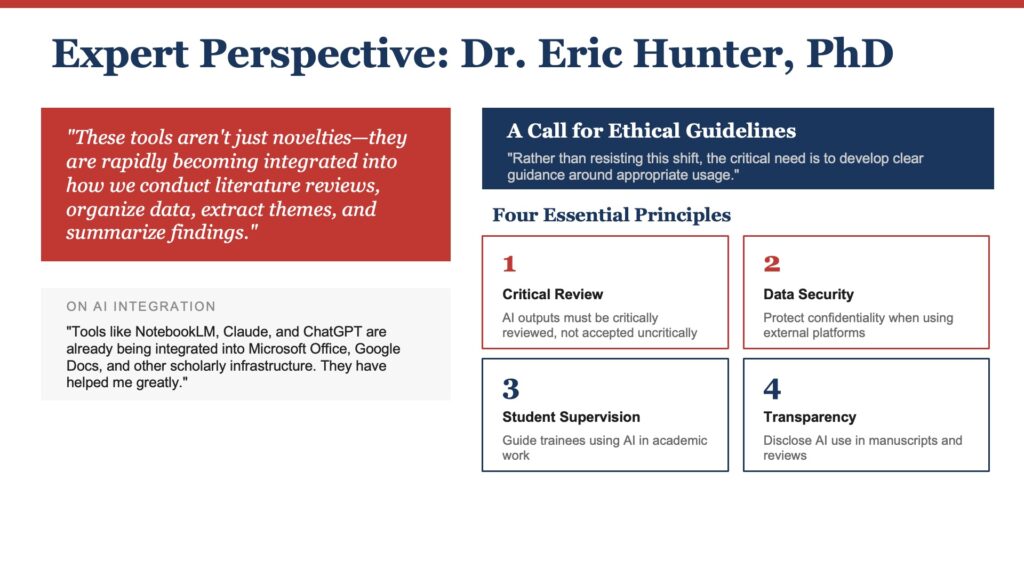
"These tools aren’t just novelties. They are rapidly becoming integrated into how we conduct literature reviews, organize data, extract themes from large bodies of text, and even summarize findings."
From journal article preparation and manuscript review to collaborative writing and data synthesis, platforms like NotebookLM, Claude, and ChatGPT are embedding themselves into standard academic infrastructure. Rather than resisting this technological wave, Dr. Hunter issues a vital call to action for the scientific community: establish clear, transparent guidance for appropriate usage.
Dr. Hunter advocates for a balanced framework built on four core pillars:
- Uncompromising Transparency: Authors must clearly disclose if and how generative tools were utilized in drafting or analyzing research.
- Human Accountability: AI can assist with summarization and data processing, but human researchers must retain total responsibility for scientific integrity, factual accuracy, and conclusions.
- Data Privacy and Security: Clinical voice data must be protected under strict ethical guidelines, ensuring patient confidentiality is never compromised by third-party model training.
- Editorial Integrity: Peer review processes must adapt to screen for unverified AI-generated content while embracing AI’s efficiency in spotting structural flaws and formatting inconsistencies.
A Global Research Community
The rapid evolution of computational voice science is not the product of a few isolated laboratories. It is driven by a vibrant, interconnected global network of researchers spanning every continent.
Prominent contributors whose prolific output has shaped the pages of the Journal of Voice include:
- Jérôme René Lechien (multiple papers focusing on clinical interventions and AI diagnostics)
- Dimitar Deliyski and Stephanie Zacharias (pioneers in acoustic measurement and laryngeal imaging)
- Ahmed Yousef (leading numerous investigations as first author)
- Paavo Alku, Leonardo Wanderley Lopes, and Maryam Naghibolhosseini
These scientists, alongside dozens of international research groups, represent a unified commitment: leveraging machine learning to decode the hidden mechanics of the human voice while maintaining the rigorous standards of classical medical science.
Future Outlook and The Path Forward
As the Journal of Voice and The Voice Foundation look toward the next fifty years of innovation, the path forward requires a deliberate, collective strategy. The leadership outlines three non-negotiable imperatives for the scientific community:
- Mindful Engagement: Researchers and clinicians must approach AI tools as sophisticated aids for managing complexity. These systems are designed to augment human expertise, not replace clinical intuition and critical judgment.
- Collaborative Ethics: The establishment of a shared ethical framework—as championed by institutional leaders—cannot be achieved by a single journal or university. It requires an ongoing, global dialogue among ethicists, technologists, clinicians, and legal experts.
- Continuous Sharing: The 161 AI papers cataloged to date represent merely the opening chapter. Every clinician, speech-language pathologist, and engineer possesses unique frontline insights that can propel the field forward.
Conclusion: An Extraordinary Moment in Voice History
The human voice is our most intimate instrument of connection, emotional expression, and personal identity. For hundreds of thousands of years, it has carried our joys, our vulnerabilities, and our health in ways no other physiological signal can replicate.
Now, for the first time in human history, we possess computational tools sophisticated enough to truly comprehend that complexity—decoding what the voice reveals about our brains, our bodies, and our overall wellbeing. We stand at the threshold of an era where non-invasive digital biomarkers can extend the reach of expert clinicians, detect pathology before symptoms manifest, and democratize access to advanced voice care across the globe.
The Journal of Voice stands proudly at the epicenter of this transformation. As we look ahead to the next decade of discovery, the fusion of art, science, and artificial intelligence promises a future where the human voice speaks louder, clearer, and more revealingly than ever before.