
Executive Overview
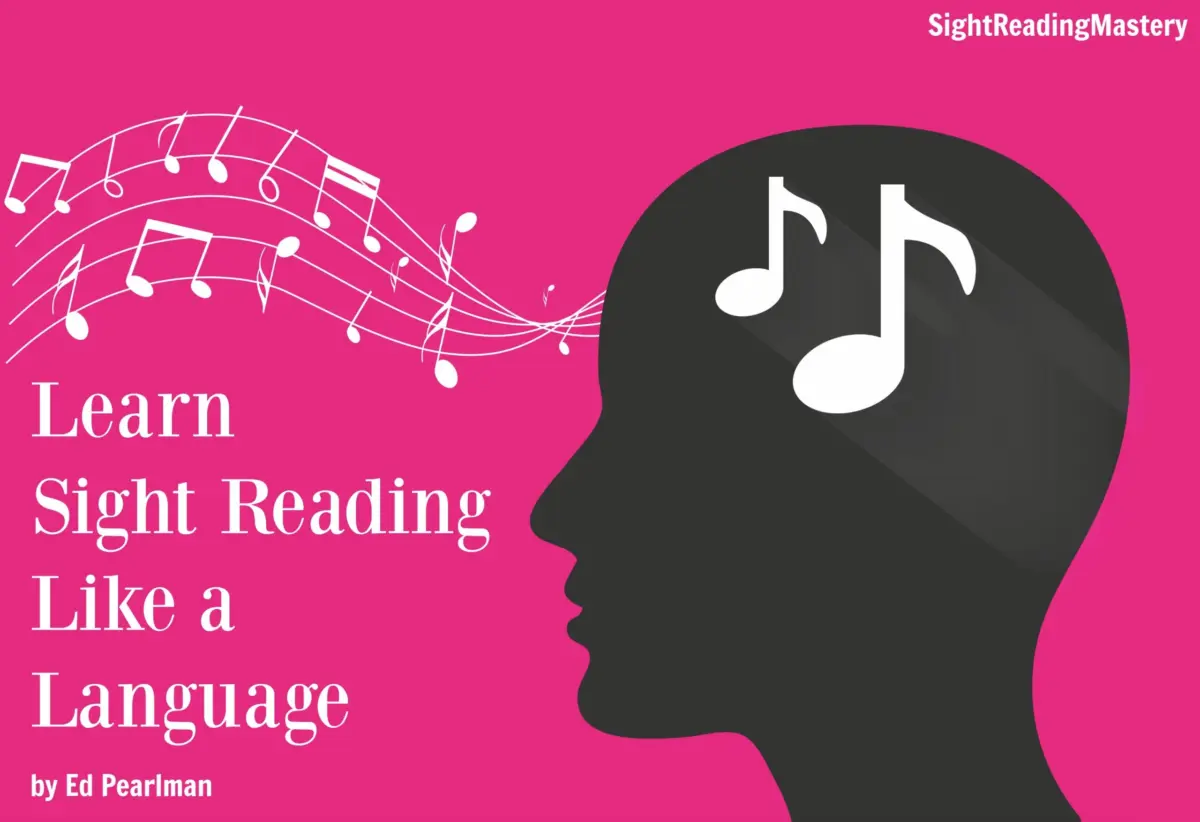
In the realm of cognitive linguistics and music pedagogy, a profound parallel exists between acquiring a spoken language and mastering the art of musical sight-reading. When an individual learns a foreign tongue, the ultimate objective transcends mere word-for-word translation. True fluency is achieved only when the mind bypasses the bottleneck of native-language translation, instantly mapping meaning to sound and concept.
For instance, encountering the Spanish phrase "¡Buenos días!" triggers an immediate understanding of morning greetings without mentally converting the words into "good morning." While translation serves as an early verification tool to confirm comprehension, over-reliance on it anchors the learner to a sluggish, mechanical process that stymies spontaneous expression.
This cognitive constraint applies identically to musical performance. Whether instrumentalist or vocalist, a musician attempting to sight-read a novel score faces a daunting processing challenge. If the performer’s workflow requires seeing a note, translating it into a letter name, locating the corresponding finger number on the instrument, verifying the accuracy of that choice, and finally executing the physical action, disaster ensues. The sheer volume of cognitive operations guarantees a collapse of tempo and rhythm.
To bridge this gap, veteran violinist, educator, and author Ed Pearlman has introduced a progressive, five-tier pedagogical framework designed to cultivate authentic musical fluency. By decoupling sight-reading from exhaustive mental translation and treating written music as a direct visual-motor language, performers can dramatically enhance their accuracy, confidence, and internal pulse. This comprehensive report explores Pearlman’s methodology, examines the cognitive mechanics of musical decoding, and outlines a structured approach to elevating sight-reading proficiency from the ground up.
Detailed Chronology and Pedagogical Evolution
The evolution of music reading instruction has historically swung between two extremes: strictly academic, analytical decoding (focusing intensely on theory, note identification, and solfège) and purely intuitive, ear-based imitation. For centuries, traditional teaching models prioritized absolute note recognition over contextual flow. Students were drilled on individual pitches, often at the expense of rhythmic integrity and overarching architectural shape.
As music education evolved into the modern era, pedagogues recognized that this analytical bottleneck was failing students under pressure. The demand for flexible, adaptable musicians in orchestral, chamber, and commercial settings necessitated a shift toward holistic reading strategies. The realization that reading music mirrors reading text—where humans process entire words and phrases at a glance rather than spelling out every single letter—catalyzed a reevaluation of sight-reading drills.
Pearlman’s five-tier framework represents the culmination of this pedagogical shift. Developed through decades of classical violin training in major cultural hubs like Chicago and Boston, followed by a 35-year immersion in traditional fiddle styles across North America and Scotland, the methodology synthesizes rigorous structural awareness with intuitive, kinesthetic flow.
Instead of demanding perfection across all musical parameters from the outset, Pearlman’s methodology mimics natural language acquisition: children learn the cadence and rhythm of speech long before they master spelling or grammar. Similarly, the framework mandates a phased introduction of musical elements, ensuring the student’s working memory is never overloaded.
Supporting Context & Metrics: The Anatomy of the Five-Tier Framework
To implement Pearlman’s approach effectively, musicians must understand that the five levels detailed below operate independently of formal "grade levels" (such as those found on platforms like SightReadingMastery, which measure a piece’s structural difficulty). Rather, these represent cognitive processing layers that a musician applies to any given piece of music, regardless of its objective difficulty.
Once a student masters Level 1, that skill is maintained as a baseline while integrating Level 2, and so forth, culminating in a multi-layered perceptual habit.
Level 1: Rhythms Only — Establishing the Pulse
[Visual Score] ---> [Rhythmic Extraction] ---> [Internal Pulse & Tapping] ---> [Zero Pitch Distractions]The foundational layer of sight-reading is the extraction and execution of pure rhythm. Before a single pitch enters the equation, the student selects a comfortable tempo and taps, claps, or speaks the rhythm of the passage.
- The Pedagogical Objective: To force the brain to process measures as continuous rhythmic phrases rather than isolated note durations.
- Why It Matters: Rhythms are inherently relational; a quarter note only holds meaning in direct opposition to the eighth notes, rests, or half notes surrounding it. By isolating the rhythm, the student eliminates pitch anxiety.
- Humor in Practice: Pearlman highlights the classic conservatory joke about the violist who boasts to a violinist about his ability to play hyper-fast 64th notes. When challenged to demonstrate, the violist plays just one note. While a humorous jab at string players, it underscores a serious truth: playing notes without rhythmic context is musically meaningless.
Level 2: Note Profile — Mapping the Contour
With the rhythm successfully internalized, the student advances to Level 2. Maintaining the established tempo, the performer now sings or plays the passage while focusing exclusively on the contour or profile of the notes.
- The Pedagogical Objective: To track whether successive notes are ascending, descending, or remaining static, without worrying about exact pitch names or precise intervals.
- Why It Matters: The human eye can easily track spatial directionality on a staff. By prioritizing the "shape" of the musical line while maintaining strict time, the student ensures that rhythm—the backbone of musical performance—is never sacrificed for the sake of note accuracy. A slight pitch error is acceptable at this stage; a timing error is not.
Level 3: Focusing the Picture — Integrating Key Context
Level 3 introduces harmonic grounding. Before tackling the passage, the musician must take note of the key signature and perform a scale in that specific key, paying explicit attention to the placement of half steps (semitones).
- The Pedagogical Objective: To anchor the note profiles from Level 2 into a specific tonal landscape.
- Why It Matters: Knowing where the half steps lie within the local range prevents catastrophic intonation and note errors. When sight-reading at this level, the rule remains absolute: never pause or slow down due to uncertainty. If a specific pitch eludes the performer, they must educatedly guess based on the profile and key signature while maintaining the pulse. Slowing down the overall tempo or breaking the exercise down into one- or two-measure segments is permissible if the continuous flow breaks down.
Level 4: Seeing Intervals — Geometric Recognition
At Level 4, the musician moves from general contours to specific geometric relationships on the page: intervals.
- The Pedagogical Objective: To recognize the physical topography of musical distance instantly.
- Why It Matters: Just as fluent readers recognize whole words rather than individual letters, advanced sight-readers recognize intervals at a glance:
- Scales (Seconds): Consecutive notes moving fluidly from a line note to an adjacent space note (or vice versa).
- Thirds: Notes skipping a space or line, moving from line-to-line or space-to-space.
- Larger Japs (Fourths, Fifths, and Beyond): While wider intervals require more processing power, they become instinctively recognizable through iterative exposure. For instance, a fifth spans two lines (line to two lines away) or two spaces.
Level 5: Names of Notes — The Analytical Layer
The final level introduces note-naming—either internally thinking or aloud speaking the letter names (e.g., C, D, E) while performing.
- The Pedagogical Objective: To verify structural awareness without relying on it as a crutch.
- Why It Matters: Pearlman notes that this tier is strictly optional for core sight-reading fluency. Because fluent musical reading is a direct-action language skill, translating notes into alphabetical names is not strictly necessary for performance. However, it serves as a brilliant stress-test for focus. If a student can maintain rhythm, contour, key context, and intervals while simultaneously processing note names, their cognitive mastery of the score is complete. For those struggling with this layer, supplementary tools like SightReadingMastery’s Note Recognition features provide targeted, rapid-fire notation drills.
Official Statements and Expert Insights
Ed Pearlman’s pedagogical philosophy challenges the traditional, anxiety-ridden approach to learning an instrument. Reflecting on his extensive career spanning classical performance in major urban centers and traditional fiddle immersion across North America and Scotland, Pearlman emphasizes that music education must prioritize holistic communication over mechanical calculation.

"When you’re learning a language, the goal is to be able to understand and speak without having to mentally translate the words into your native language… It’s the same in music. You want to play directly from sight. You’ll get bogged down if you try to see the notes on paper, translate them into names and finger numbers, make sure you’ve got it right, and then finally play—you won’t have time to do all this and stay in tempo."
— Ed Pearlman, Violinist, Educator, and Founder of Fiddle-Online
Pearlman’s insights align with modern cognitive science research, which demonstrates that expert performance relies heavily on "chunking"—grouping individual data points into meaningful, larger cognitive units. By breaking sight-reading practice down into rhythms, profiles, key centers, intervals, and note names, Pearlman provides a systematic scaffolding mechanism that allows the human brain to construct these cognitive chunks organically.
Future Outlook: The Digital Frontier of Musical Fluency
As music education continues to intersect with digital platforms and interactive learning environments, methodologies like Pearlman’s five-tier framework are positioned to become standard operating procedure for instrumentalists and vocalists worldwide.
The traditional paradigm—where a student sits alone with a static method book, paralyzed by the fear of playing a wrong note—is rapidly giving way to dynamic, gamified, and targeted sight-reading ecosystems. Platforms that offer automated rhythm tracking, instant interval recognition drills, and infinitely generated practice examples allow students to apply Pearlman’s graded steps in real time.
Key Recommendations for Integrating the Framework:
- Embrace Imperfection: Prioritize unbroken tempo over pristine note accuracy during Levels 1 through 3.
- Iterative Stacking: Once a level is mastered, do not discard it; layer it seamlessly into the next tier.
- Leverage Technology: Utilize specialized note-recognition software and digital sight-reading repositories to expose the brain to a high volume of varied examples daily.
- Contextualize Before Playing: Always anchor passages with key signatures and scale work before initiating the sight-reading run.
By treating music not as a complex cryptography puzzle to be slowly deciphered, but as a living, breathing language to be spoken fluently at sight, musicians can unlock unprecedented levels of artistic freedom, confidence, and joy in their craft.