Today, voice science stands at a profound and irrevocable inflection point. Artificial intelligence (AI) and machine learning are fundamentally reshaping how researchers conduct investigations, analyze multi-dimensional data sets, and deliver precision care to patients worldwide. This technological renaissance does not emerge in a vacuum; rather, it builds upon more than half a century of pioneering interdisciplinary work championed by institutions like The Voice Foundation and its premier publication, the Journal of Voice.
Far from being a sudden or reactive trend, the convergence of artificial intelligence and voice science spans over three decades of quiet, methodical development. Today, this trajectory has erupted into exponential growth. Driven by deep neural networks, large language models, and advanced acoustic processing, the field is unlocking unprecedented insights into human physiology, neurological wellness, and systemic health. This article explores the rich legacy of voice research, traces the rapid historical integration of computational methodologies, examines the paradigm-shifting concept of the voice as a digital biomarker, and outlines the urgent need for a unified ethical framework to guide future discoveries.
A Legacy of Innovation: Bridging Art and Science
To understand the current computational revolution in voice science, one must look back to its foundational roots. In 1969, Dr. Wilbur James Gould established The Voice Foundation in New York City. At a time when comprehensive, interdisciplinary care for the human voice was virtually non-existent, Dr. Gould possessed the groundbreaking foresight to bring together distinct professional communities. Physicians, scientists, speech-language pathologists, vocal performers, and master teachers were invited to share their specialized knowledge for the holistic care of the professional voice user.
The momentum generated by this coalition led to the Foundation’s first Annual Symposium on the Care of the Professional Voice in 1972, followed closely by its inaugural Gala (later christened Voices of Summer) in 1973. For over fifty years, the Foundation has successfully built structural and intellectual bridges between the arts and sciences, connecting the clinical examining room with the theatrical stage.
Since 1989, the organization has been guided by Dr. Robert Thayer Sataloff, an internationally renowned otolaryngologist, professional singer, and conductor. Under Dr. Sataloff’s visionary leadership—marked by the authorship of more than 1,200 publications, including 79 textbooks—the Foundation relocated its headquarters to Philadelphia. Here, it continues to expand the frontiers of voice science through rigorous interdisciplinary research and global education.
Today, the annual Symposium in Philadelphia draws hundreds of medical practitioners, researchers, academics, and performing artists from every corner of the globe. Alongside this vibrant physical convening, the Foundation publishes the Journal of Voice, the definitive, peer-reviewed authority dedicated entirely to voice science, medicine, and clinical care.
Detailed Chronology: 30 Years of AI Research in Voice Science
While mainstream society has only recently awakened to the possibilities of artificial intelligence through conversational agents and generative tools, the readership of the Journal of Voice has been engaging with computational intelligence for over thirty years.
The historical timeline of AI in voice science is both surprising and illuminating. In 1994—thirty-one years ago, during the infancy of the World Wide Web, when the concept of sending an email was still novel to the general public—the Journal of Voice published a paper by Rihkanen and colleagues titled "Spectral Pattern Recognition of Improved Voice Quality." This foundational study utilized early neural networks to analyze voice metrics, marking the official inception of machine learning applications within the discipline.
For the next two decades, computational research progressed at a steady, incremental pace. However, the publication timeline reveals a striking exponential acceleration in recent years:
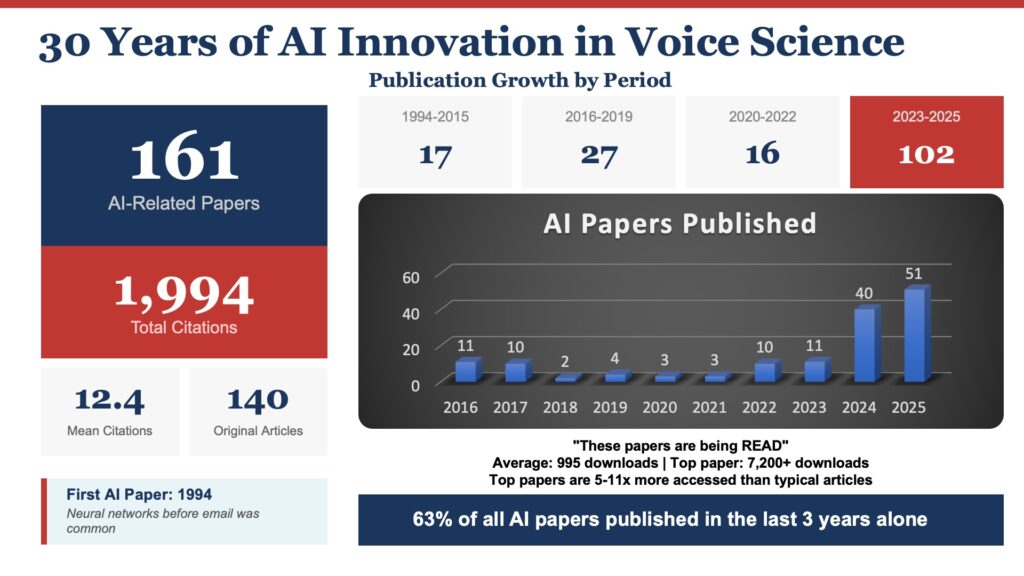
1994–2015: 17 papers published over two decades, establishing baseline acoustic modeling and pattern recognition techniques.
2016–2019: 27 papers published as deep learning architectures began replacing traditional statistical classifiers.
2020–2022: 16 papers published during a period of consolidation and refinement amidst global health disruptions.
2023–2025: 102 papers published in just three years, signaling an unprecedented surge in computational voice research.
In the year 2025 alone, the journal published 51 AI-related papers—surpassing the total output of the field’s first twenty years combined. This dramatic leap highlights a structural transformation from experimental curiosity to mainstream clinical and diagnostic methodology.
Supporting Context and Metrics: Real-World Impact and Landmark Studies
The value of these computational studies extends far beyond traditional academic citation metrics; they are actively downloaded, read, and applied by clinicians and researchers on a daily basis. Recent usage analytics demonstrate the profound, real-world reach of this literature.
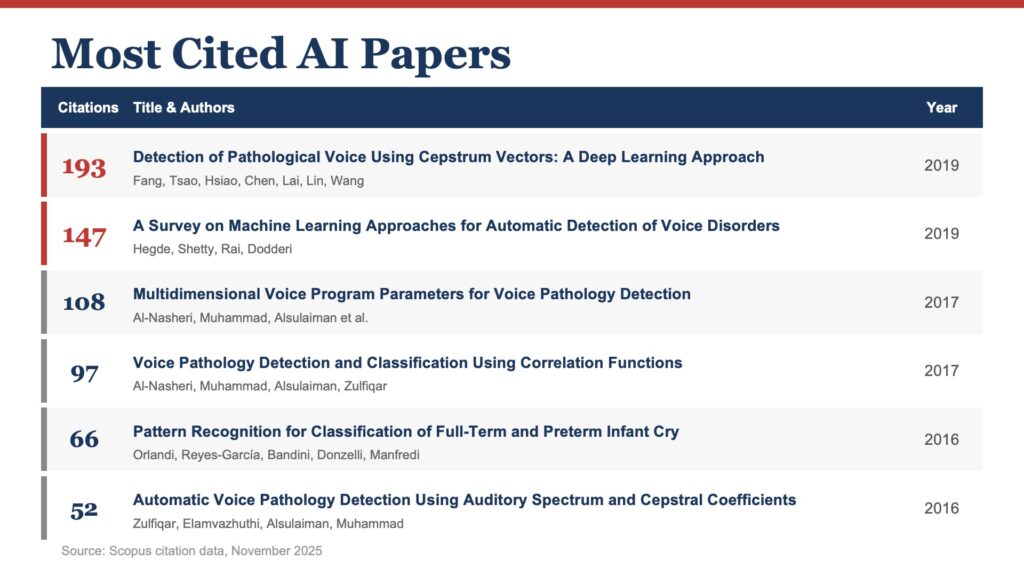
On average, an AI-focused paper published in the Journal of Voice is downloaded nearly 1,000 times. The most-accessed article—a breakthrough study examining machine learning models for COVID-19 detection via voice analysis—has garnered over 7,200 downloads, eclipsing the median download rate for its issue by a factor of eleven. Similarly, the two most-cited papers in the journal’s computational catalog—Fang and colleagues’ deep learning study on pathology detection (193 citations) and Hegde’s comprehensive machine learning survey (147 citations)—have each been accessed nearly 5,000 times, cementing their status as essential reading for practitioners seeking practical, technology-driven diagnostic tools.
Deep Learning for Voice Pathology Detection
Published in 2019, Fang et al.’s paper, "Detection of Pathological Voice Using Cepstrum Vectors: A Deep Learning Approach," remains the most-cited AI paper in the journal’s history. The study proved that deep neural networks could identify pathological conditions within the vocal tract with remarkable accuracy by analyzing acoustic features imperceptible to the human ear.
This work built upon earlier methodological milestones, such as Al-Nasheri et al.’s 2017 studies on Multidimensional Voice Program parameters and correlation functions. Subsequent research by Chen and Chen, Fujimura, and Cho and Choi progressively refined these neural frameworks, introducing one-dimensional convolutional neural networks and advanced image classification models for laryngoscopic evaluations.
Voice as a Digital Biomarker for Systemic Health
Perhaps the most paradigm-shifting development in modern voice science is the conceptualization of the human voice as a non-invasive digital biomarker—a window into broader systemic health and neurological function.
Recent literature highlights pioneering work in using voice acoustics to detect and monitor the progression of neurodegenerative disorders like Parkinson’s disease. For instance, a 2022 study by Hemmerling and Wójcik-Pędziwiatr on predicting Parkinson’s severity from voice signals quickly accumulated dozens of citations, paving the way for remote patient monitoring. Furthermore, systematic reviews exploring voice quality as a digital biomarker for clinical depression and bipolar disorder suggest that routine acoustic screening could soon help alleviate the immense burdens placed on global mental health systems through early, non-invasive detection.
AI Chatbots in Clinical Decision-Making
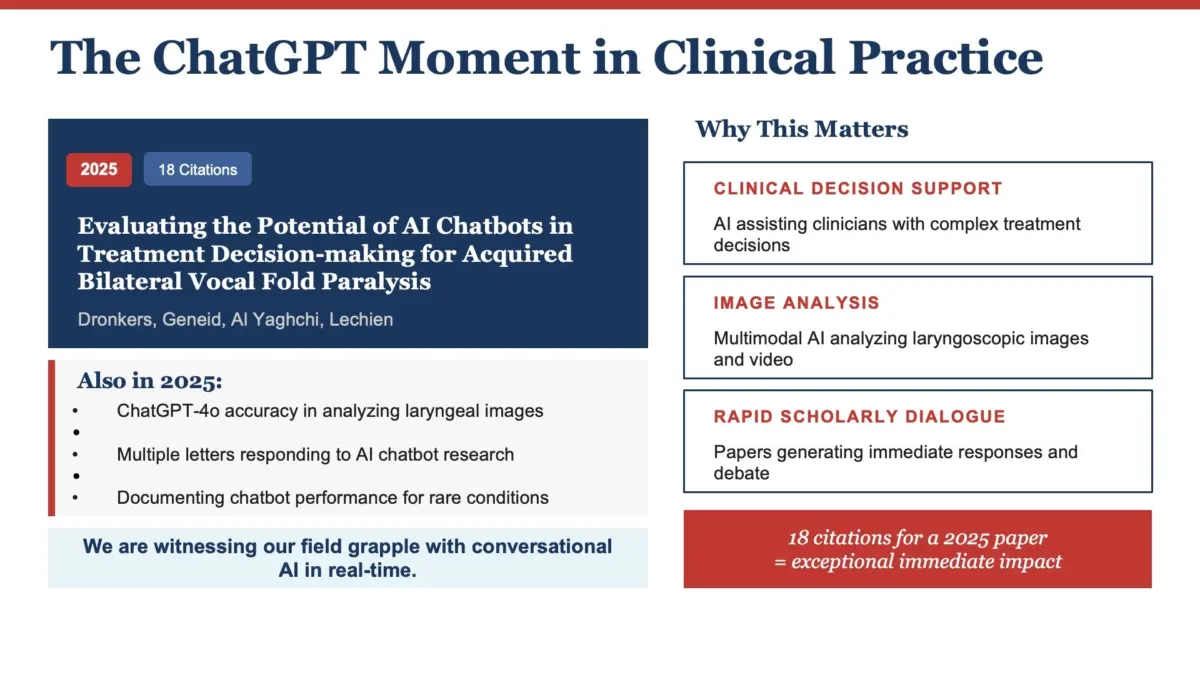
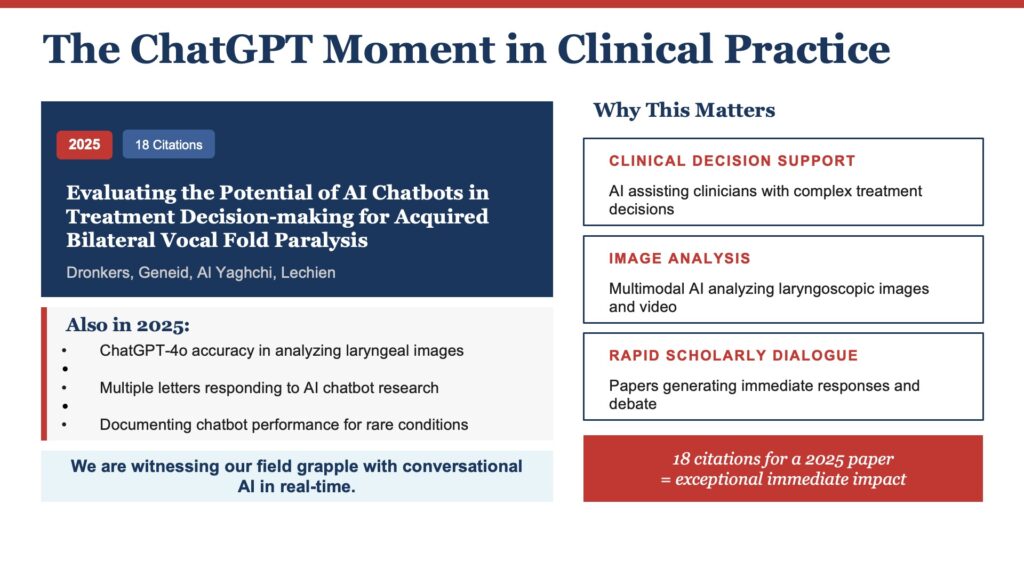
As conversational models mature, the Journal of Voice has expanded its scope to evaluate the utility of AI chatbots in medical decision-making. A notable 2025 paper by Dronkers and colleagues, "Evaluating the Potential of AI Chatbots in Treatment Decision-making for Acquired Bilateral Vocal Fold Paralysis," generated immediate scholarly impact and rigorous debate. Subsequent letters to the editor and response papers analyzing tools like ChatGPT-4o’s accuracy in evaluating laryngeal images illustrate a scientific community actively wrestling with the real-time integration of conversational AI in clinical workflows.
Official Perspectives: Expert Insights on Complexity and Ethics
To contextualize these technological leaps, leading voices within computational voice science offer critical perspectives on the opportunities and responsibilities ahead.
Dr. Mark Berardi: Managing Biological Complexity
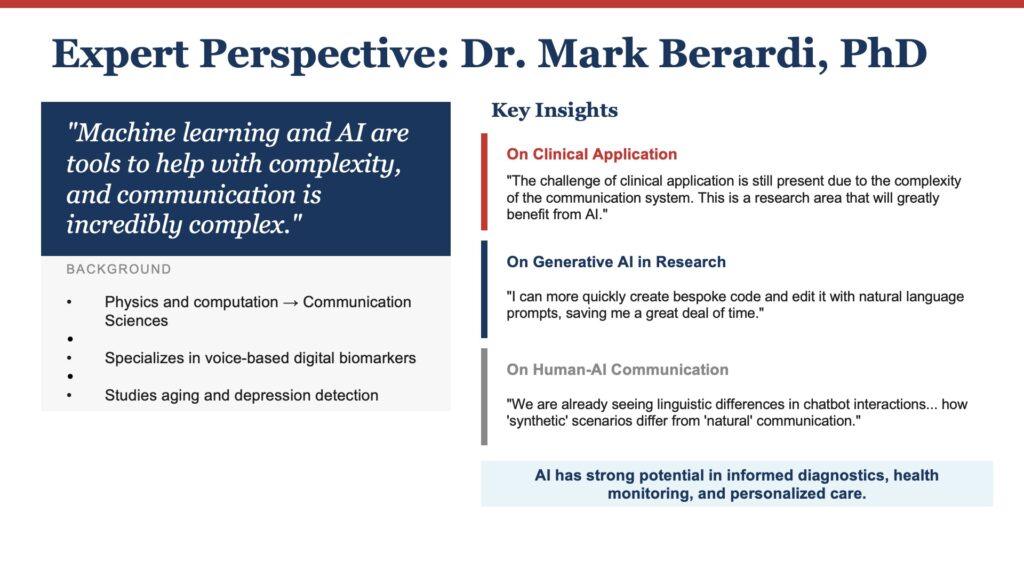
Drawing from a background in physics and computation, Dr. Mark Berardi views artificial intelligence primarily as an essential tool for managing multi-dimensional complexity.
"Machine learning and AI are tools to help with complexity, and communication is incredibly complex in its neurobiological and physiological processes. So I think the application is warranted," Dr. Berardi explains.
His current research centers on extracting health indicators related to aging and depression from vocal acoustics. While noting that acquiring speech signals has become relatively frictionless, he emphasizes that the core challenge remains the inherent intricacy of human communication—an arena where machine learning naturally excels.
Regarding generative AI, Dr. Berardi maintains a pragmatic view. While it has not entirely rewritten the foundational laws of research, it successfully eradicates persistent bottlenecks, particularly in data processing and custom software development. Researchers can now author bespoke analytical code using natural language prompts. Intriguingly, Dr. Berardi is also studying human-machine communication itself, analyzing how human speech patterns adapt when interacting with conversational agents or participating in synthetic environments like Zoom calls.
Dr. Eric Hunter: Embracing Change with Ethical Clarity
Dr. Eric Hunter focuses heavily on the institutional and operational realities of integrating AI into academia and clinical practice.
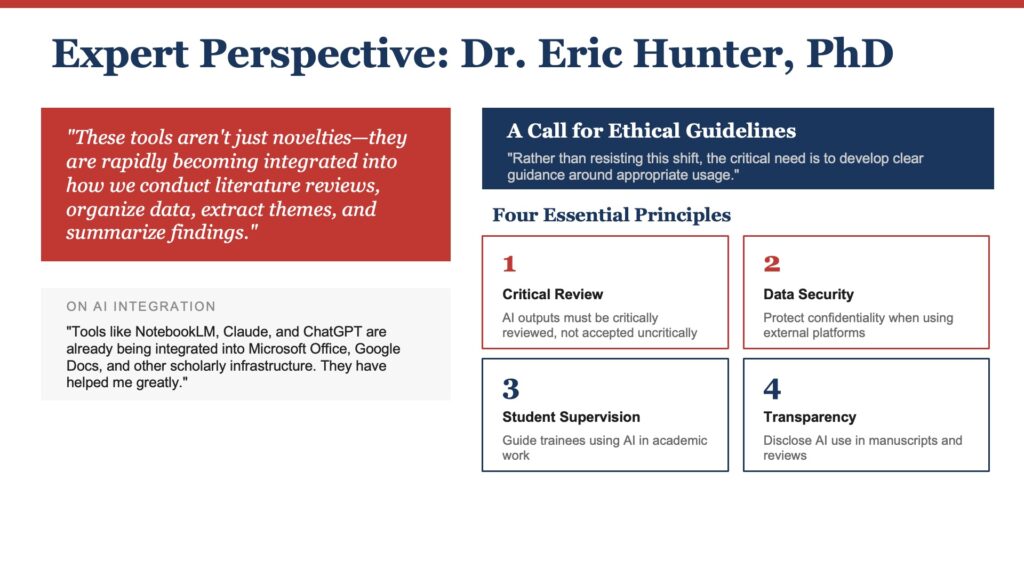
"These tools aren’t just novelties," Dr. Hunter observes. "They are rapidly becoming integrated into how we conduct literature reviews, organize data, extract themes from large bodies of text, and even summarize findings."
Dr. Hunter stresses that large language models and machine learning pipelines are permanent fixtures of the scholarly landscape. Rather than adopting an adversarial stance toward emerging technologies, the academic community must proactively establish clear guidelines for appropriate usage across writing, peer review, and data analysis. To achieve this, he advocates for a balanced approach that maximizes computational productivity while safeguarding intellectual rigor, transparency, and scientific integrity.
A Global Research Community
The rapid evolution of computational voice science is not the isolated achievement of a single laboratory or institution. The global research ecosystem spans every continent, driven by dedicated scholars publishing in the Journal of Voice. Leading contributors—such as Jérôme René Lechien, Dimitar Deliyski, Stephanie Zacharias, Ahmed Yousef, Paavo Alku, Leonardo Wanderley Lopes, and Maryam Naghibolhosseini—alongside dozens of international research teams, represent a unified commitment to decoding the human voice through advanced computation.
Future Outlook and the Path Forward
As the Journal of Voice charts its course through the twenty-first century, it remains steadfastly committed to publishing rigorous, boundary-pushing research. However, unlocking the full potential of artificial intelligence requires collective action across three critical fronts:
Thoughtful Engagement: Researchers and clinicians must master AI platforms not as replacements for human judgment, but as cognitive amplifiers designed to manage complex data sets and enhance diagnostic precision.
Shared Ethical Frameworks: The academic and medical communities must collaborate globally to establish transparent guidelines for authorship, data privacy, and algorithmic accountability.
Continuous Knowledge Sharing: As the 161 published AI papers demonstrate, every clinician, educator, and scientist holds valuable insights that contribute to our collective understanding of human vocal physiology.
The human voice has served as our primary instrument of connection, emotional expression, and identity for hundreds of millennia. Today, for the first time in history, we possess computational tools sophisticated enough to fully decode its complexity—revealing the state of our brains, our bodies, and our overall well-being. Standing at the center of this transformation, the Journal of Voice looks ahead to a decade defined by extraordinary discovery, clinical innovation, and global health equity.
About the Author Ian DeNolfo is Executive Director of The Voice Foundation, which publishes the Journal of Voice. A graduate of The Juilliard School and The Curtis Institute of Music, he formerly performed as a leading tenor at major opera houses worldwide before transitioning to arts administration and scientific leadership at The Voice Foundation.