
Executive Overview
In what is shaping up to be one of the most prestigious cultural events of the decade, four of the world’s most venerable opera institutions—The Metropolitan Opera, the Royal Opera, Opera Australia, and Venice’s Teatro La Fenice—have announced a historic joint tribute to commemorate the centenary of Dame Joan Sutherland. Entitled "La Stupenda: The Voice of the Century," the gala celebration will take place at Australia House in London on October 28, 2026.
The event is presented by the Tait Memorial Trust in close collaboration with Opera Australia and the Metropolitan Opera. It will serve as a definitive global homage to the Australian soprano whose breathtaking vocal agility, dramatic range, and effortless high notes redefined the boundaries of the art form during the 20th century. Adding profound emotional resonance to the evening, Maestro Richard Bonynge AC CBE—Sutherland’s lifelong collaborator, musical mentor, and husband—will attend as the Guest of Honor.
This extraordinary convergence of international opera powerhouses underscores the enduring legacy of a singer who was not merely a star of her era, but a foundational pillar of modern operatic performance. From her legendary triumphs at Covent Garden and the Met to her championing of neglected bel canto masterpieces, Sutherland’s footprint on the history of classical music remains indelible. The upcoming London celebration will blend high-level artistic performance, historical reflection, and institutional tribute, bringing together the global opera community to honor a voice that truly defined an epoch.
Detailed Chronology: The Life and Artistry of Dame Joan Sutherland
To understand the magnitude of the upcoming 2026 centenary, one must retrace the remarkable trajectory of a farm girl from Sydney who ascended to the absolute zenith of the global classical music stage.
Formative Years and Australian Beginnings (1926–1951)
Born in Sydney, Australia, on November 7, 1926, Joan Sutherland inherited her musical inclinations from her mother, a mezzo-soprano who had studied in London. However, young Joan initially pursued secretarial work and trained as a voice teacher before her undeniable vocal gifts demanded a professional pivot. Studying initially under John and Aida Dickens, and later with her future husband Richard Bonynge, Sutherland possessed a naturally rich, warm mezzo-soprano timbre that gradually ascended into the soaring, crystalline soprano dimensions that would make her world-famous.
After winning several prestigious local competitions in Australia—including the lucrative Mobil Quest in 1949—Sutherland made the pivotal decision to relocate to London in 1951 to further her studies at the Operatic Studio of the Royal College of Music under Clive Carey.
The Covent Garden Breakthrough and "La Stupenda" (1952–1960)
Sutherland made her professional stage debut at the Royal Opera House, Covent Garden, in November 1952 as the First Lady in Mozart’s Die Zauberflöte. For the next several years, she dutifully sang a diverse repertoire, ranging from Wagnerian roles (such as the Woodbird in Siegfried and Woglinde in Das Rheingold) to Verdi, showcasing a versatility that surprised critics who pigeonholed her as a heavy dramatic voice.
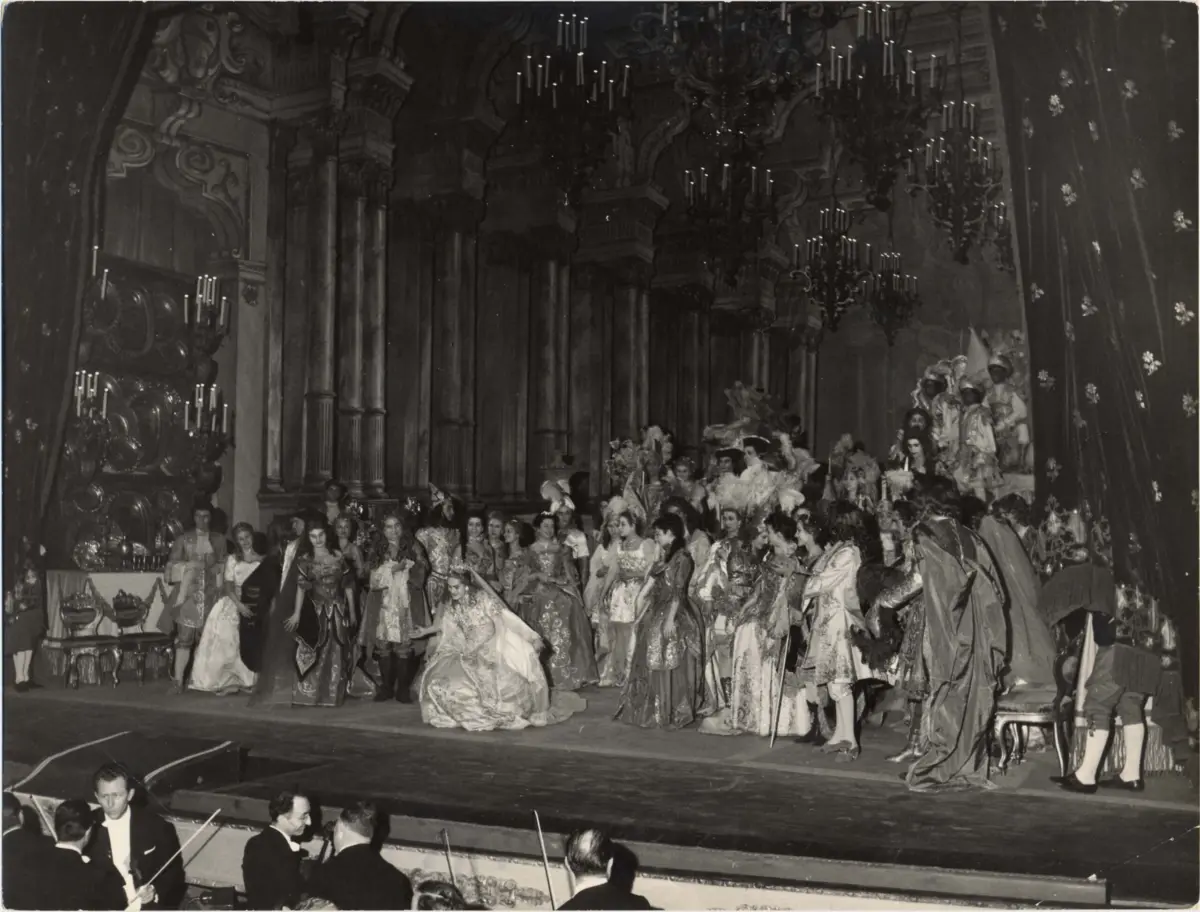
The turning point of her career—and arguably one of the most important moments in 20th-century opera history—occurred on February 17, 1959. Under the baton of Tullio Serafin and directed by Franco Zeffirelli, Sutherland starred in a new production of Donizetti’s Lucia di Lammermoor at Covent Garden. Her breathtaking execution of the punishing mad scene, characterized by unprecedented vocal clarity, dizzying staccatos, and uncanny pitch precision, sent shockwaves through the international music community. Overnight, Sutherland was transformed from a respected house soprano into a global superstar. It was during this run that Italian audiences, mesmerized by her jaw-dropping vocal acrobatics, bestowed upon her the immortal moniker: "La Stupenda."
Conquest of the Met and Global Dominance (1961–1990s)
Following her European triumph, Sutherland made her Metropolitan Opera debut on November 26, 1961, as Lucia. The reception in New York was ecstatic, cementing a multi-decade relationship with the house that would see her headline countless seasons.
Throughout the 1960s, 70s, and 80s, Sutherland, alongside Bonynge as her conductor and musical champion, spearheaded the bel canto revival. They rescued forgotten masterpieces by Bellini (Norma, I Puritani, La Sonnambula), Donizetti (Lucrezia Borgia, Maria Stuarda), and Rossini from the historical archives, proving that these works were not merely historical curiosities but thrilling theatrical vehicles.
Her career was defined by remarkable vocal longevity and discipline. Unlike many high-coloratura sopranos whose voices burn out quickly, Sutherland maintained her astonishing technique well into her sixties. She officially retired from the opera stage on October 31, 1990, at the Gala Farewell at the Sydney Opera House, singing "Home to our mountains" from Verdi’s Il Trovatore alongside Marilyn Horne, though her influence continued undiminished until her passing in 2010.
Supporting Context & Metrics: The Architectural Scale of Sutherland’s Legacy
The upcoming centenary at Australia House is not merely a sentimental gathering; it is a celebration backed by staggering historical metrics and institutional weight.
Global Footprint and Repertoire Scale
- The Metropolitan Opera: Sutherland performed in 222 total performances across 25 distinct roles at the Met between 1961 and 1987. Her signature roles in New York included Lucia, Violetta (La Traviata), Norma, and Gilda (Rigoletto).
- The Royal Opera House: As her primary European artistic home, Covent Garden staged Sutherland in hundreds of performances, cementing the theater’s reputation as a global hub for bel canto excellence.
- Discography: Sutherland recorded extensively, primarily for Decca Records. Her discography includes multiple complete recordings of Lucia di Lammermoor, Norma, and Messiah, setting the gold standard for recorded operatic sound in the stereo era.
The 2026 London Gala Production Architecture
The artistic forces assembled for "La Stupenda: The Voice of the Century" reflect a meticulous commitment to world-class musicianship:
- Conductor: Natalie Murray Beale will lead the Tait Sutherland Chamber Orchestra.
- Orchestral Foundation: The ensemble features elite alumni of Sinfonia Smith Square, ensuring a rich, symphonic texture.
- Vocal Talent: A carefully curated roster of rising and established soloists—including Cassandra Wright, Alasdair Kent, Duncan Rock, Emmanuel Fonoti-Fuimaono, Bella Marslen, Eden Shifroni, Lyla Levy-Jordan, Karl Huml, and Valda Wilson—will showcase the next generation of classical vocal talent.
- Special Guests: Sopranos Ellie Neate and Soraya Mafi will appear courtesy of Opera Rara, a label synonymous with the rediscovery of rare operatic repertoire, a mission deeply aligned with Sutherland’s own artistic ethos.
- Repertoire: The program is designed to mirror Sutherland’s eclectic and demanding tastes, featuring masterworks by Bellini, Donizetti, Verdi, and Delibes, alongside lighter selections from operetta and the sophisticated parlor songs of Noël Coward.
Official Statements: Perspectives from Global Opera Leadership
The gravity of the centenary has drawn profound reflections from the current leaders of the world’s premier opera institutions. Their statements emphasize how deeply Sutherland’s artistic DNA is embedded in the modern identity of their respective houses.
Peter Gelb, General Manager of the Metropolitan Opera, offered a sweeping assessment of her historic stature:
"Few artists have made as meaningful a contribution to the Metropolitan Opera as Dame Joan Sutherland, one of the most transcendent singers of the 20th century—if not the entire history of our art form.
I will never forget the power of her voice, the thrill of her stratospheric high notes, and the endless ovations she received."
Alex Beard, Chief Executive of the Royal Opera House, echoed this sentiment, highlighting the special bond between the soprano and London audiences:
"The Royal Opera is delighted to join in the celebrations for the centenary of Dame Joan Sutherland’s birth. Her history with Covent Garden is legendary, and her interpretations defined an era of artistic excellence that continues to inspire our artists and audiences to this day."
These institutional endorsements from New York, London, Sydney, and Venice elevate the October 2026 event from a localized tribute to a truly global summit of classical music leadership.
Future Outlook: Preserving the Flame for Future Generations
As the classical music world looks ahead to October 28, 2026, the centenary of Dame Joan Sutherland serves a dual purpose: celebrating a magnificent past while safeguarding a fragile artistic legacy for the future.
Mentorship and the Next Generation
One of Sutherland’s greatest gifts, apart from her performances, was her commitment to mentoring young artists. Through masterclasses and private coaching in her retirement, she passed down the rigorous technical discipline of the old Italian school—breath support, vowel placement, and impeccable diction—to singers who are now gracing the world’s stages. The inclusion of young artists and chamber orchestra alumni in the 2026 London tribute directly mirrors this ethos, ensuring that her pedagogical lineage remains unbroken.
The Evolution of Bel Canto
Before Sutherland and Bonynge re-evaluated the bel canto repertoire in the late 1950s and 60s, operas by Bellini and Donizetti were frequently dismissed as outdated vehicles for vocal exhibitionism without dramatic substance. Sutherland proved that dazzling coloratura technique could coexist with profound emotional tragedy. Today, young sopranos tackling roles like Norma or Lucia do so on terrain that Sutherland single-handedly cleared, cultivated, and mapped.
Conclusion
When the first notes of Bellini and Donizetti resonate through Australia House on October 28, 2026, they will carry the weight of a century of musical history. With Maestro Richard Bonynge present to witness the homage, and with artistic leaders from New York to London standing united, "La Stupenda: The Voice of the Century" will confirm that while Dame Joan Sutherland’s physical voice fell silent in 2010, her artistic spirit remains as vibrant, stratospheric, and breathtaking as ever.