
By Ian DeNolfo
Executive Director, The Voice Foundation
Executive Overview
Voice science stands at a profound historical inflection point. Today, artificial intelligence (AI) and machine learning (ML) are fundamentally reshaping how researchers conduct investigations, how medical professionals analyze complex physiological data, and how clinicians care for patients. This technological revolution, however, is not happening in a vacuum. It is the latest chapter in an evolutionary continuum built upon decades of pioneering, interdisciplinary collaboration.
For over half a century, The Voice Foundation and its premier peer-reviewed publication, the Journal of Voice, have bridged the gap between the art of performance and the rigor of medical science. While contemporary discourse often treats AI as an overnight phenomenon born of modern large language models, the integration of computational intelligence into voice science is decades old. In fact, the Journal of Voice was publishing neural network research before the widespread commercialization of the World Wide Web.
This article examines the explosive growth of artificial intelligence in voice science, analyzing milestone research, tracking historical publication timelines, exploring real-world clinical impacts, and addressing the ethical frameworks necessary to guide our field into a transformative future.
A Legacy of Innovation: The Foundation of Modern Voice Care
To understand where voice science is heading, one must appreciate its origins. In 1969, Dr. Wilbur James Gould founded The Voice Foundation in New York City. At that time, interdisciplinary care for the human voice was virtually non-existent. Dr. Gould possessed the groundbreaking foresight to bring together physicians, vocal scientists, speech-language pathologists (SLPs), performing artists, and master teachers to share expertise in the comprehensive care of the professional voice user.

The Foundation inaugurated its Annual Symposium—Care of the Professional Voice—in 1972, followed by its first Gala (later named Voices of Summer) in 1973. For more than five decades, these forums have successfully bridged the divide between the clinic and the stage.
Since 1989, the Foundation has operated under the visionary leadership of Dr. Robert Thayer Sataloff, an internationally renowned otolaryngologist, professional singer, and conductor. Having authored more than 1,200 publications, including 79 textbooks, Dr. Sataloff relocated the Foundation to Philadelphia. Under his guidance, the organization has continuously expanded the boundaries of voice science through rigorous research and global education. Today, the annual Philadelphia Symposium draws hundreds of medical, scientific, academic, and performing arts professionals from around the globe, cementing the Journal of Voice as the undisputed flagship periodical of the discipline.
Detailed Chronology: 30 Years of AI Research in Voice Science
A common misconception in the broader tech landscape is that AI applications in medicine are a strictly post-2020 development. In reality, the Journal of Voice has been championing computational voice research for over thirty years.
The foundational milestone occurred in 1994, when the journal published a paper by Rihkanen and colleagues titled "Spectral Pattern Recognition of Improved Voice Quality." This pioneering study utilized early neural networks to analyze voice metrics—occurring in the exact same year the World Wide Web was emerging into public consciousness, and long before institutional email was ubiquitous.
Yet, while early seeds were planted in the 1990s, the modern era has witnessed an unprecedented, exponential explosion of research output. A macro-analysis of the Journal of Voice archives reveals a dramatic acceleration:
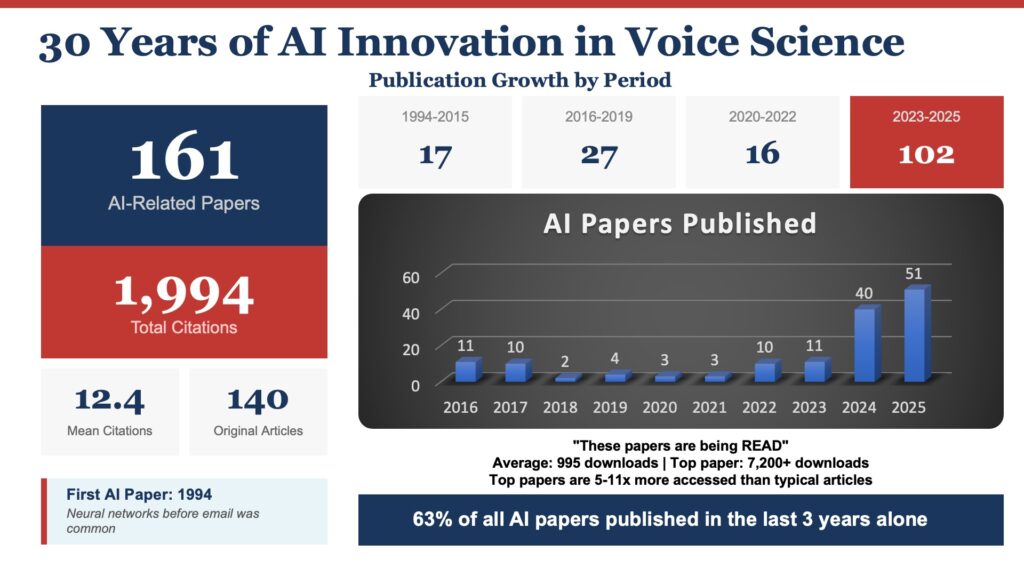
- 1994–2015: 17 papers published over two decades.
- 2016–2019: 27 papers published, showing steady momentum.
- 2020–2022: 16 papers published during the global pandemic disruption.
- 2023–2025: 102 papers published, representing 63 percent of the entire historical archive.
In the year 2025 alone, the journal published 51 AI-related papers—surpassing the total output of the first twenty years combined. This growth curve is not incremental; it is an exponential transformation that mirrors the broader technological leaps in computing power, algorithm architecture, and clinical data accessibility.
Supporting Context & Metrics: Beyond Citations to Real-World Impact
Academic value is frequently measured through citation counts, but in applied medical sciences, the ultimate metric is real-world utility. Voice professionals—clinicians, researchers, and speech-language pathologists—are actively downloading, reading, and integrating these studies into daily practice.
Usage statistics for AI-focused articles in the Journal of Voice demonstrate extraordinary global reach:
- The average AI paper published in the journal has been downloaded nearly 1,000 times.
- The single most-accessed AI paper—a landmark study exploring machine learning applications for COVID-19 detection via voice—has surpassed 7,200 downloads, a figure eleven times the median for standard articles in that issue.
- The two most-cited papers, authored by Fang et al. (deep learning, 193 citations) and Hegde et al. (machine learning survey, 147 citations), have each garnered nearly 5,000 downloads.
These metrics underscore a vital truth: healthcare practitioners are actively hunting for scalable, digital tools to elevate diagnostic precision and therapeutic outcomes.
Landmark Research Reshaping the Field
1. Deep Learning for Voice Pathology Detection
Published in 2019, Fang and colleagues’ study, "Detection of Pathological Voice Using Cepstrum Vectors: A Deep Learning Approach," remains the most-cited AI paper in the journal’s history. It proved definitively that deep neural networks could detect vocal pathologies with phenomenal accuracy using acoustic features imperceptible to the human ear.
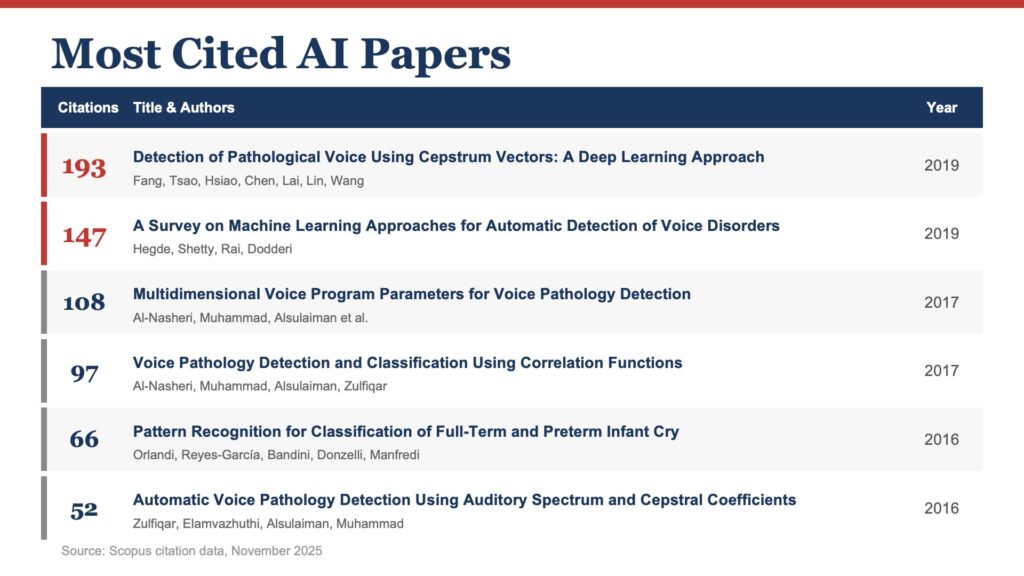
This work was contextualized by Hegde’s comprehensive survey on machine learning for automatic detection of voice disorders, alongside pivotal contributions from Al-Nasheri et al., Chen and Chen, Fujimura, and Cho and Choi. Each successive paper refined neural network architectures—from multi-layer perceptrons to 1D convolutional neural networks and advanced laryngoscopic image classifiers.
2. The Voice as a Digital Biomarker
Perhaps the most paradigm-shifting concept to emerge is the establishment of the human voice as a digital biomarker—a non-invasive, highly accessible window into systemic health.
Groundbreaking research has demonstrated the efficacy of voice analysis in detecting and tracking neurodegenerative conditions such as Parkinson’s disease. For instance, Hemmerling and Wójcik-Pędziwiatr’s 2022 paper on predicting Parkinson’s severity via voice signals has rapidly accrued citations and clinical interest.
Beyond neurology, systematic reviews now explore voice quality as a digital biomarker for mental health conditions, including depression and bipolar disorder. The clinical implications are immense: routine acoustic screening could flag psychological distress early, reducing the immense diagnostic burden on overstretched mental health infrastructures. Similarly, machine learning models analyzing respiratory sounds and vocal tract changes have proven invaluable in respiratory health surveillance.
3. AI Chatbots in Clinical Practice
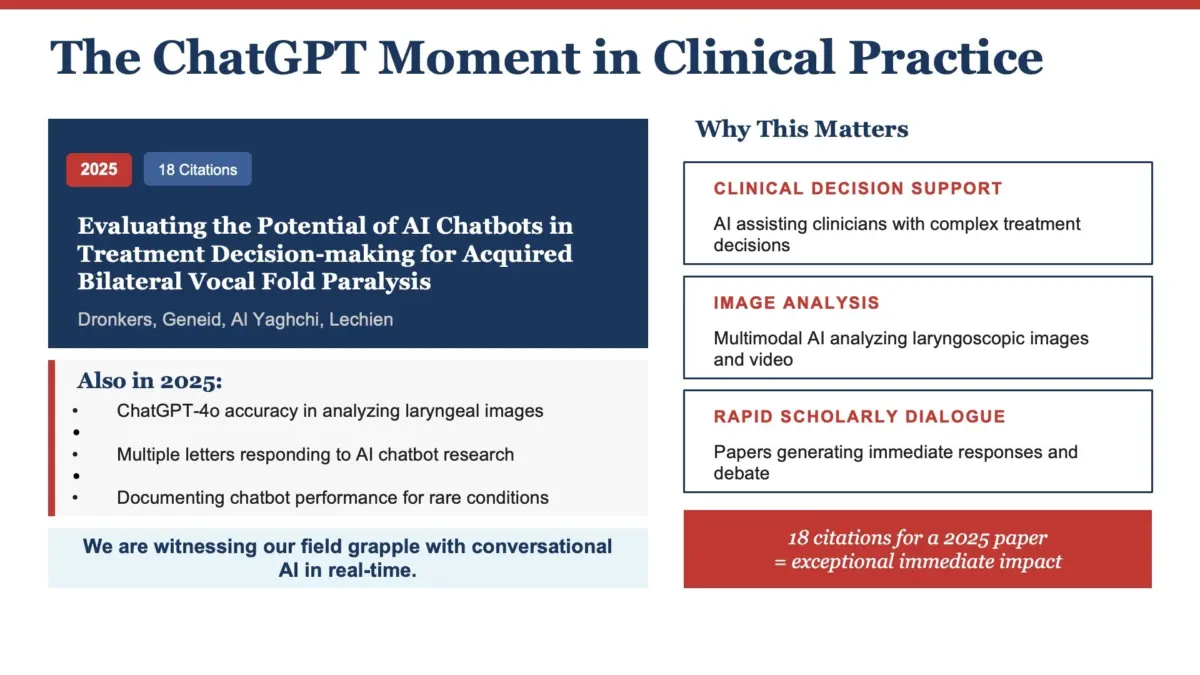
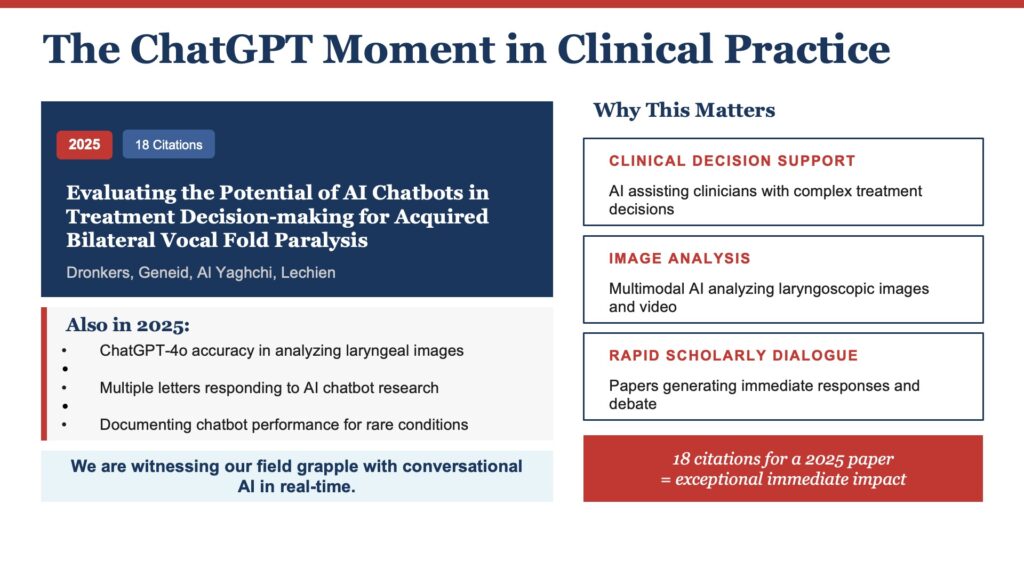
Entering uncharted territory, recent 2025 publications have begun evaluating conversational AI and chatbots in clinical decision-making. A notable paper by Dronkers and colleagues, "Evaluating the Potential of AI Chatbots in Treatment Decision-making for Acquired Bilateral Vocal Fold Paralysis," accumulated 18 citations almost immediately upon release. Accompanied by rigorous reader correspondence assessing tools like ChatGPT-4o in analyzing complex laryngeal imagery, the field is actively and critically debating the role of conversational AI at the clinical bedside.

Official Statements and Expert Perspectives
To navigate this technological frontier, we must listen to the scientists and institutional leaders shaping the discourse. Two preeminent figures offer vital perspectives on complexity, workflow, and ethics.
Dr. Mark Berardi: Managing Complexity and Synthetic Communication
Drawing from a background in physics and computation, Dr. Mark Berardi views artificial intelligence primarily as an indispensable instrument for managing overwhelming systemic complexity.
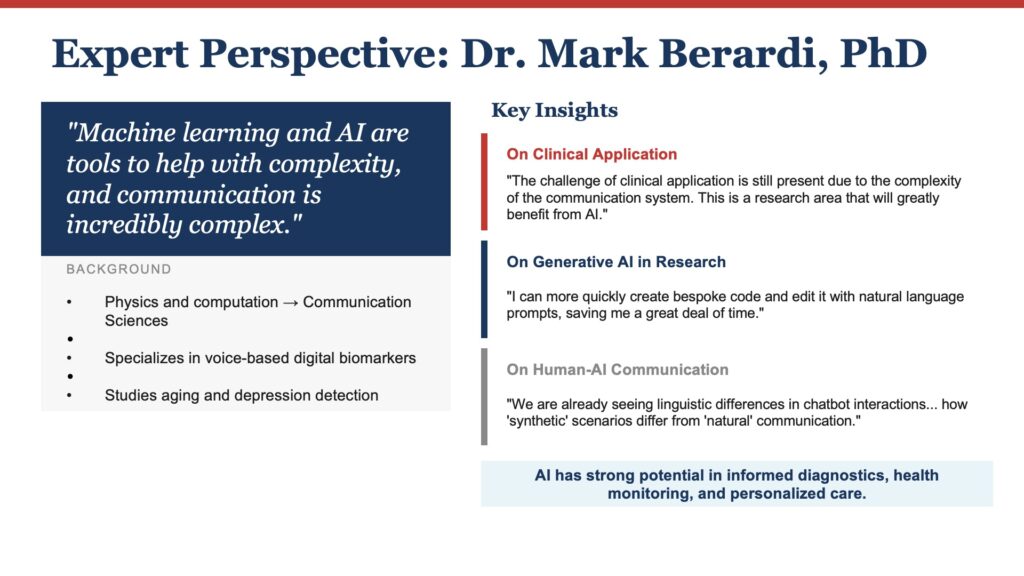
"Machine learning and AI are tools to help with complexity, and communication is incredibly complex in its neurobiological and physiological processes. So I think the application is warranted."
Dr. Berardi’s research centers on voice-based digital biomarkers for aging and depression. "Acquiring speech and voice signals is relatively easy now, and we have shown potential for extracting meaningful health information," he notes. However, he cautions that the fundamental hurdle remains the sheer intricacy of human communication—an arena where machine learning excels.
Regarding generative AI, Dr. Berardi offers a pragmatic evaluation. While generative models may not have rewritten the theoretical rulebook overnight, they have shattered persistent workflow bottlenecks. "I can now quickly create bespoke code and edit it with natural language prompts," he explains.
Fascinatingly, Dr. Berardi’s work also extends into human-AI interaction dynamics. He studies how human linguistic patterns shift when conversing with synthetic agents versus human interlocutors, and how virtual communication mediums (such as Zoom calls) alter vocal delivery compared to face-to-face interaction. The discipline, he suggests, must expand its scope to understand not just the isolated human voice, but the human voice co-adapting with machines.
Dr. Eric Hunter: Embracing Change with Ethical Clarity
Dr. Eric Hunter emphasizes the structural and institutional changes necessitated by AI integration within academia and clinical spaces.
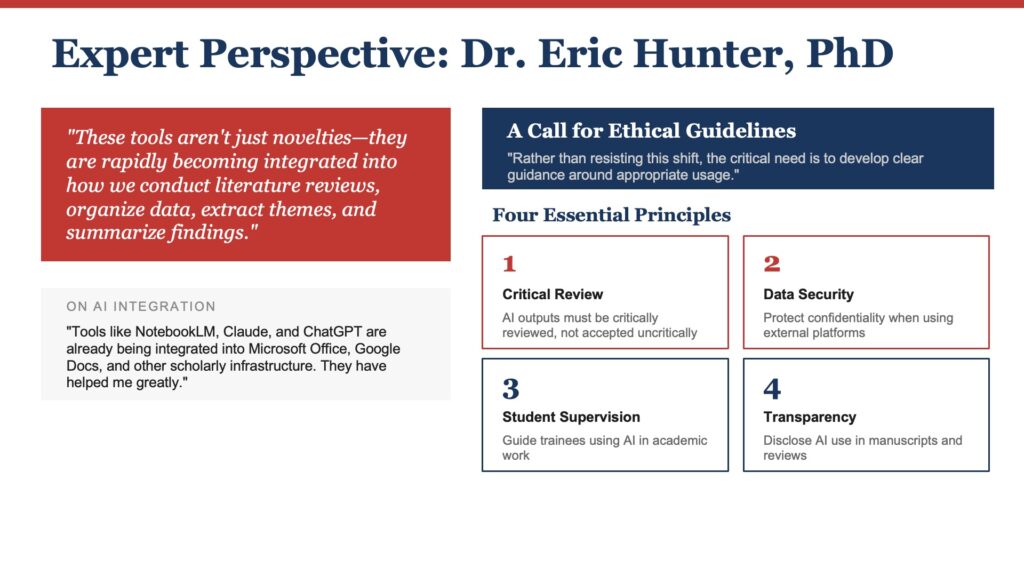
"These tools aren’t just novelties. They are rapidly becoming integrated into how we conduct literature reviews, organize data, extract themes from large bodies of text, and even summarize findings."
Dr. Hunter stresses that large language models and analytical platforms are deeply embedded within modern scholarly infrastructure, from Microsoft Office plugins to advanced manuscript review suites. Consequently, resistance is futile; the imperative is proactive adaptation.
To achieve this, Dr. Hunter advocates for a balanced framework built upon four foundational pillars:
- Uncompromising Transparency: Clear disclosure of AI tool utilization in literature searches, data structuring, and drafting.
- Rigorous Human Oversight: Retaining absolute human accountability for factual accuracy, synthesis, and clinical interpretation.
- Intellectual Integrity: Guarding against algorithmic bias, data hallucination, and intellectual property infringements.
- Collaborative Governance: Establishing institutional guidelines that protect peer-review integrity while encouraging technological efficiency.
"Our field will benefit most," Dr. Hunter concludes, "if we embrace the productivity these tools offer while also building a shared ethical framework for their responsible use."
A Global Research Community
The transformation of voice science is driven by an interconnected, international collective. The Journal of Voice serves as the central hub for researchers spanning every continent. Prolific contributors—such as Jérôme René Lechien, Dimitar Deliyski, Stephanie Zacharias, Ahmed Yousef, Paavo Alku, Leonardo Wanderley Lopes, and Maryam Naghibolhosseini—alongside dozens of global laboratory teams, are actively writing the playbook for computational voice science. This is a unified global movement dedicated to unlocking the diagnostic and therapeutic secrets locked within human speech.
Future Outlook and the Path Forward
As we look toward the horizon, the Journal of Voice and The Voice Foundation remain unyielding in their commitment to publishing rigorous, boundary-pushing research anchored in scientific integrity.
However, realizing this potential requires navigating three clear mandates:
- First, thoughtful engagement: We must treat AI tools as amplifiers of human expertise rather than replacements for clinical judgment. Understanding their operational boundaries is just as critical as harnessing their computing power.
- Second, collective ethics: Dr. Hunter’s call for a unified ethical framework demands cooperative action across academic institutions, medical boards, and publishing houses.
- Third, continuous dissemination: With 161 AI papers published to date, we have only scratched the surface. Every clinician, therapist, and researcher holds observational insights capable of enriching our collective understanding.
An Extraordinary Moment
The human voice has served as our primary instrument of connection, emotional expression, and identity for hundreds of thousands of years. It conveys our innermost psychological states, our physiological health, and our core humanity in ways no other biological signal can replicate.
Now, for the first time in human history, we possess computational tools sophisticated enough to truly decode that complexity. We hold the capacity to extend the reach of expert clinicians, detect pathological changes before symptoms manifest, and democratize access to world-class voice care across the globe.
This is an extraordinary epoch, and the Journal of Voice sits proudly at its center. The coming decade promises discoveries that will alter the landscape of medicine and art alike. We look forward to pioneering that future together.
About the Author
Ian DeNolfo is Executive Director of The Voice Foundation, which publishes the Journal of Voice. A graduate of The Juilliard School and The Curtis Institute of Music, he formerly performed as a leading tenor at major opera houses worldwide before transitioning his extensive artistic background into executive leadership within voice science and medicine.