
LOS ANGELES — The red carpet outside The Music Center’s Dorothy Chandler Pavilion brimmed with palpable energy on a balmy Saturday evening. Operagoers turned out in full force, draped in high fashion to celebrate the official opening night of the LA Opera’s 2026–2027 season. True to the company’s famously relaxed dress code—which playfully proscribes only "meat dresses and swim trunks"—patrons leaned heavily into opulence, filling the outdoor plaza with flashes of camerabulbs, vibrant flamenco dancing, and an air of unmistakable anticipation. Even global pop culture icons partook in the civic ritual; Jennifer Lopez turned heads and flooded feeds, showing off a sheer Dolce & Gabbana coat to her 240 million Instagram followers.
Yet, beneath the glittering exterior and high-society fanfare lay a deeper theatrical curiosity. This opening night was not merely a celebratory return to the performing arts calendar; it marked a definitive pivot for the institution. The company inaugurated its new season with a bold, brand-new Spanish Gothic production of Georges Bizet’s timeless masterpiece, Carmen, while simultaneously welcoming Domingo Hindoyan to the podium for his inaugural performance as the LA Opera’s new Music Director.
For an organization staking its reputation on fresh perspectives and artistic risk-taking, the combination of a high-profile debut and a reimagined classic felt monumental. Audiences arrived ready to surrender to the psychological depths of nineteenth-century Seville. Unfortunately, despite a wealth of thoughtful conceptual choices and standout individual performances, the ambitious production ultimately struggled to find its footing, delivering an evening that was frequently muted where it needed to roar.
Executive Overview
The LA Opera’s 2026–2027 season opener stood as a fascinating study in contrasts: high-fashion external grandeur paired with internal artistic hesitation. The primary engine of this year’s opening gambit was twofold: the arrival of Music Director Domingo Hindoyan and a visually striking, conceptually dense production of Carmen directed by Thaddius Strassberger.
Promising a departure from traditional stagings, Strassberger’s vision sought to peel back the layers of Bizet’s score to explore the darker, eerier corridors of Spanish history. Paired with Hindoyan’s cerebral, analytical approach to the orchestra, the production aimed for a sophisticated, gothic introspection.
However, this intellectualized framing came at a steep price: the loss of theatrical and musical catharsis. Where Carmen demands unbridled passion, fatalistic momentum, and explosive visceral highs, the production often offered polite restraint. Hindoyan’s baton coaxed a clean, balanced sound from the orchestra pit, but systematically sanded down the razor-sharp edges and rhythmic buoyancy that make Bizet’s score universally intoxicating. Similarly, the directorial choices—ranging from distracting digital projections to an overly rigid Spanish Gothic set design—created a sense of aesthetic alienation.
Despite a cast featuring vocally secure and emotionally committed leads, the overarching production felt timid in its execution. It was an evening where individual excellence could not fully rescue a staging that fundamentally mistook quietness for depth.
Detailed Chronology: An Evening of High Expectations and Muted Triumphs
The Prelude and the Podium: Hindoyan’s Measured Debut
Few thematic motifs in the operatic canon carry the instant recognition and psychological weight of the opening bars of Carmen. Serving as the musical gateway to a world governed by fatal allure and bullfighting pageantry, the prelude typically functions as an adrenaline shot for the audience.
Under Hindoyan’s baton, however, the famous theme registered more as atmospheric background music than a visceral welcome. The orchestra initiated the evening with a soft, somewhat muffled attack, lacking the rhythmic bounce and brazen swagger required to establish the opera’s high-stakes environment. This muted temperament characterized much of the evening. Hindoyan deliberately chose not to lean into Bizet’s more grandiose, crowd-pleasing inclinations, opting instead for a transparent, accompaniment-heavy style that prioritized vocal clarity over orchestral thunder.
This conservative strategy had its virtues. By reining in the orchestra, Hindoyan ensured that the singers were rarely forced to battle excessive volume, allowing them space to articulate their interpretations clearly. The night’s musical zenith arrived near the conclusion of Act I, as Carmen maneuvers Don José into releasing her from custody. Here, the orchestra played with an acute, nervous intensity that mirrored the psychological tightrope walk between infatuation and calculated manipulation. Punchy, deliberate accents underscored the toxic chemistry of the characters.
Yet, when left entirely to its own devices—most notably during the instrumental entr’actes between acts—Hindoyan’s orchestra sounded strangely anemic. While this cerebral, subdued approach harmonized neatly with Strassberger’s dour production design, it starved the audience of genuine musical release. It was a cautious debut that proved Hindoyan is a thoughtful, comprehensive conductor, leaving many to wonder how he will fare when paired with more visceral source material.
Scenic Architecture and Digital Distractions
Director Thaddius Strassberger’s conceptual framework positioned the drama in a "Seville suspended between centuries," aiming to evoke a timeless, haunting atmosphere. Visually, the production achieved moments of striking architectural beauty. The set design boasted an impressive sense of physical depth, with Spanish Gothic structures stretching deep into the vast reaches of the Dorothy Chandler Pavilion stage.
Yet, this robust physical foundation was undermined by a curious lack of organic vitality. The ornate decorations and structural elements were arranged with an over-aligned symmetry that clashed violently with the raw, untamed verve of the narrative. Rather than feeling like a lived-in, breathing community, the set functioned more as an architectural blueprint—impressive to look at, yet emotionally inert.
Compounding these spatial issues were Strassberger’s digital projections. Introduced quietly during the prelude via thin, flowing patterns across the backdrops, the projections continued throughout the performance to accent the scenery. While technically competent, they frequently cheapened the physical labor of the set design. Imagery such as curling, detailed smoke grabbed the eye, but acted as a distraction rather than a gateway into the music, failing to forge a cohesive thematic link with the libretto.
Fortunately, costume designer Mattie Ulrich and her team offered a masterclass in visual storytelling, easily earning the status of production MVPs. Through meticulous color palettes, Ulrich successfully bridged uniformity with individual character arcs. Don José’s psychological descent was powerfully charted through his evolving wardrobe, while the chorus was unified in complementary garments that subtly amplified the prevailing sense of civic unease.
A Tale of Two Leads: Chaieb and Guerrero
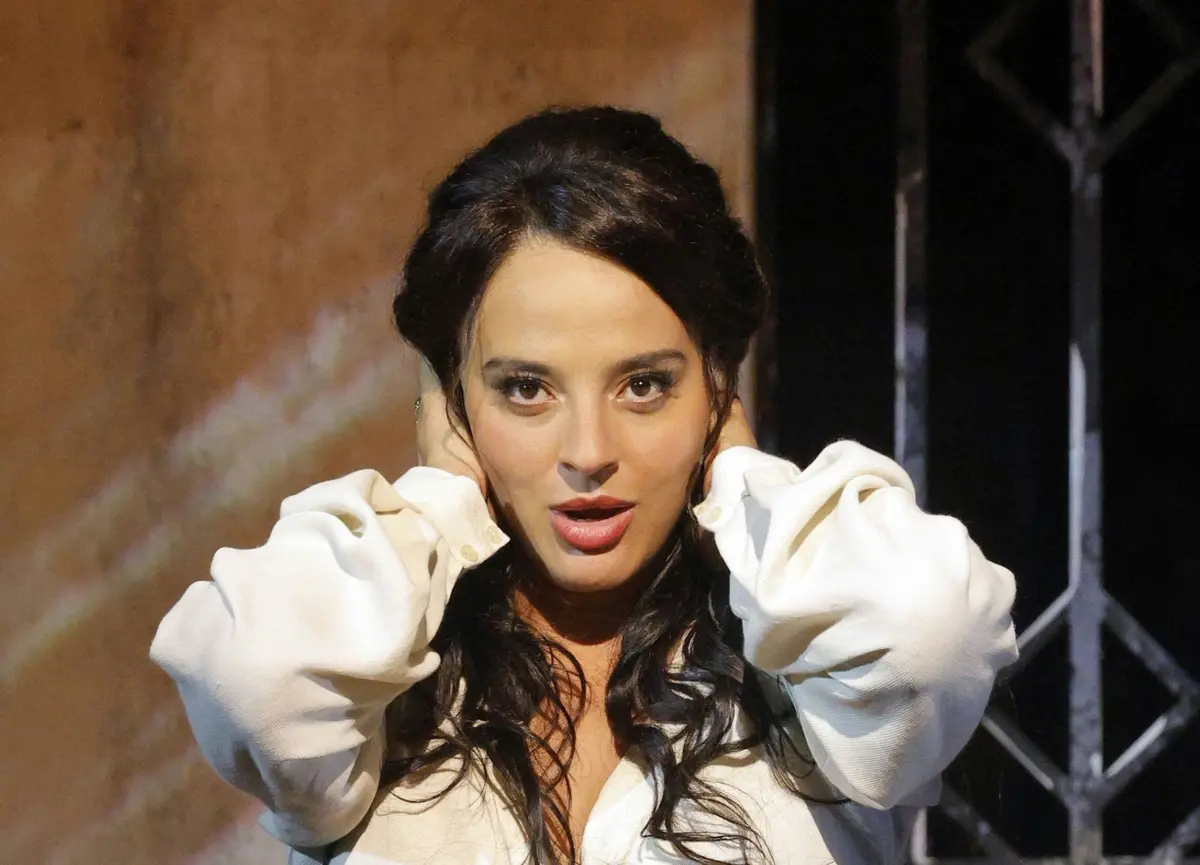
The central tragedy of Carmen hinges upon the combustible, highly volatile dynamic between its title character and her desperate pursuer. Unfortunately, Rihab Chaieb’s portrayal of Carmen leaned heavily away from danger, presenting audiences with a soothing, maternal figure rather than a force of nature. Upon her initial entrance, the townspeople gravitated toward her not with a sense of erratic fascination, but as if she were a comforting matriarch.
This interpretation drained the production of its primary narrative engine. It remained entirely unclear why this particular Carmen commanded such obsessive, life-destroying devotion. Vocally, Chaieb delivered a polished, technically secure performance devoid of blatant errors, but her delivery lacked the necessary theatrical punch. Her rendition of the iconic "L’amour est un oiseau rebelle" (The Habanera) was remarkably devoid of surprise, dynamism, or unpredictability. While Chaieb possessed a gorgeous, soaring midrange that shone during moments of raw vulnerability—particularly when expressing emotional confusion toward Don José—her high notes failed to project with the force required to create dynamic vocal contrast.
Conversely, tenor Joshua Guerrero anchored the production with a deeply humane, empathetic portrayal of Don José. Trading the traditional, verbose buffoonery for a puppy-dog vulnerability, Guerrero presented a man whose tragic trajectory felt utterly plausible until the bitter end. He infused the role with flashes of comedic, crazed determination, charting a heartbreaking descent from clean-cut innocence to complete psychological collapse.
While Guerrero’s vocalism was decidedly milquetoast compared to more swaggering interpretations of the soldier, his sweet, wholesome timbre served his characterization well. His Act I duet with Micaëla, "Parle-moi de ma mère!", stood as a vocal highlight of the evening, sung with a tender sincerity that rendered Don José’s subsequent poor decisions profoundly tragic.
Standout Supporting Performances
While the central pairing offered mixed results, the supporting cast consistently raised the artistic stakes of the evening.
Soprano Kathleen O’Mara delivered arguably the most vocally commanding performance of the night as Micaëla. Possessing a rich, resonant instrument that easily filled the cavernous auditorium, O’Mara struck a masterful balance between innocent devotion and formidable vocal power. Her duets with Guerrero established a genuine emotional baseline, making her anticipated Act III return a welcome dramatic anchor—though her momentum was momentarily interrupted by Strassberger’s perplexing directorial choice to thrust heavy, unexpected imagery of the Virgin Mary into the opera’s final moments.
In the comedic arena, Liam James Karai brought a refreshing, self-aware absurdity to the role of the bullfighter Escamillo. Channeling shades of physical comedy reminiscent of Will Ferrell, Karai leaned into the ridiculous vanity of the character. While his vocal timbre was largely utilitarian, he deployed enough power to cleanly strike the challenging high F4 during “Votre toast, je peux vous le rendre.” Additionally, Karrie Trigg proved to be an absolute delight as Mercédès, injecting genuine comedic timing into her lines—her delivery of a spoken desire to become a wealthy widow extracting spontaneous, delighted laughter from the crowd.
Supporting Context & Metrics: Operational & Artistic Data
To understand the scope of the LA Opera’s season-opening gambit, it is vital to examine the institutional metrics and artistic parameters governing the production:
- Venue: The Dorothy Chandler Pavilion at The Music Center, Los Angeles (Capacity: ~3,155 seats).
- Season Timeline: Opening night occurred on Saturday, kicking off the company’s 2026–2027 performance calendar.
- Digital Footprint: High-society attendance was amplified globally, notably via celebrity engagement such as Jennifer Lopez’s Instagram post reaching an audience of over 240 million followers.
- Leadership Milestone: The production marked the official debut of Domingo Hindoyan as the company’s new Music Director.
- Production Team:
- Composer: Georges Bizet
- Director: Thaddius Strassberger
- Costume Designer: Mattie Ulrich
- Conductor: Domingo Hindoyan
- Principal Cast:
- Carmen: Rihab Chaieb
- Don José: Joshua Guerrero
- Micaëla: Kathleen O’Mara
- Escamillo: Liam James Karai
- Mercédès: Karrie Trigg
Official Statements and Institutional Vision
While formal post-mortem critiques from company executives are rarely published immediately following an opening night, the artistic trajectory of the LA Opera under its new leadership points clearly toward institutional evolution.
In pre-season press releases and program notes, the company repeatedly underscored its commitment to "fresh perspectives" and challenging conventional staging norms. The choice to pair an incoming Music Director known for analytical clarity with a director specializing in historical deconstruction was an intentional, calculated gamble.
The company’s public relations and digital marketing campaign leading up to the gala emphasized accessibility combined with high artistic standards—exemplified by their lighthearted policy regarding evening wear. The messaging consistently reflected an institution eager to shed elitist stereotypes while maintaining the rigorous standard of world-class performing arts.
Future Outlook: Growing into the Tenure
The LA Opera’s new production of Carmen may not have been the unmitigated home run the institution was undoubtedly hoping for. Much like a struggling sports franchise where individual star athletes cannot quite compensate for a lack of collective momentum, the production suffered from a persistent timidity that prevented its innovative ideas from fully catching fire.
Yet, it would be shortsighted to write off the evening as a failure. Thoughtful, courageous decisions were made across every department. The artistic team demonstrated a willingness to break free from comfortable, predictable interpretations of a standard-repertory warhorse. Choosing Carmen as a season opener inherently invites intense scrutiny, as the opera carries centuries of baggage and immovable audience expectations.
As Domingo Hindoyan settles into his tenure as Music Director, and as the creative personnel continue to refine their collaborative chemistry, there is ample reason for optimism. If this opening night proved anything, it is that the LA Opera is willing to take artistic chances. The challenge moving forward will be ensuring that future productions possess not only intellectual depth and visual flair, but the unbridled theatrical heartbeat required to set the operatic world ablaze.