
Executive Overview
The holiday season is intrinsically linked to the evocative, soaring melodies of traditional Christmas carols. Among the rich tapestry of seasonal folk music, few pieces command the serene dignity and historical resonance of "The Holly and the Ivy." This enduring classic has once again taken center stage in the contemporary music education landscape, thanks to a sophisticated yet accessible new piano arrangement by accomplished composer, pianist, and educator Ben Dunnett, LRSM.
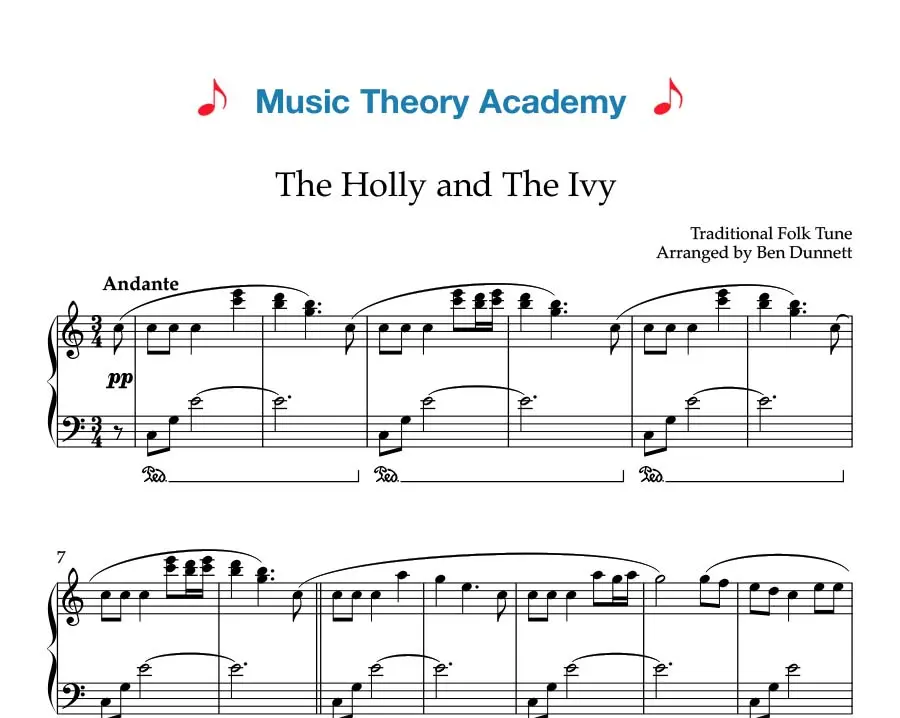
Published through the Music Theory Academy, this newly minted arrangement bridges the gap between historical folk traditions and modern pedagogical practice. Written in the approachable key of C major, the piece appears deceptively simple at first glance. However, a deeper examination reveals a carefully crafted score designed to challenge intermediate pianists through nuanced dynamic control, atmospheric sustain pedal management, and intricate textural contrasts—most notably in the demanding middle section featuring long octave notes paired with alternating quavers in the right hand.
This comprehensive feature explores the anatomy of Dunnett’s arrangement, provides a detailed guide to mastering its technical hurdles, examines the rich historical and lyrical lineage of the carol itself, and offers insights from its creator regarding the philosophy of modern piano pedagogy. Whether you are an educator seeking fresh repertoire for students, a pianist looking to enrich your holiday performance portfolio, or a musicology enthusiast, this analysis unpacks every facet of the publication.
Detailed Chronology: From Ancient Folk Roots to Contemporary Pedagogical Score
To fully appreciate the significance of Ben Dunnett’s modern arrangement, it is essential to trace the historical trajectory of "The Holly and the Ivy" from its obscure folkloric origins to its prominent position in contemporary music curricula.
1. The Pre-Christian and Medieval Origins
The thematic elements of "The Holly and the Ivy" are rooted deeply in pre-Christian winter solstice celebrations. Across ancient Northern Europe, evergreen plants like holly and ivy were venerated for their ability to survive the harshest winters, symbolizing resilience, eternal life, and the eventual return of spring.
As Christianity spread throughout Europe, these pagan symbols were gradually reinterpreted through a Christian lens. Holly, with its thorny leaves, white blossoms, and red berries, became a potent allegory for the Passion of Christ: the white flower represented purity, the red berries symbolized the shedding of blood, and the sharp prickles foreshadowed the crown of thorns.
2. Collection and Publication in the 19th and 20th Centuries
For centuries, the tune and lyrics of "The Holly and the Ivy" existed primarily within the oral traditions of rural folk communities, particularly in Gloucestershire, England. The modern incarnation of the carol was famously captured in 1909 by folk song collector Cecil Sharp, who transcribed a variant sung by Mrs. Clayton of Chipping Campden.
However, it was the inclusion of the carol in the definitive 1928 choral collection The Oxford Book of Carols—edited by Percy Dearmer, Martin Shaw, and Ralph Vaughan Williams—that cemented its place in the global consciousness. Since then, it has become a staple of festival services, concert halls, and community sing-alongs worldwide.
3. The Genesis of the Dunnett Arrangement (November 2022)
Fast forward to November 2022, when seasoned music educator and Music Theory Academy founder Ben Dunnett released his contemporary piano arrangement of the carol. Recognizing a distinct gap in the market for holiday repertoire that is both technically rewarding and approachable for intermediate learners, Dunnett set out to create a version that honors the modal, folk-like simplicity of the original melody while introducing sophisticated pianistic textures.
Released alongside a comprehensive instructional YouTube video and free downloadable sheet music across a four-page score, the arrangement quickly gained traction among students and teachers navigating the autumn-to-winter teaching term.
Supporting Context & Metrics: Analyzing the Score and Technical Demands
Composing or arranging traditional music for the piano requires a delicate balancing act: preserving the nostalgic integrity of the original vocal line while leveraging the unique acoustic and mechanical capabilities of the keyboard. Dunnett’s arrangement achieves this through thoughtful harmonic choices and textural variation.
Harmonic and Structural Breakdown
- Key Signature: C Major. By choosing C major, Dunnett eliminates the cognitive load of reading complex accidentals, allowing students to focus entirely on articulation, phrasing, and hand independence.
- Form: Strophic development, mirroring the verse-and-refrain structure of the traditional lyrics. Each verse introduces subtle variations in accompaniment, preventing musical stagnation.
- The Middle Section Challenge: The technical climax of the piece occurs in the central movements, where the right hand must simultaneously execute sustained octave notes alongside a fluid, alternating pattern of quavers (eighth notes). This requires a high degree of finger independence and hand-weight distribution.
- Pedaling Dynamics: The proper execution of the sustain pedal is paramount in this arrangement. Because the piece relies on open, resonant harmonies, students must master half-pedaling and timely clearing to prevent muddying the counterpoint between the melody and the accompanying inner voices.
Pedagogical Value Matrix
| Pedagogical Focus | Skill Level | Description in Dunnett’s Arrangement |
|---|---|---|
| Key Familiarity | Beginner/Intermediate | Set in C major for maximum readability and physical comfort on the keyboard. |
| Pedal Technique | Intermediate | Demands precise acoustic management through conscious sustain pedal application. |
| Polyphonic Independence | Advanced Intermediate | Requires the right hand to balance sustained octaves against moving quaver figures. |
| Phrasing & Expression | All Levels | Encourages lyrical breathing, mirroring the vocal origins of the folk text. |
Official Statements and Pedagogical Philosophy
Behind every successful pedagogical resource is an educator with a clear vision for student development. Ben Dunnett, LRSM—the mind behind the arrangement—brings over two decades of multifaceted experience as a piano teacher, music examiner, composer, and author to his work at the Music Theory Academy.

In discussing his approach to arranging traditional holiday music, Dunnett emphasizes the importance of balancing technical rigor with emotional engagement. "When students work on music they already know and love, half the motivational battle is won," Dunnett notes in his instructional materials. "However, my goal as a composer and educator is to ensure that familiarity doesn’t breed complacency. By introducing subtle technical hurdles—such as the octave-and-quaver combinations in the middle section—we use a beloved seasonal tune as a Trojan horse to build genuine, transferable pianistic skills."
Dunnett’s philosophy underscores the value of contextual learning: encouraging students to listen to professional recordings, study the structural flow of the score, and internalize the lyrical narrative before translating those elements onto the physical keyboard.
The Holly and the Ivy: Complete Lyrics
To fully capture the mood intended by the arranger, performers are encouraged to sing or silently recite the traditional verses as they play. The interplay between the botanical imagery and the theological narrative provides an essential interpretive guide for shaping the musical phrases:
The holly and the ivy when they are both full grown,
Of all the trees that are in the wood the holly bears the crown.Refrain
The rising of the sun and the running of the deer,
The playing of the merry organ sweet singing in the choir.The holly bears a blossom as white as the lily flower,
And Mary bore sweet Jesus Christ to be our sweet Saviour.The holly bears a berry as red as any blood,
And Mary bore sweet Jesus Christ for to do us sinners good.The holly bears a prickle as sharp as any thorn,
And Mary bore sweet Jesus Christ on Christmas Day in the morn.The holly bears a bark as bitter as any gall,
And Mary bore sweet Jesus Christ for to redeem us all.
Future Outlook: The Evolution of Digital Music Education
The release and subsequent reception of Ben Dunnett’s arrangement of "The Holly and the Ivy" highlight a broader, ongoing transformation in how music education materials are produced, distributed, and consumed.
In the digital era, traditional publishing models are increasingly complemented—and in some cases superseded—by direct-to-educator platforms like the Music Theory Academy. By bundling high-definition video demonstrations, easily downloadable PDF sheet music, and structured theoretical analysis into an accessible online ecosystem, contemporary creators are democratizing access to high-quality pedagogical resources.
Looking ahead, we can expect to see further integration of multimedia tools in instrumental teaching. As platforms evolve, resources that combine visual performance models with traditional notation will likely become the gold standard for independent learners and studio teachers alike. For now, pianists worldwide can unwrap the gift of Dunnett’s meticulous arrangement—bringing centuries of folkloric warmth and modern technical refinement into living rooms and teaching studios every holiday season.