
Executive Overview
For decades, a silent frustration has plagued the classical and contemporary piano communities: the inability to read sheet music fluently. Countless students spend years—often a decade or more—pouring immense time, energy, and financial resources into weekly lessons, only to find themselves stumbling over rudimentary level-one beginner books. This paradox of musical instruction points to a systemic failure within traditional music pedagogy: while sight-reading is universally acknowledged by master educators as one of the most critical musicianship skills, it remains glaringly absent from standard lesson plans and curricula.
Enter Lara Mirinjian, a seasoned pianist, dedicated educator, and passionate sight-reading advocate hailing from larasmusic.com. In a revealing retrospective, Mirinjian exposes her own decade-long struggle with sight-reading fluency and outlines the transformative pedagogical framework that revolutionized her playing and teaching. Supported by academic research—most notably the landmark studies conducted by Dr. Dianne Hardy at Dickinson State University—this article investigates why traditional piano instruction fails to cultivate sight-reading proficiency, explores the core foundational principles required to reverse this trend, and offers a definitive, step-by-step roadmap for pianists of all levels to achieve true fluency.
Detailed Chronology of a Musical Blind Spot
The narrative of sight-reading neglect is not a modern anomaly; it is a generational cycle woven into the very fabric of private music instruction. To understand how a student can spend ten years mastering complex Beethoven sonatas yet remain functionally illiterate at the sheet music page, we must examine the historical trajectory of how piano is taught.
Phase 1: The Rote Memorization Trap (Years 1–3)
In the formative stages of piano education, students are introduced to the instrument through method books that heavily rely on rote learning, finger-number tracking, and rapid memorization. Because beginner pieces are short, students naturally memorize them within a single practice session. Consequently, the eyes cease to function as real-time decoders of musical notation and instead become passive observers while the hands execute muscle memory.
Phase 2: The Widening Gap (Years 4–7)
As repertoire advances into intermediate territory (Sonatinas, Chopin preludes, intermediate Bach inventions), the sheer volume of notes increases exponentially. Students who have never developed genuine sight-reading mechanics begin to rely entirely on brute-force repetition. Learning a new piece becomes a grueling, multi-week archaeological dig rather than a fluid act of literary translation. Frustration mounts, practice sessions become exhausting, and students begin to avoid challenging new music altogether.

Phase 3: The Plateau and Resignation (Years 8–10+)
By the time a student reaches advanced proficiency, the psychological barrier of sight-reading feels insurmountable. Adults and advanced teenagers alike experience severe performance anxiety when handed unfamiliar scores. Many internalize the false belief that sight-reading is an innate, God-given talent rather than a mechanical skill. Mirinjian herself lived this reality: "Over ten years of lessons and I still couldn’t read fluently from a level one book. It was ridiculous. How was this possible?"
Phase 4: The Paradigm Shift
The turning point for Mirinjian occurred only when she encountered a mentor who understood the true mechanics of reading music. By dismantling old habits and rebuilding her approach from the ground up using fundamental principles rather than complex "methods," Mirinjian unlocked exponential growth—a breakthrough she has since weaponized as an educator to transform her own students’ capabilities.
Supporting Context & Metrics: The Academic Reality
Mirinjian’s personal tribulations are not isolated incidents; they are symptomatic of a widespread institutional failure within music education. Empirical research underscores just how neglected sight-reading pedagogy truly is in contemporary studios.
In her definitive study on piano sight-reading instruction at the collegiate and preparatory levels, Dr. Dianne Hardy, Assistant Professor of Music Education and Piano at Dickinson State University, surveyed numerous piano instructors regarding their curriculum design. The findings exposed an alarming systemic vacuum:
- Absence of Pedagogy: The vast majority of surveyed teachers admitted that sight-reading was entirely omitted from their studio programs simply because they were never taught how to teach it.
- Method Book Blind Spots: Instructors heavily relied on commercial method book series that lack structured, progressive sight-reading components, assuming that reading skill would magically materialize as a byproduct of learning standard repertoire.
- The Competency Loop: A significant portion of surveyed educators confessed that they actively avoided teaching sight-reading because they themselves were atrocious sight-readers.
These metrics reveal a vicious cycle: unqualified teachers produce struggling students, who in turn become teachers unequipped to break the cycle.

[Traditional Teaching] ➔ [Omission of Sight-Reading] ➔ [Student Stagnation]
         ▲                                                       │
         └───────────── [Generational Cycle Perpetuated] ────────┘
Furthermore, cognitive hurdles such as Attention Deficit Disorder (ADD), performance anxiety, and the sheer intimidation factor compound the problem. Without a structured, step-by-step framework to bridge the gap between brain processing and physical execution, students remain trapped in a perpetual state of musical illiteracy.
Official Statements & Pedagogical Philosophy
At the heart of Mirinjian’s philosophy—and championed by platforms like SightReadingMastery—is a profound philosophical distinction made famous by Ralph Waldo Emerson:
"As to methods there may be a million and then some, but principles are few. The man who grasps principles can successfully select his own methods. The man who tries methods, ignoring principles, is sure to have trouble."
Applying this wisdom to piano pedagogy reveals why quick-fix method books often fail. Sight-reading is not about memorizing tricks; it is about retraining the brain-eye-hand connection.
The Core Principles of Sight-Reading Fluency
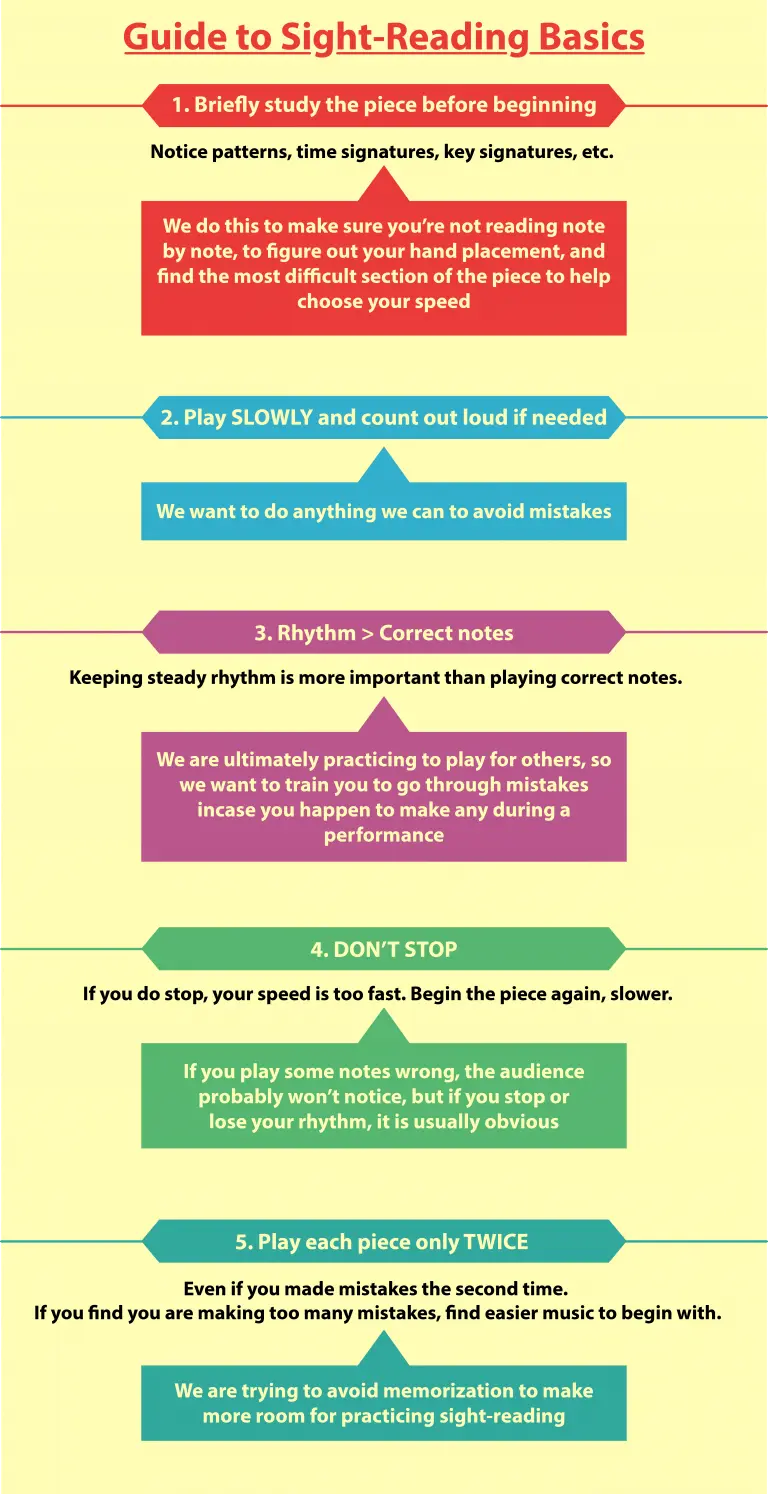
- Embrace Radical Simplicity: Regardless of your current playing level (even if you are an advanced diploma holder), sight-reading practice must begin with the simplest music imaginable—even rudimentary level-one material. This eliminates cognitive overload, allowing the brain to focus exclusively on the mechanics of translation.
- The Two-Read Rule: Each piece of sight-reading material must be read only twice. Lingering on a piece turns sight-reading into standard repertoire learning. Moving on immediately forces the brain to adapt to constantly changing stimuli.
- Rhythm Over Perfection: The pulse is king. Stopping to correct a wrong note destroys the forward momentum essential to true reading fluency.
Putting Principles Into Practice: A Step-by-Step Action Guide
To demonstrate how these principles translate into daily execution, Mirinjian breaks down the exact physical and cognitive process using a simple beginner composition. This protocol can be scaled up for advanced musicians using appropriately matched literature.

The 8-Step Sight-Reading Protocol
- Step 1: Environmental Setup
Place your chosen piece of beginner music on your music stand or digital tablet. We begin with the foundational piece, "Middle C." - Step 2: Pattern Recognition (Score Analysis)
Before playing a single note, scan the score. Look for structural patterns. In a basic exercise, notice if the note repeats, steps up, or leaps. For instance: "We have middle C. We see it repeats twice, goes one step up to D, repeats five times, goes back to C and repeats three times." Simply observe this pattern without touching the keys. - Step 3: Metric Establishment
Identify the time signature and establish the internal pulse. Count out loud consistently (1, 2, 3, 4, 1, 2, 3, 4…). Vocalizing the rhythm anchors the internal metronome. - Step 4: Tactile Positioning
Place your hand calmly on the keys with your thumb resting precisely on Middle C. Ensure relaxed posture and tension-free wrists. - Step 5: Psychological Preparation
Internalize the golden rule: Do not stop. Even if you strike an incorrect note, maintain the forward momentum. If the reading speed requires you to freeze, stop entirely, reset, and restart the piece at an even slower tempo. - Step 6: Execution at Micro-Tempo
Begin playing at an extremely slow pace. Play the note while vocalizing the count: "One… Two… Three… Four…" - Step 7: The Second Pass (The Magic Step)
Upon reaching the end of the piece, immediately play it a second (and final) time. Integrate the lessons learned from the first pass, correct obvious errors on the fly, and maintain a smooth, unbroken pulse. - Step 8: Progressive Advancement
Transition immediately to the next micro-piece (e.g., "Stepping Up and Down") and repeat Step 2 through 7.
Adapting for Advanced Players
If your technical level is advanced, do not bypass this system. Instead, source vast quantities of very easy music and challenge yourself to master microscopic details: nuances in phrasing, micro-dynamics, articulation, and flawless tonal balance. As Mirinjian notes, this process fills in the structural "cracks" left behind by years of traditional, repertoire-only training.
Future Outlook: The Evolution of Piano Pedagogy
As the global music education community increasingly embraces evidence-based methodologies, the landscape of piano instruction is undergoing a quiet revolution. Digital learning tools, specialized sight-reading curricula, and online repositories are democratizing access to foundational training that was once locked behind the doors of elite conservatories.
The future of piano teaching belongs to educators who bridge the gap between technical virtuosity and fundamental literacy. By stripping away ego—acknowledging that playing complex Chopin does not equate to strong sight-reading skills—and committing to daily, principled micro-practice, pianists of all ages can dismantle their reading barriers.
As Lara Mirinjian proves through her journey from frustration to mastery, the keys to unlocking musical fluency are already within your reach. All it takes is the courage to start at the very beginning, embrace the simplicity of the principles, and never stop moving forward.