
Executive Overview
The landscape of jazz has always been defined by a constant tension between historical preservation and radical reinvention. In the relentless evolution of this art form, certain foundational epochs and contemporary explorations serve as vital markers of where the music has been and where it is heading.
This review and analysis examines three distinctive releases that span a century of sonic innovation: Mosaic Records’ monumental six-CD box set, The Complete Louis Armstrong In New York 1924-1925; violinist Jason Kao Hwang Human Rites Trio’s forward-thinking release, Second Life; and vocalist and multi-disciplinary artist Judi Silvano’s delicate, chamber-leaning collaboration with Garden Winds, First Flight.
Together, these works offer a sweeping panorama of jazz history. They capture the exact moment Louis Armstrong transformed the vocabulary of American music during his pivotal, foundational residency in New York, while also showcasing how contemporary visionaries like Hwang and Silvano continue to stretch the boundaries of improvisation, cultural identity, and sonic textures today.
Through painstaking archival restoration and daring modern compositions, these releases underscore the enduring vitality of jazz as a medium of profound personal and collective expression.
Detailed Chronology
Louis Armstrong in New York (1924–1925): The Genesis of Modern Jazz
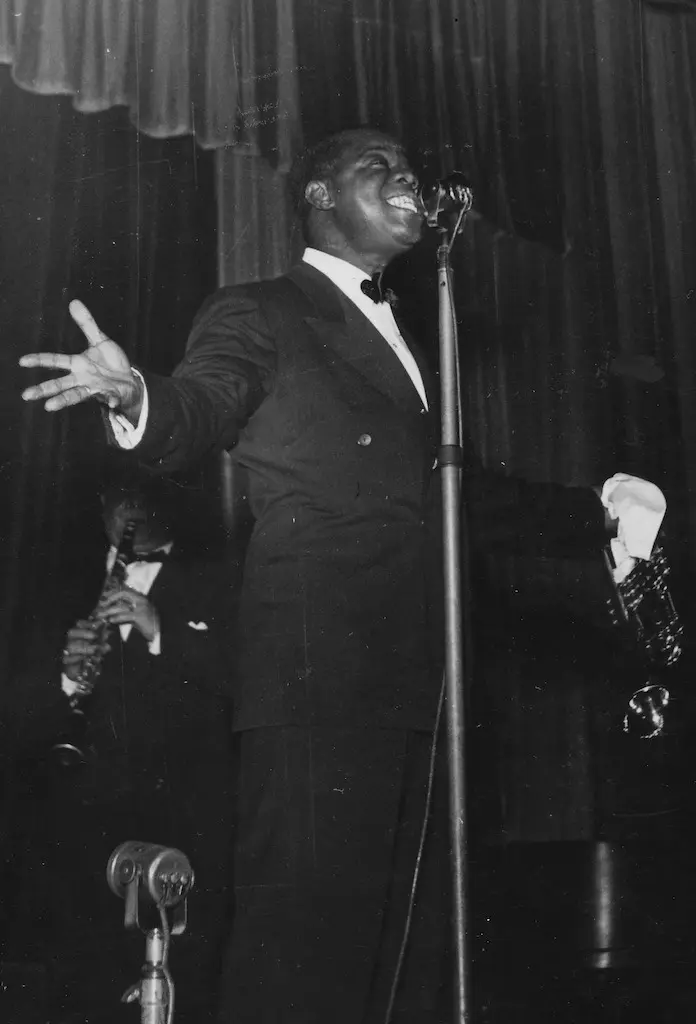
The trajectory of American music shifted irrevocably in October 1924 when a young, fiercely talented cornetist named Louis Armstrong arrived in New York City. Invited by Fletcher Henderson—then leader of the most significant Black dance orchestra of the era—Armstrong stepped onto a national stage that was primed for his unique genius. Yet, this initial crucible was not without its stylistic friction.
As historical sleeve notes observe, Armstrong’s revolutionary approach in 1924 still bore traces of the novelty style popular in early jazz and vaudeville. The Fletcher Henderson Orchestra of that period often leaned toward a stiff, polite aesthetic. Early sides, such as "Manda," featured jaunty yet rigid arrangements complete with clarinet choirs and hesitant solos—even from a 19-year-old saxophonist named Coleman Hawkins, who was yet to discover the fluid phrasing that would later make him a titan of the tenor sax.
However, the infusion of Armstrong’s organic, deeply rhythmic jazz sensibility gradually loosened the rigid joints of the Henderson ensemble. Over the course of a single year, the orchestra transformed, culminating in the recording of Sugar Foot Stomp (a brilliant reinterpretation of Joe "King" Oliver’s Dippermouth Blues), which stands as a crown jewel of this collection. On this track, an early, soaring Armstrong solo cuts through the arrangement before arranger Don Redman brings the band down, setting up a thunderous release driven by Ralph Escudero’s relentless four-four time on the tuba.
Simultaneously, Armstrong’s work outside the Henderson orchestra revealed the true depth of his artistry, serving as a direct precursor to his legendary 1925 Hot Five recordings. His collaborations with Clarence Williams’ Blue Five—supporting vocalists like Virginia Liston—and his work with the Red Onion Jazz Babies alongside soprano saxophonist Sidney Bechet showcased an astonishing mastery of space, tone, and harmonic invention.
On Cake Walking Babies, Armstrong, Bechet, and trombonist Charlie Irvis united their three horns in a striking three-note harmonic opening, propelled by Bechet’s florid, passionate runs. Even more forward-looking is the 1925 recording of Of All The Wrongs You’ve Done To Me, on which Armstrong unspools a shockingly modern solo built entirely of striking two- and three-note fragments, suspended dynamically over relentless stop-time backing.
The chronological sweep of this era also includes five classic tracks recorded with blues matriarch Bessie Smith and pianist/harmonium player Fred Longshaw, followed by six later sides featuring the addition of trombonist Charlie Green. Notably, their rendition of St. Louis Blues is performed at such a deliberate, stately tempo that the sprawling composition is pared down to its structural essentials: two 12-bar choruses, a 16-bar minor-keyed habanera, and a final 12-bar chorus. On these sides, Armstrong trades aggressive soloing for a deeply communicative, conversational duet style with Smith, proving that his genius lay as much in restraint and support as it did in pyrotechnic lead playing.
The Contemporary Avant-Garde: Jason Kao Hwang Human Rites Trio and Judi Silvano’s Garden Winds
Fast-forwarding nearly a century brings us to the contemporary explorations of violinist Jason Kao Hwang and vocalist Judi Silvano, both of whom draw upon deep historical lineages while pushing firmly into uncharted sonic territory.
Jason Kao Hwang’s Second Life represents the latest chapter in a two-decade collaboration with bassist Ken Filiano and percussionist Andrew Drury. Building upon their critically acclaimed 2020 self-titled debut, the Human Rites Trio functions as an interconnected organism capable of vast dynamic range. Opening with Galaxies Twist Under Before It, the album establishes an infectious, swinging groove punctuated by Hwang’s passionate, high-intensity violin solo.
The suite-like nature of the recording continues with pieces like What To Keep, What To Let Go, which dissolves conventional boundaries by shifting fluidly from a rubato dirge into driving, interconnected tempos. Throughout the session, Drury expands the traditional percussion palette by incorporating gongs, aluminum pots, stainless steel bowls, a Tibetan prayer bowl, bells, shells, and even a sink faucet escutcheon. The resulting string-and-metal sonorities create a uniquely dry, spacious, and intellectually stimulating atmosphere.
Meanwhile, Judi Silvano’s First Flight—recorded alongside flutist Haruna Fukazawa and bassoonist Claire de Brunner—explores the intersection of contemporary composition, chamber music, and vocal improvisation. Silvano, whose illustrious career has bridged dance, choreography, painting, and vocal performance, utilizes her "vocalese" approach on pieces like Flower Talk.
Rather than relying on traditional lyrical storytelling or standard jazz scatting, Silvano treats her voice as an instrumental fourth voice, employing improvised syllables that blur the line between free improvisation and contemporary classical composition. Supported by Fukazawa’s classically trained flute lines and de Brunner’s idiosyncratic bassoon stylings (born from her roots in the post-punk band 101 Crustaceans), the trio crafts an intimate, conversational chamber-jazz experience that defies easy categorization.
Supporting Context & Metrics
Archival Restoration Metrics: Mosaic Records’ 6-CD Set
The technical achievement behind Mosaic Records’ The Complete Louis Armstrong In New York 1924-1925 (Mosaic #286) cannot be overstated. Transferring, cleaning, and mastering audio from fragile, century-old 78 RPM shellac discs presents formidable engineering challenges.
- Source Material: Sourced directly from rare, original 78 RPM pressings held by top-tier collectors and archives.
- Format: Comprehensive 6-CD box set, representing the definitive audio portrait of Armstrong’s foundational New York years.
- Sonic Enhancement: Advanced digital restoration techniques successfully minimized surface noise, wow, and flutter while preserving the upper-register transients of Armstrong’s cornet, resulting in the cleanest, most vivid presentation these historic sides have ever received.
- Scholarly Contribution: The physical package includes extensive session notes and historical essays authored by jazz historians David Sager and Ricky Riccardi, the latter of whom serves as Director of Research Collections for the Louis Armstrong House Museum and is the author of a definitive multi-volume biography on Armstrong.
Modern Release Metrics
-
Jason Kao Hwang Human Rites Trio – Second Life
- Label: True Sound Recordings (TS07)
- Personnel: Jason Kao Hwang (violin), Ken Filiano (bass), Andrew Drury (drums, extended percussion).
- Recording Location & Dates: Recorded in Paramus, New Jersey, March 18–19, 2024.
- Track Count & Duration: Four extended compositions (Galaxies Twist Under Before It, What To Keep, What To Let Go, Second Life, Ricochet) totaling approximately 55 minutes and 40 seconds.
-
Judi Silvano’s Garden Winds – First Flight
- Label: JSL Records (#011)
- Personnel: Judi Silvano (vocals, percussion), Haruna Fukazawa (flute), Claire de Brunner (bassoon).
- Recording Location & Date: Recorded in New York City, July 1, 2024.
- Track Count & Duration: Nine concise movements (First Flight, Gathering, Flock Of Three, Stravinsky, Passing Through, This Morning, On The Deck, Beaverbrook, Coming Together) totaling 33 minutes and 34 seconds.
Official Statements and Archival Insights
The cultural weight of these releases is underscored by the commentary of scholars, archivists, and the artists themselves.
Reflecting on the structural complexity of Armstrong’s 1925 work with Clarence Williams’ Red Onion Jazz Babies, noted jazz scholar Lewis Porter observed of Armstrong’s solo on Of All The Wrongs You’ve Done To Me:
"It is entirely composed of two- or three-note fragments which he places in constantly surprising relationships to the incessant stop-time backing."
This analytical perspective highlights how Armstrong was already dismantling predictable harmonic phrasing years before his landmark Hot Five recordings, establishing a modernist rhythmic vocabulary that anticipated bebop by two decades.
Contextualizing the historical environment into which Armstrong stepped, archival sleeve notes from the Mosaic release note:
"In 1924 his style still bore traces of the novelty style… [yet] by working organically rather than applying jazz elements superficially, the ensemble found its true, swinging voice."
In the contemporary sphere, Jason Kao Hwang’s body of work continues to interrogate the intersections of identity, heritage, and musical form. Having collaborated with avant-garde luminaries such as Anthony Braxton, Fred Ho, and Bill Dixon since the late 1970s, Hwang has consistently used his platform to champion Asian-American creative improvised music.
Reflecting on his multi-disciplinary output—which includes chamber operas like The Floating Box: A Story In Chinatown and extended suites like Burning Bridge—Hwang views his music as a living bridge between his classical training, his Chinese-American heritage (stemming from his parents’ post-WWII emigration from Hunan to the American Midwest), and the spontaneous traditions of free jazz.
Future Outlook
As the recorded jazz canon continues to expand backward into the archives and forward into uncharted avant-garde territory, the releases highlighted here point toward an encouraging future for the genre.
The meticulous restoration of Louis Armstrong’s 1924–1925 recordings by Mosaic Records establishes a new benchmark for archival preservation. By utilizing advanced audio restoration techniques on fragile 78 RPM artifacts, contemporary labels are proving that early jazz history can be experienced with unprecedented clarity, ensuring that future generations of musicians and listeners can study the foundational architecture of swing and improvisation with pristine fidelity.
Simultaneously, the vital output of artists like Jason Kao Hwang and Judi Silvano demonstrates that jazz remains a relentlessly expansive vehicle for personal narrative and cross-genre experimentation. Whether through Hwang’s integration of extended metal percussion with microtonal string voicings or Silvano’s pioneering exploration of vocalese as an untexted chamber instrument, contemporary improvisers are actively dismantling genre walls.
The future of jazz does not lie in a single, codified direction; rather, it thrives in the dynamic dialogue between historical reverence and fearless sonic inquiry—proving that a century after Louis Armstrong first electrified New York City, the music’s capacity to surprise, challenge, and elevate the human spirit remains entirely undiminished.