
Executive Overview
The Metropolitan Opera is set to captivate audiences once again with one of the crown jewels of the bel canto repertoire: Gaetano Donizetti’s dramatic masterwork, Maria Stuarda. Opening on December 6, this high-stakes revival brings a powerhouse cast, a celebrated directorial vision, and deep historical resonance back to the famed stage at Lincoln Center. Running through December 22, the limited six-performance run centers on the volatile political and personal rivalry between two of history’s most formidable monarchs: Mary, Queen of Scots, and Queen Elizabeth I of England.
At the helm of this vocal tour de force is acclaimed soprano Lisette Oropesa, who steps into the title role following a wave of international triumphs. Oropesa’s portrayal of the doomed Scottish queen has already earned ecstatic notices across Europe, most notably at Madrid’s Teatro Real in 2024 and the prestigious Salzburg Festival in 2025. Sharing the stage with her is soprano Angela Meade as her fierce adversary, Queen Elisabetta (Elizabeth I). This pairing of two of today’s leading operatic sopranos promises vocal fireworks and profound dramatic intensity, testing the acoustic and emotional limits of the Met’s vast auditorium.
The stellar vocal ensemble also features tenor René Barbera as the Earl of Leicester, baritone Mihai Damian as Lord Cecil, and bass Adolfo Corrado as the Earl of Talbot. Guiding the orchestra and chorus through Donizetti’s intricate, emotionally lacerating score is maestro Enrique Mazzola. He will conduct all six performances of David McVicar’s grand, historically sweeping production, which has remained a fan favorite since its blockbuster New Year’s Eve premiere in 2012.
For opera lovers unable to make the trip to Manhattan, the production’s reach extends far beyond the physical walls of the opera house. The performances on December 12 and December 22 will be broadcast live via the SiriusXM app, while the December 12 performance will additionally reach a global listenership through the Robert K. Johnson Foundation–Metropolitan Opera International Radio Network. As one of the marquee events of the Met’s winter calendar, this revival of Maria Stuarda offers a masterclass in vocal athletics, theatrical pageantry, and enduring historical drama.
Detailed Chronology: From Creation to the Met’s Grand Revival
To fully appreciate the significance of the Metropolitan Opera’s upcoming revival, one must examine both the tumultuous genesis of Donizetti’s opera and the timeline of the current production at Lincoln Center.
The Birth and Suppression of a Masterpiece
Composed in 1834 to an Italian libretto by Giuseppe Bardari, Maria Stuarda had an infamously rocky path to the stage. Based loosely on Friedrich Schiller’s play Mary Stuart, the opera focuses on the fictionalized confrontation and historical execution of Mary, Queen of Scots, under the orders of her cousin, Queen Elizabeth I of England.
Censorship plagued the opera from its very inception. During rehearsals in Naples, the reigning Bourbon monarch took umbrage at the depiction of a sovereign being put to death on stage, as well as the insults hurled between the two queens during their dramatic confrontation (most famously, Mary’s declaration that Elizabeth is a "bastard vile"). The authorities forced Donizetti and his librettist to alter the text, change the plot, and eventually banned the opera entirely just days before its scheduled premiere.
Undeterred, Donizetti quickly adapted the music to a completely different libretto titled Buondelmonte, which bombed. Maria Stuarda itself languished in obscurity for more than a century. It was not until the mid-20th century—spearheaded by the bel canto revival championed by legends like Leyla Gencer, Montserrat Caballé, and later Beverly Sills and Joan Sutherland—that the opera reclaimed its rightful place in the international canon. Today, it is recognized as a psychological and vocal thriller that demands absolute mastery of Donizetti’s ornamentation, phrasing, and dramatic nuance.
The McVicar Production: A Decade of Tudor Splendor
When stage director David McVicar unveiled his production of Maria Stuarda on New Year’s Eve in 2012 at the Metropolitan Opera, it marked a major milestone in the house’s ongoing exploration of Donizetti’s Tudor trilogy (which also includes Anna Bolena and Roberto Devereux).
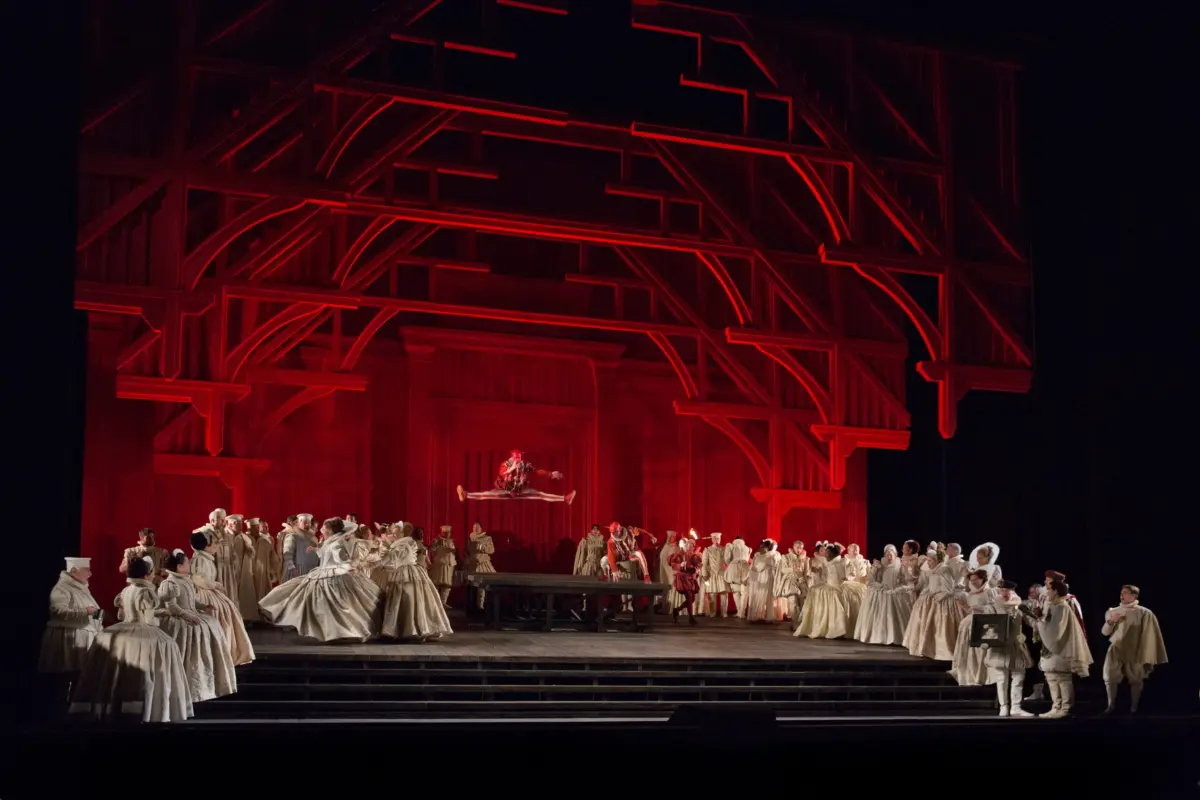
McVicar’s vision deliberately avoids minimalist updates, opting instead for a grand, historically grounded aesthetic. The production utilizes massive, shifting wooden paneling, heavy velvet drapery, candlelit chandeliers, and sumptuously detailed Tudor costumes that instantly transport the audience to the opulent yet claustrophobic courts of 16th-century England. The visual contrast between Elizabeth’s court—drenched in stark, blinding whites and golds—and Mary’s grim, shadowed prison cell establishes a clear ideological and emotional divide long before a single note is sung.
Over the past decade, this production has proven remarkably durable, serving as a reliable and visually stunning vehicle for successive generations of dramatic sopranos. The upcoming December 2024–2025 revival cycle marks another chapter in the life of McVicar’s staging, proving that traditional, high-production-value opera continues to resonate powerfully with modern audiences.
Supporting Context & Metrics: The Artistry and Mechanics of the Revival
Mounting a production of Maria Stuarda of this caliber requires an extraordinary convergence of vocal talent, orchestral precision, and logistical planning.
The Vocal Heavyweights
The core of Maria Stuarda’s appeal lies in the vocal sparring match between its two female leads. In the title role, Lisette Oropesa brings a reputation for pristine vocal technique, crystalline high notes, and deep emotional intelligence. Oropesa’s recent triumphs in the role—most notably at Madrid’s Teatro Real in 2024, where critics praised her effortless agility and heartbreaking pathos, and her subsequent triumph at the Salzburg Festival in 2025—have cemented her status as one of the definitive Mary Stuards of her generation. Her ability to navigate Donizetti’s soaring cantilenas while maintaining a fragile, sympathetic vulnerability makes her performance a must-see event.
Opposite her stands soprano Angela Meade as Queen Elisabetta. Meade, renowned for her massive, soaring voice and formidable command of bel canto pyrotechnics, brings a commanding stage presence to the paranoid, conflicted English monarch. The vocal contrast between Oropesa’s silvery, agile soprano and Meade’s rich, steel-cored instrument creates a magnificent dialectic—a musical manifestation of the immovable object meeting the unstoppable force.
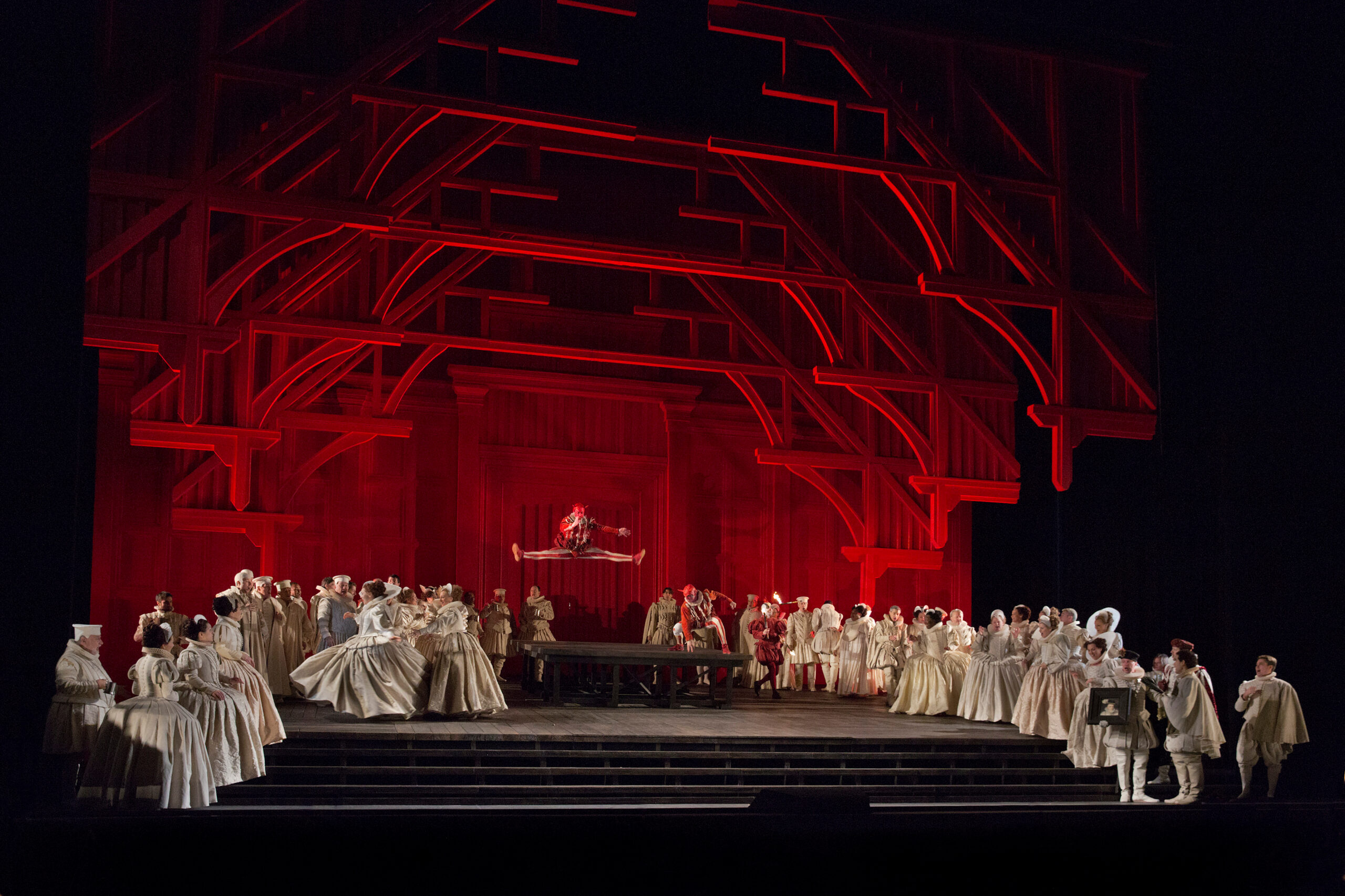
They are supported by a formidable supporting cast. Tenor René Barbera lends his bright, ringing tone and effortless high register to the role of Robert Dudley, the Earl of Leicester, who is caught in a dangerous romantic and political triangle between the two queens. Baritone Mihai Damian takes on the calculating statesman Lord Cecil, while bass Adolfo Corrado provides a stabilizing, noble anchor as the Earl of Talbot, Mary’s steadfast confidant.
Maestro Enrique Mazzola and the Pit
In the orchestra pit, Enrique Mazzola commands the forces of the Metropolitan Opera Orchestra. Mazzola, a specialist in Italian repertoire, is celebrated for his propulsive rhythms, sensitive phrasing, and profound understanding of the delicate balance required in bel canto works. Donizetti’s orchestration must never drown out the singers; rather, it must cushion their vocal lines while driving the dramatic tension forward. Mazzola’s leadership ensures that every nuance of the score—from the jaunty, courtly dances to the crushing despair of the final judgment scene—is delivered with maximum dramatic impact.
Broadcast Metrics and Global Reach
The Metropolitan Opera’s commitment to expanding its audience beyond the physical boundaries of Lincoln Center remains a cornerstone of its modern identity. The decision to broadcast the December 12 and December 22 performances via the SiriusXM app ensures that hundreds of thousands of subscribers across North America can experience the production in real-time high fidelity. Furthermore, the December 12 global transmission via the Robert K. Johnson Foundation–Metropolitan Opera International Radio Network connects international listeners to the live energy of a New York opera night, reinforcing the Met’s status as a global cultural institution.
Official Statements and Artistic Vision
While specific press releases for the upcoming December run emphasize the star power of the cast, previous insights from director David McVicar and the principal artists offer a window into the creative philosophy driving this revival.
David McVicar has frequently spoken about his fascination with the Tudor period, viewing these historical dramas not merely as costume pageants, but as intense psychological studies of power, isolation, and gender politics in a patriarchal world. In past commentary regarding his Met Tudor trilogy, McVicar noted:
"These pieces are essentially political thrillers disguised as operas. You have absolute monarchs living under the constant threat of assassination, betrayal, and instability. The glamour of the court is a thin veneer masking a brutal struggle for survival. When you strip away the velvet and gold, you find human beings eaten away by jealousy, fear, and loneliness."
Lisette Oropesa, reflecting on her journey with the role of Mary Stuart, has highlighted the immense physical and emotional stamina required to bring the Scottish queen to life. Speaking on the character’s famous final prayer and execution scene, Oropesa remarked:
"Mary Stuarda is a character who begins her journey stripped of her crown and ends it stripped of her life, yet somehow she finds her ultimate dignity and spiritual freedom on the scaffold. Singing this role demands complete vulnerability. You have to let go of all vanity and allow the tragedy of the music to completely consume you."
Enrique Mazzola has similarly emphasized the theatrical vitality of Donizetti’s score, arguing that bel canto is frequently misunderstood as mere vocal ornamentation when it is, in fact, an engine of profound dramatic truth. "Donizetti does not write decorative notes just for the sake of showing off," Mazzola has observed. "Every trill, every coloratura run, every sudden shift from major to minor is a heartbeat, a sob, or a declaration of war. Our job in the pit and on the stage is to make those musical choices feel as urgent and dangerous today as they did in the 19th century."
Future Outlook: The Evolution of Bel Canto at the Met
The return of Maria Stuarda to the Metropolitan Opera stage underscores a broader programming trend at the institution under General Manager Peter Gelb: a balanced commitment to contemporary opera alongside a passionate defense of the core bel canto and 19th-century repertoire.
As the opera world navigates shifting audience demographics and economic realities, productions that combine star power, high-end traditional design, and timeless dramatic themes continue to serve as vital anchors for the Met. The pairing of Lisette Oropesa and Angela Meade represents a gold standard in modern vocal casting, proving that the tradition of the great operatic "diva duel" remains intensely alive and capable of selling out the house.
Looking ahead, the success of this six-performance run of Maria Stuarda will likely influence future planning for similar revivals of Donizetti, Bellini, and Rossini at Lincoln Center. It demonstrates that when a house matches world-class vocalists with a cohesive, time-tested production, the result is an artistic triumph that bridges the gap between historical reverence and contemporary theatrical immediacy.
As the house lights dim on December 6, and the heavy Tudor curtains part to reveal the chilling splendor of McVicar’s vision, audiences in New York and across the globe via radio and streaming will once again bear witness to the timeless potency of Donizetti’s tragic masterwork—a night at the opera where history, music, and raw human emotion collide with unforgettable force.