
By Ian DeNolfo, Executive Director of The Voice Foundation
Executive Overview
Voice science stands at a definitive, historic inflection point. Today, artificial intelligence (AI) and machine learning (ML) are fundamentally reshaping how clinicians care for patients, how researchers analyze complex biological data, and how scientists conceptualize the human voice itself. Far from being a recent technological fad, AI has deep, foundational roots within the discipline of voice science—roots that trace back more than three decades through the pages of the field’s premier peer-reviewed publication, the Journal of Voice.
Founded in 1969 by Dr. Wilbur James Gould, The Voice Foundation has spent over half a century bridging the traditionally disparate worlds of art and science, clinic and stage. Guided since 1989 by internationally renowned otolaryngologist, singer, and conductor Dr. Robert Thayer Sataloff, the Foundation
has served as the global epicenter for interdisciplinary voice research, education, and clinical advancement.
In recent years, the intersection of artificial intelligence and voice research has undergone an exponential acceleration. Out of 161 AI-focused papers published in the Journal of Voice over its history, a staggering 63%—totaling 102 papers—have been published in just the last three years (2023–2025). In 2025 alone, the journal published 51 AI-related studies, surpassing the output of the field’s entire first two decades combined. This article examines the historical trajectory of AI in voice science, explores the real-world impact of foundational research, highlights the emergence of the voice as a digital biomarker for systemic health, and outlines the urgent need for ethical frameworks as conversational AI and machine learning become permanent fixtures in academic and clinical medicine.

A Legacy of Interdisciplinary Innovation
To understand the magnitude of the current technological revolution in voice science, one must appreciate the history of the institution driving it. In 1969, when interdisciplinary care for the human voice was virtually nonexistent, Dr. Wilbur James Gould established The Voice Foundation in New York City. Dr. Gould possessed the extraordinary foresight to recognize that optimizing care for professional voice users—singers, actors, politicians, and teachers—required a collaborative approach uniting physicians, scientists, speech-language pathologists, performing artists, and vocal pedagogues.
By 1972, the Foundation inaugurated its Annual Symposium: Care of the Professional Voice, followed a year later by its premier gala (later known as the Voices of Summer). These gatherings transformed the professional landscape, creating a permanent forum where clinical medicine and artistic performance could inform one another.
In 1989, leadership of The Voice Foundation transitioned to Dr. Robert Thayer Sataloff. Under Dr. Sataloff’s visionary stewardship—marked by more than 1,200 publications and 79 authored or edited textbooks—the Foundation relocated to Philadelphia. Today, its annual symposium draws hundreds of medical specialists, scientists, academics, and performers from across the globe. Alongside this international conference, the Foundation publishes the Journal of Voice, the undisputed premier peer-reviewed journal dedicated exclusively to voice science and medicine. It is within the pages of this journal that the marriage between computational science and vocal physiology has quietly matured over the last thirty-one years.
Detailed Chronology: 30 Years of AI Research in Voice Science
The integration of artificial intelligence into voice science predates the modern public awareness of AI by decades. While much of the world was first introduced to consumer-facing neural networks and large language models in the 2020s, the Journal of Voice was pioneering computational voice analysis as early as 1994.
The Pioneers: 1994–2015
In 1994—the exact same year the World Wide Web was emerging into public consciousness and long before most professionals had ever sent an electronic mail—Rihkanen and colleagues published a landmark paper titled "Spectral Pattern Recognition of Improved Voice Quality." This pioneering study utilized early artificial neural networks to analyze acoustic voice signals.
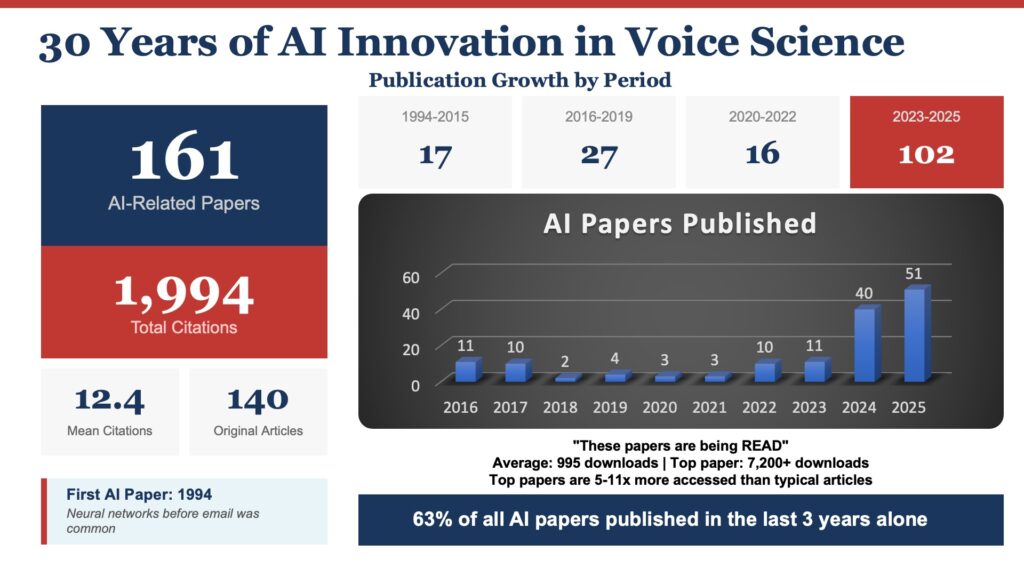
However, progress during the subsequent two decades was measured and methodical. Between 1994 and 2015, the journal published just 17 AI-related papers. Researchers laid the mathematical and acoustic groundwork, testing early machine learning algorithms on constrained datasets and proving that automated systems could identify basic acoustic patterns associated with vocal health and pathology.
The Acceleration: 2016–2022
As computing power expanded and machine learning evolved into deep learning, the volume of research began to climb. Between 2016 and 2019, the Journal of Voice published 27 AI papers. This period saw the introduction of more sophisticated multilayer neural networks capable of parsing complex acoustic parameters. From 2020 to 2022, despite global disruptions caused by the COVID-19 pandemic, another 16 papers were added to the literature, setting the stage for an unprecedented explosion in computational research.
The Exponential Curve: 2023–2025
The publication timeline from 2023 onward tells a dramatic story of exponential transformation. In this three-year window, researchers published 102 AI-related papers. In the single year of 2025, the journal published 51 AI-related papers—surpassing the cumulative total of the field’s first twenty years. This is not gradual, linear growth; it represents a profound paradigm shift in how voice scientists approach data collection, diagnostic modeling, and clinical decision-making.
Supporting Context & Metrics: Real-World Impact and Citation Reach
The value of academic publishing is measured not merely by the volume of output, but by how deeply that research penetrates clinical practice and influences subsequent inquiry. Usage and citation statistics from the Journal of Voice demonstrate that AI research is actively consulted by clinicians, researchers, and speech-language pathologists worldwide.
- High Download Rates: The average AI-focused paper published in the journal has been downloaded nearly 1,000 times, significantly outpacing the baseline metrics for traditional acoustic studies.
- The COVID-19 Benchmark: The most-accessed AI paper in the journal’s history—a cutting-edge study exploring machine learning applications for COVID-19 detection via voice analysis—has garnered over 7,200 downloads. This figure represents eleven times the median download rate for articles published in its respective issue.
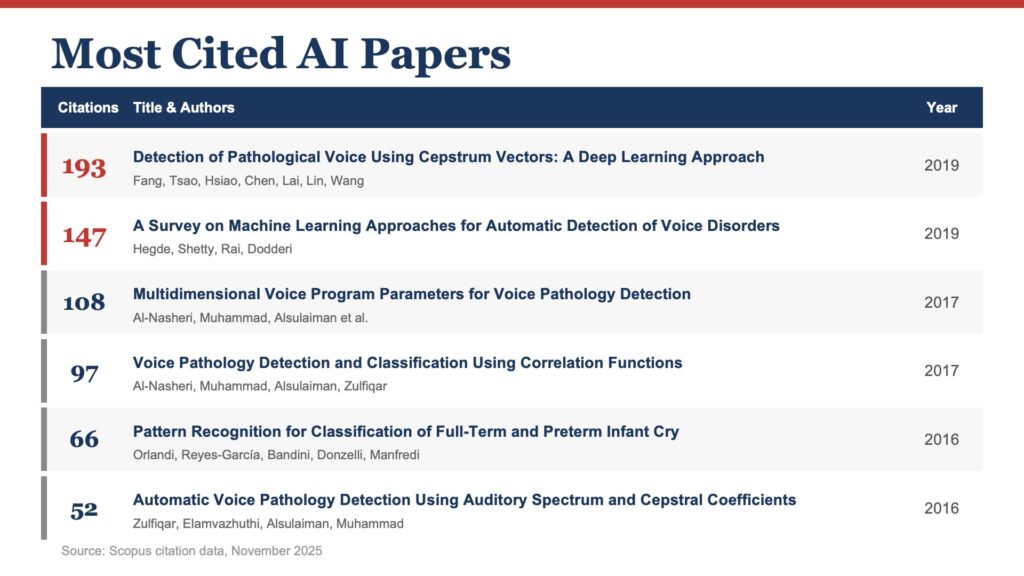
- Leading Citations: The two most-cited AI papers in the journal’s history are Fang and colleagues’ deep learning study (193 citations) and Hegde’s machine learning survey (147 citations). Both articles have been downloaded nearly 5,000 times each and consistently ranked among the top three most-accessed pieces in their respective issues.
These metrics confirm that the readership is not simply archiving digital files; rather, frontline clinicians and biomedical engineers are actively searching for practical, technologically advanced tools to elevate patient care.
Landmark Research Reshaping the Field
The body of AI literature hosted by the Journal of Voice spans several distinct yet interconnected domains, each pushing the boundaries of what is diagnostically possible.
Deep Learning for Voice Pathology Detection
In 2019, Fang and colleagues published "Detection of Pathological Voice Using Cepstrum Vectors: A Deep Learning Approach," which has since become the most-cited AI paper in the journal’s history (193 citations). This pivotal research demonstrated that deep neural networks could identify pathological conditions in the human voice with remarkable precision—using acoustic features operating far beyond the limits of human auditory perception.
This work built upon earlier foundational literature, such as Hegde and colleagues’ comprehensive "Survey on Machine Learning Approaches for Automatic Detection of Voice Disorders" (147 citations), which mapped the computational landscape for newcomers to the field. Concurrently, Al-Nasheri et al. contributed heavily cited studies in 2017 examining Multidimensional Voice Program parameters (108 citations) and correlation functions for pathology detection (97 citations).
As the technology matured, researchers applied increasingly advanced architectures. Chen and Chen (2022) explored deep neural networks for advanced voice classification; Fujimura applied one-dimensional convolutional neural networks (CNNs) to acoustic data; and Cho and Choi compared various CNN models for the automated evaluation of laryngoscopic images.
Voice as a Digital Biomarker for Systemic Health
Perhaps the most transformative conceptual leap in modern voice science is the recognition of the human voice as a digital biomarker—a non-invasive, highly accessible window into systemic neurological, psychological, and respiratory health.

Groundbreaking research published in the journal has explored the automated detection and monitoring of Parkinson’s disease through vocal tremors and micro-instabilities. For instance, Hemmerling and Wójcik-Pędziwiatr’s 2022 paper on predicting Parkinson’s severity from voice signals garnered 29 citations in just three years, driving clinical applications forward at a rapid pace.
Beyond neurology, systematic reviews have investigated voice quality as a digital biomarker for affective disorders such as depression and bipolar disorder. The clinical implications are profound: routine, automated voice screening could enable early psychiatric intervention, alleviate the immense burden on overstretched mental health infrastructures, and provide continuous, objective monitoring for chronic conditions. Furthermore, machine learning models capable of assessing COVID-19 and other respiratory infections from vocal characteristics underscore the voice’s role as a sentinel for pulmonary health.
AI Chatbots in Clinical Decision-Making
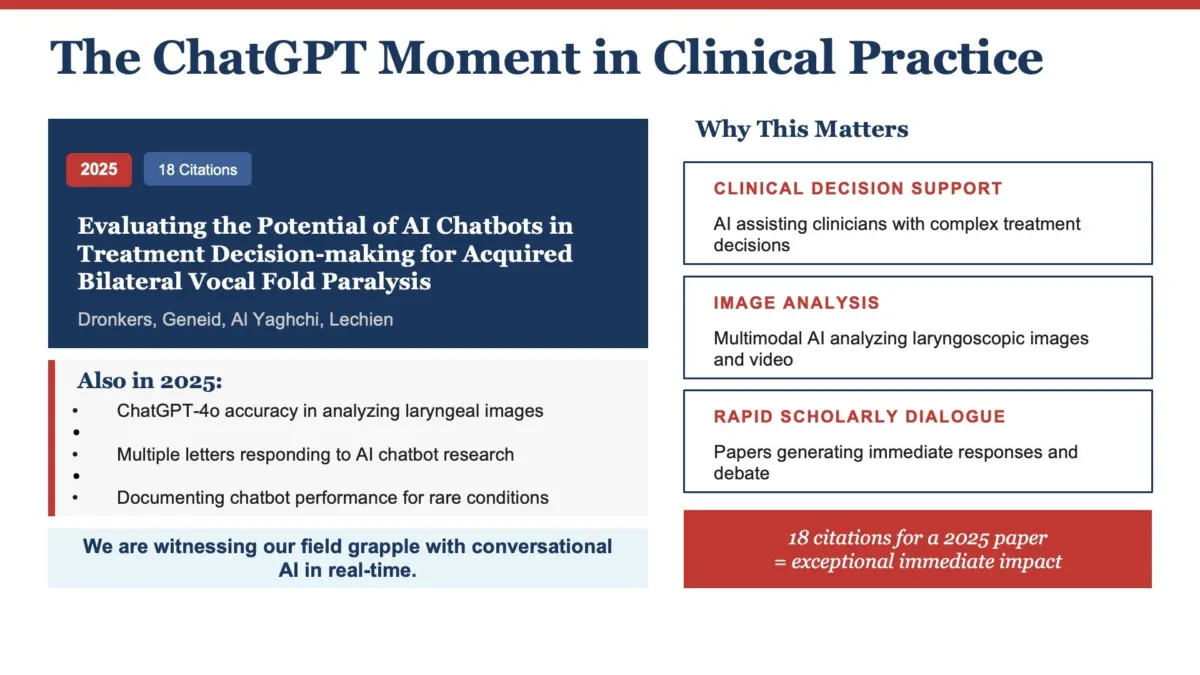
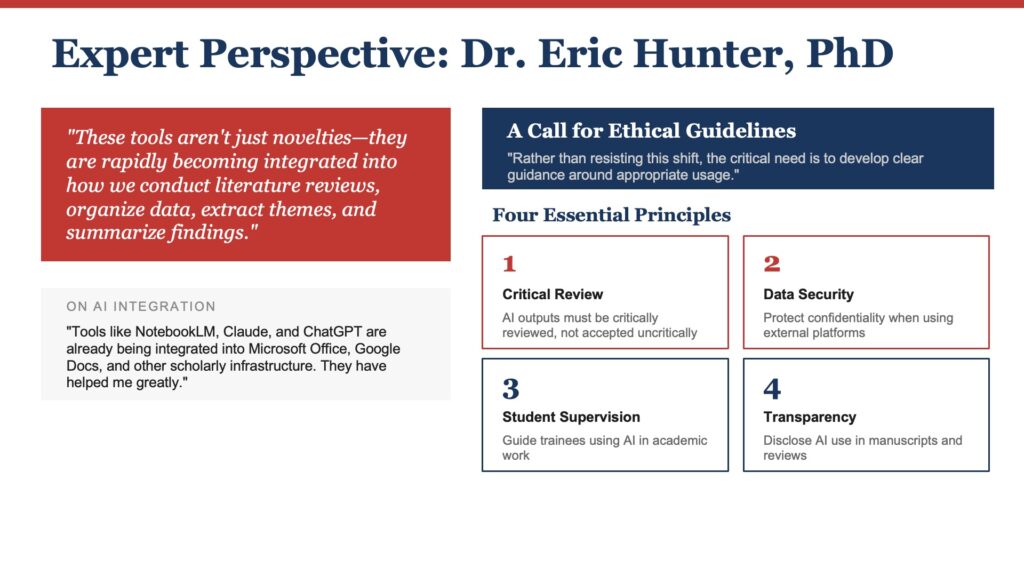
Entering 2025, the journal expanded its scope to evaluate conversational AI and large language models within clinical workflows. A notable study by Dronkers and colleagues, "Evaluating the Potential of AI Chatbots in Treatment Decision-making for Acquired Bilateral Vocal Fold Paralysis," accumulated 18 citations within its first year of publication—an exceptional velocity indicating immediate scholarly interest.
This paper sparked a flurry of academic discourse, including letters to the editor and dedicated response studies analyzing the diagnostic accuracy of systems like ChatGPT-4o in interpreting complex laryngeal imagery. The field is actively and transparently grappling with the integration of conversational AI into medical practice.
Official Statements and Expert Perspectives
To contextualize these technological leaps, two leading voices within the academic and clinical community offer vital insights regarding the opportunities and responsibilities accompanying the AI revolution.
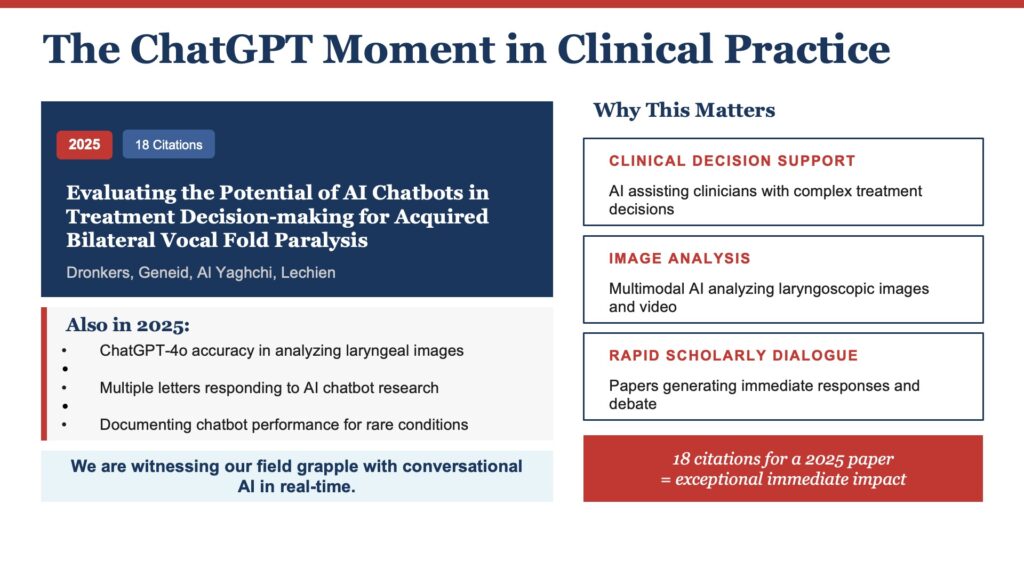
Dr. Mark Berardi: AI as a Tool for Managing Complexity
Dr. Mark Berardi, whose academic background spans physics and computation, views artificial intelligence through the lens of complexity management.
"Machine learning and AI are tools to help with complexity, and communication is incredibly complex in its neurobiological and physiological processes. So I think the application is warranted."
Dr. Berardi’s own research investigates voice-based digital biomarkers for aging and depression. While noting that acquiring speech signals has become technically straightforward, he emphasizes that the true hurdle remains the inherent intricacy of human neurophysiology—an obstacle tailor-made for machine learning.
Regarding generative AI, Dr. Berardi offers a pragmatic assessment. While it has not yet single-handedly rewritten foundational scientific theory, it has dramatically streamlined research workflows. "We can now address some of the bottlenecks we have in research—particularly in coding and data processing," he explains, noting his ability to rapidly generate and refine bespoke code using natural language prompts.
Intriguingly, Dr. Berardi is also examining human-AI communication itself: how human speech patterns adapt when interacting with conversational agents versus fellow humans, and how "synthetic" communication media (such as Zoom calls) alter interpersonal dynamics. "We are already seeing linguistic differences in chatbot interactions," he observes, suggesting that voice science must soon encompass not only the human voice in isolation, but human vocal behavior in direct dialogue with machines.
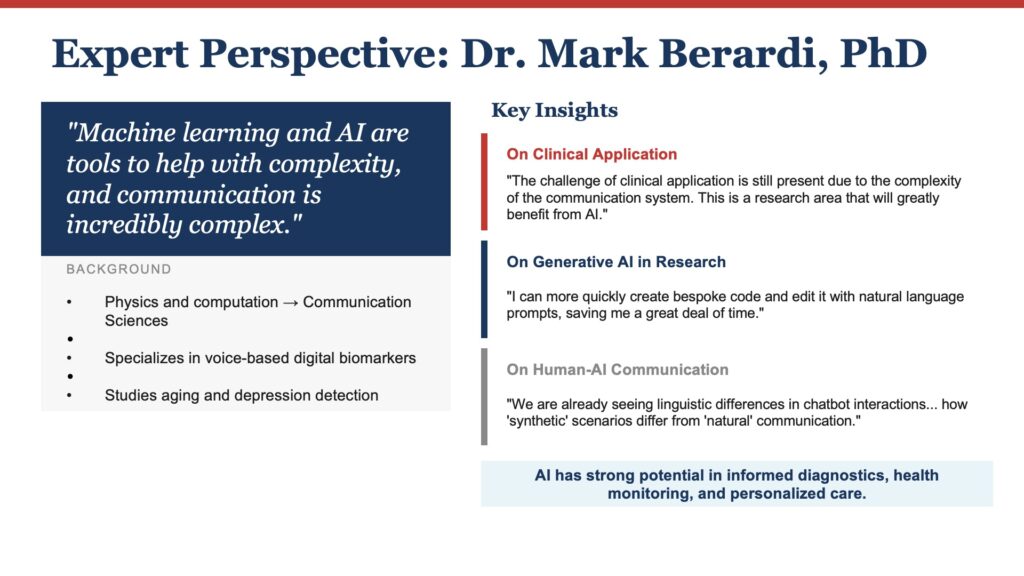
Dr. Eric Hunter: Embracing Change with Ethical Clarity
Dr. Eric Hunter emphasizes that institutional integration of AI is no longer optional.
"These tools aren’t just novelties. They are rapidly becoming integrated into how we conduct literature reviews, organize data, extract themes from large bodies of text, and even summarize findings."
Dr. Hunter points to the reality that large language models are embedding themselves deeply into academic and corporate software suites, including Microsoft Office and Google Docs. Rather than resisting this technological tide, he issues a clear call to action: the development of rigorous, transparent guidelines governing appropriate usage for both authors and peer reviewers.
To navigate this transition successfully, Dr. Hunter advocates for a balanced framework that maximizes productivity while preserving absolute scholarly integrity. The voice science community, he argues, will benefit most by welcoming technological efficiency while collaboratively building robust ethical guardrails.
A Global Research Community
The rapid ascent of AI in voice science is not the work of a few isolated laboratories; it is propelled by a vast, interconnected global network of investigators. Leading contributors to AI research in the Journal of Voice span continents and disciplines. Prominent authors and co-authors include:
- Jérémie René Lechien (6 papers)
- Dimitar Deliyski (5 papers)
- Stephanie Zacharias (5 papers)
- Ahmed Yousef (4 papers as first author)
- Paavo Alku (4 papers)
- Leonardo Wanderley Lopes (4 papers)
- Maryam Naghibolhosseini (4 papers)
Supported by dozens of research teams across Europe, the Americas, Asia, and the Middle East, this international community is united by a shared commitment to decoding the human voice through advanced computational analytics.
Future Outlook: The Path Forward
As the Journal of Voice looks toward the next decade, its editorial mission remains resolute: to publish rigorous, peer-reviewed research that pushes scientific boundaries while upholding the highest standards of academic integrity. However, this new era presents three distinct challenges that demand collective action from the global voice science community:
- Thoughtful Engagement: Researchers and clinicians must approach AI tools as sophisticated aids for managing biological complexity. Practitioners must master their capabilities, understand their algorithmic limitations, and utilize them to augment—never replace—human clinical judgment.
- Ethical Harmonization: The establishment of shared ethical frameworks, as advocated by leaders like Dr. Hunter, cannot be achieved by a single institution. The entire vocal health community must collaborate to set transparent standards for authorship, data transparency, and AI-assisted manuscript preparation.
- Continuous Collaboration: The 161 AI papers published to date represent merely the foundation. Clinicians, speech-language pathologists, engineers, and educators must continue sharing clinical insights and technological innovations to expand our collective understanding of vocal health.
Conclusion: An Extraordinary Moment in Vocal History
For hundreds of thousands of years, the human voice has served as our primary instrument of connection, emotional expression, and personal identity. It carries the distinct markers of our health, our moods, and our humanity in a manner unmatched by any other biological signal.
Now, for the first time in human history, science possesses computational instruments sophisticated enough to truly decode that complexity—tools capable of revealing what the voice discloses about our brains, our bodies, and our overall well-being. These technologies promise to extend the diagnostic reach of expert clinicians, detect pathological changes before symptoms manifest, and democratize access to high-quality voice care across the globe.
We are living through an extraordinary moment in scientific history, and The Voice Foundation, alongside the Journal of Voice, stands proudly at its center. The coming decade promises even greater breakthroughs in our understanding of the human voice, opening new frontiers in medicine, art, and technology.

About the Author
Ian DeNolfo is Executive Director of The Voice Foundation, which publishes the Journal of Voice. A graduate of The Juilliard School and The Curtis Institute of Music, he formerly performed as a leading tenor at major opera houses worldwide before transitioning to arts administration and scientific leadership at The Voice Foundation.