
Executive Overview
The evolution of improvised music is a narrative defined by radical departures, structural deconstruction, and the relentless pursuit of uncharted aural territories. At the heart of this continuum lies John Coltrane’s 1965 masterwork, Ascension—a seismic recording that forever ruptured the boundaries of traditional jazz and challenged the dogmas of its audience. Released by Impulse! Records during a period of profound artistic transition, Ascension remains a towering monument of free jazz, standing alongside Ornette Coleman’s similarly disruptive works as a fierce, uncompromising interrogation of form and harmony.
To examine Ascension in isolation, however, is to miss the broader ecology of avant-garde music. The impulses that drove Coltrane to assemble a sprawling, double-quartet-plus ensemble to capture collective chaos continue to echo through the decades. They resurface in the border-crossing artistry of French reed master Michel Portal, whose eclectic career bridged classical discipline, film scoring, and European free jazz before his passing at the age of 90. They roar back to life, too, in the anarchic fury of contemporary outfits like Suncuts, whose 2023 release Collective Heliophobic Dream updates the visceral intensity of "splatter jazz" for the modern era.
This investigative review traces the historical lineage, structural intricacies, and enduring resonance of these three distinct sonic milestones. By examining the studio mechanics of Coltrane’s masterclass, the multifaceted legacy of Portal, and the raw, confrontational energy of modern noise-jazz collectives, we map out a comprehensive overview of how improvised music continues to challenge, provoke, and transcend its own boundaries.
Detailed Chronology: Key Milestones in Avant-Garde Jazz History
To understand the weight of these recordings, one must map the historical trajectory that connected mid-century American modal and free jazz to European improvisational movements and contemporary noise experimentations.
- The Early 1960s – The Shift Toward Radicalism: Following his commercial and spiritual triumph with A Love Supreme, John Coltrane’s music underwent a rapid, uncompromising evolution. Live recordings like Chasin’ The Trane and collaborations with avant-garde luminaries such as Eric Dolphy and Archie Shepp signaled to conservative fans that the saxophonist was moving far beyond the comforting confines of his earlier work with balladeers and Duke Ellington.
- June 28, 1965 – The Recording of Ascension: Coltrane convenes an expanded ensemble at Van Gelder Studio in Englewood Cliffs, New Jersey. Featuring a heavy-hitting cast of horns (including Pharoah Sanders, Archie Shepp, John Tchicai, Dewey Johnson, and Freddie Hubbard alongside a dual rhythm section), the group records two distinct takes of a sprawling, collective improvisation anchored loosely by a five-note motif.
- Late 1960s to 1970s – European Free Jazz Awakening: Following the trailblazing paths of American free jazz pioneers, European artists like Michel Portal begin merging avant-garde impulses with classical techniques. Portal participates in avant-garde ensembles like New Phonic Art and collaborates with radical classical composers like Karlheinz Stockhausen, helping forge a distinct European free jazz identity alongside peers such as John Surman.
- 1986–1994 – The Birth of "Splatter Jazz": The all-star quartet Last Exit—comprising Peter Brötzmann, Sonny Sharrock, Bill Laswell, and Ronald Shannon Jackson—defines a hyper-aggressive fusion of free jazz, heavy metal, hardcore punk, and blues. Journalist Steve Lake coins the term "Splatter Jazz" to capture this ferocious, high-decibel aesthetic.
- 1991–1992 / 1993 – Michel Portal’s Any Way: Portal records a career-spanning synthesis of styles in Paris and New York, released via Label Bleu in 1993. Featuring an all-star transatlantic lineup (including Kenny Wheeler, Robin Eubanks, and Trilok Gurtu), the album showcases his enduring ability to balance rigorous composition with spontaneous groove.
- December 4–5, 2023 – The Genesis of Suncuts: Born out of logistical necessity when the ensemble Tufelskeller could not field a full roster for the Xciting Festival in Stuttgart, saxophonist Anton Ponomarev recruits Swiss drummer Maxime Hänsenberger and Brazilian bassist Felipe Zenicola. The trio records Collective Heliophobic Dream in Biel, Switzerland, breathing new life into the splatter jazz lineage.
- February 12, 2024 – The Passing of Michel Portal: The distinguished French multi-reedist and composer dies at the age of 90, leaving behind an extraordinary legacy spanning classical conservatories, cinematic Césars, and boundary-pushing free improvisation.
Supporting Context & Metrics: Analyzing the Sonic Architectures
John Coltrane’s Ascension: The Anatomy of a Masterpiece
When Ascension hit record store shelves, it was met with immediate disorientation. Where A Love Supreme offered a structured, devotional narrative, Ascension presented a swirling vortex of sound that felt, to many contemporary listeners, like an assault on musical syntax. Yet, beneath the apparent chaos lay a meticulous, if precarious, structural framework.
Coltrane provided the session musicians with sheet music featuring a foundational five-note motif, designed to anchor the sprawling ensemble during recurring ensemble passages. However, recollections regarding the rigidity of these charts remain hazy. Archie Shepp later recalled that the use of the provided chords or modes was entirely optional, while saxophonist John Tchicai had no recollection of receiving any written music at all.
This tension between total freedom and composed structure spilled over into the album’s production history. Coltrane initially approved the second take for early LP pressings, focusing deeply on the internal logic and developmental trajectory of the performance. He later reversed his decision, requesting that subsequent pressings feature the first take. This editorial shift altered the pacing significantly: on the preferred first take, Shepp’s solo is repositioned after Tchicai’s, and Elvin Jones’s ferocious solo between the bass duet and the closing ensemble is omitted—reportedly because Coltrane wished to keep the two alto saxophone solos distinct.
Despite the logistical confusion, the performances captured on the Verve Vault reissue (spanning roughly 78 minutes across both editions) showcase remarkable individual contributions. Pharoah Sanders displays a startlingly coherent approach to thematic development, reining in his penchant for extreme extended techniques (such as his signature "underwater gurgle") in favor of sharp, aggressive articulation. John Tchicai’s alto saxophone solos stand out for their pristine tone and methodical examination of motifs, mirroring Coltrane’s relentless investigative approach. Meanwhile, hard-bop master Freddie Hubbard—often dismissed by purists as an uneasy participant in the "New Thing"—delivers a performance charged with staggering intensity, wrestling manfully and brilliantly with the demands of the avant-garde.
Michel Portal’s Any Way: A Transatlantic Synthesis
To transition from the raw fury of Ascension to Michel Portal’s Any Way is to witness the evolution of the European avant-garde from disruptive radicalism to sophisticated integration. Recorded across 1991 and 1992 and originally issued in 1993, the album serves as a masterclass in stylistic synthesis.
Portal’s background was uniquely suited to bridge seemingly incompatible worlds. Trained at the Paris Conservatoire in clarinet and conducting, he moved fluidly between light music, classical symphonies, avant-garde happenings with Karlheinz Stockhausen, and cinematic scoring (ultimately winning three César Awards). On Any Way, this breadth of experience manifests in compositions that refuse to settle into a single genre.
Backed by an extraordinary collective roster featuring jazz heavyweights such as trumpeter Kenny Wheeler, trombonist Robin Eubanks, guitarists Marc Ducret and Kevin Eubanks, and percussionist Trilok Gurtu, Portal’s music is characterized by fierce intellect and rhythmic vitality. Aside from Mino Cinelu’s Octaver, all compositions are penned by Portal himself, moving effortlessly from complex, cerebral modern jazz structures to deep, infectious funk grooves. The music stands as a testament to an artist who, even in his late fifties during these sessions, maintained the exploratory fire of his youth.
Suncuts and Collective Heliophobic Dream: The Modern "Splatter Jazz" Revival
If Portal represents the refined integration of European jazz, Suncuts represents its explosive, uncompromising antithesis. Coined by journalist Steve Lake, the term "Splatter Jazz" originally described the high-octane collision of free jazz, heavy metal, hardcore punk, and blues pioneered by the legendary quartet Last Exit. In 2023, this mantle was aggressively seized by Suncuts.
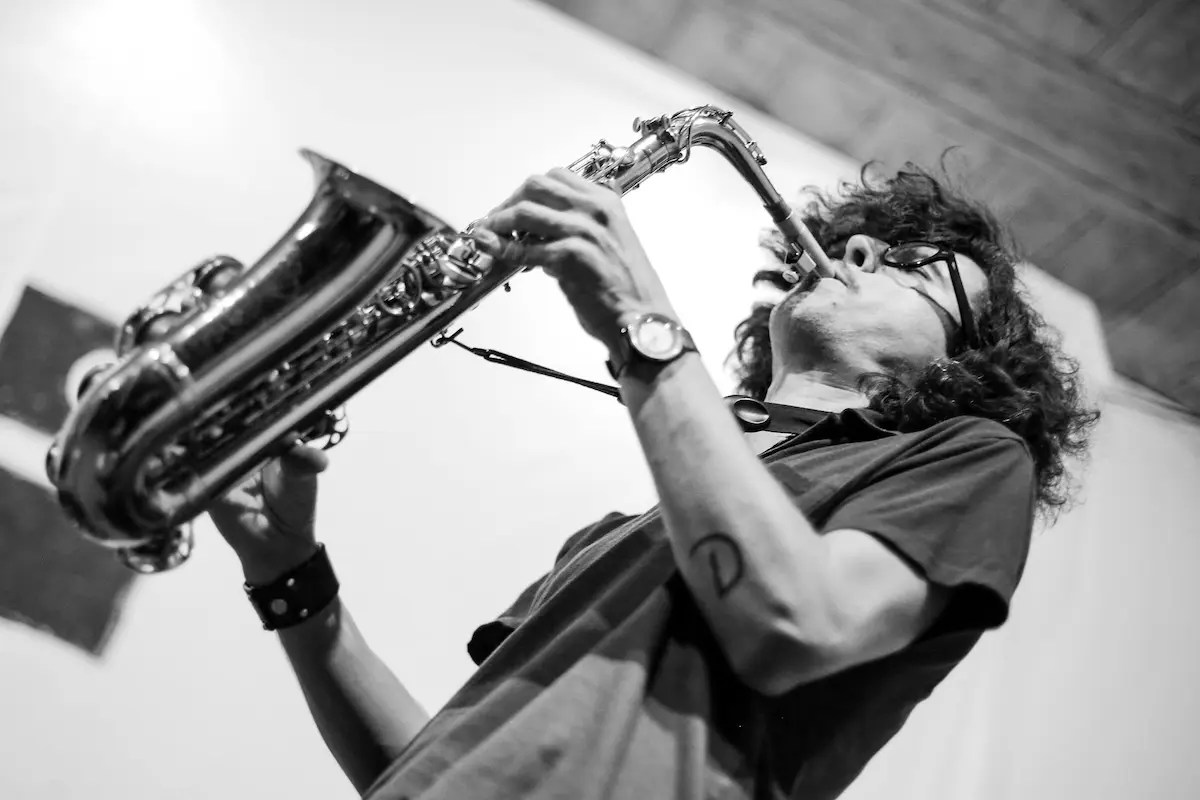
Emerging from the ashes of the project Tufelskeller when personnel shortages forced a lineup pivot at the Xciting Festival in Stuttgart, saxophonist and electronic artist Anton Ponomarev joined forces with Swiss drummer Maxime Hänsenberger and Brazilian bassist Felipe Zenicola. The resulting album, Collective Heliophobic Dream, recorded over two intense days in Biel, Switzerland, is a masterclass in sonic extremity.
The opening track plunges the listener immediately into a wall of aggressive noise, serving as a visceral trial by fire. Yet, beneath the initial raucous and anarchistic exterior lies a deep, intuitive improvisational dialogue. The interactions between Ponomarev’s biting reeds, Zenicola’s thunderous bass lines, and Hänsenberger’s relentless polyrhythms reveal a profound collective cohesion. Whether the listener finds the 43-minute runtime exhilarating or exhausting depends entirely on their appetite for edge-of-the-seat sonic subversion.
Official Statements & Critical Perspectives
The historical and contemporary reception of these works highlights the ongoing debate between structural discipline and absolute freedom in improvised music.
- On John Coltrane’s Intentions during the Ascension Sessions:
"I was concentrating so hard on such structure and development that the music had that I was unaware of how it was sounding overall."
— John Coltrane (Reflecting on the overwhelming complexity and mental focus required to steer the historic 1965 session). - On the Optional Nature of Avant-Garde Scores:
"The use of the chords or modes contained on the distributed sheets was entirely optional… though most of the musicians didn’t even recall receiving them."
— Archie Shepp (Recalling the fluid, shifting parameters of the Ascension recording environment). - On the Aesthetic of Suncuts and Modern Noise-Jazz:
"It throws you straight into the jaws of the beast… raucous and anarchistic, yet exhibiting genuine, edge-of-the-seat interaction that is either invigorating or exhausting depending on your taste."
— Contemporary Critical Assessment (Highlighting the uncompromising sonic footprint of Collective Heliophobic Dream).
Future Outlook: The Enduring Legacy of Improvised Subversion
As we look toward the future of improvised and avant-garde music, the reverberations of John Coltrane’s 1965 experiment, Michel Portal’s institutional cross-pollination, and Suncuts’ raw noise-jazz aggression remain vital. The historical friction that greeted Ascension—the tension between audience comfort and artistic necessity—continues to serve as a litmus test for authentic creative expression.
In an era dominated by hyper-processed, algorithmically curated digital soundscapes, the uncompromising human elements found in these recordings are more essential than ever. The lessons of Ascension teach us that collective improvisation is not merely the absence of structure, but a higher-order dialogue requiring immense trust, technical mastery, and emotional vulnerability.
The passing of masters like Michel Portal reminds the global jazz community of the importance of fluidity—of refusing to be constrained by genre boundaries, whether crossing from the Paris Conservatoire to free-jazz basements or scoring cinematic features. Meanwhile, modern underground outfits like Suncuts prove that the fierce, confrontational spirit of splatter jazz is alive and well, ensuring that the avant-garde will continue to challenge, disrupt, and expand the human auditory experience for generations to come.