
Executive Overview
The landscape of music education has undergone a profound paradigm shift. By mid-2026, the intersection of real-time digital signal processing (DSP), machine learning, and mobile hardware has elevated artificial intelligence from a novel pitch-tracking gimmick into an active participant in vocal pedagogy. No longer restricted to passive "correct/incorrect" visualizers, the modern suite of AI vocal coach applications can now analyze vocal timber, measure microtonal fluctuations, structure long-term practice regimens, and even monitor respiratory patterns.
However, as the market floods with applications claiming "AI-powered" capabilities, a stark division has emerged between platforms using AI as a marketing buzzword and those deploying sophisticated, adaptive architectures.
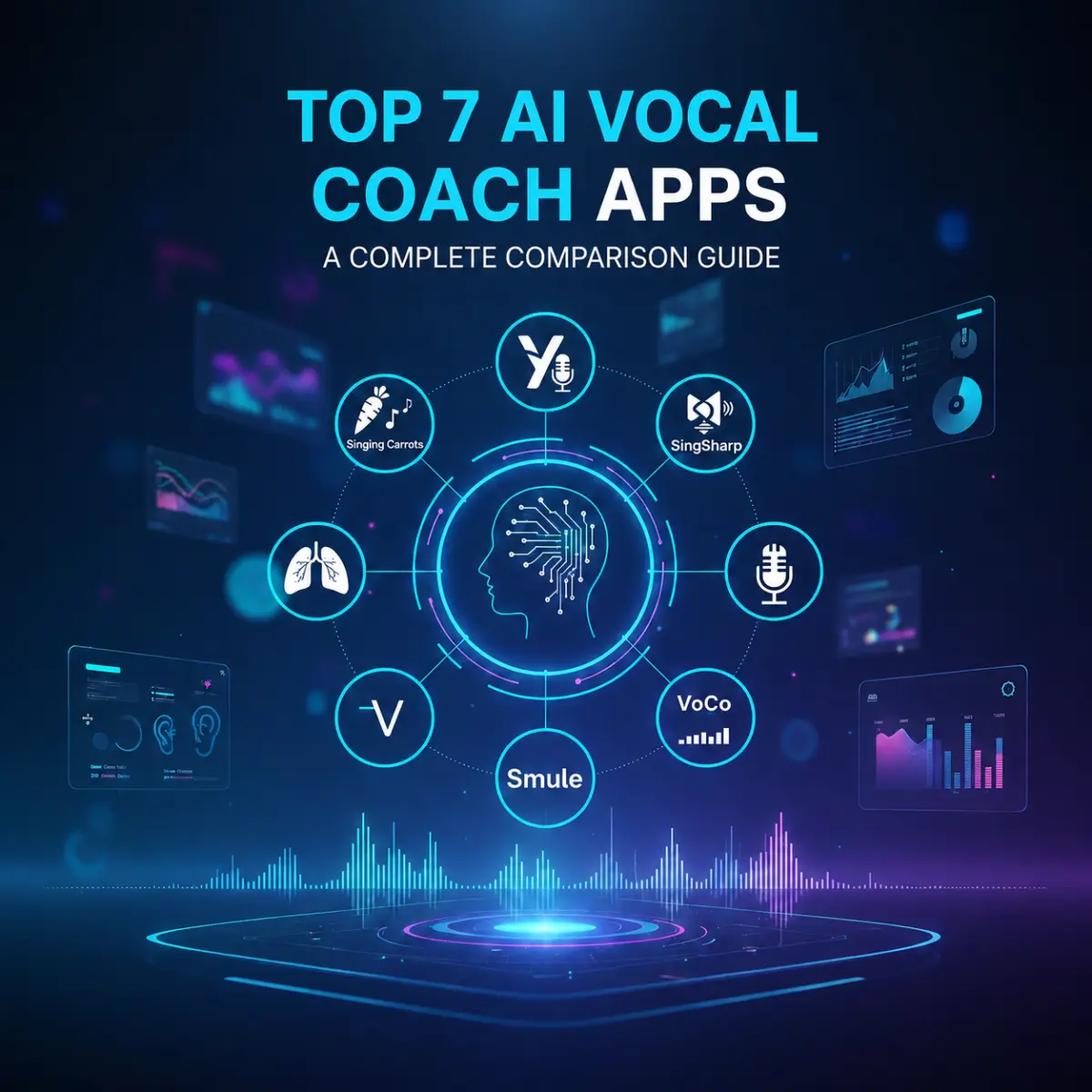
This investigative analysis evaluates the leading consumer applications of 2026: Singing Carrots, Yousician, SingSharp, Smule, Vanido, SingTrue, and VoCo Vocal Coach.
Our findings indicate that while Yousician remains the industry standard for structured, gamified music curricula, and SingSharp leads in mechanical breath-support training, Singing Carrots stands alone as the only platform to release audited, empirical outcome data demonstrating quantifiable user improvement.
Detailed Chronology: The Evolution of Digital Vocal Training
The path to the highly sophisticated AI vocal applications of 2026 was paved by over a decade of incremental technological breakthroughs. Understanding this timeline explains how the industry transitioned from simple pitch visualizers to true cognitive training partners.
+-----------------------------------------------------------------+
|                        HISTORICAL TIMELINE                      |
+-----------------------------------------------------------------+
|                                                                 |
|  [Pre-2020: The Pitch Detection Era]                            |
|  - Fast Fourier Transform (FFT) algorithms provide basic        |
|    visual feedback. No personalization or pedagogical logic.    |
|                                                                 |
|  [2020-2024: The Gamification & Curriculum Boom]               |
|  - Platforms like Yousician and Smule popularize gamified       |
|    learning and social singing. Pitch tracking goes mobile.     |
|                                                                 |
|  [2025: The Rise of Multi-Tier AI Architectures]                |
|  - Integration of cross-session memory and adaptive training    |
|    algorithms. Systems begin simulating human coach logic.      |
|                                                                 |
|  [July 2026: Mobile Expansion & Empirical Validation]           |
|  - Singing Carrots launches its iOS app and publishes the       |
|    first large-scale user outcome dataset (13,000+ sessions).   |
|                                                                 |
+-----------------------------------------------------------------+
Phase 1: The Pitch Detection Era (Pre-2020)
Early vocal training software relied on fundamental Fast Fourier Transform (FFT) algorithms. These programs functioned as reactive digital tuners: they captured audio through a microphone, calculated the dominant frequency, and mapped it to a musical note. While useful for basic pitch verification, these systems lacked pedagogical logic. They could tell a singer if they were out of tune, but not why, nor could they suggest structured paths to correct the issue.
Phase 2: The Gamification and Curriculum Boom (2020–2024)
As mobile processor performance improved, developers integrated pitch-detection engines into interactive, video-game-like interfaces. Yousician pioneered this approach, creating linear, level-based curricula that rewarded users for hitting notes in real time. Simultaneously, Smule leveraged cloud processing to build global, social karaoke ecosystems. During this phase, "AI" was primarily used to optimize latency and apply basic pitch-correction filters, rather than to personalize the actual pedagogy.
Phase 3: The Era of True Adaptive Coaching (2025–2026)
By late 2025, developers began moving away from rigid, pre-programmed lesson trees. The industry realized that a human vocal student does not learn linearly; their voice changes daily based on fatigue, hydration, and muscle memory.
In mid-2026, this culminated in the release of multi-tiered AI architectures capable of cross-session memory and real-time behavioral adaptation.
A major milestone occurred in July 2026, when Singing Carrots expanded its advanced web-based AI coaching engine into a dedicated iOS application, accompanied by the release of the industry’s first large-scale empirical study on AI vocal outcomes.
Supporting Context & Metrics: The 2026 Market Landscape
To understand how these platforms compare, we must analyze them across five core dimensions of true AI coaching:
- Analysis: The ability to map a user’s unique vocal footprint.
- Planning: Dynamically generating custom lesson structures.
- Adaptation: Modifying exercises mid-session based on user performance.
- Memory: Carrying data across sessions to track historical progress.
- Reasoning: Providing qualitative feedback rather than raw mathematical scores.
Comparative Overview of Leading AI Vocal Applications (2026)
| App | Best For | Core AI & Audio Capabilities | Pricing Structure | Platform Availability |
|---|---|---|---|---|
| Singing Carrots | Personalized coaching, progress tracking & empirical optimization | Three-tier AI architecture, cross-session memory, cents-level tuning, pitch stability metrics | Free tier / Premium paid memberships | iOS, Web |
| Yousician | Highly structured, gamified linear learning | Real-time pitch detection, instant latency-optimized feedback | $7.49 – $17.49 / month | iOS, Android, PC/Mac |
| SingSharp | Mechanical breath-support training | Abdominal breath detection, vocal range & resonance analysis | Free tier / Premium subscription | iOS, Android |
| Smule | Social singing, collaboration & performance | AI-driven real-time pitch correction, audio style-transfer effects | Free with ads / VIP subscription | iOS, Android |
| Vanido | Daily micro-practice routines | Adaptive exercise difficulty mapping | Free (3 exercises/day) / $2.99/mo or $17.99/yr | iOS only |
| SingTrue | Pitch rehabilitation & cognitive ear training | Relative pitch analysis, "solfa" ear-voice loop training | Free tier / $7.99 one-time full unlock | iOS only |
| VoCo Vocal Coach | Advanced, self-directed vocal workouts | Customizable audio playback engines, scale/arpeggio generation | Completely Free | iOS only |
Deep-Dive Architectural & Pedagogical Analysis
1. Singing Carrots: The Data-Driven Pioneer
+-----------------------------------------------------------------+
|               SINGING CARROTS THREE-TIER AI ARCHITECTURE        |
+-----------------------------------------------------------------+
|                                                                 |
|   [Tier 1: Real-Time Audio DSP Engine]                          |
|   - Captures pitch with cents-level accuracy.                   |
|   - Measures micro-deviations (pitch stability/wobble).         |
|                                                                 |
|   [Tier 2: Session-Level Adaptive Logic]                        |
|   - Modifies exercises mid-session.                             |
|   - 10x higher probability of raising difficulty after success  |
|     (31.5%) vs. after struggle (3.0%).                          |
|                                                                 |
|   [Tier 3: Long-Term Memory & Pedagogical Reasoner]             |
|   - Tracks per-note accuracy across weeks of practice.          |
|   - Restricts daily training to 300 notes to prevent fatigue.   |
|                                                                 |
+-----------------------------------------------------------------+
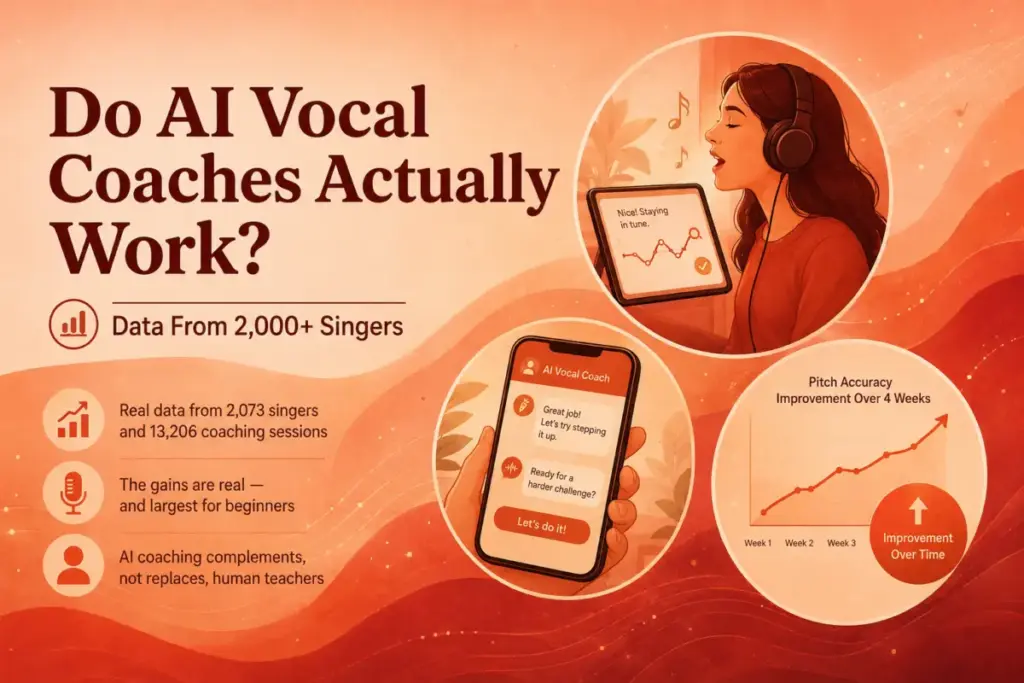
Singing Carrots represents a significant shift in vocal technology by introducing the first peer-reviewed style of user outcome data. Analyzing a sample of 2,000+ unique singers across 13,000+ distinct coaching sessions (encompassing roughly 349,000 individual exercises over a seven-month period), the platform proved that structured AI coaching yields measurable physical results.
The most notable metric from this dataset indicates that complete beginners improved their pitch accuracy by an average of 16.5 percentage points within their first month of regular use.
The Three-Tier AI Architecture
Unlike standard apps that use "AI" as a synonym for simple pitch detection, Singing Carrots operates on a sophisticated three-tier framework:
- Tier 1 (Real-Time Audio DSP): This layer captures pitch with cents-level precision (1/100th of a semitone) and measures pitch stability—detecting whether a singer’s voice is wavering or exhibiting natural vibrato versus uncontrolled wobble.
- Tier 2 (Session-Level Adaptive Logic): The app monitors success rates mid-exercise. Data shows that the system is highly responsive: after a successfully executed exercise, the coach increases the difficulty parameters 31.5% of the time. Conversely, if the singer struggles, the difficulty is raised only 3% of the time—representing a 10x behavioral swing designed to keep the user in the optimal "flow state" of learning. Furthermore, 91.5% of all generated exercises are algorithmically constrained to sit precisely within the user’s documented comfortable range, avoiding vocal strain.
- Tier 3 (Long-Term Memory & Pedagogical Reasoner): The AI remembers performance history across sessions. It doesn’t treat every day as a blank slate. If a user struggled with pitch stability on an F#4 on Tuesday, Thursday’s customized session plan will dynamically integrate warm-ups designed to stabilize the transition around that specific register break.
To protect vocal health, the application imposes a 300-note daily ceiling on intensive coaching exercises. This prevents users from over-practicing and developing vocal fatigue or nodules—a common risk with self-directed digital training.
2. Yousician: The Gold Standard for Gamified Curriculum
Yousician approaches vocal training through a highly structured, gamified framework. Rather than acting as an open-ended personal coach, it behaves like an interactive, linear textbook.
+-----------------------------------------------------------------+
|                    YOUSICIAN LINEAR CURRICULUM                  |
+-----------------------------------------------------------------+
|                                                                 |
|  [Level 1: Basics] -> [Level 2: Intervals] -> [Level 3: Songs]  |
|                                                                 |
|  * Strengths: Highly engaging, licensed catalog, multi-key      |
|    instrument support.                                          |
|  * Weaknesses: Rigid progression, lacks real-time vocal range  |
|    adaptation, higher subscription cost.                        |
|                                                                 |
+-----------------------------------------------------------------+- Pedagogical Methodology: Yousician utilizes a step-by-step, level-based path. Users sing along with bouncing-ball notation over fully produced, licensed backing tracks. The platform’s real-time pitch-tracking engine is highly optimized for low latency, providing instant visual feedback on pitch and timing.
- Strengths: Excellent for complete beginners who find the open-ended nature of traditional practice intimidating. The inclusion of a vast catalog of popular, licensed music makes practice engaging and fun.
- Limitations: The curriculum is rigid. If a user has a highly developed ear but poor breath control, they must still progress through the standard curriculum sequentially. Additionally, Yousician does not dynamically alter the key of its catalog songs to fit a singer’s natural vocal range, which can lead to straining.
3. SingSharp: Specialized Breath-Support Mechanics
SingSharp addresses the fundamental physical engine of the voice: the diaphragm and respiratory system. While other apps focus almost entirely on pitch output, SingSharp recognizes that pitch stability is a direct byproduct of consistent subglottic air pressure.
- Breath Detection Technology: SingSharp utilizes the mobile device’s microphone to analyze the acoustic signature of inhalation and exhalation. It guides users through diaphragmatic breathing patterns, assessing the duration, consistency, and control of their breath support.
- Vocal Analysis: Alongside breath tracking, the app features an analysis engine that maps vocal range and resonance, helping singers identify where their tone is richest.
- Limitations: The interface is less polished than its competitors, and the pitch-tracking visualizer can feel less responsive during complex vocal runs.
4. Specialty Contenders: Vanido, SingTrue, VoCo, and Smule
Vanido (Daily Micro-Sessions)
Vanido is designed around the psychology of micro-learning, offering users exactly three exercises per day.
- The AI Logic: Vanido’s algorithm evaluates the user’s pitch accuracy in real time and automatically shifts the key of the next exercise up or down to keep the singer challenged without causing strain.
- Platform Limit: It remains strictly iOS-only, limiting its reach, but it is highly regarded for its clean, minimal user experience.
SingTrue (Cognitive Ear Training & Tone-Deafness Rehabilitation)
SingTrue targets the psychological connection between the ear and the vocal cords. Many people who believe they are "tone-deaf" actually suffer from a disconnect in their audio-feedback loop: their ear hears the pitch, but their brain cannot coordinate the vocal muscles to replicate it.
- The "Solfa" Approach: Using relative pitch training and solfège exercises, SingTrue helps users internalize intervals. It acts as an excellent rehabilitative tool for absolute beginners before they attempt complex songs.
VoCo Vocal Coach (The Advanced Singer’s Workout Tool)
VoCo eschews typical AI hand-holding and gamification. It is designed for experienced singers who already understand their voice and need a flexible, digital practice keyboard.
- Uncapped Customization: Users can program specific scales, arpeggios, and vocalises, adjusting the tempo, pitch, and key transposition on the fly. It is a highly efficient, completely free utility belt for the working vocalist.
Smule (The Social Performance Network)
Smule sits on the boundary between training and recreation. It does not offer structured coaching, but its AI-driven real-time pitch correction (akin to studio auto-tune) and vocal style-transfer effects allow users to record polished performances and duet with other singers globally. It serves as a performance outlet rather than a technical training platform.
Official Statements & Industry Perspectives
The rise of AI vocal coaching has sparked an important dialogue within the academic and professional singing communities.
Vocal Coach Mark Graham highlights the inherent tension between quantitative data and qualitative art:
"Machines operate predominantly on quantitative aspects—identifying whether someone is mathematically on pitch or not. But singing is far more about qualitative aspects: the emotional delivery, the warmth of the tone, the subtle placement of resonance, and the stylistic choices of the artist. An algorithm can tell you if you hit a C4; it cannot tell you if that C4 made the listener feel something."
This sentiment is echoed by product developers at Singing Carrots, who openly state that their software is not designed to replace human voice teachers. Instead, the pedagogical consensus of 2026 views AI as an asynchronous practice assistant.
+-----------------------------------------------------------------+
|               THE COMPLEMENTARY VOCAL TRAINING MODEL            |
+-----------------------------------------------------------------+
|                                                                 |
|   [Human Vocal Coach] (Weekly / Bi-weekly)                      |
|   - Artistic interpretation & emotional delivery                |
|   - Physiological posture & jaw tension analysis                |
|   - Complex register blending & vocal health diagnostics        |
|                                                                 |
|                           ^                                     |
|                           | (Informs & guides)                  |
|                           v                                     |
|                                                                 |
|   [AI Vocal Coach] (Daily Deliberate Practice)                  |
|   - Scale exercises with precise pitch feedback                 |
|   - Ear training & relative pitch calibration                   |
|   - Data-driven tracking of comfortable vocal range             |
|                                                                 |
+-----------------------------------------------------------------+
Can AI Replace a Human Vocal Coach?
The definitive answer in 2026 remains a resounding no. A human coach brings critical, non-quantifiable skills to a lesson:
- Visual Posture and Tension Diagnosis: A human teacher can look at a singer and instantly spot jaw tension, raised shoulders, or poor neck alignment—all of which choke vocal production but are invisible to a standard audio microphone.
- Vocal Health Monitoring: An experienced human ear can detect the early acoustic signs of vocal fatigue, swelling, or nodules before they manifest as outright pitch errors, guiding the student to rest.
- Artistry and Style: Teaching phrasing, emotional expression, and stylistic nuances (such as when to use a breathy tone versus a belt) requires human empathy and connection.
The optimal modern training regimen combines both worlds: a student meets with a human coach to establish proper technique and artistic direction, then utilizes an AI coach (like Singing Carrots or SingSharp) for daily, structured practice to build muscle memory and track pitch stability.
Future Outlook: The Next Stage of Voice Training
As we look beyond late 2026, several emerging technologies are poised to reshape the digital vocal training landscape:
- Multimodal AI Integration: Future iterations of mobile vocal apps will likely integrate the device’s front-facing camera to analyze facial expressions and body posture. Computer vision models will detect jaw clenching, tongue tension, and shallow chest breathing in real time, bridging the gap between acoustic analysis and physiological observation.
- AI Voice Synthesis vs. AI Voice Training: It is vital to distinguish between AI that trains human voices and AI that synthesizes them (such as deepfake voice generators). While synthesis technology aims to replicate or replace human singers, AI coaching technology is focused on empowering and preserving the physical, human instrument.
- Local, On-Device Neural Processing: As mobile hardware continues to integrate dedicated neural processing units (NPUs), complex vocal analysis will shift entirely away from cloud servers. This will ensure absolute data privacy and reduce latency to near-zero, allowing for incredibly responsive, real-time feedback even in remote areas without internet access.
Ultimately, the advancements of 2026 prove that while technology can measure and guide our progress, the heart of singing remains a deeply human experience. Whether utilizing Singing Carrots’ advanced data analytics, Yousician’s engaging gamified paths, or SingSharp’s respiratory focus, the modern singer now has an unprecedented suite of tools to help them find their true voice.