
Executive Overview
In the landscape of instrumental and vocal pedagogy, few skills remain as universally revered—and as notoriously difficult to master—as sight-reading. At the absolute foundation of fluent sight-reading lies note recognition: the cognitive process of instantly translating a visual symbol on a musical staff into a physical action on an instrument or a pitch in the vocal tract. For decades, music educators have relied on flashcards, repetitive workbook drills, and traditional acoustic practice to bridge the gap between the eye and the instrument. However, these analog methods often lack the dynamic feedback loops, gamified engagement, and data-driven tracking necessary to accelerate modern cognitive development.
Recognizing this enduring pedagogical bottleneck, SightReadingMastery—under the leadership of founder, musician, software engineer, and educator Evan R. Murphy—released a dedicated, free-to-use digital tool designed specifically to sharpen note-reading speed and accuracy: the Note Recognition App.
Originally launched as a streamlined web utility, the platform has undergone significant evolutionary milestones. What began as a treble-clef-only web application has since matured into a comprehensive, cross-platform training utility supporting both treble and bass clefs, alongside expanded capabilities for ledger lines. Designed with cross-device compatibility at its core, the tool bridges the gap between desktop software and mobile accessibility, allowing musicians of all proficiency levels to train wherever and whenever inspiration strikes.
This retrospective report examines the genesis, technical mechanics, iterative updates, and broader implications of the SightReadingMastery Note Recognition App. Through an analysis of its underlying pedagogical philosophy, technological framework, and historical development, we explore how digital micro-tools are fundamentally reshaping how musicians decode the universal language of Western staff notation.
Detailed Chronology
The journey of the SightReadingMastery Note Recognition App is a testament to the iterative nature of modern educational technology. Rather than emerging overnight as a monolithic software suite, the tool developed in response to real-world user feedback, shifting technological standards, and a persistent commitment to solving the foundational hurdles of music literacy.
Phase 1: The Genesis and Initial Launch (May 1, 2015)
On May 1, 2015, SightReadingMastery officially rolled out the initial version of its online note recognition tool. Conceptualized by Evan R. Murphy—who combined his dual backgrounds in professional software engineering and music education—the app was built to address a glaring need in the digital learning ecosystem. While countless rhythm trainers and generalized music theory apps flooded the market, very few offered a focused, zero-friction environment dedicated purely to lightning-fast staff note identification.
Upon its initial release, the application was intentionally kept lightweight to ensure rapid loading times and seamless browser compatibility. However, this early iteration carried notable technical and scope limitations. Most prominently, the initial build was restricted exclusively to the treble clef, omitting the bass clef entirely. Furthermore, the software could not yet process notes situated on ledger lines—the crucial extensions above and below the standard five-line staff that are indispensable for intermediate and advanced sight-readers. Despite these early constraints, the core premise resonated deeply with students, teachers, and self-taught musicians seeking a direct way to build reading fluency.
Phase 2: User-Driven Expansion and Technical Refinement (September 2018)
As the digital education landscape evolved, so too did the demands placed on online learning tools. Recognizing that pianists, cellists, bassists, and multi-instrumentalists required comprehensive multi-clef training, the development team prioritized a series of major software updates in late 2018.
- September 14, 2018: The platform received its first major structural overhaul, introducing expanded clef support and foundational architectural upgrades to handle more complex musical layouts.
- September 23, 2018: A secondary, highly anticipated update closed the gap on previous functional limitations. Official support was rolled out for the bass clef and ledger lines, transforming the application from a specialized treble-clef drill into a comprehensive tool capable of serving a much broader instrumental demographic.
These updates represented a critical turning point in the application’s lifecycle, proving that the development team was closely attuned to the practical realities of music classrooms and home practice studios.
Supporting Context & Metrics: The Cognitive Science of Note Recognition
To understand why a dedicated note-recognition web app holds such profound value for musicians, one must examine the cognitive mechanics of sight-reading. Sight-reading is not merely a physical act; it is an extraordinary feat of rapid neuro-cognitive processing. When a professional pianist sight-reads a complex score, their brain executes a continuous, lightning-fast loop: visual perception, pattern recognition, working memory retrieval, motor planning, and sensory feedback.
The Bottleneck of Conscious Translation
For developing musicians, the primary point of failure in this loop is not motor skill or rhythmic understanding, but conscious note translation. When a student encounters a note head on a staff, they must mentally execute several steps:
- Identify the line or space the note occupies.
- Recall the mnemonic device associated with that clef (e.g., "Every Good Boy Does Fine" or "FACE").
- Translate that letter name to a specific physical location on their instrument (e.g., finding middle C on a piano keyboard or the third fret of the G-string on a guitar).
In beginning and intermediate players, this entire sequence requires conscious cognitive effort. This cognitive load exhausts working memory, leaving little mental bandwidth available to process tempo, phrasing, dynamics, or rhythm.
The Power of Automaticity
Pedagogical research consistently demonstrates that true fluency in sight-reading is achieved only when note recognition transitions from a conscious, calculated process into an automatic reflex. Just as a literate adult does not consciously sound out every individual letter in a word—instead recognizing the entire word as a Gestalt visual unit—an advanced sight-reader perceives staff notes instantaneously as direct physical commands.
Digital micro-tools like the SightReadingMastery app are engineered specifically to accelerate this journey toward automaticity. By stripping away extraneous distractions and presenting randomized, high-frequency visual stimuli, the app forces the brain to bypass slow, deliberate letter-name calculation and build direct neural pathways between visual notation and motor response.
Accessibility and Cross-Device Integration
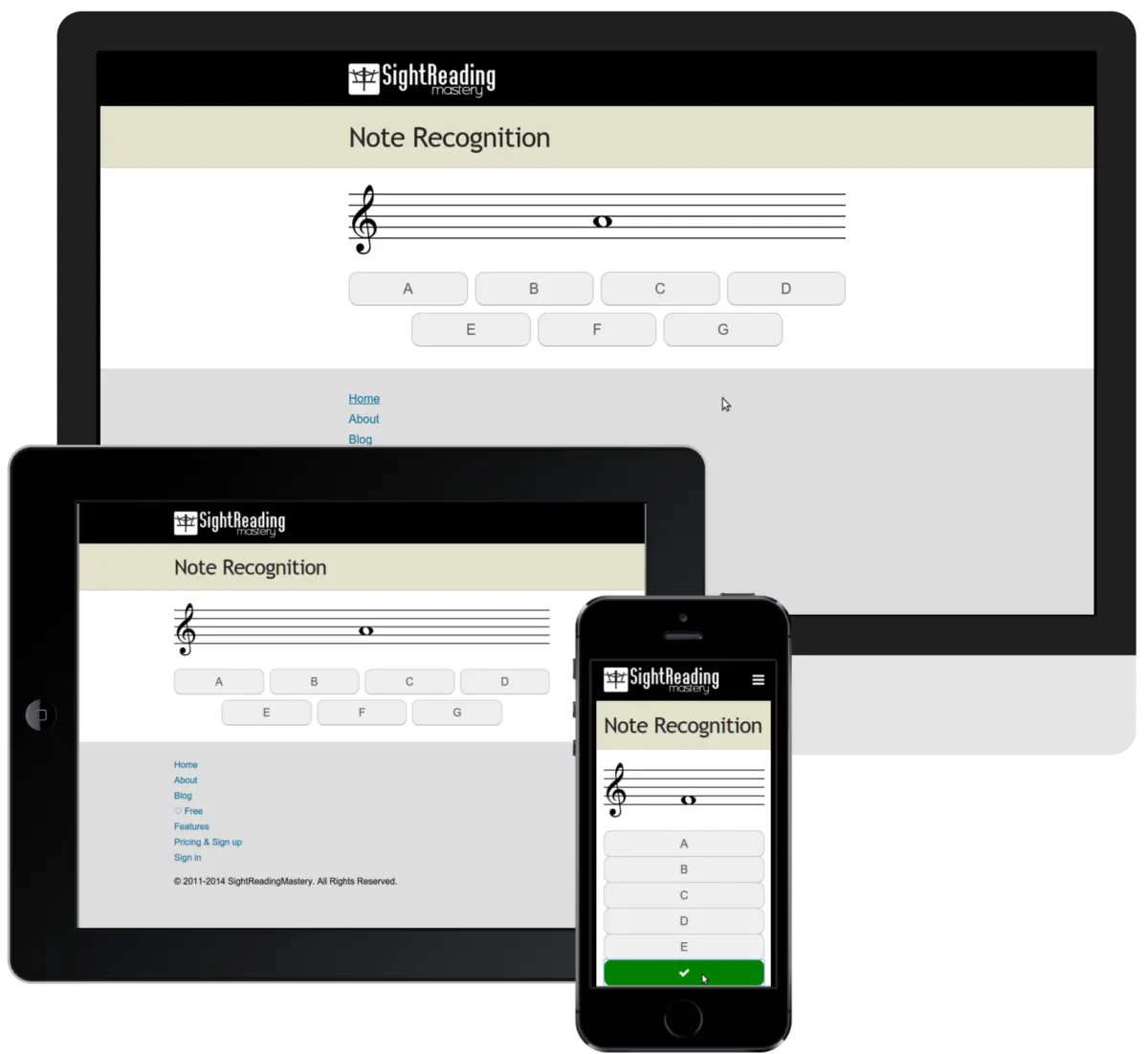
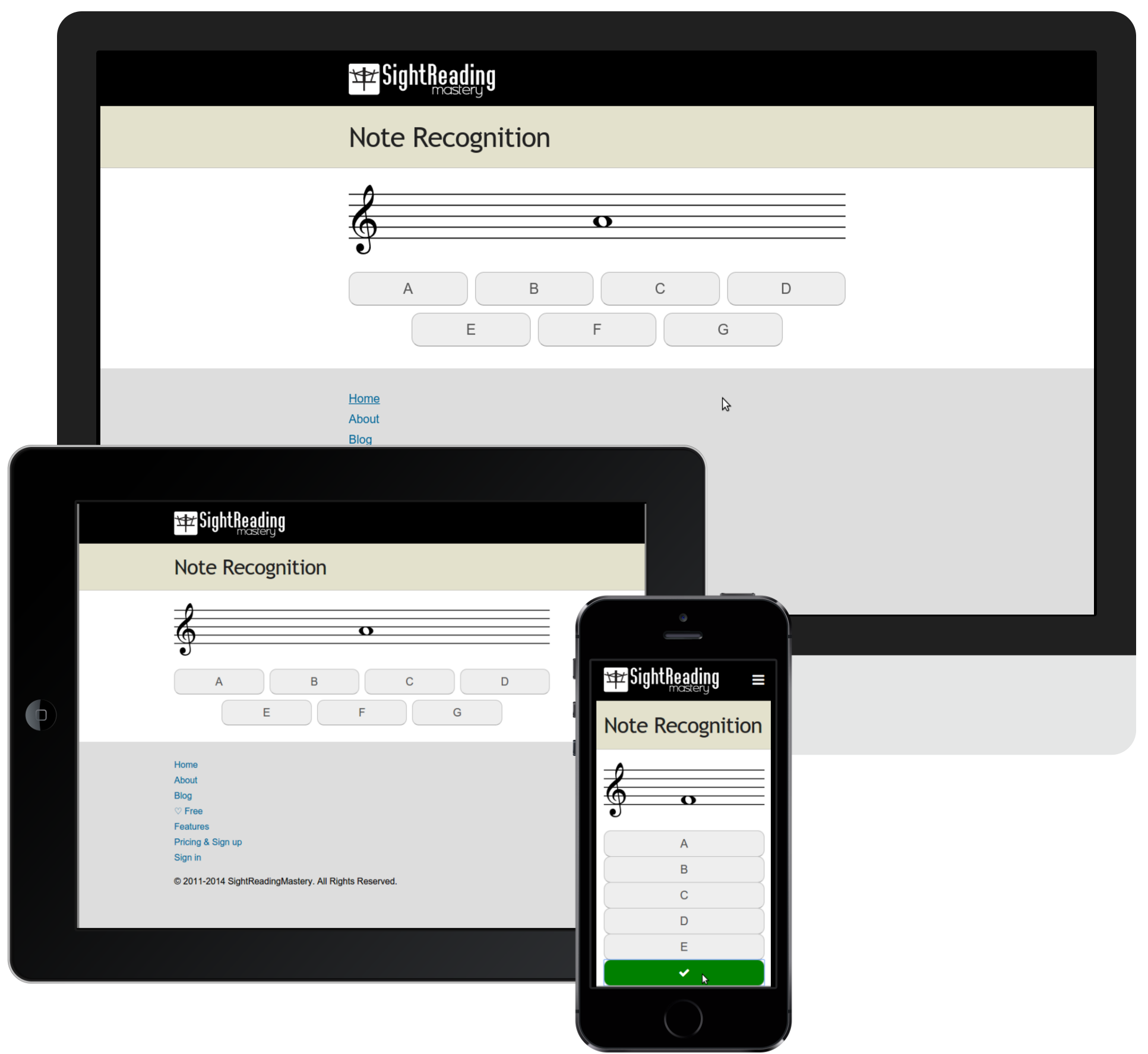
Another critical metric of the app’s success lies in its deployment architecture. Recognizing that modern students practice in diverse environments—ranging from traditional acoustic piano benches and band rooms to commuter trains and living room couches—the platform was built to be fully responsive.
Optimized to run smoothly across smartphones, tablets, and full-size desktop computers, the application eliminates the friction of traditional software installation. Users can simply open a web browser, navigate to the portal, and immediately engage in targeted practice. This portability dramatically increases daily practice frequency, adhering to the fundamental pedagogical principle that short, frequent micro-sessions yield superior neurological retention compared to infrequent, marathon study blocks.
Official Statements and Pedagogical Philosophy
At the heart of the SightReadingMastery ecosystem is the philosophy of its founder, Evan R. Murphy. Operating from Seattle, Washington, Murphy has spent over a decade analyzing the structural barriers that prevent otherwise dedicated musicians from achieving fluid sight-reading capabilities.
The Vision Behind the Tool
In outlining the rationale for the Note Recognition App, Murphy emphasizes that sight-reading is the ultimate gateway skill in musicianship. It unlocks the ability to explore vast repertoires independently, accelerates ensemble learning, and deepens overall musical comprehension.

"Realizing how important sight reading is to unlocking opportunities in music, we started SightReadingMastery… to help musicians develop this valuable skill," Murphy notes.
The introduction of the free online recognition tool was a direct extension of this mission. Rather than locking fundamental literacy tools behind expensive paywalls or cumbersome proprietary software, the team engineered a frictionless, accessible utility available to any musician with an internet connection.
Addressing the Realities of Instrumental Diversity
The evolution of the app—moving from a treble-clef-only prototype to a robust platform incorporating bass clef and ledger lines—reflects an authoritative understanding of cross-instrumental pedagogy. Pianos, harps, and orchestral conductors operate across grand staves requiring simultaneous processing of multiple clefs. By expanding the app’s scope, the developers ensured that pianists, bassists, low brass players, and upper-register instrumentalists alike could utilize the platform as an authentic daily training ground.
Future Outlook: The Ongoing Evolution of Digital Music Literacy
As educational technology continues to integrate artificial intelligence, machine learning, and advanced audio recognition, the horizon for tools like the SightReadingMastery Note Recognition App is expanding rapidly.
The Shift Toward Interactive Audio Feedback
While traditional visual-response drills (where a user identifies a note visually on screen) are extraordinarily effective for building cognitive speed, the next frontier of music education lies in real-time acoustic tracking. Future iterations of digital literacy tools are increasingly incorporating microphone-based pitch detection. This allows musicians to play or sing the recognized note into their device, creating a closed-loop system where visual recognition instantly triggers physical instrument execution and automated digital verification.
The Integration of Spaced Repetition Systems (SRS)
Another promising avenue for development is the integration of algorithmic spaced repetition—the same cognitive science methodology that powers modern language-acquisition apps. By tracking which specific notes, clefs, or ledger-line configurations a user struggles with most frequently, future platforms can automatically calibrate drill frequencies to target individual weaknesses, maximizing study efficiency.
Preserving Core Fundamentals in a Digital Age
Despite the rapid pace of technological innovation, the core mission championed by Evan R. Murphy and SightReadingMastery remains timeless: helping musicians decode the staff with absolute confidence. As digital learning tools become more sophisticated, platforms that prioritize clean design, pedagogical soundness, and zero-friction accessibility will continue to form the bedrock of modern music education.
For students, educators, and lifelong learners striving to unlock the full potential of their musical expression, tools like the Note Recognition App serve as an indispensable bridge between the printed page and effortless performance. Musicians interested in testing their skills and accelerating their cognitive fluency can access the tool directly via the official SightReadingMastery Note Recognition Portal.