
Executive Overview
Twenty-five years ago, the theatrical landscape of Broadway was forever altered by a show with a title so audacious, provocative, and seemingly off-putting that its creators initially struggled to find producers willing to touch it. Urinetown: The Musical—with music and lyrics by Mark Hollmann and a book and lyrics by Greg Kotis—officially began preview performances at Henry Miller’s Theatre (now the Stephen Sondheim Theatre) on August 27, 2001. Reminding audiences that “it’s a privilege to pee,” this unlikely satirical juggernaut evolved from a fringe festival experiment into a critical darling, a multiple Tony Award winner, and a global cultural phenomenon.
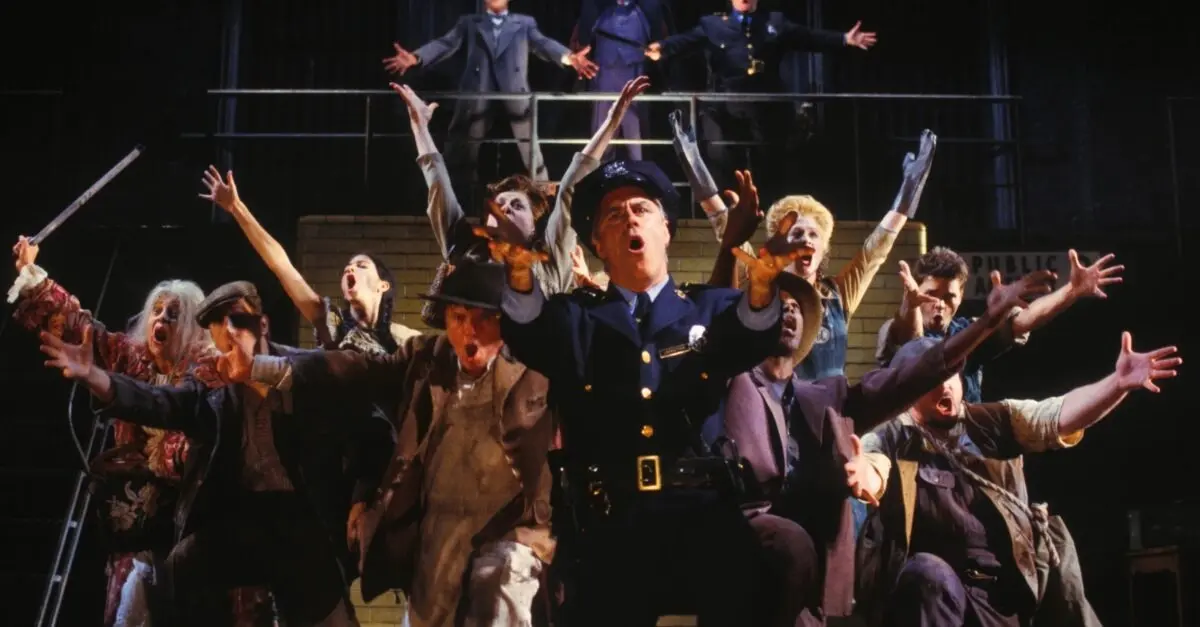
Set in a dystopian future paralyzed by a catastrophic 20-year drought and crippling water shortages, the musical presents a world where private toilets have been strictly outlawed to conserve every precious drop. Urination is corporatized and heavily monetized; citizens are forced to pay exorbitant fees at public, monopolized amenities or face banishment to the dreaded, mysterious "Urinetown." When Bobby Strong, an idealistic employee of the tyrannical Urine Good Company, sparks a populist uprising alongside Hope Cladwell—the daughter of the corporation’s ruthless CEO, Caldwell B. Cladwell—the show morphs into a razor-sharp critique of capitalism, income inequality, and the privatization of natural resources. Simultaneously, it functions as a loving, knowing parody of classic protest musicals like The Cradle Will Rock and Les Misérables.
Yet, the true legacy of Urinetown extends far beyond its biting social satire and musical ingenuity. Its Broadway debut coincided with one of the darkest chapters in modern American history: the terrorist attacks of September 11, 2001. As the first new musical to open in the wake of the tragedy, Urinetown became an accidental crucible for New York City’s emotional recovery, transforming theatre from mere entertainment into a vital, life-affirming communal force.
Over the past quarter-century, the show has transcended its humble origins. From its early days as an underdog entry at the New York International Fringe Festival to a celebrated 2025 Off-Broadway revival at New York City Center starring Jordan Fisher and Stephanie Styles, Urinetown has cemented its status as a timeless classic. With more than 3,670 licensed productions mounted across 34 countries, the musical continues to challenge, amuse, and provoke audiences worldwide, proving that even the most unpromising premise can achieve theatrical immortality when paired with brilliant writing and sheer resilience.
Detailed Chronology: From European Travel to the Great White Way
The Germination of an Unlikely Idea
The genesis of Urinetown reads like theatrical folklore. Co-creator Greg Kotis was inspired to write the show during a backpacking trip through Europe, where he frequently encountered pay-to-use public restrooms. Struck by the indignity and commercialization of a fundamental bodily function, Kotis began to wonder what kind of desperate societal breakdown would normalize such a practice on a mass scale.
Collaborating with composer-lyricist Mark Hollmann, Kotis set out to construct a show based on what they jokingly considered the worst, most commercially unviable concept imaginable.
“The concept, when Mark and I were building this show, was thinking of the worst concept for a show we could imagine and giving it a full expression,” Kotis reflected years later. “Sort of like what would the whole ‘Springtime for Hitler’ have been like from The Producers?”
Armed with this tongue-in-cheek philosophy, the duo crafted a sprawling, self-aware satire that gleefully broke the fourth wall while maintaining a surprisingly earnest commitment to its melodramatic narrative arc. However, pitching a musical titled Urinetown to traditional commercial producers proved to be an uphill battle. Time and again, investors balked at the name, failing to see past the scatological humor to the sophisticated political commentary beneath.
The Fringe Festival Breakthrough
When the Chicago Neo-Futurists, who were initially slated to shepherd the production, backed out, Hollmann and Kotis took matters into their own hands. Forming their own production company aptly named "Theatre of the Apes," they decided to produce the show themselves at the 1999 New York International Fringe Festival.
The gamble paid off spectacularly. Urinetown became the breakout hit of the festival, generating intense buzz, enthusiastic word-of-mouth recommendations, and selling out every performance—including standing-room-only allocations. Recognizing commercial potential where others had seen only risk, theatrical production entity The Araca Group stepped in to remount the show for a strictly limited engagement from May 6 to June 25, 2001.
The resounding success of this pre-Broadway run proved that audiences were hungry for something fresh, irreverent, and daringly original. Just two months later, the production packed its bags and transferred directly to Broadway, securing a home at Henry Miller’s Theatre. With Hunter Foster starring as the idealistic rebel Bobby Strong and Jennifer Laura Thompson portraying the wide-eyed heroine Hope Cladwell, the stage was set for a historic Broadway arrival.
Navigating the Shadow of 9/11
Urinetown was originally scheduled to officially open on Broadway on September 13, 2001. But two days prior, the world changed forever.
The terrorist attacks on the World Trade Center plunged New York City into profound shock and chaos. In the immediate aftermath, Broadway theaters went dark on September 11 and 12. As the city reeled, then-Mayor Rudy Giuliani strongly urged cultural institutions to reopen as soon as possible, arguing that resuming normal activities was a vital act of defiance against terror and a necessary step toward civic healing.
For the cast and crew of Urinetown, the decision to return to the stage was fraught with emotional turbulence. Reflecting on that dark period, star Hunter Foster admitted to having deeply conflicted feelings about performing while the city was still smoking and mourning:
“Trust me, the last thing I wanted to do was perform. But, there was a feeling that maybe if we did, we could bring a little hope back to this terror-ravaged city.”
Foster recalled that the performance on September 13 was “one of the hardest nights of my life.” Yet, what awaited the cast upon the final curtain drop transcended traditional theatrical validation. As the actors exited the Henry Miller Theatre stage door onto 43rd Street, they were met by an unexpected sight: nearly the entire audience was waiting for them.
For roughly an hour, cast members and theatergoers stood together on the street, sharing hugs, shedding tears, and processing their collective trauma while military fighter jets roared overhead on constant air patrol.
“The audience members thanked us. Told us how brave we were to perform again, and how much they needed this,” Foster remembered.
Opening Night and Tony Triumph
After navigating these unprecedented emotional waters, Urinetown officially opened on September 20, 2001, earning the distinction of being the first new Broadway show to premiere in the post-9/11 era. Far from being overshadowed by the tragedy, the musical’s themes of resilience, rebellion against oppressive systems, and community solidarity struck a deeply resonant chord with theatergoers seeking solace, laughter, and catharsis.
The production became a critical and commercial darling, running for more than two years before closing on January 18, 2004, after 965 performances and 25 previews. During the 2002 Tony Awards ceremony, Urinetown dominated the competition, pulling in nine nominations and securing three major victories:
- Best Book of a Musical (Greg Kotis)
- Best Original Score (Mark Hollmann and Greg Kotis)
- Best Direction of a Musical (John Rando)
Supporting Context & Metrics: Cultural Impact and Global Footprint
To fully appreciate the scope of Urinetown, one must examine the quantitative metrics of its longevity and international reach. What began as an underdog experiment at a fringe festival has transformed into a staple of modern musical theater repertoire.
According to Music Theatre International (MTI), which handles the global licensing rights for the show, Urinetown has achieved staggering penetration across educational, community, and professional theater markets worldwide. As of recent data, the show boasts:
- Over 3,670 licensed productions mounted across the globe.
- Performances staged in 34 distinct countries, demonstrating that its satirical targets—corporate greed, environmental degradation, and bureaucratic absurdity—translate across cultural and linguistic divides.
| Metric Category | Statistical Detail |
|---|---|
| Broadway Run | August 27, 2001 – January 18, 2004 (965 regular performances, 25 previews) |
| Tony Recognition | 9 Nominations, 3 Wins (Best Book, Best Score, Best Direction) |
| Global Reach | 3,670+ licensed productions in 34 countries |
| First New York Revival | 2025 at New York City Center (Off-Broadway) |
The show’s success also lies in its clever pastiche style. By explicitly referencing the conventions of Brechtian epic theatre, Rodgers and Hammerstein optimism, and gritty revolutionary anthems like Les Misérables, Urinetown serves as both a parody and a celebration of the art form itself. Characters openly debate the limitations of musical theater tropes, narrative pacing, and unhappy endings, creating a meta-theatrical experience that delights both casual theatergoers and seasoned aficionados.
Official Statements and Archival Reflections
The unique journey of Urinetown has inspired extensive reflection from its creators and cast members over the past quarter-century. Speaking candidly about the show’s unorthodox identity, Greg Kotis noted in early interviews that the title was intentionally chosen to test the boundaries of audience convention:
“A lot of people wouldn’t give the show a chance based on the title, but there’s a huge market that would want to see this just because it’s odd. It’s not profane; urine isn’t a bad word. Urinetown! exists in the tradition of off-beat, quirky, heightened shows, like Rocky Horror and Little Shop of Horrors.”
This lineage of alternative, dark musical comedy helped carve out a dedicated niche for Urinetown, proving that commercial viability does not require conventional sanitization. The show’s willingness to court controversy and embrace absurdism became its greatest asset.
Furthermore, the intersection of the show’s Broadway opening with the historical trauma of September 11 remains a foundational chapter in Broadway lore. As artists continue to look back at how theater functioned as a life force during moments of civic crisis, the story of the cast of Urinetown standing on 43rd Street, embracing weeping audience members beneath the roar of fighter jets, stands as a testament to the enduring power of live performance to heal fractured communities.
Future Outlook: The 2025 Revival and Beyond
Twenty-five years after its initial Broadway bow, Urinetown shows no signs of fading into theatrical obscurity. The enduring relevance of its themes—corporate monopolies on basic human needs, ecological disaster, and the friction between civic compliance and revolutionary justice—feels increasingly prescient in the modern socio-political climate.
This enduring vitality was underscored in 2025 when Urinetown received its first major New York revival. Staged as part of the esteemed Off-Broadway season at New York City Center, the production brought a fresh generation of talent to the material, starring Jordan Fisher as Bobby Strong and Stephanie Styles as Hope Cladwell. The revival proved that the show’s razor-sharp wit, infectious score, and dizzying theatricality remain as potent and entertaining as they were at the turn of the millennium.
As universities, regional theaters, and international companies continue to program the show at a remarkable clip, Urinetown has firmly secured its place in the modern musical theater canon. It stands as a shining reminder that artistic risks, when backed by uncompromising vision, razor-sharp craftsmanship, and genuine heart, can weather any storm—whether it is an initial resistance to a provocative title, or the darkest days of a city recovering from tragedy. Ultimately, Urinetown taught a generation of theatergoers that while using the restroom may indeed be a privilege, experiencing great, daring musical theater is an absolute necessity.