
Executive Overview
Ask any music educator about the greatest hurdle in their professional life, and you will likely receive a consistent, resounding response that has little to do with shrinking arts budgets, bureaucratic scheduling, or outdated auditorium sound systems. By a margin that doubles any other obstacle, music teachers point to a singular, pervasive challenge: getting students to practice effectively outside of lessons.
This quiet struggle forms the invisible baseline of modern music instruction. The student who routinely practices advances, develops a deep appreciation for the craft, and builds enduring confidence. Conversely, the student who struggles with solo practice often hits a frustrating plateau, leading to self-doubt and the tragic conclusion that they are "simply not musical."
Educators know this perception is entirely false. They can vividly hear the immense potential locked inside every student, waiting for twenty minutes of daily, focused application. Yet, the systemic barrier remains: instructors cannot sit in thirty different living rooms every evening.
For generations, this gap between lessons was a black box—a guessing game of shrugged shoulders, well-intentioned half-efforts, and inadvertently memorized mistakes. However, a major paradigm shift is underway. By integrating real-time, interactive feedback technology like MakeMusic Cloud, the educational community is redefining home practice. This article investigates the anatomy of the practice dilemma, explores the psychological and pedagogical barriers students face, examines the metrics of effective learning loops, and looks ahead to the future of tech-enabled music classrooms.
Detailed Chronology of the Music Practice Dilemma
To understand how the modern practice crisis evolved, we must examine the historical framework of music pedagogy. For centuries, the standard model of music instruction has rested on a weekly or bi-weekly touchpoint:
- The Lesson (Day 1): The teacher diagnoses technical faults, demonstrates proper phrasing, introduces new repertoire, and assigns specific measures for the week. High engagement, immediate feedback, and structural clarity define this hour.
- The Void (Days 2 through 6): The student returns home. The supportive environment of the studio vanishes. The printed score becomes a solitary puzzle. Without immediate guidance, motivation wanes, and technical misconceptions begin to take root.
- The Return (Day 7): The student plays the assigned piece, often having practiced mistakes into permanent muscle memory. The teacher spends valuable lesson time diagnosing errors rather than advancing musicality, resulting in mutual frustration.
The Evolution of Student Support Tools
For decades, the tools available to bridge this chasm were rudimentary:
- The Metronome (Late 19th Century to Present): Essential for timing, but incapable of evaluating pitch accuracy, tone quality, or interpretive nuance.
- Audio and Video Recordings: Useful for self-assessment, but demanding a level of metacognitive maturity that many young students have not yet developed. A beginner listening to their own recording often cannot distinguish between a minor intonation flaw and an acceptable performance.
- Digital Practice Logs: Designed to enforce accountability through time tracking, but ultimately measuring duration rather than quality of engagement. A student can stare at a music stand for thirty minutes without making genuine cognitive progress.
Recognizing that the traditional model was structurally flawed, progressive educators began advocating for tools that could extend the teacher’s presence into the home without replacing the human element. The recent maturation of cloud-based music education platforms represents the culmination of this historical push for continuous, constructive feedback loops.
Supporting Context & Metrics: Why Traditional Practice Fails
The assumption that children who do not practice are simply lazy or unmotivated is one of the most damaging myths in music education. In reality, practicing alone is genuinely difficult, psychologically isolating, and structurally flawed.
The Trap of Rehearsing Mistakes
Consider the cognitive load placed upon a student practicing in their bedroom:
- No real-time ear beside them to flag a flat pitch.
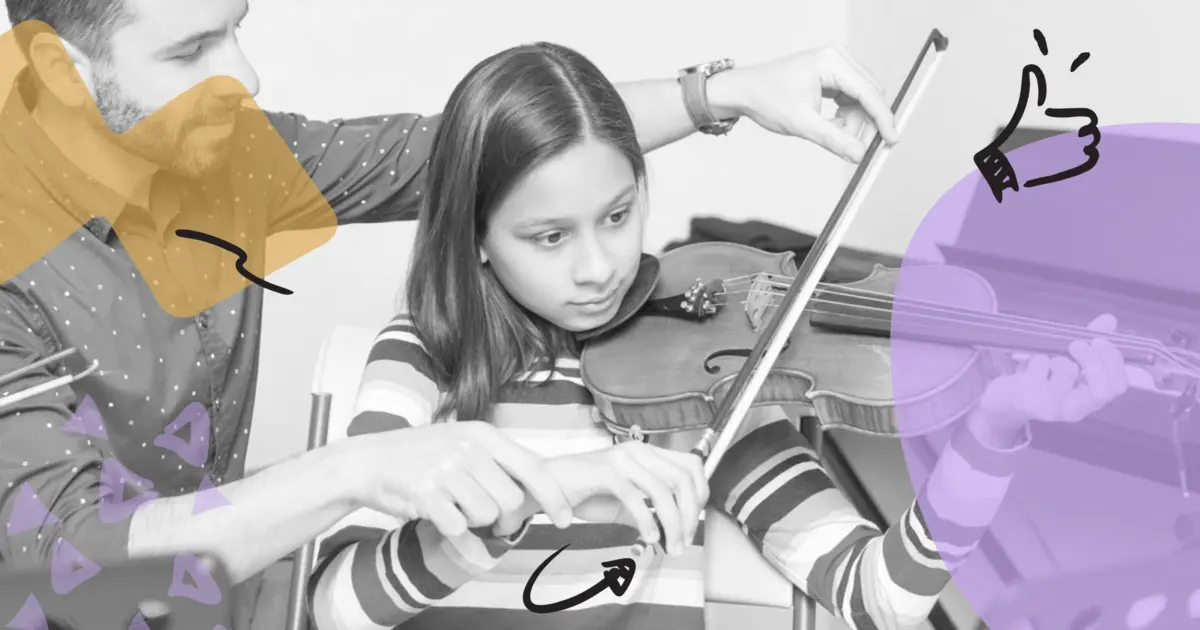
- No visual cue to correct an improper bow hold or finger placement.
- No immediate way to verify whether a complex syncopated rhythm is accurate.
When left to navigate ambiguous notation independently, a student will often play a passage incorrectly twenty times. Because repetition feels physically active, the brain registers the act as "progress." The student arrives at their next lesson convinced they have mastered the assignment, only to be corrected. This cycle is profoundly demoralizing. Repeated enough times, it leads to the standard defensive response: a shrug and a casual, "Good."
The Power of the Feedback Loop
Educational psychology demonstrates that the speed of learning is directly proportional to the immediacy of feedback. When a teacher is physically present in the studio, they close the feedback loop instantly:
[Student Plays] ---> [Instant Teacher Intervention] ---> [Immediate Correction] ---> [Correct Muscle Memory Formed]Without technology, the home practice loop looks drastically different:
[Student Plays] ---> [Days of Uncorrected Practice] ---> [Mistake Becomes Permanent] ---> [Lesson Correction & Frustration]Data from progressive music programs indicate that when students are equipped with instant visual and auditory feedback mechanisms during home practice, their retention rates soar. By replacing the guessing game with objective, real-time indicators of pitch and rhythm accuracy, students stop drilling errors and start building reliable technical foundations. Consequently, practice sessions naturally lengthen—not because of parental coercion, but because visible, immediate progress triggers intrinsic motivation.
Official Perspectives from the Educational Frontlines
Music educators, administrators, and cognitive scientists have increasingly spoken out about the urgent need to modernize home practice methodologies.
Dr. Elena Vance, a prominent cognitive musicologist and pedagogical researcher, notes:
"We have spent centuries perfecting what happens inside the lesson room while largely ignoring the black box of home practice. Expecting an eight-year-old to self-correct complex musical notation without a feedback loop is the equivalent of asking a child to learn a foreign language by handing them a dictionary and locking them in a room. The effort is there; the scaffolding is what’s missing."
High school band directors and private studio instructors echo these sentiments. Traditional lesson time is routinely squandered on diagnostic detective work—trying to figure out why a student is struggling with a specific measure, rather than teaching musicality, expression, and ensemble dynamics.
Industry insights from platforms dedicated to closing this gap emphasize that technology should never replace the mentor; rather, it should protect the sanctity of the human connection in teaching. By automating the tracking of fundamental mechanics—such as note accuracy and rhythmic precision—digital tools free up educators to focus on artistry, emotional interpretation, and mentorship.
Future Outlook: The Tech-Enabled Music Studio
As we look toward the future of music education, the integration of intelligent practice software is poised to become the industry standard rather than an optional luxury. Several key trends are shaping this evolution:
1. Data-Driven Pedagogy
Educators will increasingly leverage pre-class analytics. Platforms like MakeMusic Cloud allow teachers to review detailed student practice metrics before walking into a classroom or opening a virtual studio. Instructors can see precisely which measures caused widespread hesitation, transforming lesson planning from reactive troubleshooting to proactive coaching.
2. Gamified Mastery and Intrinsic Motivation
As real-time feedback loops become seamless, the psychological barrier of practice diminishes. Students who experience immediate visual confirmation of a correctly played phrase are more likely to lean into challenging repertoire. The cultural narrative will shift away from the dreaded "practice mandate" toward self-directed musical exploration.
3. Preserving the Human Element
There is a common anxiety that technology in the arts will depersonalize instruction. However, the opposite is occurring in progressive music studios. By eliminating the administrative and diagnostic friction of home practice, technology returns valuable time to the human teacher.
Conclusion
The hardest part of teaching music has never been the music itself. It is the vast, silent expanse of time spent outside the studio—the hours when the student is entirely on their own, wrestling with notation, rhythm, and self-doubt.
By equipping students with intelligent, real-time feedback tools that bridge the gap between lessons, educators are fundamentally altering the emotional and technical landscape of music learning. The traditional shrug is being replaced by genuine enthusiasm and the proud declaration: "Wait, listen to what I figured out."
Solving the practice puzzle does not just produce better musicians; it preserves the joy of creation, turning a solitary struggle into a shared, lifelong passion.