
Executive Overview
Few musical compositions capture the profound stillness, stark beauty, and quiet reverence of the winter season quite like the Christmas carol "In the Bleak Midwinter." Rooted in a deeply evocative 19th-century poem by Christina Rossetti, the carol has transcended its literary origins to become a cornerstone of global holiday traditions. While traditionally experienced through choral performances in grand cathedrals and local churches alike, the piece continues to inspire contemporary instrumental interpretations.
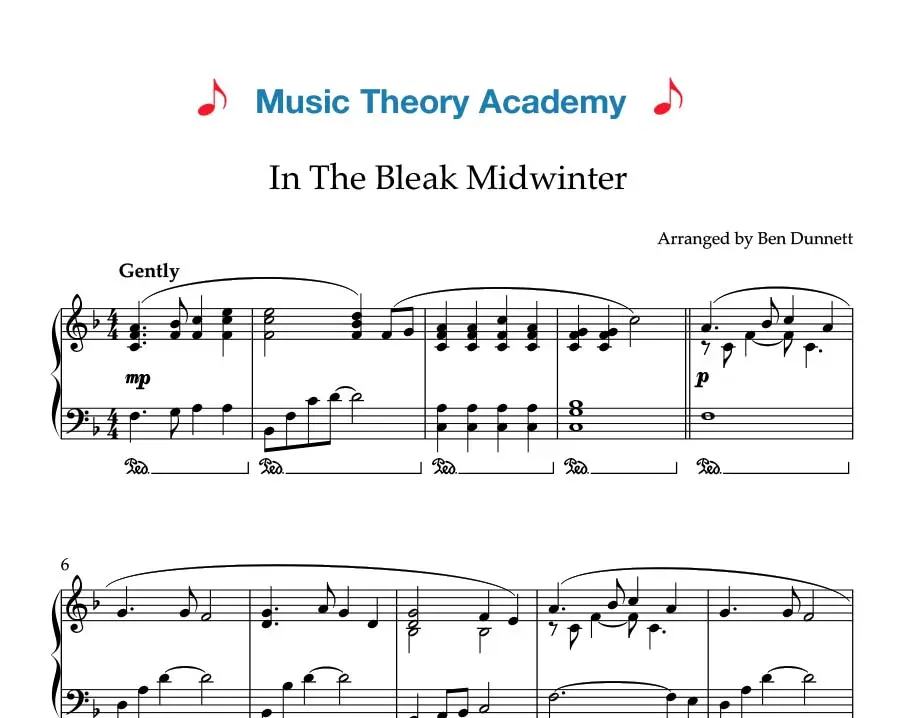
In this comprehensive feature, we examine a specialized, highly anticipated piano arrangement of the carol by experienced composer, educator, and Music Theory Academy founder Ben Dunnett, LRSM. Taken from his album 10 Christmas Carols, Dunnett’s rendition breathes fresh life into the globally recognized melody composed by Gustav Holst—famously titled "Cranham."
Designed for intermediate to advanced pianists, Dunnett’s arrangement bridges the gap between accessible holiday music and technically rigorous classical performance. This article offers an in-depth exploration of the arrangement’s structural mechanics, a chronological look at the carol’s historical and musical evolution, technical performance metrics, insights from the composer himself, and an outlook on the enduring legacy of piano arrangements in modern music education.
Detailed Chronology: From Rossetti’s Verse to Dunnett’s Modern Arrangement
To fully appreciate the scope and complexity of Ben Dunnett’s contemporary piano adaptation, one must first trace the historical trajectory of "In the Bleak Midwinter." The journey of this beloved Christmas staple spans more than a century and a half, weaving together Victorian poetry, early 20th-century English classical composition, and modern pedagogical arranging.
1872: The Poetic Foundation
The genesis of the carol dates back to January 1872, when English poet Christina Rossetti published the poem titled "A Christmas Carol" in the American magazine Scribner’s Monthly. Rossetti, a prominent literary figure of the Victorian era known for her mastery of devotional and melancholic themes, crafted a five-stanza masterpiece. The poetry contrasted the harsh, unyielding physical elements of midwinter—"Earth stood hard as iron, water like a stone"—with the profound theological mystery of the Incarnation, culminating in the intimate, selfless offering of a human heart. At the time of publication, Rossetti’s words were purely literary; they were not yet paired with any specific musical accompaniment.
1906: The Holst Masterpiece Emerges
More than three decades after Rossetti’s poem captivated readers, composer Gustav Holst—renowned worldwide for his orchestral suite The Planets—was approached to provide a tune for the text. Published in the 1906 English Hymnal, Holst’s melody, christened "Cranham," instantly resonated with congregations. Holst’s setting was characterized by a sublime, hymn-like simplicity that mirrored the quiet austerity of Rossetti’s verses. Though a competing, more ornate melody was later composed by Harold Darke in 1909, it was Holst’s "Cranham" that secured a permanent place in the global choral consciousness.
Late 20th Century: Choral Omnipresence
Throughout the mid-to-late 1900s, "In the Bleak Midwinter" (specifically the Holst setting) became an indispensable fixture of Festival of Nine Lessons and Carols services, most notably championed by the Choir of King’s College, Cambridge. Its evocative harmonies and solemn pacing made it a universal vehicle for choral reflection, though its presence in solo instrumental repertoires remained largely confined to traditional church organ improvisations.
November 2022: The Modern Piano Adaptation
Seeking to expand the solo piano repertoire for festive music, composer and educator Ben Dunnett embarked on a project to adapt ten canonical Christmas carols for intermediate and advanced pianists. Released as part of his album 10 Christmas Carols, Dunnett’s arrangement of "In the Bleak Midwinter" was published alongside freely accessible pedagogical resources via the Music Theory Academy. By translating a fundamentally vocal and choral work into a structurally rich solo piano piece, Dunnett provided musicians with a fresh avenue to explore the emotional depths of Holst’s melody.
Supporting Context & Metrics: Structural and Technical Analysis of the Score
Ben Dunnett’s arrangement of "In the Bleak Midwinter" is far more than a simple transcription of vocal chords onto a grand staff; it is a meticulously crafted solo piano work designed to test and refine a pianist’s technical control, dynamic expression, and interpretive nuance.
Key Signature and Harmonic Progression
The arrangement is primarily anchored in the key of F major, a tonality frequently associated with pastoral warmth, clarity, and lyrical grace. However, Dunnett cleverly subverts expectations by modulating to D minor for a poignant, introspective section in the middle of the piece. This shift from major to minor mirrors the emotional contrast within Rossetti’s poetry—moving from the stark, freezing external landscape into the deeply personal interiority of the final stanzas.

Technical Metrics and Performance Challenges
For pianists approaching the three-page score, several specific technical demands require careful preparation:
- Pedaling Discipline: The left hand relies heavily on arpeggiated chords that stretch across wide registers. Pianists must master precise damper pedal techniques to sustain these rich sonic textures without blurring the harmonic transitions. The pedal must be cleanly lifted at the end of each bar to "refresh" the acoustic space.
- Structural Framing: The piece opens with a distinct introductory passage that establishes the frosty, atmospheric mood. This same material reappears strategically as an interlude between the verses, serving as a narrative bridge.
- Progressive Textural Decoration: As the arrangement progresses through the verses, the right-hand accompaniment becomes increasingly ornate. What begins as a sparse, delicate melodic line evolves into a rich tapestry of supportive counter-melodies and figuration.
- Register Shifts and Clef Fluctuations: One of the most demanding technical hurdles in Dunnett’s arrangement occurs when both hands move dynamically upward into higher pitch ranges. During these passages, the left hand frequently shifts between Bass Clef and Treble Clef. Pianists must pay meticulous attention to these clef changes to avoid misreading notes during high-register sequences.
Official Statements and Pedagogical Insights
To understand the artistic philosophy guiding this arrangement, one must look to the creator himself. Ben Dunnett LRSM—a seasoned music teacher, examiner, and pianist with over twenty years of experience in music education—has consistently advocated for repertoire that balances technical rigor with profound emotional engagement.
In commentary accompanying the release of the score, Dunnett shared his motivations for tackling such a revered piece:
"In the Bleak Midwinter is a timeless piece of music that carries an incredible emotional weight through both its lyrics and Holst’s iconic melody. When arranging this for solo piano within my ’10 Christmas Carols’ album, my goal was to honor the stillness of the original hymn while giving the pianist enough expressive and technical tools to make the instrument truly sing. It is challenging, yes, but it is designed to reward the player’s patience and technical precision with moments of genuine beauty."
Reflecting on the broader mission of the Music Theory Academy, Dunnett emphasizes that educational resources should be made readily available to foster a global community of lifelong learners:
"Music education should never feel locked behind paywalls or elitist barriers. By offering high-quality arrangements alongside accessible breakdowns of their technical challenges—from clef shifts to pedal control—we empower students and independent pianists to stretch their boundaries and discover a deeper connection to the music they play."
Future Outlook: The Evolution of Solo Piano Carols in Modern Education
As the digital landscape continues to reshape how musicians discover, share, and study sheet music, works like Ben Dunnett’s arrangement of "In the Bleak Midwinter" point toward an encouraging future for classical and contemporary pedagogy.
The Shift Toward Hybrid Digital-Analog Learning
The integration of embedded media—such as high-definition performance videos on platforms like YouTube—alongside downloadable, high-resolution PDF scores represents a paradigm shift in music education. Students are no longer restricted to static printed pages; instead, they can audit professional interpretations aurally and visually before diving into the tactile work of practicing the score. This multi-sensory approach accelerates learning curves and encourages more nuanced, stylistically accurate performances.
Sustaining Classical Traditions Through Contemporary Adaptations
As modern audiences increasingly seek out intimate, acoustic arrangements for holiday reflection, solo piano interpretations of choral standards are experiencing a renaissance. Pianists are continually searching for repertoire that offers both sentimental resonance and intellectual stimulation. By transforming vocal hymns into sophisticated piano miniatures, composers like Dunnett ensure that 19th-century poetry and early 20th-century English harmonies remain vibrant, living art forms for 21st-century musicians.
Looking ahead, the demand for sophisticated yet accessible seasonal repertoire is projected to grow. Educators and independent artists alike are expected to continue leveraging digital publishing platforms to distribute pedagogical gems directly to global audiences. Whether performed on a concert grand stage or in the quiet warmth of a family living room during a snowy December evening, pieces like In the Bleak Midwinter will undoubtedly continue to inspire players to "give their heart" to the art of the piano.