
Executive Overview
In an era where digital content is routinely locked behind paywalls, subscription models, and tiered memberships, the classical and contemporary piano communities are being offered a refreshing exception. Ben Dunnett LRSM, an esteemed composer, experienced music educator, and the founder of the globally recognized Music Theory Academy, has officially made his reflective contemporary piano piece, “A Time to Heal,” completely free to the public.
Extracted from his acclaimed studio album A Time for Everything, the composition serves as both an artistic triumph and a generous gift to pianists worldwide. By releasing the full, unbridled 3-page sheet music alongside streaming access on Spotify, Dunnett is democratizing access to high-quality contemporary repertoire. This initiative underscores a growing movement among independent artists who value community engagement, education, and emotional resonance far above immediate commercial gatekeeping.
For intermediate and advanced pianists alike, “A Time to Heal” provides a rich canvas for technical expression and emotional storytelling. This article explores the background of the piece, the artistic philosophy of its creator, the structural anatomy of the composition, and the broader implications of free educational resource distribution within the modern digital music landscape.
Detailed Chronology & Background
The journey of “A Time to Heal” begins long before its recent digital distribution milestone. To understand the depth of the composition, one must examine the creative evolution of its composer, Ben Dunnett, and the conceptual framework of the album from which it originates.
The Roots of the Music Theory Academy
Ben Dunnett’s career in music education spans more than two decades. As a multi-faceted professional—functioning concurrently as a music teacher, formal examiner, seasoned pianist, and composer—Dunnett recognized a persistent gap in the digital landscape: students and independent learners frequently struggled to find reliable, high-grade, and theoretically sound materials online without falling prey to predatory subscription traps or misleading advertisements.

Driven by a passion to make music theory and performance accessible, Dunnett launched the Music Theory Academy. Over the years, the platform evolved from a modest resource hub into an authoritative global academy, offering comprehensive guides, structured learning pathways, and curated sheet music collections.
Conception of A Time for Everything
As Dunnett continued to compose original works, he synthesized his pedagogical insights with his personal artistic voice. This synthesis culminated in the studio album A Time for Everything. The album’s conceptual framework draws heavily on themes of human experience, emotional cycles, and introspective healing.
“A Time to Heal” was penned as a pivotal movement within this larger body of work. Rather than relying on virtuosic pyrotechnics or overwhelmingly dense polyphony, Dunnett focused on tonal warmth, spacious phrasing, and harmonic reflection. Upon its initial recording and release on streaming platforms like Spotify, the track resonated deeply with listeners seeking tranquility in a fast-paced, high-stress world. Recognizing the grassroots demand from pianists who wanted to recreate the track at home, Dunnett initiated the project to digitize, format, and distribute the official sheet music without financial barriers.
Supporting Context & Musical Anatomy
To truly appreciate the value of Dunnett’s free sheet music offering, it is essential to examine the musical construction of “A Time to Heal” and the technical challenges it presents to the modern pianist.
Harmonic Language and Mood
Stylistically, “A Time to Heal” aligns itself with contemporary classical and neo-classical movements—genres populated by influential modern composers such as Ludovico Einaudi, Yann Tiersen, and Ólafur Arnalds. The piece relies heavily on modal shifts, lush chord voicings, and a delicate balance between rhythmic consistency and expressive rubato.

The tonal center is designed to evoke a sense of quiet contemplation and gradual emotional restoration. Moving gracefully through thoughtful harmonic progressions, the piece avoids jarring dissonances in favor of suspensions and resolutions that mirror the psychological journey from pain to recovery.
Structural Breakdown of the 3-Page Score
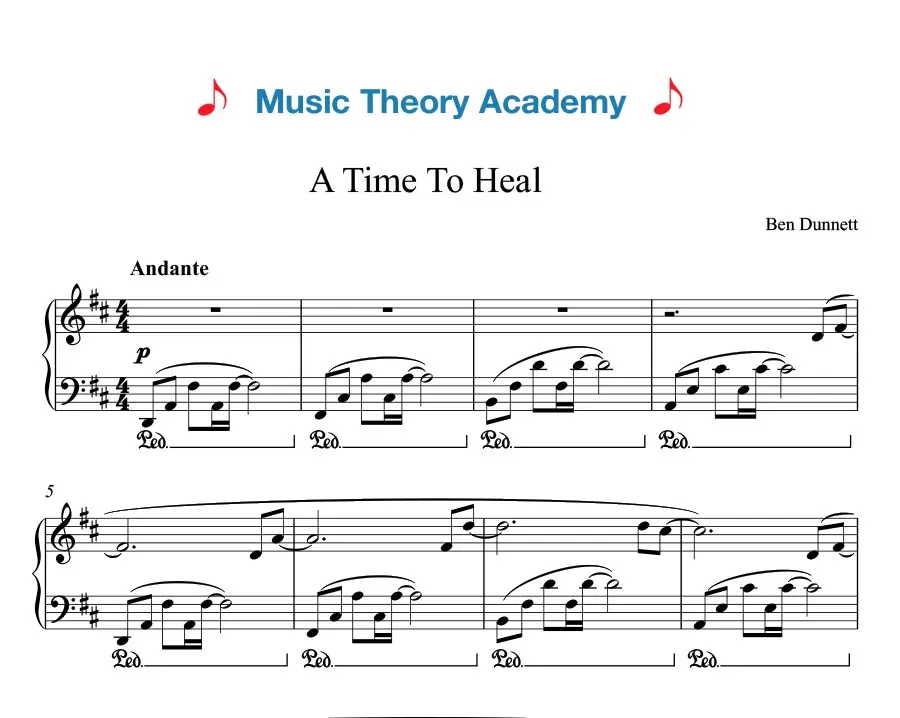
The official sheet music, spanning three cleanly engraved pages, is meticulously formatted for readability and ease of study.
- The Introduction: The piece opens with a gentle, rolling accompaniment figure in the left hand that establishes a calm, meditative pulse. The right hand enters with an expressive, lyrical motif that invites the player to focus heavily on tone production and legato phrasing.
- The Development: As the composition progresses into its second page, the texture thickens subtly. Dunnett introduces wider intervals and fuller chords, requiring the pianist to exercise careful dynamic control so that the melody sings effortlessly above the accompanying arpeggiated patterns.
- The Resolution: The final page brings a gradual deceleration of harmonic motion, leading the listener back to a state of profound stillness. The piece closes with a quiet, lingering cadence that leaves a lasting emotional footprint.
Pedagogical Value for Pianists
For piano teachers and self-taught musicians, “A Time to Heal” serves as an exceptional pedagogical tool. It targets several crucial technical skills:
- Independent Hand Balancing: Students must learn to project a delicate, singing melody in the right hand while maintaining a soft, perfectly even background texture in the left.
- Pedaling Technique: Proper use of the sustain pedal is vital to blur the harmonies just enough to create warmth without muddying the intricate voice-leading.
- Musicality and Phrasing: Because the piece is not bound by rigid, metronomic tempos, players are encouraged to utilize rubato, shaping phrases organically as though they were singing through the instrument.
Official Statements and Industry Impact
The decision by an established artist and examiner of Dunnett’s caliber to distribute professional-grade sheet music entirely free of charge has drawn positive attention from educators and digital music advocates alike.
The Philosophy of Open Access in Music Education
In recent years, the commercialization of digital sheet music has created significant financial hurdles for students, particularly those in underfunded schools or developing regions. While copyright protection and fair compensation for artists remain critical issues, the barrier to entry for learning contemporary piano literature has often been unnecessarily high.

By offering “A Time to Heal” as a direct download—coupled with a straightforward newsletter opt-in for future releases—Dunnett bridges the gap between commercial independence and community generosity. In statements accompanying the release of his compositions, Dunnett has consistently emphasized that music is, above all, a medium for communication and emotional connection. Allowing individuals to learn, perform, and interpret his work without financial friction multiplies the cultural impact of the composition.
Community Reception
Since the sheet music was made available, pianists from around the globe have shared recordings of their interpretations across social media channels, tagging the Music Theory Academy and expressing gratitude for the accessible resource. This organic grassroots promotion highlights the power of value-first digital strategies in the modern creative economy. Rather than hoarding intellectual property, artists who embrace open-source or freemium distribution models often cultivate intensely loyal, highly engaged fanbases.
Future Outlook & Ongoing Projects
The successful rollout of the sheet music for “A Time to Heal” marks neither an isolated event nor the conclusion of Ben Dunnett’s publishing efforts. It represents a continuing commitment to expanding the repertoire available through the Music Theory Academy.
Expanding the Repertoire
Dunnett’s catalogue of original piano works continues to grow. Pieces such as “Solace” and “A Time to Mourn” demonstrate his ongoing exploration of the human emotional spectrum through instrumental music. Observers of the Music Theory Academy anticipate further releases, potentially culminating in a complete, physically bound songbook of the A Time for Everything album cycle.
The Future of the Music Theory Academy
As digital education continues to evolve, platforms like the Music Theory Academy are uniquely positioned to shape the next generation of musicians. By blending rigorous theoretical instruction with practical, emotionally engaging performance material, Dunnett and his team are redefining what an online music hub can achieve.

For aspiring pianists, teachers, and music lovers looking to expand their repertoires, the path forward is clear. One can stream “A Time to Heal” on Spotify to absorb its atmospheric nuance, and subsequently navigate to the Music Theory Academy to download the free 3-page score. In doing so, players not only acquire a beautiful piece of contemporary piano literature but also participate in a vibrant, generous community dedicated to the universal language of music.