
Executive Overview
In an era where modern houses of worship strive to offer immersive, dynamic, and spiritually uplifting experiences, a critical demographic is frequently overlooked: individuals experiencing hearing loss. For many congregants, attending a traditional church service can be an isolating experience rather than a communal one. Acoustic challenges, high reverberation times in traditional sanctuaries, background instrumentation, and the soft-spoken delivery of pastors or lectors often combine to create an environment where the spoken word is muddy, distant, and ultimately incomprehensible.
The implementation of an Assistive Listening System (ALS) is no longer merely an ADA (Americans with Disabilities Act) compliance checkbox or a secondary ministry amenity; it is a profound declaration of radical hospitality. By bridging the acoustic gap between the pulpit and the pew, houses of worship can ensure that every member of their community—regardless of auditory ability—can fully engage with sermons, prayers, and musical worship.
This special report explores the strategic roadmap for introducing, funding, and managing an effective Assistive Listening System within a faith-based organization. Drawing from industry standards, expert insights from audio-visual integration specialists like CCI Solutions, and technological frameworks established by leaders such as Listen Technologies, this article provides a detailed, four-step chronological blueprint for success. From initial congregation assessments and budgeting to staff training, change management, and community-wide awareness campaigns, we examine how spiritual leaders can cultivate a truly inclusive auditory environment.
Detailed Chronology: The Four-Step Implementation Roadmap
Successfully deploying an Assistive Listening System requires a deliberate, methodical approach. Rushing the integration without adequate preparation often leads to underutilized equipment, frustrated volunteers, and a failure to reach the intended demographic. Ministry leaders and technical directors should follow this chronological framework to ensure seamless adoption.
Step 1: Understand Your Needs Through Congregation-Wide Assessment
The foundational misstep many facilities make is purchasing audio hardware based solely on architectural square footage or manufacturer recommendations, without evaluating the actual human beings occupying the pews. Every congregation possesses a unique demographic profile, and the nature and severity of hearing loss vary widely among attendees.
Conducting the Audit
The most effective and accurate way to understand your congregation’s specific needs is to deploy a comprehensive survey. This data-gathering phase should not be treated as a bureaucratic hurdle, but as a pastoral outreach initiative.
- Survey Design: Craft a short, accessible survey (available in both digital formats for email newsletters and large-print paper formats for older demographics).
- Targeted Inquiries: Ask specific questions regarding the congregant’s current worship experience:
- Can you comfortably understand the spoken word during different parts of the service (e.g., spoken prayer, guest speakers, scripture readings)?
- Do you currently use hearing aids or cochlear implants?
- If you use hearing aids, are they equipped with telecoils (t-coils)? (This question is vital for determining whether an induction loop system, an FM system, or an infrared system is most appropriate).
- What specific situations present the greatest listening challenges? (e.g., background music during speaking, echoes in the sanctuary, soft-spoken announcements).
By analyzing the survey results, audio technicians and church leadership can quantify the exact scale of the need. If 15% of the active congregation reports moderate-to-severe hearing impairment—and a significant portion utilizes t-coil-equipped hearing aids—the technical strategy will look vastly different than if the primary demographic consists of individuals who simply need mild amplification via lightweight personal receivers.
Step 2: Fully Understand Your Options, Costs, and Budgeting
Once the congregation’s demographic and technical needs have been established, the next phase involves navigating the vast landscape of available audio technologies and financial planning.
Evaluating Technological Options
Generally, houses of worship choose among three primary types of assistive listening technologies:
- RF (Radio Frequency) Systems: These systems transmit audio via radio waves from a base station transmitter to lightweight personal receivers worn by the user. They offer broad coverage and are relatively easy to install, making them ideal for large sanctuaries.
- Infrared (IR) Systems: Utilizing invisible light waves to transmit audio, IR systems are secure and prevent signal spillover outside the room. However, they require a direct line of sight between the transmitter and the receiver, rendering them susceptible to blockage by pillars or bodies.
- Induction Loop (Hearing Loop) Systems: Copper wire is installed around the perimeter of the room, transmitting an electromagnetic signal directly to the telecoils built into modern hearing aids and cochlear implants. This is often heralded as the gold standard for users because they do not need to wear extra hardware; the sound feeds directly into their personal medical devices.
Financial Planning and Professional Consultation
Investing in professional-grade audio equipment requires careful budgeting. Estimated costs will vary depending on the size of the worship space, the chosen technology, and the number of receivers required.
Organizations do not need to navigate this alone. Industry leaders such as CCI Solutions offer expert assistance and free consultations specifically tailored to help houses of worship evaluate their expenses and structure a realistic budget. Furthermore, leadership should explore creative funding mechanisms:
- Capital Campaigns: Incorporating the ALS upgrade into broader facility modernization fundraising drives.
- Memorial Gifts: Allowing families to dedicate equipment donations in honor of loved ones with hearing loss.
- Grants and Foundations: Researching non-profit grants dedicated to accessibility and disability inclusion.
Step 3: Prepare for Success Through Comprehensive Staff and Volunteer Training
The finest audio hardware on the market is rendered useless if the people operating it are untrained, indifferent, or intimidated by the technology. The human element is the ultimate arbiter of success for any new ministry initiative.
Empowering "Assistive Listening Ambassadors"
Staff members, ushers, welcome desk personnel, and audio-visual (AV) volunteers must be thoroughly trained not only on how the equipment works, but why it matters. Think of these individuals as your Assistive Listening Ambassadors. Their demeanor during the check-out process can make a hesitant user feel welcomed or alienated.
- Hands-On Training Sessions: Conduct mandatory workshops for front-line volunteers. Have them handle the receivers, clean and sanitize the ear couplers, troubleshoot common connectivity issues, and practice pairing devices.
- Structured Check-Out Protocols: Train volunteers to proactively offer devices to those who might benefit, rather than waiting for visitors to ask awkwardly. When checking out a device, staff should take the time to gently instruct the user on volume adjustments, directional positioning, and hygiene protocols.
- Visual Aid Integration: Maintain a laminated, easy-to-read sheet of Frequently Asked Questions (FAQs) directly at the welcome desk or distribution counter. This ensures that even rotating volunteers or new hires can answer technical questions with confidence.
Step 4: Create Comprehensive Awareness and Community Outreach
An Assistive Listening System cannot be treated as a secret amenity. If congregants do not know the technology exists, utilization rates will remain dismal, regardless of how badly the service is needed.

Multi-Channel Communication Campaigns
To maximize return on investment and ensure every eligible participant is reached, churches must launch a multi-channel awareness campaign:
- Strategic Signage: Display clean, universally recognized international symbols for deafness and hard-of-hearing access at all main entrances, welcome centers, and sanctuary doors. Clear directional signage should indicate precisely where Assisted Listening Devices (ALDs) can be acquired.
- Print and Digital Reminders: Embed brief, welcoming reminders inside weekly church bulletins, order-of-service handouts, and pre-service digital slide presentations.
- Dedicated Live Training Events: Host a special post-service demonstration or workshop where senior citizens, hard-of-hearing community members, and curious congregants can test-drive the equipment in a relaxed, low-stakes environment.
- External Community Outreach: Do not restrict marketing to current attendees. Advertise the new accessibility features on the church’s website, social media channels, and local community bulletin boards. Countless individuals stop attending traditional services simply because they cannot hear; hearing that a church has invested in their specific needs is often the catalyst that brings them back through the doors.
Supporting Context & Metrics: The Human and Architectural Impact
To fully appreciate the urgency of deploying Assistive Listening Systems, one must examine the broader socio-acoustic data surrounding modern worship environments and auditory health.
The Acoustic Challenge of Contemporary Worship
Modern worship spaces present severe acoustic hurdles. Unlike traditional cathedrals designed primarily for unamplified acoustic resonance and liturgical chant, contemporary spaces frequently feature:
- High-Volume Amplification: Blended or modern worship styles utilize drums, electric guitars, and synthesizers, creating a dense sonic wall of sound.
- Acoustic Treatment Deficits: Hard reflective surfaces (drywall, glass, concrete floors) introduced for aesthetic minimalist design cause excessive reverberation, muddying speech intelligibility.
- The "Distance-to-Sound" Ratio: As sanctuaries grow larger, the physical distance between the speaker and the listener increases, drastically reducing the clarity of the spoken word even with high-end PA systems.
Demographic Realities
According to epidemiological data from organizations such as the Hearing Loss Association of America (HLAA) and the World Health Organization (WHO):
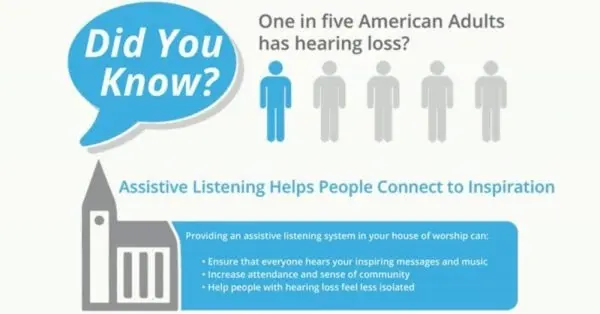
- Over 48 million Americans experience some degree of hearing loss.
- Hearing loss is the third most prevalent chronic physical condition in older adults, yet it disproportionately affects working-age adults as well.
- Untreated hearing loss is directly correlated with social isolation, depression, cognitive decline, and estrangement from community institutions, including faith-based organizations.
When a church implements an ALS, it directly combats this isolation, transforming an otherwise disabling acoustic barrier into an open door of fellowship.
Official Statements: Industry Insights and Expert Frameworks
The imperative for accessibility in sacred spaces is strongly supported by industry leaders and technical standards organizations.
"Reaching out to those who feel disconnected from your community due to hearing loss is central to sharing the message of inclusion. Genuinely compassionate service involves being aware of and caring for the needs of everyone, especially those dealing with impairments. Make sure they are able to hear the beauty and emotion of the spoken word in your church by providing them with the equipment they need to stay connected."
— Audio-Visual Accessibility Coalition Guidelines
Furthermore, major equipment manufacturers provide robust institutional support to ensure churches do not operate in a vacuum. Organizations like Listen Technologies have developed comprehensive educational frameworks to guide facility managers through the legal, financial, and technical nuances of acoustic design.
For institutional leaders seeking deeper educational materials, comprehensive toolkits—complete with sample congregation surveys, standardized signage graphics, and pre-written bulletin announcements—are readily available through specialized resources such as the Listen Technologies Church Assistive Listening Toolkit.
Future Outlook: The Evolution of Inclusive Worship Technology
Looking ahead, the landscape of assistive listening is undergoing a rapid technological transformation driven by advances in wireless connectivity, artificial intelligence, and personal medical devices.
The Rise of Wi-Fi and Streaming Audio
While traditional RF, IR, and Loop systems remain standard, the future of assistive listening is increasingly leaning toward Wi-Fi-based audio streaming platforms. These systems allow congregants to download a dedicated app on their personal smartphones, connecting directly to the church’s local audio feed with ultra-low latency. This approach significantly reduces the hardware management overhead for church volunteers, as users supply their own display and listening screens (smartphones coupled with wireless earbuds or Bluetooth hearing aids).
Integration with Next-Generation Hearing Aids
As Bluetooth Low Energy (BLE) Audio and Auracast technologies become ubiquitous in consumer electronics and hearing aid manufacturing, houses of worship will soon be able to broadcast uncompressed, multi-channel audio directly to hundreds of personal hearing devices simultaneously without requiring intermediary receivers or complex loop wiring.
A Lasting Commitment to Pastoral Care
Regardless of which technological iteration a church chooses, the core mission remains immutable. Technology is merely the conduit; the ultimate goal is pastoral and communal connection. By proactively investing in advanced Assistive Listening Systems today, houses of worship future-proof their ministry, ensuring that the transformative message of the spoken word resonates clearly, powerfully, and equitably for every soul in the sanctuary.
Is your worship facility currently equipped to serve every member of your community? Contact professional AV consultants to evaluate how an upgraded Assistive Listening System can transform your ministry today.