
Executive Overview
Few musical compositions evoke the profound sentimentality, majesty, and communal warmth of the holiday season quite like the timeless Christmas carol "O Come All Ye Faithful." Widely recognized as a cornerstone of traditional Christmas carol services across the globe, the hymn stands as an enduring monument of sacred choral and instrumental literature. Behind its soaring melodies and stirring harmonies lies a rich historical legacy, traditionally attributed to the 18th-century English hymnist and musician John Francis Wade.
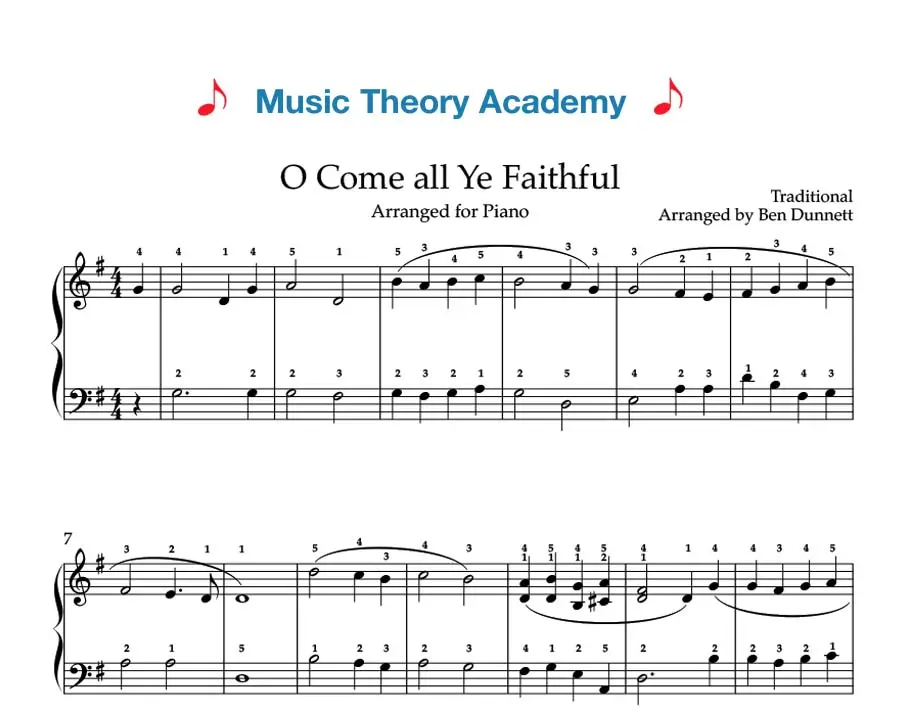
To honor this rich tradition while addressing the practical demands of contemporary musicians, professional composer, educator, and pianist Ben Dunnett LRSM has curated an exclusive suite of pedagogical resources. Featuring two distinct piano arrangements—a streamlined, accessible version for beginners (available with and without vocal lyrics) and a more sophisticated, richly textured intermediate arrangement—this comprehensive guide is engineered to elevate the holiday repertoire of pianists at various stages of proficiency.
This feature provides an in-depth breakdown of these newly released arrangements, complete with performance notes, historical and lyrical context, and direct pathways to digital sheet music, audio streams, and visual demonstrations. Whether you are preparing to accompany a quiet family gathering or perform in a formal recital, these resources bridge the gap between technical accessibility and artistic expression.
Detailed Chronology & Historical Background
To truly interpret a piece of sacred music, a performer must understand its origins, evolution, and cultural footprint. The history of "O Come All Ye Faithful"—historically known by its Latin incipit, Adeste Fideles—is a fascinating study in musical migration and archival discovery.
The 18th-Century Origins
While the exact authorship of the tune has been the subject of considerable musicological debate, music historians traditionally attribute the melody to John Francis Wade (1711–1786), a devout English Catholic layman, music copyist, and teacher who lived in exile in France. Wade made his living supplying handwritten copies of liturgical music to Catholic chapels and colleges in France and England.
The earliest known manuscript of Adeste Fideles, featuring both the Latin text and the iconic four-note opening motif, dates back to approximately 1740. It was discovered within manuscript collections associated with English colleges in Douai, France. The tune quickly gained traction within both clandestine Catholic circles and, eventually, mainstream Anglican and Protestant worship spaces as legal restrictions on Catholic liturgy eased in the late 18th century.
The English Translation and Global Adoption
The metamorphosis from Latin hymn to global English carol was catalyzed by the Reverend Frederick Oakeley. In 1841, while serving as a minister at Margaret Chapel in London (and prior to his conversion to Roman Catholicism), Oakeley translated the first of the Latin verses into English as "O Come, All Ye Faithful" to help his congregation engage more deeply with the Christmas narrative.
Oakeley’s translation was later combined with additional verses translated by William Thomas Brooke, solidifying the four-verse structure familiar to modern listeners. By the mid-19th century, the hymn had crossed the Atlantic, finding a permanent home in American hymnals and securing its place as an indispensable element of the global festive soundtrack.
Supporting Context & Musical Architecture
Ben Dunnett’s modern interpretations—extracted directly from his acclaimed studio album 10 Christmas Carols—demonstrate a deep respect for the structural integrity of Wade’s original composition while tailoring the technical demands to suit contemporary learners.
Analyzing the Source Material
At its core, the traditional melody of "O Come All Ye Faithful" relies on a triumphant, diatonic harmonic framework. The tune opens with a striking rising fifth interval (sol to re), establishing an immediate sense of grandeur and anticipation. The rhythm is stately and metrically stable, usually presented in common time ($4/4$), which encourages a steady, marching momentum that mirrors the lyrical invitation for the faithful to journey to Bethlehem.
Key Structural Elements of "O Come All Ye Faithful":
--------------------------------------------------
• Time Signature: Common Time (4/4)
• Form: Verse-Refrain (A-B structure)
• Harmonic Foundation: Diatonic major scale, strong dominant-tonic resolutions
• Characteristic Interval: Rising perfect fifth (opening motif)
Deconstructing the Audio and Visual Assets
Before diving into the physical sheet music, modern pedagogy emphasizes the importance of aural internalization. Dunnett provides a multi-modal learning experience:
- Auditory Immersion: Listeners can stream the official track via Spotify to absorb the precise rubato, dynamics, and articulation intended for the intermediate arrangement.
- Visual Demonstration: The accompanying YouTube masterclass video offers a synchronized viewing experience, allowing developing pianists to observe hand positioning, pedaling techniques, and keyboard geography in real-time.
Pedagogical Breakdown: The Two Piano Arrangements
To accommodate players of varying skill levels, the curriculum is divided into two distinct tiers of difficulty. Both arrangements maintain the emotional core of the original tune while scaling technical requirements appropriately.
1. The Easy Piano Version
Designed specifically for early-stage pianists, the beginner arrangement strips away complex chromaticism and dense chordal inversions, focusing instead on core hand independence and clean melody delivery.
- Without Lyrics: Focuses purely on instrumental execution, helping students master basic finger placement, rhythm, and phrasing.
- With Lyrics: Integrated text allows pianists to align syllables directly with note values, fostering a natural, speech-like phrasing that is essential for expressive playing.
Downloadable Resources (PDF):
2. The Intermediate Piano Arrangement (Ben Dunnett Signature Version)
For pianists seeking a richer, more harmonically colorful challenge, the three-page intermediate arrangement introduces fuller accompaniments, counter-melodies, and sophisticated chord voicing across the keyboard.

- Page-by-Page Breakdown:
- Page 1: Introduces the theme with a warm, supportive left-hand arpeggiated figuration that elevates the iconic opening motif.
- Page 2: Expands the dynamic range, incorporating passing tones and richer harmonic suspensions that reflect the theological weight of verses two and three.
- Page 3: Builds toward a climactic, triumphant resolution, utilizing the full range of the piano keyboard to emulate a soaring cathedral organ or a full choir.
Downloadable Resources (PDF):
Lyrical Analysis & Performance Interpretation
To deliver a compelling musical performance, pianists must look beyond the black and white notes on the page and connect with the poetry of the text. Each verse of Adeste Fideles carries a distinct theological and emotional narrative that should directly inform your dynamic choices and touch at the keyboard.
Verse-by-Verse Guide
-
Verse 1 (Adeste Fideles): The opening call to worship.
- Performance Note: Play with a bright, welcoming, and inviting tone (mezzo-forte). The rhythm should be crisp and steady, drawing the listener into the journey to Bethlehem.
- Lyrics:
O come, all ye faithful joyful and triumphant!
O come ye, O come ye, to Bethlehem
Come and behold Him born the King of Angels
-
The Refrain: The communal focal point of the hymn.
- Performance Note: This is where the texture thickens. Build the volume to a rich forte, encouraging a sense of unity and shared adoration.
- Refrain:
O come, let us adore Him, O come, let us adore Him,
O come, let us adore Him, Christ the Lord!
-
Verse 2: Focuses on the quiet mystery and miracle of the incarnation.
- Performance Note: Soften the dynamic palette to piano or pianissimo. Use a legato touch to highlight the intimate, tender nature of the Virgin birth.
- Lyrics:
God of God, Light of Light,
Lo, He abhors not the Virgin’s womb;
Very God, begotten, not created
-
Verse 3: A triumphant celebration of heavenly hosts.
- Performance Note: Introduce sparkling right-hand ornamentation or brighter articulation, emulating the brilliant sound of angelic choirs.
- Lyrics:
Sing, choirs of angels, sing in exultation,
Sing, all ye citizens of heaven above!
Glory to God in the highest
-
Verse 4 (Traditionally sung exclusively on Christmas Day): The culmination of the narrative, emphasizing the divine nature of Christ.
- Performance Note: Unabashedly grand and triumphant (fortissimo). This verse requires full use of the damper pedal and rich, resonant chord voicing.
- Lyrics:
Yea, Lord, we greet Thee, born this happy morning,
Jesus, to Thee be glory given;
Word of the Father, now in flesh appearing
Future Outlook & Educational Impact
As digital music education continues to evolve, resources that bridge traditional musicology with accessible, modern media formats are becoming increasingly vital. Projects like Ben Dunnett’s 10 Christmas Carols demonstrate how professional artists can empower musicians of all skill levels to engage deeply with classic repertoire.
By providing multi-format assets—ranging from streaming audio and video tutorials to meticulously typeset PDF scores—this initiative ensures that historic compositions like "O Come All Ye Faithful" remain vibrant, living pieces of art. For piano teachers, students, and hobbyists alike, mastering these arrangements offers a rewarding holiday challenge that deepens technical proficiency while honoring centuries of musical tradition.
About the Author & Creator
Ben Dunnett LRSM is a distinguished music teacher, examiner, composer, and pianist with over two decades of experience in formal music education. As the founder of the Music Theory Academy, Dunnett is dedicated to making high-quality music theory and performance resources accessible to students worldwide. Explore more of his educational guides, compositions, and piano arrangements by visiting the Music Theory Academy Official Website.