
Executive Overview
The holiday season unfurls a familiar, yet perpetually enchanting, tapestry of sound each year, anchored by centuries-old melodies that manage to evoke both deep nostalgia and festive joy. Among these crown jewels of seasonal repertoire is "Ding Dong Merrily on High," a composition whose historical roots stretch back to a 16th-century French dance tune. While generations have sung its soaring vocal lines in cathedrals, parish churches, and concert halls, the piece continues to inspire fresh instrumental interpretations.
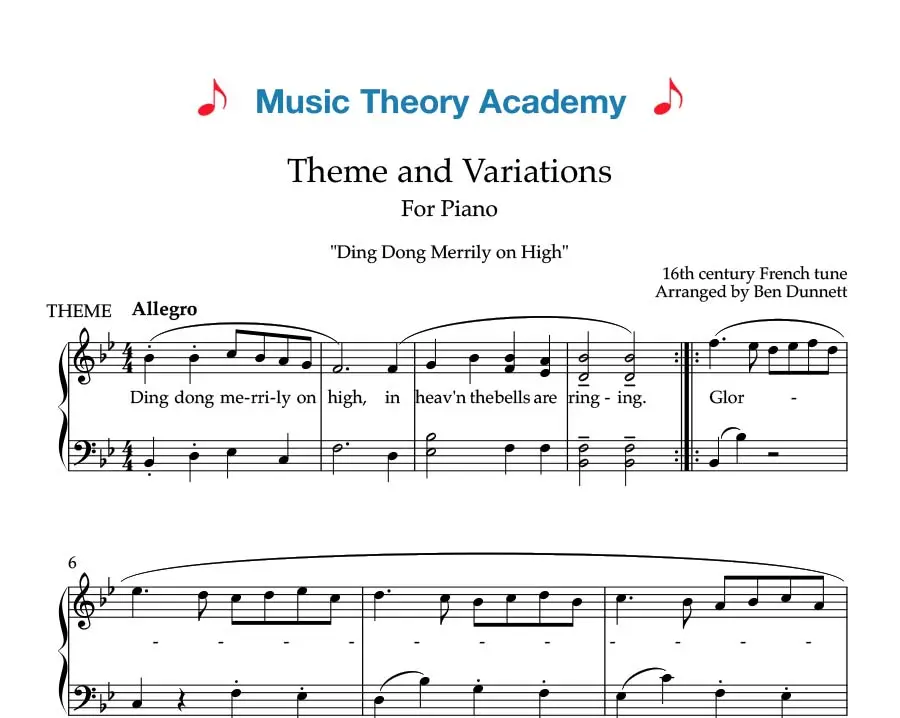
In this comprehensive analysis and pedagogical overview, we examine a brilliant, newly highlighted piano arrangement of "Ding Dong Merrily on High" composed by Ben Dunnett LRSM, founder of the Music Theory Academy. Designed in a sophisticated theme and variations format, this arrangement breathes new life into the historic tune. However, beneath its sparkling, celebratory surface lies a technically demanding work. Featuring a swift tempo, an intricate key signature of B-flat major, and rapid right-hand scalic runs, the piece requires targeted practice strategies, meticulous attention to articulation, and precise left-hand control.
This article explores the rich history of the carol, deconstructs Dunnett’s contemporary piano arrangement, offers professional technical insights for mastering its performance challenges, and provides the complete textual context of George Ratcliffe Woodward’s iconic 20th-century lyrics. Whether you are an intermediate pianist looking to elevate your holiday repertoire or a music educator seeking structured pedagogical material, this guide serves as an authoritative companion to learning the piece.
Detailed Chronology: From 16th-Century French Dance to 20th-Century Carol and Beyond
To truly understand the weight and character of Ben Dunnett’s piano arrangement, one must trace the remarkable evolutionary path of "Ding Dong Merrily on High." The melody’s journey spans more than four centuries, crossing boundaries from secular French dance to sacred English choral tradition, and finally into contemporary solo piano literature.
1. The Renaissance Roots: Jehan Tabourot and "Branle de l’Official" (1588)
The musical foundation of "Ding Dong Merrily on High" did not begin in a church, but rather on the lively dance floors of 16th-century France. The tune originated as a secular dance melody known as "Branle de l’Official." A branle was a type of French Renaissance dance performed by couples stepping from side to side, popular in the courts and villages of the 16th century.
The tune was first published in 1588 in the seminal treatise Orchésographie by Jehan Tabourot (writing under the anagrammatic pseudonym Thoinot Arbeau). Orchésographie is one of our most valuable historical sources for Renaissance dance, providing detailed descriptions of steps accompanied by musical notation. The infectious, rhythmic bounce of the original branle melody laid the structural groundwork for what would, centuries later, become one of the most recognizable Christmas carols in the world.
2. The Twentieth-Century Transformation: George Ratcliffe Woodward (1924)
For over three centuries, the French dance tune existed independently of its modern association with Christmas. The transformation from secular dance to sacred carol occurred in the early 20th century, courtesy of the English clergyman, poet, and composer George Ratcliffe Woodward (1848–1934).
Woodward was a pioneer in unearthing and rehabilitating obscure Renaissance and medieval melodies, pairing them with newly minted, whimsical, and archaic English texts. In 1924, Woodward published the lyrics we know today in his influential collection The Cambridge Carol-Book. He matched his effervescent, bell-simulating poetry directly to Arbeau’s 1588 branle tune. The result was an instant stylistic triumph: words and music locked together in a joyous imitation of swinging church bells, crowned by the triumphant Latin refrain, "Gloria, hosanna in excelsis!"
3. The Modern Pedagogical Era: Ben Dunnett’s Theme and Variations (Present Day)
Fast forward to the 21st century, where the evolution of the tune takes a technical and pedagogical turn. Recognizing the enduring appeal of the melody, experienced music educator, pianist, and composer Ben Dunnett set out to create a concert-worthy piano arrangement designed to challenge and delight intermediate-to-advanced players.
Published via the Music Theory Academy, Dunnett’s arrangement departs from standard homophonic hymn-style accompaniments. Instead, he utilizes the classical theme and variations structure. By introducing the pristine 16th-century melody in its unadorned state before splintering it into rhythmic, harmonic, and textural variations, Dunnett bridges the gap between historical reverence and contemporary pianistic technique. The release of this arrangement, complete with downloadable sheet music and instructional video resources, provides modern pianists with a structured pathway to mastering a timeless classic.
Supporting Context & Metrics: Structural and Technical Analysis of the Arrangement
A successful performance of Ben Dunnett’s arrangement requires a thorough breakdown of its structural framework and technical demands. Pianists approaching this work must balance historical interpretation with rigorous physical preparation.
1. Form and Architecture: Theme and Variations
The structural backbone of the piece is the theme and variations form—a revered cornerstone of classical composition utilized by masters from Mozart and Beethoven to Brahms and Rachmaninoff.
- The Theme: The work opens with a clean, direct statement of the historic melody. This exposition allows the listener to absorb the pure Renaissance tune before the variations begin to transform it.
- The Variations: As the piece progresses through subsequent variations, Dunnett alters the rhythmic density, harmonic color, and register of the material. Each variation presents a unique technical hurdle, demanding adaptability from the performer while maintaining the underlying architecture of the original branle.
2. Key Signature and Tonality
The arrangement is set in B-flat major, a key defined by two flats (B♭ and E♭). While B-flat major is generally considered a warm, resonant key on the piano—fitting comfortably under the hands due to the natural geometry of the black keys—it introduces specific topographical challenges in fast passages. Performers must navigate the black-and-white key layouts smoothly, ensuring that thumb tucks and hand shifts do not disrupt the horizontal momentum of the music.
3. Technical Challenges and Practice Metrics
Dunnett’s arrangement is classified as moderately challenging, largely due to two primary factors: tempo and texture.

- Tempo and Left-Hand Independence: The piece requires a lively, buoyant tempo to capture the physical sensation of swinging church bells (“let steeple bells be swungen”). To achieve this, the left hand must maintain a steady, articulate underlying pulse, often playing rhythmic figures or harmonic counter-melodies that support the right hand. Because the left hand drives the dance-like momentum, slow, deliberate practice of the left hand alone is mandatory during the initial learning phase.
- Right-Hand Scalic Runs: One of the most prominent technical features of the arrangement occurs in the right hand during passages that correspond to the word "Gloria" in the vocal carol. These rapid scalic runs require immaculate finger independence and evenness. Attempting to play these runs up to speed prematurely often leads to tension and uneven tone. Pianists are advised to practice these passages using varied rhythms (e.g., long-short, short-long) and at reduced metronome speeds before gradually accelerating.
- Articulation and Phrasing: The score is rich with articulation and phrasing marks. Most notably, the pervasive use of staccato notes is essential for creating the crisp, light touch required throughout the piece. Without these articulate, detached strokes, the fast tempo can easily muddy the texture, obscuring the melodic clarity that defines the branle style.
Official Statements and Pedagogical Insights from the Creator
To gain deeper insight into the philosophy behind the arrangement, we turn to the expertise of its creator, Ben Dunnett LRSM. With over two decades of experience in music education as a teacher, examiner, composer, and pianist, Dunnett’s pedagogical approach emphasizes structural understanding and methodical practice habits.
On the Nature of the Arrangement
In his instructional notes accompanying the sheet music, Dunnett highlights the deliberate choice of form:
"This piano arrangement of Ding Dong Merrily on High is based on a theme and variations structure. The theme is played at the beginning of the piece and then varied through a number of different variations. The piano music is quite challenging due to the fast tempo of the piece and the key of B flat major (2 flats)."
On Effective Practice Strategies
Addressing the technical hurdles faced by intermediate pianists tackling the work, Dunnett offers targeted advice regarding both hands:
"Some slow practice of the left hand movement will be particularly helpful when learning the piece. Also, the right hand scalic runs (where the lyric ‘Gloria’ is sung in the carol) will benefit from slow practice before speeding them up. It is important to try to create a sense of flow in this melodic line."
Furthermore, Dunnett emphasizes that technical brilliance must be paired with stylistic sensitivity, noting that the inclusion of specific phrasing and articulation marks is not merely decorative, but functional:
"There are quite a number of articulation and phrasing marks on the sheet music to look for. The staccato notes are crucial to providing the light touch needed throughout the piece."
Future Outlook: The Continuing Evolution of Holiday Piano Repertoire
As the landscape of music education and digital resource sharing continues to evolve, arrangements like Ben Dunnett’s point toward an exciting future for holiday piano literature. The integration of traditional classical forms—such as theme and variations—with accessible digital distribution (including embedded video demonstrations, high-resolution sheet music previews, and direct PDF downloads) democratizes access to high-quality concert repertoire.
Looking ahead, educational platforms like the Music Theory Academy are redefining how musicians interact with seasonal music. No longer confined to dry, simplified arrangements that strip historic melodies of their complexity, modern pianists increasingly seek out arrangements that are simultaneously pedagogically sound, historically grounded, and artistically rewarding.
For performers, teachers, and students alike, mastering works like this B-flat major arrangement of "Ding Dong Merrily on High" offers a dual benefit: it sharpens core technical competencies—such as scale execution, left-hand independence, and articulation control—while injecting genuine historical depth and celebratory joy into seasonal concert programs for years to come.
Appendix: The Complete Lyrics by George Ratcliffe Woodward (1924)
For performers seeking to connect the instrumental arrangement directly to its vocal heritage, studying George Ratcliffe Woodward’s original text provides invaluable inspiration for phrasing and narrative shape.
Verse 1
Ding-dong! Merrily on high
in heaven the bells are ringing.
Ding-dong! Verily the sky
is riven with angels singing:
Gloria, hosanna in excelsis!
Verse 2
E’en so, here below, below,
let steeple bells be swungen;
and i-o, i-o, i-o,
by priest and people sungen!
Gloria, hosanna in excelsis!
Verse 3
Pray you, dutifully prime
your matin chime, you ringers;
may you beautifully rhyme
your evetime song, you singers:
Gloria, hosanna in excelsis!