
Executive Overview
For centuries, the gateway to musical literacy has been anchored in a singular, foundational competency: note recognition. Defined as the cognitive and visual ability to instantly identify a pitch as it appears represented on the musical staff, this skill serves as the primary engine driving sight reading fluency. Whether a musician is an absolute beginner decoding their first elementary melodies or an advanced professional navigating dense, contemporary orchestral scores, the speed and accuracy with which they process staff notation dictate their overall musical fluidity.
Recognizing a persistent bottleneck in traditional music education—where students frequently struggle with sluggish recall and inefficient practice methodologies—SightReadingMastery announced the release of a dedicated, free online utility engineered specifically to accelerate this cognitive process: the Note Recognition App. Originally launched as a streamlined digital flashcard tool and subsequently refined through rigorous updates, the platform was designed to bridge the gap between theoretical knowledge and rapid, subconscious visual processing.
Developed by musician, educator, and software engineer Evan R. Murphy, the application represents a convergence of pedagogical insight and accessible web technology. Engineered to operate seamlessly across a diverse array of hardware ecosystems—ranging from desktop computers to mobile smartphones and tablets—the tool democratizes sight-reading training. Following significant updates that expanded its architecture to incorporate both treble and bass clefs alongside extended ledger lines, the utility has evolved into a comprehensive digital companion for instrumentalists and vocalists alike. This report provides a detailed examination of the application’s genesis, its technical capabilities, the pedagogical philosophy underpinning its design, and its broader implications for contemporary music education.
Detailed Chronology
The development and maturation of the Note Recognition App reflect a systematic approach to addressing long-standing hurdles in music pedagogy. To fully understand the impact of the tool, one must trace its development across key milestones from its initial public release to its current iteration.
May 1, 2015: The Initial Launch and Core Vision
On May 1, 2015, SightReadingMastery officially debuted its free online note recognition utility. At its inception, the application was conceived as a targeted solution to a universal problem: the deliberate, often agonizingly slow translation of visual staff symbols to physical instrument execution.
The initial release established the core philosophy of the platform—providing a zero-barrier-to-entry, web-based environment where musicians could drill note identification without the cumbersome setup of physical flashcards or expensive proprietary software. However, like many pioneering software iterations, the initial rollout possessed distinct functional boundaries. Designed primarily as a proof-of-concept for rapid visual training, the earliest version was constrained strictly to the treble clef and omitted support for ledger lines. Despite these initial limitations, the platform immediately captured the attention of educators and students seeking a streamlined method for building fundamental fluency.
The Mobile-First Pivot
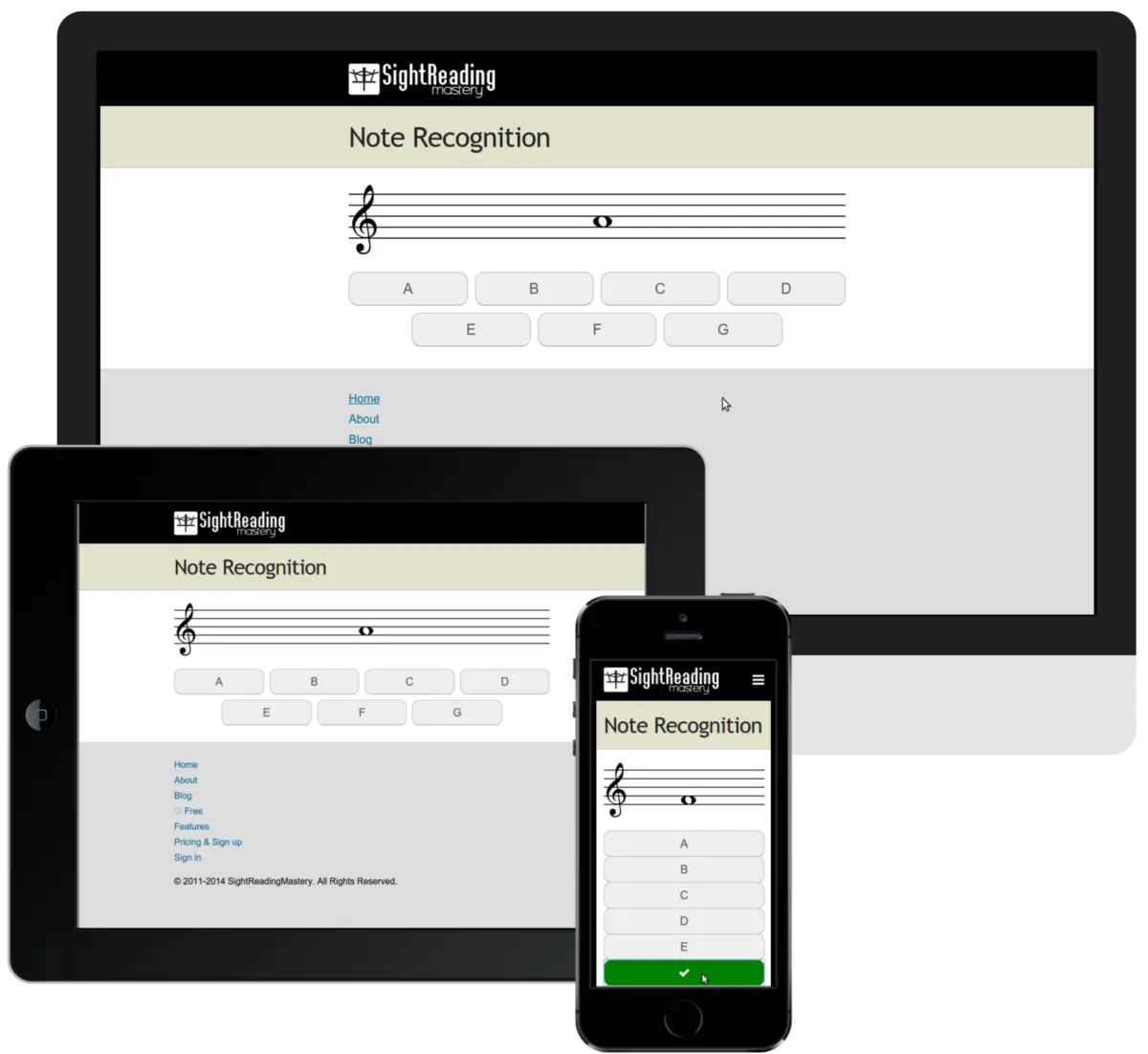
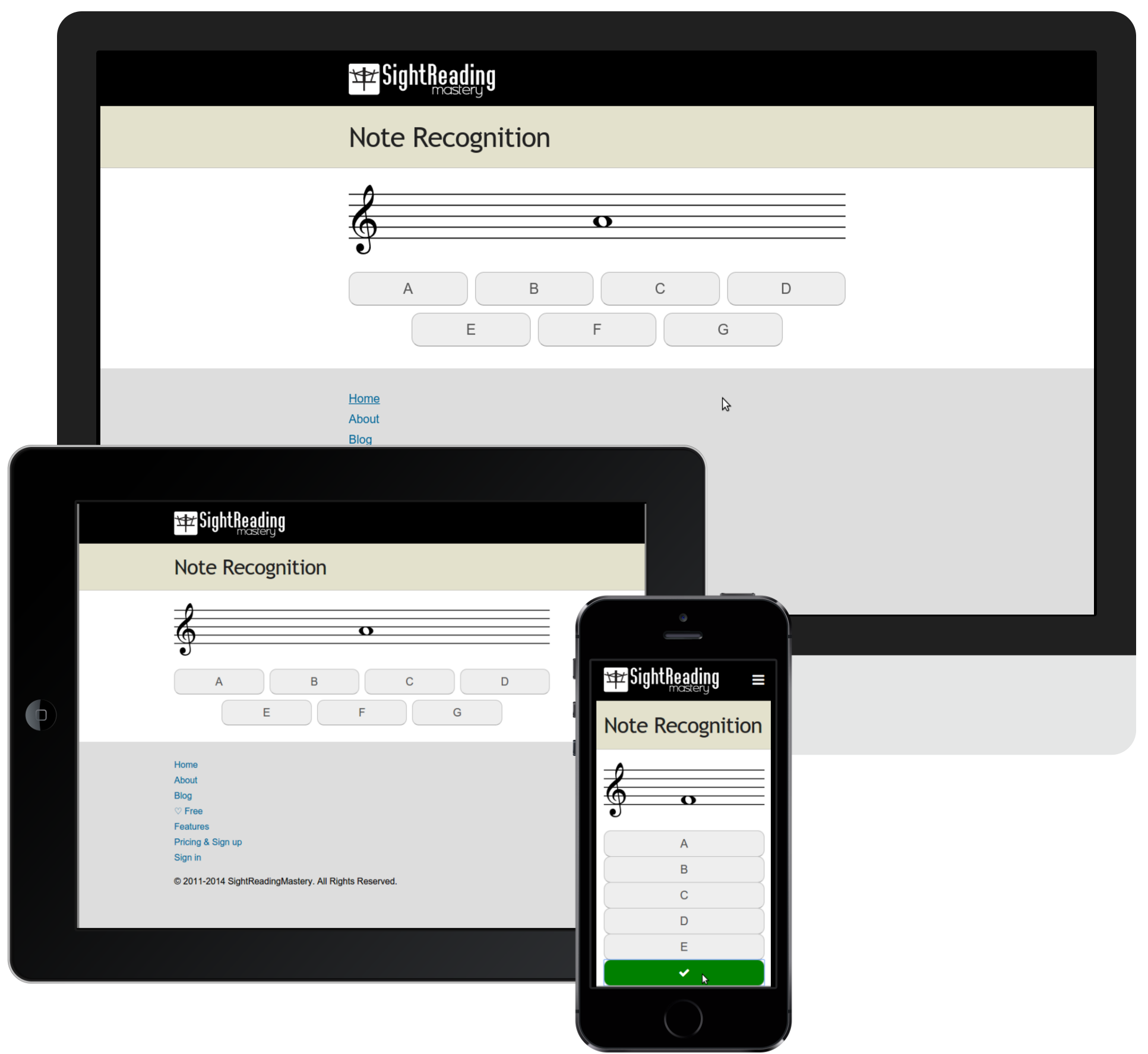
Recognizing that modern practice habits rarely adhere to traditional studio environments, the development team prioritized cross-device compatibility from the ground up. The application was architected to be fully responsive, ensuring that musicians could access their training regimens on full-size desktop computers, portable tablets, and pocket-sized smartphones. This structural decision transformed dead time—such as commuting on public transit or waiting between rehearsals—into productive micro-practice sessions, fundamentally altering how students integrated sight-reading drills into their daily routines.
September 2018: Architectural Expansion and Feature Parity
Following years of user feedback and technological maturation, September 2018 marked a watershed moment for the application. Through two targeted updates deployed on September 14 and September 23, 2018, SightReadingMastery dismantled the platform’s original constraints.
The integration of bass clef support immediately opened the application to a vast new demographic of musicians, including cellists, bassists, trombone players, tubists, and left-hand pianists. Furthermore, the inclusion of ledger lines pushed the utility past basic proficiency training, allowing advanced instrumentalists—such as flutists, violinists, and upper-register keyboardists—to test and refine their ability to read pitches existing far outside the standard five-line staff. This comprehensive overhaul transformed a basic treble-clef trainer into a universal, multi-clef diagnostic and training powerhouse.
Supporting Context & Metrics: The Science of Sight Reading and Cognitive Processing
To appreciate the utility of the Note Recognition App, one must examine the cognitive mechanics of sight reading. In cognitive psychology, reading music is frequently compared to reading linguistic text, but with a critical distinction: it requires the simultaneous processing of multiple streams of information (pitch, rhythm, articulation, and dynamic intent) mapped onto a non-linear, spatial-temporal grid.
The Cognitive Bottleneck: Working Memory vs. Automaticity
When a novice musician encounters a note on a staff, they typically engage in a multi-step conscious process:
- Identifying the line or space the note occupies.
- Recalling a mnemonic device (e.g., "Every Good Boy Does Fine" or "FACE").
- Translating that letter name to a specific finger placement or key on their instrument.
This conscious decoding taxes working memory. Because working memory has a strictly limited capacity, processing individual notes in this manner creates a severe cognitive bottleneck. When the brain is overburdened with identifying basic pitch locations, it lacks the processing power required to interpret phrasing, maintain steady tempo, or execute expressive nuance.
Fluency, therefore, is achieved only when note recognition transitions from conscious decoding to automaticity—a state of subconscious, instantaneous pattern recognition. The SightReadingMastery app is engineered specifically to force this neurological shift. By presenting randomized notes in rapid succession, the software forces the brain to bypass verbal mnemonics, forging direct neural pathways between the visual stimulus of the staff position and the conceptual identity of the pitch.
Quantitative Impact on Practice Efficiency
Traditional flashcard methods, while effective to a degree, suffer from several logistical flaws:
- The Shuffle Problem: Physical cards become worn, ordered predictably, or lost.
- Lack of Temporal Data: Traditional cards do not measure the exact speed of recall.
- Accessibility: They require physical preparation and cannot be utilized effectively in transit.
Digital web applications eliminate these friction points. By automating the randomization process and removing physical barriers, digital training tools dramatically increase "time-on-task"—the single most reliable predictor of skill acquisition in instrumental music. Studies in psychomotor skill development indicate that distributed, high-frequency practice sessions (e.g., five to ten minutes multiple times a day) yield significantly better retention and reflex speeds than marathon weekly study sessions. The mobile-friendly architecture of the SightReadingMastery app directly facilitates this optimal pedagogical schedule.
Official Statements and Pedagogical Philosophy
At the core of the platform’s development is the philosophy of its creator, Evan R. Murphy. As a seasoned musician, private music teacher, and professional software engineer, Murphy’s dual background uniquely positioned him to identify the intersection where educational technology could genuinely serve artistic development.

The Vision of Evan R. Murphy
Founded in 2011, SightReadingMastery was born out of Murphy’s firsthand observations of the profound barriers poor sight-reading skills erect for developing musicians. In professional environments, auditions, pit orchestras, chamber ensembles, and studio recording sessions demand an immediate, high-level command of unfamiliar notation. Students who lack this foundational fluency frequently experience performance anxiety, plateau in their technical development, and miss out on lucrative or creatively fulfilling musical opportunities.
Reflecting on the motivations behind building tools like the Note Recognition App, Murphy has consistently emphasized that sight reading should not be viewed as an innate, unchangeable talent, but rather as a mechanical skill subject to systematic training. In statements regarding the platform’s design philosophy, the development team has stressed:
"Note recognition is fundamental to reading music. Even at advanced levels, improving the speed and accuracy of your note recognition will make you a better sight reader. Our goal is to strip away the administrative and logistical friction of practice, giving musicians a clean, frictionless environment where they can build pure visual reflexes."
This ethos is reflected in the minimalist, distraction-free user interface of the application. Eschewing flashy, gamified distractions that can dilute focus, the app centers entirely on the clarity of the musical staff, ensuring that the user’s cognitive energy is channeled exclusively toward immediate pitch identification.
Future Outlook: The Evolution of Digital Music Pedagogy
As music education continues its rapid migration toward hybrid and digital-first models, tools such as the SightReadingMastery Note Recognition App offer a glimpse into the future of instrumental pedagogy.
Integration with Advanced Audio Processing
While the current application focuses primarily on visual identification and cognitive recall, the broader landscape of music technology is moving toward real-time audio and MIDI integration. Future iterations of digital sight-reading tools are increasingly exploring features such as microphone pitch-detection and direct MIDI keyboard input. By allowing users to play the recognized note on their physical instrument rather than simply clicking a screen or typing a keystroke, future applications will close the loop between visual perception and physical muscle memory.
Personalization and Adaptive Learning Algorithms
Another frontier in this domain is the implementation of adaptive learning algorithms. By tracking response times down to the millisecond across specific staff locations and ledger lines, future iterations of note-recognition software can dynamically weight the randomizer to favor pitches where the user historically exhibits higher latency or error rates. This data-driven approach to music practice mirrors the advanced spaced-repetition systems (SRS) used in language acquisition, ensuring that every second of practice time is optimized for maximum cognitive impact.
Conclusion
The journey of the SightReadingMastery Note Recognition App—from a simple treble-clef browser tool launched in May 2015 to a comprehensive, multi-clef training utility—underscores the profound impact thoughtful software engineering can have on traditional art forms. By tackling the fundamental bottleneck of music literacy with clean design, cross-platform accessibility, and an unwavering focus on cognitive automaticity, the platform continues to empower musicians worldwide to unlock their full expressive potential. As digital pedagogy matures, tools like this will remain indispensable anchors in the modern musician’s technical toolkit, proving that mastery begins with the single, instantaneous recognition of a note upon the staff.