
Executive Overview
For decades, the narrative surrounding music education has been romanticized: a passionate director leading an ensemble through sweeping crescendos, unlocking raw talent, and sharing the transcendent joy of a unified chord. Yet, behind the pristine concert hall performances and the energetic applause lies a less glamorous, deeply exhausting reality. Music educators across the globe are facing an unprecedented administrative crisis, drowning in an ocean of manual paperwork, after-hours grading, and rigid attendance tracking.
According to recent educational survey data, attendance logging and grading remain the two most burdensome administrative tasks that music teachers wish to automate. For directors managing large ensembles of sixty or more students, the traditional methods of running a classroom are no longer sustainable. Standing at a podium, desperately trying to call out names while classroom momentum plummets, or spending weekends listening to dozens of raw, unpolished audio files, exacts a heavy toll. The hidden cost of this manual overhead is severe: burned-out educators, stifled instructional creativity, and a gradual erosion of the very passion that drew these professionals to the field in the first place.
Fortunately, a paradigm shift is underway. By integrating smart classroom workflows, student-led accountability frameworks, and innovative educational technology platforms like MakeMusic, forward-thinking educators are reclaiming their weekends. This report investigates the structural roots of music education burnout, explores innovative administrative methodologies adopted by pioneering schools like Rouse High School and Wiley Middle School, and outlines a comprehensive roadmap for transforming the modern music classroom.
Detailed Chronology: The Evolution of Classroom Administration and the Breaking Point
To understand how music educators arrived at the current crossroads of administrative exhaustion, one must examine the evolution of the modern school day. Historically, the responsibilities of a music director were compartmentalized: select repertoire, run rehearsals, prepare for concerts, and grade occasional written or practical tests. However, over the past twenty-5 years, accountability metrics, district-mandated documentation, and burgeoning class sizes have systematically expanded the teacher’s administrative footprint.
Phase 1: The Traditional Classroom Workflow (Pre-Digital Era)
For generations, attendance was taken via paper rosters. Teachers would spend the first three to seven minutes of every class period calling out names, manually noting tardiness and absences. In an academic classroom, this delay is negligible. In a large ensemble setting—such as a concert band, marching band, or choir—these lost minutes represent a significant fraction of instructional time. Over a five-day school week, a teacher losing five minutes per class surrenders over twenty-two hours of rehearsal time per academic year.
Phase 2: The Digital Transition and the Grading Backlog
With the advent of digital gradebooks and Learning Management Systems (LMS), administrative expectations shifted from paper-bound ledgers to instantaneous electronic entry. While intended to streamline communication with parents and administrators, these systems introduced a new layer of friction.
- The Playing Test Dilemma: Unlike multiple-choice quizzes that can be automatically graded by software, evaluating instrumental or vocal performance requires subjective, qualitative human judgment.
- The Audio Review Cycle: Directors began assigning recorded practice submissions. A teacher with 120 students assigning a bi-weekly playing test faces a staggering 240 audio files every two weeks. Assuming an average review and feedback time of three minutes per file, this translates to twelve hours of grading bi-weekly—work that inevitably spills over into Friday evenings, Saturdays, and Sundays.
Phase 3: The Breaking Point and the Rise of Automation
By the early 2020s, post-pandemic educational strains catalyzed a wave of teacher burnout and early retirements. Music programs were hit disproportionately hard, as ensemble courses rely fundamentally on real-time human connection and immediate feedback. Recognizing that administrative survival required radical intervention, progressive educators began experimenting with automation, peer-led logistics, and hybrid software platforms. The goal was simple: strip away the repetitive, mechanical tasks to preserve the creative heart of music education.
Supporting Context & Metrics: The Anatomy of Teacher Burnout
The statistics surrounding teacher workload paint a sobering picture. While educational institutions increasingly emphasize student mental health and holistic learning environments, the systemic support structures for educators have lagged behind.
The Metrics of Overwork
- The 60+ Student Dilemma: In secondary school music programs, ensemble sizes frequently range from 60 to over 150 students per class period. Managing spatial organization, instrument maintenance, sheet music distribution, and attendance within a 50-to-90-minute window creates an acute operational bottleneck.
- The Weekend Shift: Surveys of secondary arts educators indicate that upwards of 65% of grading and formative assessment review occurs outside contracted school hours—primarily on weekends and late evenings.
- The Retention Crisis: Administrative burden consistently ranks in the top three reasons cited by mid-career music educators for leaving the profession, rivaled only by compensation and student behavioral issues.
The Psychological Impact on Students
Manual grading structures also impact student psychology. When evaluation is tied strictly to natural talent or performed high-stakes in front of an intimidating audience (the director and fifty peers), students develop performance anxiety. Research in educational psychology consistently demonstrates that formative assessment environments—those allowing private iteration, low-stakes practice, and error recovery—yield vastly superior long-term mastery compared to high-stakes, punitive grading models.

Official Strategies and Operational Transformations
Transforming the music classroom requires addressing the two primary pain points head-on: attendance tracking and performance evaluation. Leading programs across the United States have pioneered systematic frameworks that leverage both human empowerment and cutting-edge software.
Revolutionizing Classroom Attendance
The foundational philosophy of modern attendance automation is deceptively simple: The teacher should not be the bottleneck.
At the start of a new academic year, successful directors establish immutable classroom routines that transfer baseline logistical responsibilities to student leaders.
- Empowering Student Leadership: By appointing section leaders or operational managers to oversee initial attendance logging and instrument readiness checks, the director is freed from the podium.
- Streamlining the First Five Minutes: When students enter the room knowing their immediate objective—such as setting up stands, accessing assigned digital folders, and beginning a silent or section-led warmup—the transition period evaporates.
- Eliminating Administrative Compliance Delays: Schools that adopt student-led entry routines report a dramatic reduction in administrative errors, such as missed attendance submission deadlines that trigger automated alerts from central office databases.
Automating Formative Assessment with MakeMusic
The most profound breakthrough in reducing off-the-clock teacher hours lies in the automation of initial performance evaluations. Rather than listening to raw, unpracticed student recordings, modern educators are integrating platforms like MakeMusic to establish rigorous, self-correcting practice cultures.
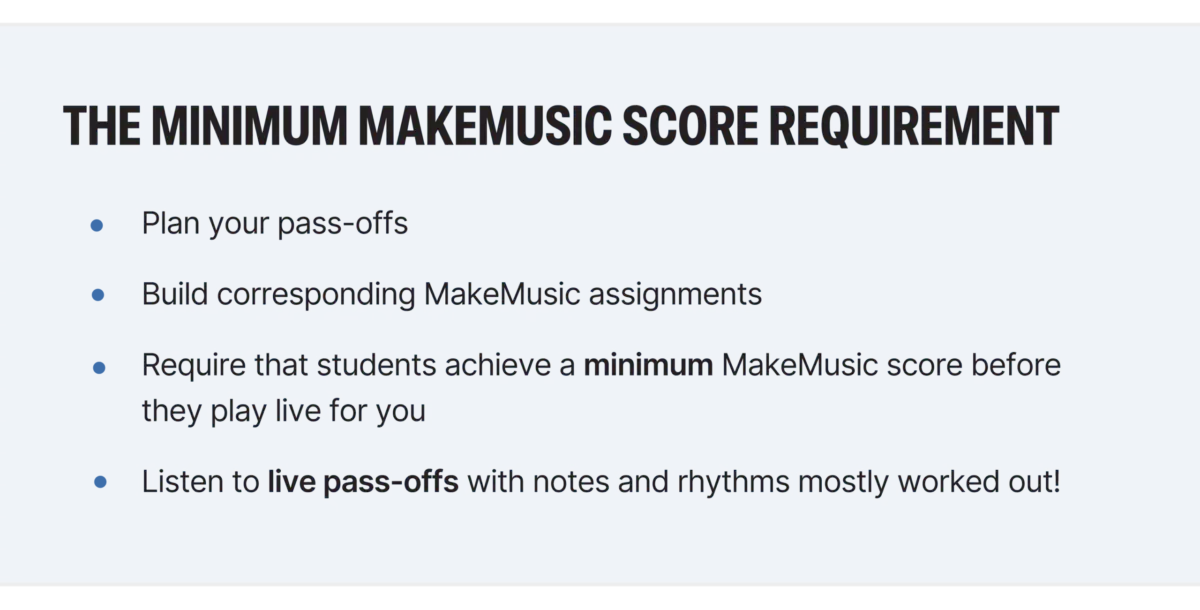
The Minimum MakeMusic Score Requirement
Exemplified by innovative programs at institutions like Rouse High School and Wiley Middle School, the "Minimum MakeMusic Score Requirement" workflow has redefined the traditional pass-off system:
- Step 1: Curriculum Mapping: The director plans out upcoming pass-offs and repertoire milestones.
- Step 2: Digital Assignment Creation: Corresponding assignments are built directly within the MakeMusic platform, embedding the required sheet music, backing tracks, and assessment parameters.
- Step 3: The Algorithmic Gatekeeper: Students are required to achieve a predetermined minimum accuracy score (e.g., 85% note and rhythm accuracy) within the MakeMusic environment before they are permitted to play a live pass-off for the director.
- Step 4: Targeted Live Instruction: When the student finally steps up to play live for the teacher, the foundational mechanical errors (wrong notes, incorrect rhythms) have already been remediated independently by the software.
[Plan Pass-Offs] ──> [Build MakeMusic Assignments] ──> [Student Reaches Min. Score] ──> [Meaningful Live Evaluation]This structural shift transforms the live teacher-student interaction from a punitive grading session into a masterclass in musicality, phrasing, and artistic expression. Teachers no longer waste precious instructional minutes correcting basic note reading; instead, they focus entirely on interpretation, tone production, and ensemble blending.
Future Outlook: The Next Frontier of Music Education Technology
As artificial intelligence, cloud computing, and adaptive learning algorithms continue to mature, the landscape of music education is poised for even greater transformation. The future points away from isolated administrative software and toward fully integrated ecosystems where attendance, practice analytics, repertoire distribution, and district grading integration function seamlessly in the background.
What Lies Ahead for the Automated Classroom?
- Predictive Practice Analytics: Future iterations of educational software will likely utilize advanced data analytics to identify which students are struggling with specific measures before a playing test is even submitted, allowing teachers to proactively intervene during sectional rehearsals.
- Zero-Touch Gradebook Sync: The complete elimination of manual grade entry is on the horizon. As LMS platforms and specialized music software deepen their API integrations, formative assessment scores will flow securely and automatically into district gradebooks based on customizable, teacher-defined rubrics.
- Cultural Shifts Toward Sustainable Artistry: By systematically removing the administrative friction that drains educator enthusiasm, the profession will become inherently more sustainable. Teachers will have the mental and physical bandwidth to innovate artistically, build deeper mentorship bonds with their students, and rediscover the pure love of music that inspired them to pick up an instrument in the first place.
Conclusion
The crisis of administrative burnout in music education is real, but it is not insurmountable. By embracing strategic operational frameworks—such as student-led attendance routines and automated formative assessment protocols powered by tools like MakeMusic—educators can reclaim their evenings, protect their mental health, and restore the joy of music-making to the center of the classroom. For those ready to step off the treadmill of manual grading and reclaim the podium, the tools for a transformed, sustainable career are available today.