
Executive Overview
The digital audio workspace (DAW) market—long dominated by legacy giants like Avid Pro Tools, Apple Logic Pro, Ableton Live, and Steinberg Cubase—is experiencing a seismic shift. Splice, a titan in the digital music ecosystem originally built as a cloud-based sample subscription service and collaboration tool, has officially launched its own digital audio workstation: Splice Create.
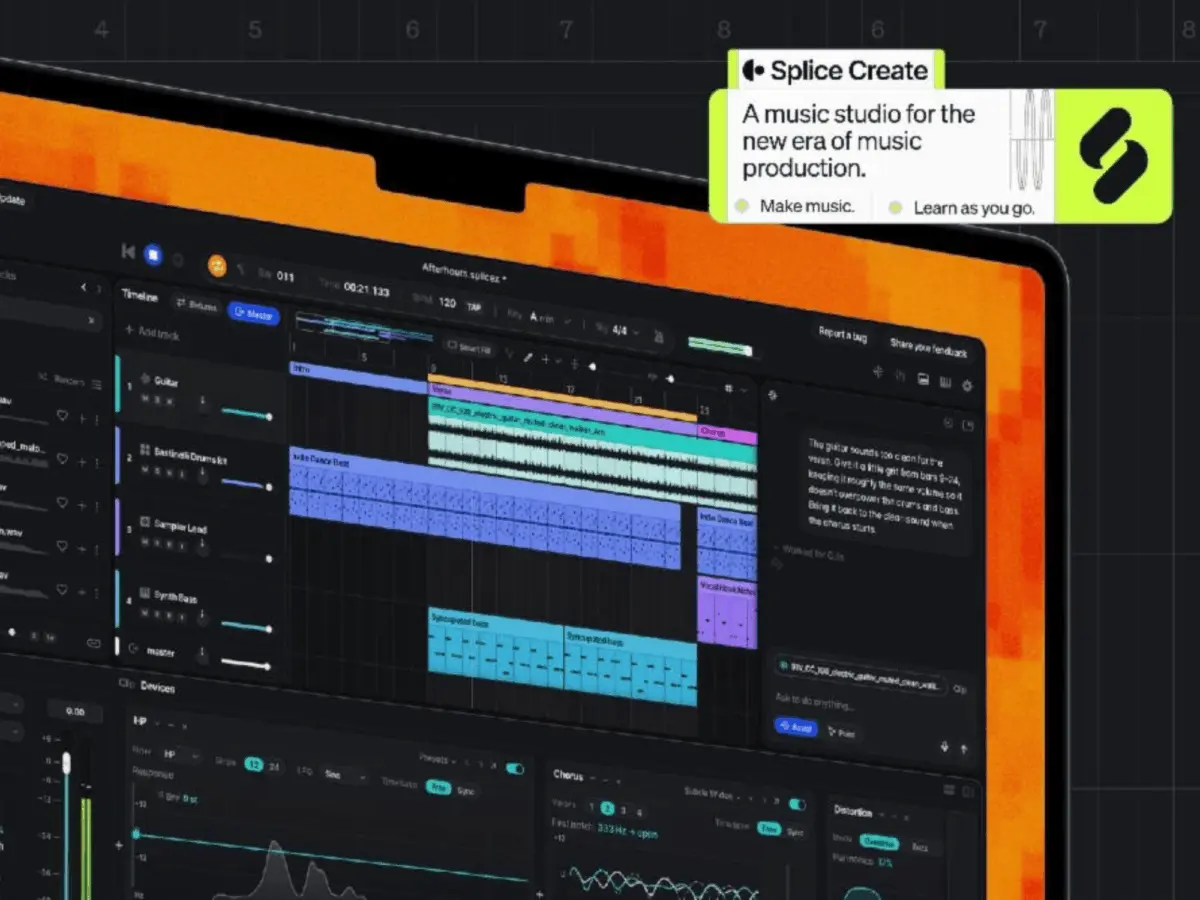
Unveiled in beta as a dedicated macOS application, Splice Create represents a massive evolutionary leap for the company. Moving far beyond its foundational identity as a cloud repository for one-shots and loops, Splice is now offering an end-to-end native production environment. By seamlessly embedding its sprawling sample catalog, virtual instruments, and native effects directly into a timeline-based workspace, the platform bridges the historically fragmented gap between sourcing audio and composing music.
At the heart of Splice Create is "Assist," an embedded, conversational artificial intelligence tool designed to function as an on-demand studio assistant. Rather than forcing producers to navigate complex menus, manual routing, or tedious sample-stretching workflows, Assist operates as an interactive co-pilot capable of executing repetitive tasks, answering technical queries, and guiding users through sound-design pathways.
From a business model perspective, Splice is rolling out the software via a freemium-to-subscription pipeline. While the beta is free to download and test on Mac—with Windows and web-browser applications slated for future release—exporting projects and licensing Splice samples require a dedicated paid tier. A standalone "Create" subscription is currently priced at an introductory rate of $9.99 per month, and the software will also be integrated directly into Splice’s broader, pre-existing "Creator" subscription plans.
This strategic expansion places Splice on a direct collision course with traditional software developers and cloud-native competitors alike. As the boundaries between AI assistance, cloud infrastructure, and traditional DAW architecture continue to blur, Splice Create is poised to alter how a new generation of bedroom producers and professional beatmakers conceptualize and execute their tracks.
Detailed Chronology: From Sample Pioneer to DAW Developer
To understand the weight of the Splice Create launch, it is essential to trace the platform’s trajectory from a niche collaboration tool to a central pillar of modern music production.
The Early Years: Cloud-Sync and Version Control (2013–2015)
Founded by Steve Martocci and Matthew Aitchison, Splice launched with a distinct mandate: to solve the frustrating file-management and version-control problems faced by electronic music producers. In its earliest iterations, Splice functioned as a "GitHub for musicians," allowing creators to back up their Ableton Live, Logic, and FL Studio project files to the cloud, track revisions, and collaborate asynchronously with artists across the globe.
The Sample Economy Disruption (2015–2020)
While cloud version control struck a chord with a dedicated subset of producers, Splice achieved hyper-growth through the 2015 pivot of its marketplace into a subscription-based sample platform ("Splice Sounds"). By decoupling sample packs from expensive, one-off purchases and offering a granular, credit-based subscription model for individual royalty-free loops and one-shots, Splice completely transformed how audio assets were monetized. This era established Splice as a household name in modern pop, hip-hop, and electronic music production, cementing its status as an indispensable digital utility.
Expanding the Ecosystem: Rent-to-Own and Plugins (2020–2025)
As its user base scaled into the millions, Splice diversified its software portfolio. The company introduced its pioneering "Rent-to-Own" model for high-end virtual instruments and plugins from third-party developers like Serum (Xfer Records), Arturia, and iZotope. This allowed financially constrained producers to access professional-grade software synths and mixing tools through manageable monthly micro-payments. Simultaneously, the company rolled out desktop applications designed to bridge the web marketplace directly to local DAWs via drag-and-drop integration.
The Next Frontier: Splice Create Beta (Late 2026)
The announcement of Splice Create marks the culmination of over a decade of infrastructure building. Rather than acting merely as an auxiliary browser for third-party production environments, Splice has engineered its own canvas. By launching Create in beta for macOS, the company is signaling its ambition to capture the entire production lifecycle—from initial inspiration and sample discovery to arrangement, mixing, and final stem export—within a single, unified ecosystem.
Supporting Context & Metrics: The Modern Production Landscape
The launch of Splice Create does not occur in a vacuum. It arrives amidst fierce competition, shifting consumer habits, and a rapid acceleration of artificial intelligence integration within creative industries.
The DAW Market Dynamics
Historically, switching DAWs has been notoriously difficult for music producers. Muscle memory, proprietary plugin formats (VST/AU/AAX), and deep workflow integrations make platforms like Ableton Live and Apple Logic Pro exceptionally sticky. However, a significant market segment—particularly Gen-Z and millennial creators who began their musical journeys on mobile apps, browser-based tools, or looped sample environments—often find traditional DAWs intimidating, bloated, or overly technical.
Splice Create capitalizes on this friction. By stripping away the steep learning curve traditionally associated with routing audio busses, sidechain compression setups, and complex MIDI mapping, Create targets creators who prioritize speed, inspiration, and frictionless workflow.
The Rise of Conversational AI in Creative Workflows
The inclusion of "Assist" reflects a broader, industry-wide race to embed generative and conversational AI into creative suites. While competitors like BandLab have aggressively integrated AI mastering and prompt-to-sample features, and tech giants like Adobe and Apple weave machine learning deeper into their media apps, Splice occupies a unique strategic high ground.
Because Splice commands one of the world’s largest proprietary audio-sample libraries, its AI model—Assist—can theoretically interface directly with millions of contextual, metadata-tagged sonic assets. This gives the software an innate advantage over generic third-party plugins: Assist doesn’t just understand music theory or DAW navigation; it intimately understands the nuances of the Splice ecosystem.
Pricing, Packaging, and Accessibility
Economic accessibility remains a primary driver of adoption in modern music tech. The introductory pricing structure of $9.99 per month for a standalone "Create" subscription positions the software competitively against rival subscription models, such as Pro Tools Artist or Adobe Creative Cloud tiering. Furthermore, bundling the DAW into existing "Creator" plans provides an immediate, zero-friction upsell path for Splice’s millions of existing subscribers who already pay monthly for sample credits.
Official Statements and Feature Breakdown
While Splice has kept technical documentation measured during the initial beta phase, public FAQs and early product demonstrations shed light on what users can expect from the software’s architecture.
What is Inside Splice Create?
At its core, Splice Create is designed to function as a lightweight, highly responsive digital audio workstation tailored for rapid ideation and loop-based arrangement. Key components include:
- Native Sample Integration: Users can search, preview, and drop sounds from the entire Splice catalog directly into their timeline without ever opening a web browser or external desktop app.
- Virtual Instruments and Effects: The DAW ships with a curated suite of built-in synths, drum machines, and mixing utilities designed to match the sonic demands of contemporary electronic, hip-hop, and pop production.
- The "Assist" Engine: Described by Splice as a virtual "studio tech inside your session," Assist utilizes conversational natural language processing. Creators can type or speak queries such as:
- "How do I route this vocal track to a reverb send?"
- "Find a bassline that matches the key and groove of this chord progression."
- "Help me clean up the muddy low-end in this drum loop."
According to the official Splice FAQ:
"Ask it how to get to a sound; it teaches you the steps, follows along, or handles the repetitive parts, so you stay in your flow."
This positions Assist not as an autonomous, ghost-writing AI that generates entire tracks from a single text prompt—a concept that often alienates traditional musicians—but rather as an interactive tutor and efficiency engine designed to keep the human creator focused on artistic decision-making.
Future Outlook: Challenges and Industry Implications
As Splice Create rolls out its beta phase on macOS, the broader music technology industry is watching closely. The platform’s long-term success will hinge on several critical factors.
1. Platform Expansion and Stability
While launching on macOS is a standard industry testing ground due to CoreAudio uniformity, the true test of Splice Create’s market viability will arrive with the deployment of the Windows application and web-browser integration. PC users make up a massive percentage of the global producer base, particularly in emerging electronic and hip-hop markets across Eastern Europe, Asia, and Latin America. Ensuring a stable, low-latency performance across fragmented PC
hardware configurations will be paramount.
2. Winning Over Professional Engineers
Traditional mixing and mastering engineers often view subscription-based, cloud-dependent software with skepticism, citing concerns over long-term project archiving, internet dependency, and proprietary lock-in. To transition Splice Create from a "sketchpad" tool into a professional-grade DAW used for commercial releases, Splice will eventually need to support robust third-party plugin ecosystems (VST3/AU), advanced multi-track routing, and high-bitrate audio stems that can easily migrate to legacy environments like Pro Tools or Logic Pro.
3. The Ethical and Creative Boundaries of AI
As conversational AI continues to polarize the creative community, Splice must navigate the delicate line between empowering producers and alienating traditionalists. By positioning Assist as a workflow accelerator and technical tutor—rather than a black-box song generator—Splice has proactively mitigated some of the controversies plaguing purely generative AI music startups. However, as Assist grows more sophisticated, maintaining transparency regarding how user data and AI models interact will be essential for retaining community trust.
Conclusion
Splice Create marks a pivotal evolutionary step for a company that fundamentally altered how musicians buy samples. By stepping out of the cloud-storage and marketplace niches and directly into the DAW arena, Splice is challenging decades of software convention. If the platform successfully balances the speed of cloud-native design with the depth required by serious music makers, Splice Create could very well establish a new standard for how the next generation of music is conceived, produced, and shared.