
Executive Overview
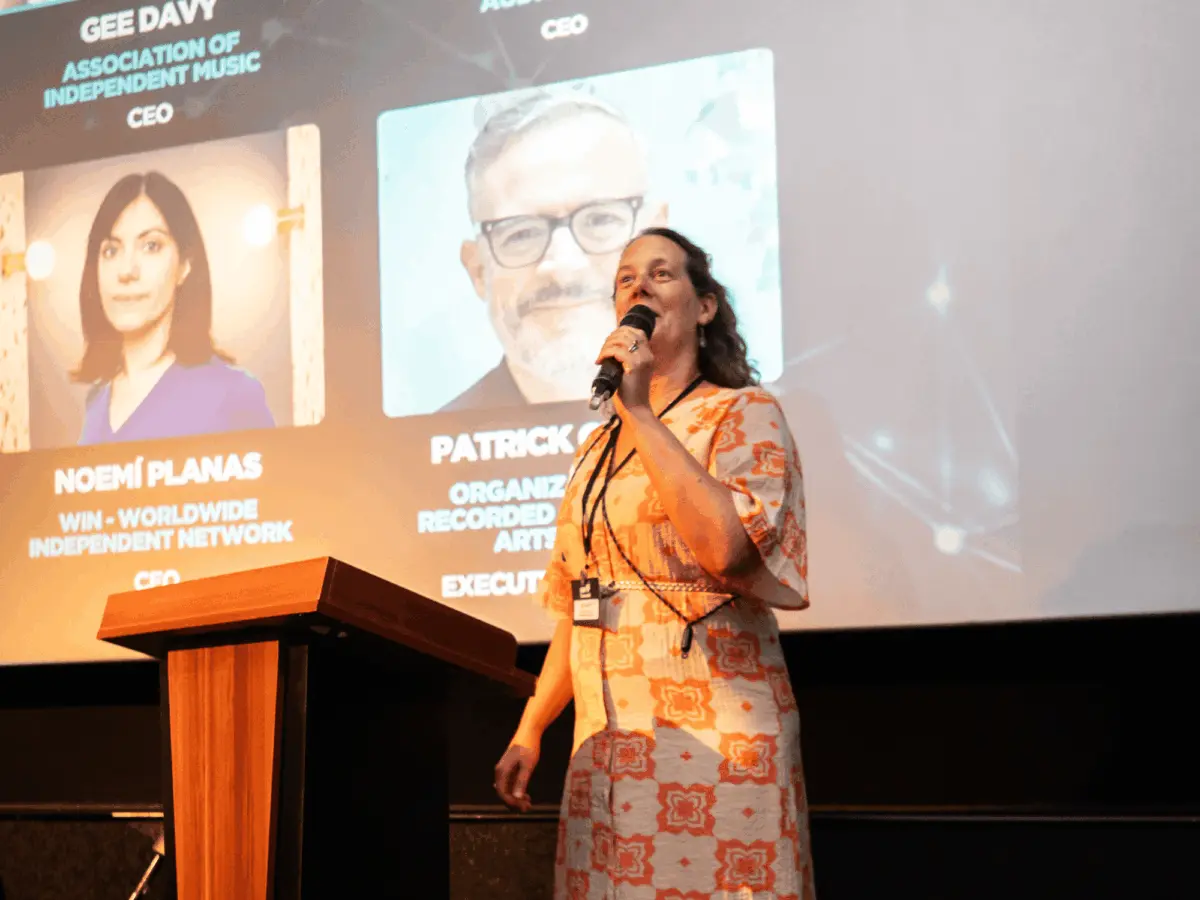
At the flagship AIM Connected conference held in London, Gee Davy, Chief Executive Officer of the Association of Independent Music (AIM), delivered a stark, uncompromising warning regarding the future of the United Kingdom’s world-renowned music ecosystem. Speaking before a packed auditorium of independent label executives, artists, publishers, and industry stakeholders, Davy used her closing keynote address to call for immediate, decisive government intervention to rescue a sector she described as the economic lifeblood of the broader UK creative industries.
At the core of Davy’s address was a chilling statistical reality check: just three years ago, British musical acts claimed over one-third of the global Top 10 positions across international singles and albums charts. In the most recently published global rankings, that figure has plummeted to zero. Not a single British artist cracked the global Top 10.
Davy framed independent music as the critical "canary in the coal mine" for the entire UK cultural economy—a foundational pipeline that discovers, nurtures, and breaks the raw talent later exported to the world stage. However, she warned that this pipeline is running dry under the weight of escalating operational costs, post-Brexit trade friction, the existential threat of unregulated generative artificial intelligence (AI), and a glaring structural disadvantage: the complete absence of the targeted fiscal incentives enjoyed by virtually every other creative sector in Britain.
As global competition intensifies and major international markets deploy aggressive strategies to protect their domestic cultures, AIM’s leadership is demanding that Whitehall move beyond rhetoric and implement robust intellectual property (IP) protections, tailored tax reliefs, and strict enforcement against unlicensed tech firms.
Detailed Chronology: The AIM Connected Summit and Davy’s Call to Action
The atmosphere at the London-based AIM Connected conference was already charged with discussions surrounding economic volatility, technological disruption, and shifting consumer habits when Gee Davy took to the stage for her concluding remarks.
Morning Sessions: Setting the Stage
Throughout the day, panels and workshops at the conference had dissected the day-to-day realities facing modern independent labels. Industry veterans discussed the squeezing of profit margins, the complexities of international touring post-Brexit, and the psychological and financial toll of breaking new acts in an algorithm-driven marketplace. Delegates repeatedly returned to a central theme: while British music remains a cultural superpower, the infrastructure required to sustain that output is visibly fraying.
The Closing Keynote: A Shift in Tone
As the conference drew to a close, Davy stepped up to deliver what many attendees would later describe as a watershed moment for the UK independent sector. Eschewing the standard celebratory tone common at industry trade events, Davy immediately confronted the systemic vulnerabilities facing indie labels—the organizations traditionally responsible for taking creative risks on boundary-pushing artists.
Davy highlighted that while the UK’s film, television, video game, and classical orchestral sectors all benefit from bespoke tax reliefs designed to stimulate investment and mitigate financial risk, recorded music remains a glaring policy outlier. She explained that the independent music community frequently struggles to produce the precise macroeconomic data points demanded by treasury officials because the sector lacks the massive corporate budgets required to commission extensive econometric studies.
This data gap, Davy argued, has allowed successive governments to overlook the acute financial pressures grinding down independent creators, grassroots recording studios, and boutique management companies. By the time she concluded her address, the message was unequivocal: without a concerted, cross-departmental rescue plan from Westminster, the UK risks losing its status as a global powerhouse of musical innovation.
Supporting Context & Metrics: The Anatomy of a Crisis
To fully grasp the gravity of Gee Davy’s warnings at AIM Connected, one must examine the broader economic and cultural metrics currently defining the British music industry.
The Global Chart Collapse
The most shocking metric cited by Davy—the drop from British artists occupying more than 33% of global Top 10 slots down to absolute zero—sends a terrifying signal to the international export market. For decades, the UK has punched far above its weight globally, exporting culture that defined generations. This recent vacuum at the top of the global charts is not merely a statistical anomaly; it is the lagging indicator of underinvestment in artist development, shrinking domestic touring circuits, and the systematic closure of grassroots music spaces.
+-----------------------------------------------------------------------+
|                 UK GLOBAL CHART REPRESENTATION (TOP 10)               |
|                                                                       |
|  [ 2023 ]  ========================>  Over 33% of Global Top 10 Slots |
|  [ Today ] ---> 0% (Zero British Artists in Global Top 10)            |
|                                                                       |
|  *Source: AIM Connected Keynote data citations                        |
+-----------------------------------------------------------------------+
The Fiscal Disparity Across Creative Sectors
British creative industries have long relied on government-backed tax incentives to attract inward investment and safeguard domestic production.

- Film & Television: Benefited immensely from high-end television and film tax reliefs, drawing massive Hollywood productions to UK soil while nurturing homegrown cinematic talent.
- Video Games: The Video Games Tax Relief (VGTR) has successfully fueled the growth of Britain’s interactive entertainment studios, positioning the UK as a premier global hub for game development.
- Orchestras: The Orchestra Tax Relief has provided a crucial financial cushion for classical music institutions facing rising operational overheads.
- Recorded Music: Standing entirely alone without comparable, modernized tax incentives tailored specifically to independent music production and artist development.
Operational Headwinds: Post-Brexit Friction and Studio Closures
Beyond the lack of tax reliefs, independent labels and touring artists face a compounding matrix of logistical nightmares. Davy explicitly drew attention to the crippling customs fees, administrative burdens, and red tape now required to sell physical music merchandise and vinyl to fans across the European Union. For emerging acts operating on razor-thin margins, these additional costs can instantly render a European tour financially unviable.
Simultaneously, the physical infrastructure of music creation is contracting. Across the UK, independent recording studios—the crucible environments where raw talent is refined and iconic sounds are engineered—are closing their doors at an alarming rate. Driven out by skyrocketing commercial property rents, gentrification, and rising energy costs, these closures remove vital physical spaces for collaboration and community building.
Official Statements and Industry Perspectives
The fallout from AIM Connected has reverberated throughout the wider music community, drawing responses from creators, publishers, and legal experts alike.
Gee Davy on the Economic Canary
"Independent music is the economic canary in the coal mine for the entire UK music industry," Gee Davy asserted during her closing remarks. "If we care about the future of British music, that should concern all of us."
The Intellectual Property Battleground and the AI Threat
Perhaps the most urgent portion of Davy’s address focused on the looming, predatory expansion of generative artificial intelligence companies harvesting copyrighted musical works without authorization or compensation. While acknowledging that the government’s recently published Music Plan included a welcome acknowledgment that AI developers must properly license the music they use, Davy insisted that policy statements must now be translated into hard law.
"Now the government must follow up by strongly backing intellectual property rights, ensuring no exceptions and enforcement with teeth, to boost personality rights, and to ensure opt-in consent and fair negotiated remuneration are non-negotiable for British music," Davy stated.
Legal and copyright experts echoed these sentiments, pointing out that without ironclad statutory protections, tech firms will continue to train proprietary models on the life’s work of British songwriters and performers, effectively cannibalizing the human talent pipeline that sustains the industry.
Future Outlook: What Lies Ahead for the UK Independent Sector?
As the dust settles on the AIM Connected conference, the onus shifts decisively to policymakers in Westminster and industry leaders on the ground. The path forward requires a multi-pronged strategy to ensure the survival and future prosperity of independent British music.
1. Legislative Action on Artificial Intelligence
The immediate test of the government’s commitment to the creative industries will lie in how it handles upcoming regulatory frameworks surrounding AI. Independent labels are demanding:
- Zero Copyright Exceptions: Rejecting any data-mining carve-outs that would allow tech conglomerates to scrape music for AI training without explicit, opt-in permission.
- Enforcement with Teeth: Establishing severe regulatory penalties for unauthorized ingestion of copyrighted masters and compositions.
- Personality Rights Reform: Modernizing UK law to protect artists’ likenesses, voices, and creative identities against deepfake exploitation.
2. Tailored Fiscal Reliefs for Recorded Music
AIM will continue lobbying the Treasury to introduce targeted tax incentives modeled on the successful frameworks utilized by the games, film, and television sectors. By de-risking early-stage investment in new talent, tax credits could unlock private capital, encouraging indie labels to take bolder creative chances on diverse, regional, and grassroots artists.
3. Easing International Friction
Resolving export bottlenecks—particularly renegotiating or streamlining the cumbersome customs and ATA carnet frameworks governing merchandise and equipment transit into the EU—remains an absolute prerequisite for international touring acts.
Conclusion
Gee Davy’s warning at AIM Connected was neither hyperbolic nor alarmist; it was a pragmatic diagnosis of a system pushed to its structural limits. If the United Kingdom wishes to retain its crown as a global cultural superpower, it can no longer afford to treat independent music as an economic afterthought. The canary has sung its warning; it is now up to government regulators and industry architects to heed the call before the music stops entirely.