
Executive Overview
Voice science stands at a monumental technological and clinical crossroads. For centuries, the human voice has served as our most fundamental medium of communication, art, identity, and emotional expression. Yet, despite its centrality to the human experience, decoding the intricate physiological and neurobiological mechanisms underlying vocalization has remained a staggering scientific challenge. Today, that paradigm is shifting dramatically. Artificial intelligence (AI) and machine learning (ML) are no longer speculative concepts on the periphery of voice medicine; they are actively reshaping research methodologies, accelerating data analysis, transforming diagnostics, and redefining patient care.
At the epicenter of this transformation is The Voice Foundation and its premier peer-reviewed publication, the Journal of Voice. Founded in New York City in 1969 by the visionary otolaryngologist Dr. Wilbur James Gould, the Foundation has spent more than five decades bridging the gap between art and science, clinic and stage. Under the enduring leadership of world-renowned otolaryngologist, professional singer, and conductor Dr. Robert Thayer Sataloff—who has helmed the organization since 1989—the Foundation has continually pushed the boundaries of interdisciplinary voice care.
Now, driven by an unprecedented surge in computational power and algorithmic sophistication, voice science is experiencing an exponential acceleration. Data from the Journal of Voice reveals a striking milestone: 63 percent of all AI-related papers published in the journal’s history have appeared within the last three years alone. What began as experimental neural network applications in the 1990s has erupted into a global, multidisciplinary movement, redefining the voice not merely as a sound, but as a rich, non-invasive digital biomarker for systemic health.
Detailed Chronology: Thirty Years of AI in Voice Science
The integration of artificial intelligence into voice research is far more mature than many realize. While the broader public consciousness only recently engaged with generative AI and large language models, the Journal of Voice was publishing neural network research before the widespread commercialization of the World Wide Web.
The Pioneering Era (1994–2015)
The journey began thirty-one years ago, in 1994, when the Journal of Voice published a landmark paper by Rihkanen and colleagues titled "Spectral Pattern Recognition of Improved Voice Quality." Utilizing rudimentary neural networks to analyze voice data, this study proved that computational models could identify acoustic patterns invisible to the unaided human ear.
However, during the first two decades following that initial breakthrough, AI-driven voice research remained largely exploratory. Between 1994 and 2015, only 17 papers touching upon machine learning or neural networks were published in the journal. Computing power was limited, feature extraction was labor-intensive, and algorithmic models lacked the depth required to handle the extreme complexity of human speech signals.
The Acceleration Phase (2016–2022)
As computational architectures matured and deep learning frameworks became more accessible, the volume of research began to climb. Between 2016 and 2019, the journal published 27 AI-focused studies. This period was characterized by the deployment of deep neural networks, support vector machines, and early convolutional neural networks (CNNs) to automate the detection of voice pathologies. Between 2020 and 2022, despite global disruptions caused by the COVID-19 pandemic, another 16 papers expanded the scope of computational voice analysis, establishing machine learning as a legitimate sub-specialty within laryngology.
The Exponential Explosion (2023–2025)
The trajectory of the field transformed from steady growth to exponential acceleration between 2023 and 2025, yielding 102 AI-related papers.
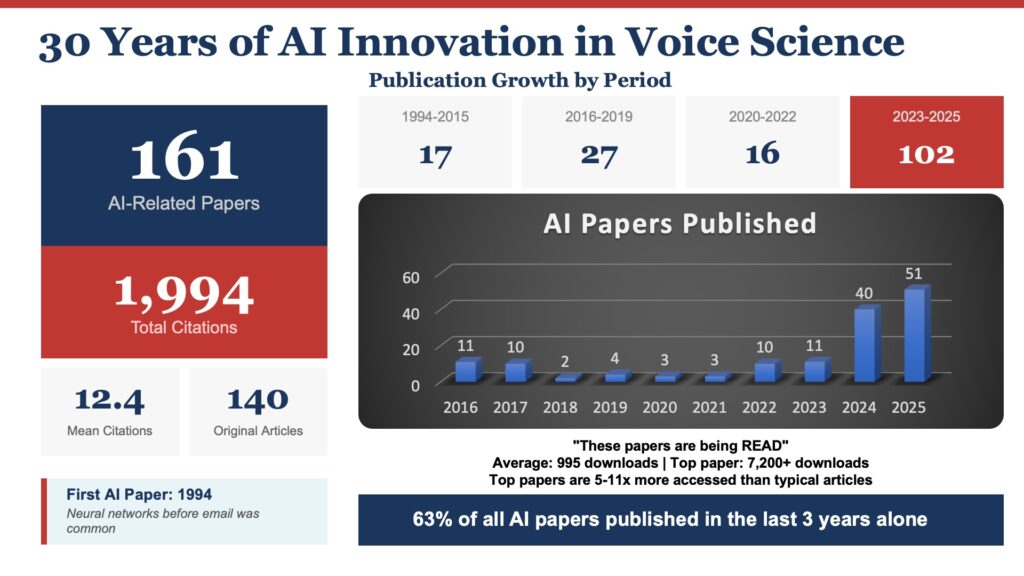
The publication timeline tells a dramatic story:
- 1994–2015: 17 papers
- 2016–2019: 27 papers
- 2020–2022: 16 papers
- 2023–2025: 102 papers
In the single year of 2025, the Journal of Voice published 51 AI-related papers—surpassing the total output of the journal’s entire first twenty years combined. This sharp upward curve reflects a fundamental shift across the global scientific community: AI is no longer an optional adjunct to voice research; it has become central to processing, interpreting, and applying clinical voice data.
Supporting Context and Real-World Metrics
The value of academic research is measured not only by its volume, but by its reach, citation impact, and real-world utility among clinicians, speech-language pathologists, and researchers. Statistics from the Journal of Voice demonstrate that its AI portfolio is exceptionally well-read and heavily leveraged.
Global Readership and Downloads
The average AI-related paper published in the Journal of Voice commands nearly 1,000 downloads, outperforming many traditional subjects. More importantly, landmark studies have achieved viral academic status. A 2020 study exploring machine learning applications for COVID-19 detection via voice characteristics has been downloaded over 7,200 times—eleven times the median download rate for articles in its respective issue.
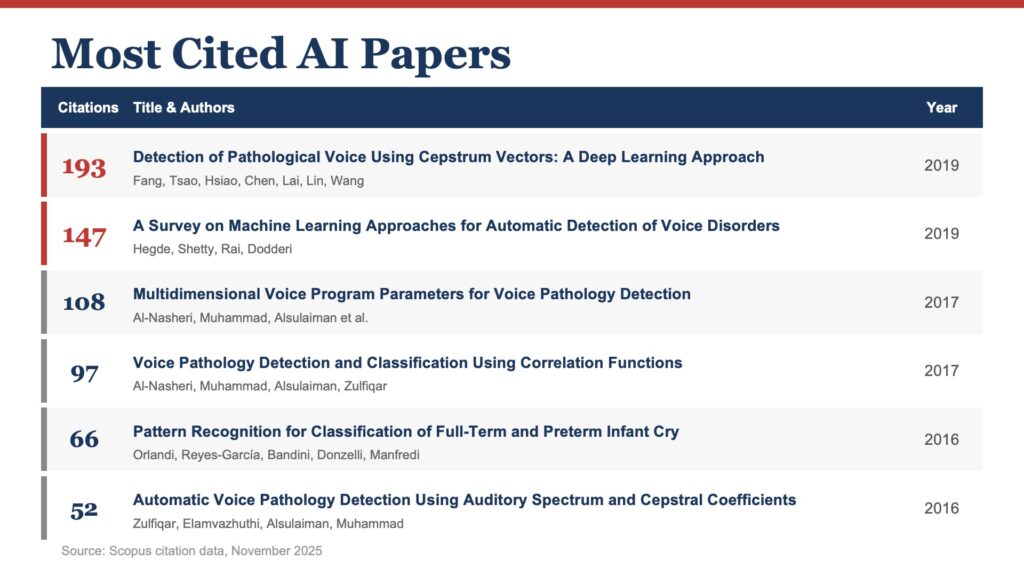
Similarly, top-cited methodological surveys and deep learning analyses have generated massive engagement:
- Fang et al. (2019): A deep learning study on pathological voice detection (193 citations, nearly 5,000 downloads).
- Hegde et al. (2018/2019): A comprehensive survey of machine learning approaches for voice disorder detection (147 citations, nearly 5,000 downloads).
These figures underscore a vital reality: clinicians and allied health professionals are actively turning to computational literature to acquire practical diagnostic tools, refine clinical workflows, and improve patient outcomes.
Landmark Research Shaping the Field
The foundational studies driving this field have systematically dismantled historical barriers in vocal diagnostics.
- Pathology Detection: Fang and colleagues demonstrated that deep neural networks can analyze cepstrum vectors to detect vocal pathologies with an accuracy that vastly exceeds human perceptual capabilities. Studies by Al-Nasheri et al. (2017), Chen and Chen (2022), and Cho and Choi have continued to refine neural architectures, moving from traditional multi-layer perceptrons to advanced 1D convolutional neural networks capable of parsing complex laryngoscopic images and acoustic waveforms.
- The Voice as a Digital Biomarker: Perhaps the most paradigm-shifting development is the conceptualization of the voice as a non-invasive digital biomarker for systemic health. Recent research has moved decisively toward tracking neurological disorders, such as Hemmerling and Wójcik-Pędziwiatr’s 2022 study on predicting Parkinson’s disease severity from voice signals. Furthermore, emerging systematic reviews suggest that acoustic parameters can signal depressive states, bipolar disorders, and early-stage respiratory vulnerabilities.
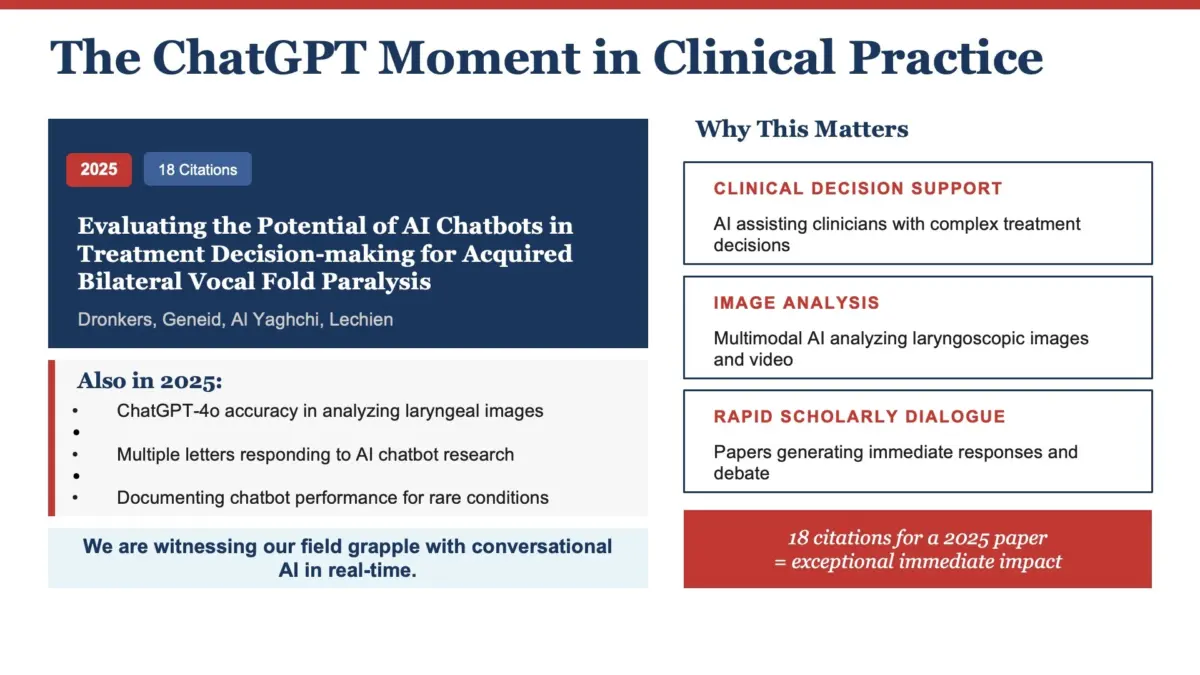
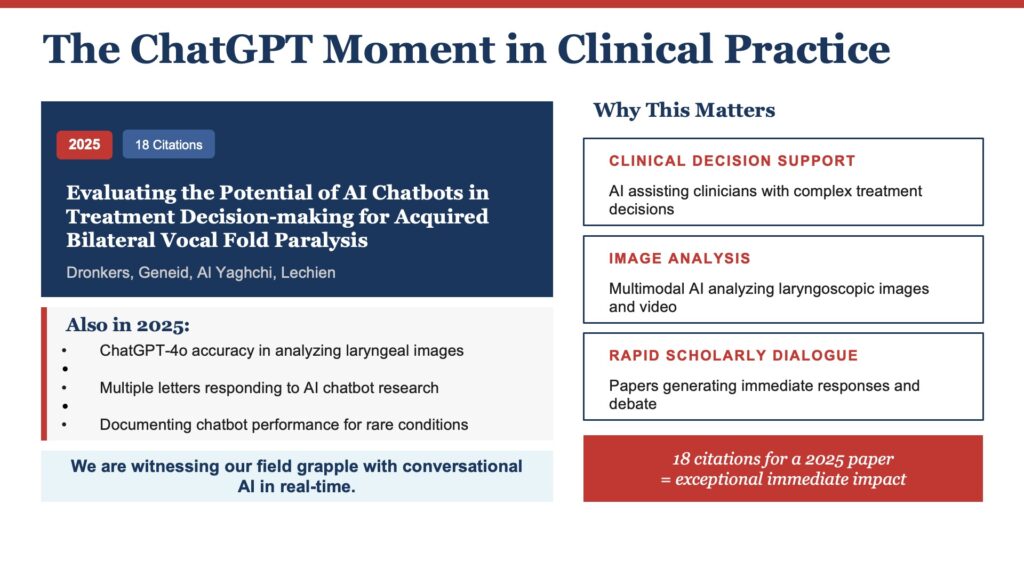
- Conversational AI in Clinical Settings: In 2025, the journal expanded into examining the role of large language models and conversational AI in clinical decision-making. Dronkers and colleagues published a foundational study evaluating AI chatbots in treatment planning for acquired bilateral vocal fold paralysis, generating widespread debate, subsequent research on ChatGPT-4o’s accuracy in laryngeal analysis, and a new frontier in human-computer clinical integration.
Official Statements and Expert Perspectives
To navigate this technological revolution safely and effectively, leading voices within the scientific community have offered critical insights regarding both the immense promise and the ethical responsibilities of AI integration.

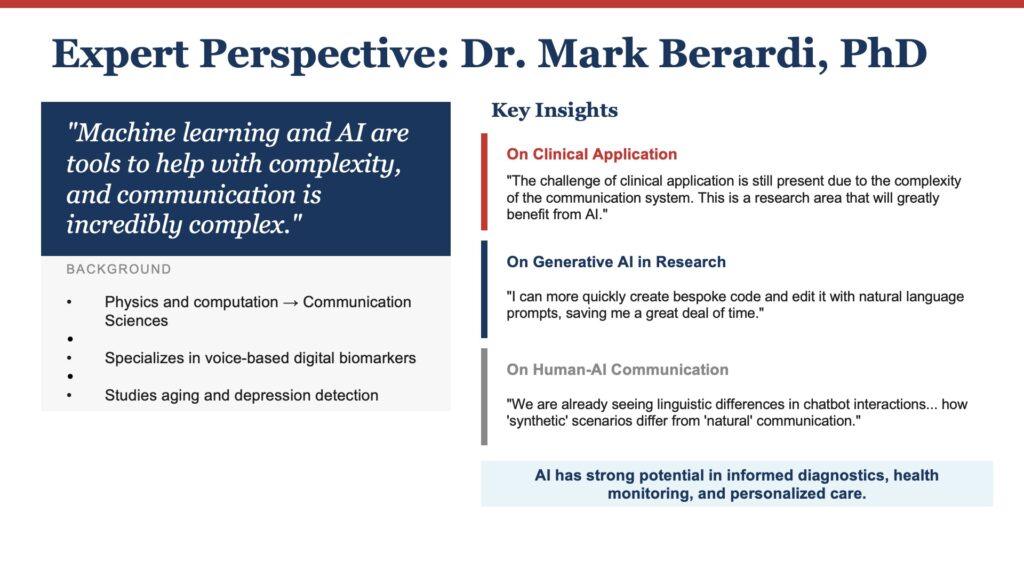
Dr. Mark Berardi: Managing Complexity and Synthetic Communication
Dr. Mark Berardi, whose academic background spans physics and computation, views machine learning primarily as an essential tool for managing multi-dimensional complexity.
"Machine learning and AI are tools to help with complexity, and communication is incredibly complex in its neurobiological and physiological processes. So I think the application is warranted," Dr. Berardi explains.
His research focuses on extracting health insights—such as markers for aging and depression—from easily acquired speech and voice signals. However, he maintains a pragmatic view of generative AI. While it may not have fundamentally rewritten foundational physics, generative AI has obliterated technical bottlenecks in research, enabling scientists to rapidly write, test, and refine bespoke code using natural language prompts.
Dr. Berardi is also breaking new ground by studying human-AI communication itself. As society shifts toward virtual interactions and chatbot consultations, he notes measurable linguistic shifts in how humans speak to machines compared to other humans. The future of voice science, therefore, may require analyzing not just human-to-human speech, but human vocal adaptation in synthetic environments.
Dr. Eric Hunter: Embracing Change with Ethical Clarity
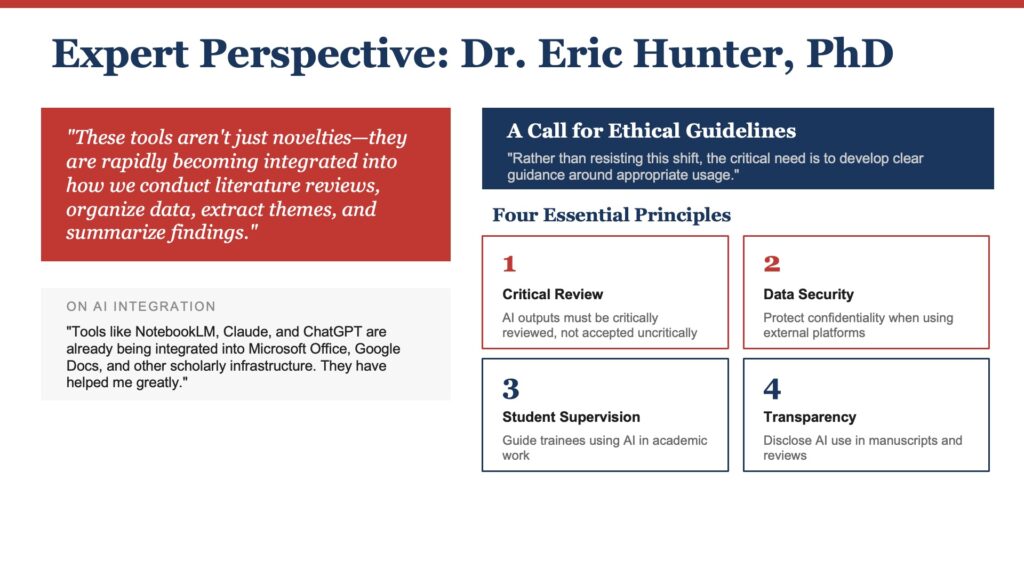
Addressing the institutional and academic implications of artificial intelligence, Dr. Eric Hunter stresses that computational tools are permanent fixtures of modern scholarly infrastructure.
"These tools aren’t just novelties," Dr. Hunter observes. "They are rapidly becoming integrated into how we conduct literature reviews, organize data, extract themes from large bodies of text, and even summarize findings."
With tools like NotebookLM, Claude, and ChatGPT embedded directly into Microsoft Office, Google Docs, and academic publishing ecosystems, Dr. Hunter issues a definitive call to action: rather than pushing back against automation, the academic community must establish transparent, rigorous guidelines for appropriate usage.
Dr. Hunter advocates for a framework resting on four core principles:
- Absolute Transparency: Full disclosure of AI assistance in literature synthesis, coding, and manuscript preparation.
- Human Accountability: Researchers must retain total responsibility for data accuracy, methodology, and scientific integrity, as AI models cannot be held accountable for errors.
- Intellectual Rigor: Utilizing AI to eliminate administrative friction while preserving original human critical thinking and creative analysis.
- Equitable Access: Ensuring that computational advancements benefit international research communities equitably, preventing technological stratification.
A Global Research Community
The rapid ascent of AI in voice science is not the isolated achievement of a single laboratory or institution. It is the product of an interconnected, global network of researchers spanning every inhabited continent.
Leading contributors to the Journal of Voice’s AI literature include international scholars such as Jérôme René Lechien, Dimitar Deliyski, Stephanie Zacharias, Ahmed Yousef, Paavo Alku, Leonardo Wanderley Lopes, and Maryam Naghibolhosseini. Supported by institutions worldwide, these investigators are pooling cross-disciplinary expertise—uniting otolaryngologists, speech-language pathologists, computer scientists, physicists, and performing artists—to decode the infinite nuances of the human voice.
Future Outlook and the Path Forward
As the Journal of Voice steps into the future under the guidance of The Voice Foundation, the field faces three critical imperatives to ensure sustainable, ethical progress:
- Mindful Technological Engagement: Researchers and clinicians must master AI not as a replacement for human clinical judgment, but as an advanced amplifier of human expertise designed to parse extreme physiological complexity.
- Collective Ethical Governance: The scientific community must collaborate to construct universal ethical guidelines for AI use in research design, data interpretation, and peer review, heeding the warnings and frameworks outlined by leaders like Dr. Eric Hunter.
- Unrestricted Knowledge Sharing: With over 161 AI-focused papers published to date, the foundation has been laid; however, the ongoing democratization of voice diagnostics requires continuous publication, open-source collaboration, and rigorous clinical validation.
An Extraordinary Moment for Humanity
For hundreds of thousands of years, the human voice has remained our most intimate vessel of identity, emotion, and connection. It carries the microscopic signatures of our physical health, our neurological vitality, and our psychological wellbeing in a manner matched by no other biological signal.
For the first time in human history, we possess computational tools sophisticated enough to genuinely decode that complexity. These technologies promise to extend the reach of expert clinicians, catch subtle pathological shifts before they become debilitating, and democratize access to elite voice care across the globe.
The Journal of Voice and The Voice Foundation stand proudly at the center of this historic transformation. As the next decade unfolds, the intersection of artificial intelligence and voice science promises discoveries that will alter the landscape of modern medicine—ensuring that the human voice continues to speak, heal, and resonate for generations to come.
About the Author: Ian DeNolfo is Executive Director of The Voice Foundation, which publishes the Journal of Voice. A graduate of The Juilliard School and The Curtis Institute of Music, he formerly performed as a leading tenor at opera houses worldwide before transitioning to arts administration and scientific leadership at The Voice Foundation.