By Ian DeNolfo Executive Director, The Voice Foundation
Executive Overview
We stand at a profound inflection point in the annals of voice science—a historic juncture where artificial intelligence (AI) has transcended the realm of theoretical experimentation to fundamentally reshape how researchers conduct studies, data scientists analyze complex acoustic metrics, and clinicians diagnose and care for patients. For over half a century, The Voice Foundation has occupied the vanguard of interdisciplinary vocal research, building bridges between art and science, and the clinic and the stage. Today, that bridge is being reinforced and expanded by computational intelligence at a pace that defies traditional academic timelines.
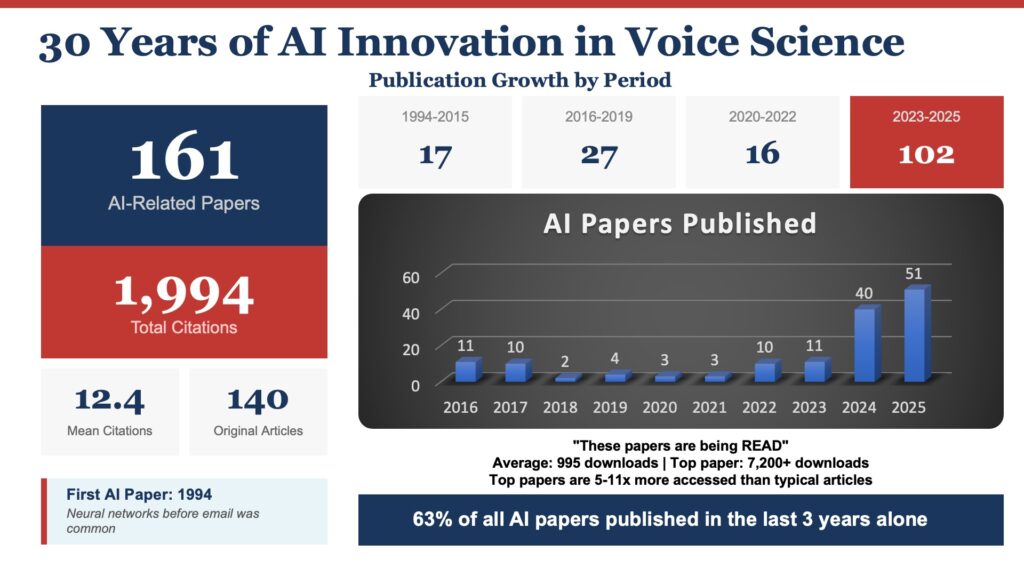
The convergence of artificial intelligence and voice science is not a sudden, twentieth-first-century phenomenon. In fact, a retrospective analysis of the field reveals that The Journal of Voice—the premier peer-reviewed journal dedicated to voice science and medicine—was publishing neural network research before the widespread commercialization of the internet. However, what we are witnessing today is an unprecedented exponential surge. More than 63 percent of all AI-related papers published in the journal’s history have appeared in just the last three years.
This article explores this digital transformation, charting its evolution from early neural network models to sophisticated deep learning architectures. It examines the emergence of the human voice as a vital digital biomarker for systemic health—capable of detecting everything from Parkinson’s disease and depression to acute respiratory infections—and outlines the imperative for a unified, ethical framework as generative AI tools permanently integrate into academic and clinical workflows.
A Legacy of Interdisciplinary Innovation
To understand the magnitude of the current AI revolution in voice science, one must first appreciate the institutional foundation upon which it rests. In 1969, Dr. Wilbur James Gould founded The Voice Foundation in New York City. At a time when the interdisciplinary care of the human voice was virtually non-existent, Dr. Gould possessed the groundbreaking foresight to bring together physicians, scientists, speech-language pathologists, performing artists, and vocal pedagogues. His mission was simple yet radical: to foster a collaborative environment where disparate disciplines could share knowledge and expertise for the betterment of the professional voice user.
The Foundation inaugurated its landmark Annual Symposium—Care of the Professional Voice—in 1972, quickly followed by its premier Gala (later christened Voices of Summer) in 1973. Since 1989, the organization has been guided by the visionary leadership of Dr. Robert Thayer Sataloff, an internationally renowned otolaryngologist, professional singer, and conductor. Dr. Sataloff has authored more than 1,200 publications, including 79 textbooks. Under his stewardship, the Foundation relocated its headquarters to Philadelphia and exponentially deepened its commitment to empirical scientific research and global education.
Today, the Foundation’s annual Philadelphia symposium draws hundreds of medical doctors, scientists, academics, speech-language pathologists, and performing artists from every corner of the globe. Alongside this thriving community, The Journal of Voice continues to set the gold standard for peer-reviewed literature in the discipline, serving as the definitive archival repository for breakthrough discoveries in voice pathology, acoustics, and therapeutics.
Detailed Chronology: Thirty Years of AI Research in Voice Science
It is a common misconception that artificial intelligence in medicine is a strictly contemporary development born of the post-2022 generative AI boom. In reality, the intersection of machine learning and voice science spans more than three decades.
The Genesis Era (1994–2015)
The historical record of The Journal of Voice proves that visionary researchers were experimenting with computational intelligence decades ahead of the cultural curve. In 1994—thirty-one years ago, during the absolute infancy of the World Wide Web—the journal published a landmark paper by Rihkanen and colleagues titled "Spectral Pattern Recognition of Improved Voice Quality." This pioneering study utilized early neural networks to analyze acoustic patterns. At a time when sending an email was still a novelty for the general public, voice scientists were already training computational models to recognize subtle acoustic signatures.
Despite this early promise, publication velocity during the first two decades was measured. Between 1994 and 2015, just 17 AI-related papers graced the pages of the journal. Researchers laid foundational methodologies, but computing power, data storage, and algorithmic maturity imposed natural boundaries on what could be achieved.
The Acceleration and Exponential Leap (2016–Present)
As machine learning matured into deep learning, the pace of publication began to accelerate. Between 2016 and 2019, the journal published 27 AI-focused studies. The period from 2020 to 2022 saw another 16 papers.
Then came the modern inflection point. Between 2023 and 2025, researchers contributed a staggering 102 AI-related papers to The Journal of Voice—accounting for 63 percent of the journal’s entire historical output in this domain. To put this explosive growth into perspective, the year 2025 alone saw the publication of 51 AI-related papers. In a single twelve-month window, the academic community published more AI research than it did during the entire first twenty years of the movement combined. This is not gradual academic progress; it is an exponential transformation of an entire scientific field.
Supporting Context and Metrics: Real-World Impact and Global Reach
Academic impact is frequently measured by citation counts, but the true value of scientific literature lies in its real-world application by clinicians, speech therapists, and biomedical engineers. Usage statistics for The Journal of Voice reveal an extraordinary, global readership actively seeking practical tools to advance patient care.
The average AI-focused paper published in the journal is downloaded nearly 1,000 times—an exceptionally high engagement metric for specialized medical literature. However, certain landmark studies have achieved viral distribution within the scientific community. For instance, a seminal study investigating machine learning methodologies for the detection of COVID-19 through acoustic profiles has been downloaded more than 7,200 times—eleven times the median download rate for articles in its respective issue.
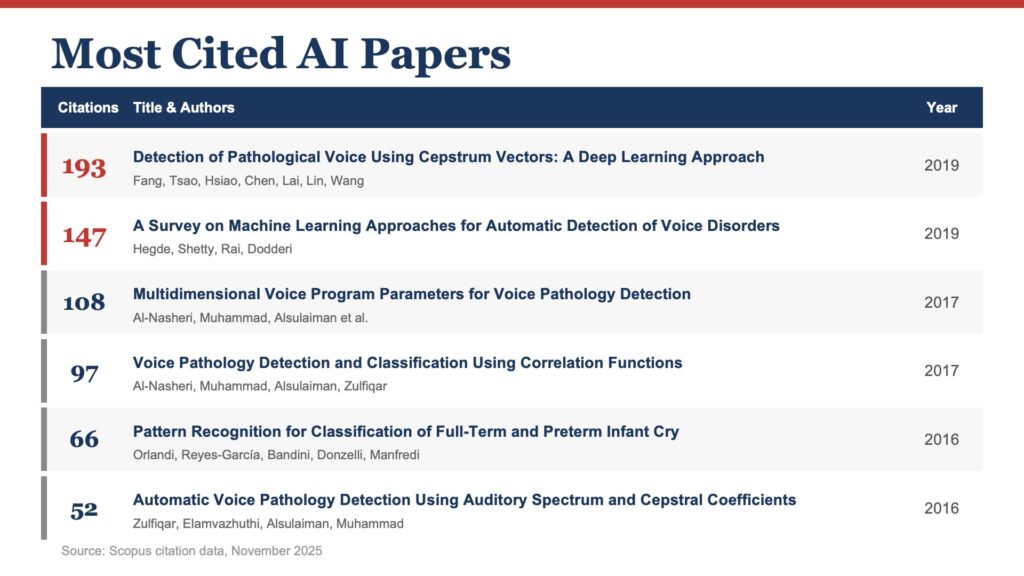
Similarly, structural survey papers and deep learning evaluations have captured the imagination of the global medical community. The two most-cited AI papers in the journal’s history—Fang and colleagues’ deep learning study (193 citations) and Hegde’s comprehensive machine learning survey (147 citations)—have each been downloaded nearly 5,000 times. These access metrics represent active clinicians, clinical researchers, and speech-language pathologists turning to peer-reviewed literature for actionable diagnostics and therapeutic frameworks.
This global research ecosystem is sustained by an international collective of scholars. Leading contributors to AI research within The Journal of Voice span continents and institutions, featuring prominent researchers such as Jérôme René Lechien, Dimitar Deliyski, Stephanie Zacharias, Ahmed Yousef, Paavo Alku, Leonardo Wanderley Lopes, and Maryam Naghibolhosseini. Their collaborative efforts demonstrate that the digital transformation of voice science is driven by a connected, international scientific community.
Landmark Research Reshaping the Field
Deep Learning for Voice Pathology Detection
The cornerstone of modern computational voice science is the ability to detect laryngeal and vocal tract pathologies before they manifest as overt symptoms audible to the human ear. Fang and colleagues’ 2019 study, "Detection of Pathological Voice Using Cepstrum Vectors: A Deep Learning Approach," remains the most-cited AI paper in the journal’s history. By deploying deep neural networks to analyze cepstral features—mathematical representations of the short-term power spectrum of a sound—the authors demonstrated that algorithms could identify pathological conditions with an accuracy that bypasses human perceptual limitations.
This work was contextualized and expanded by foundational reviews, such as Hegde and colleagues’ "Survey on Machine Learning Approaches for Automatic Detection of Voice Disorders." Serving as an essential roadmap for newcomers to the field, Hegde’s survey cataloged the myriad algorithms transforming acoustic screening. Subsequent breakthroughs, including Chen and Chen’s 2022 research on deep neural networks for voice classification, Fujimura’s pioneering use of one-dimensional convolutional neural networks (CNNs), and Cho and Choi’s comparative analysis of CNN models applied to laryngoscopic imaging, have continuously pushed the boundaries of automated diagnostics.
The Voice as a Digital Biomarker
Perhaps the most conceptually paradigm-shifting development in recent years is the recognition of the human voice as a digital biomarker—a non-invasive, continuous window into systemic human health.
Vocal folds are neuromuscular valves governed by complex interactions between the central nervous system, peripheral nerves, and respiratory mechanics. Consequently, subtle alterations in motor control, mucosal health, or psychological state manifest immediately within acoustic output.
Consider neurodegenerative disease monitoring. Hemmerling and Wójcik-Pędziwiatr’s 2022 study on predicting the severity of Parkinson’s disease from voice signals has garnered 29 citations in a remarkably short span, catalyzing a broader movement toward remote, phonatory-based disease tracking. Beyond neurology, systematic reviews published in the journal have begun exploring voice quality as a digital biomarker for psychiatric conditions, including major depressive disorder and bipolar disorder. The clinical implications are profound: routine acoustic screenings during telehealth consultations could flag early markers of mental health decline, facilitating proactive interventions and alleviating overburdened healthcare systems.
Furthermore, research utilizing machine learning to assess respiratory distress and viral infections—such as COVID-19—demonstrates that the human voice can act as an early sentinel for pulmonary health.
AI Chatbots and Conversational Agents in Clinical Practice
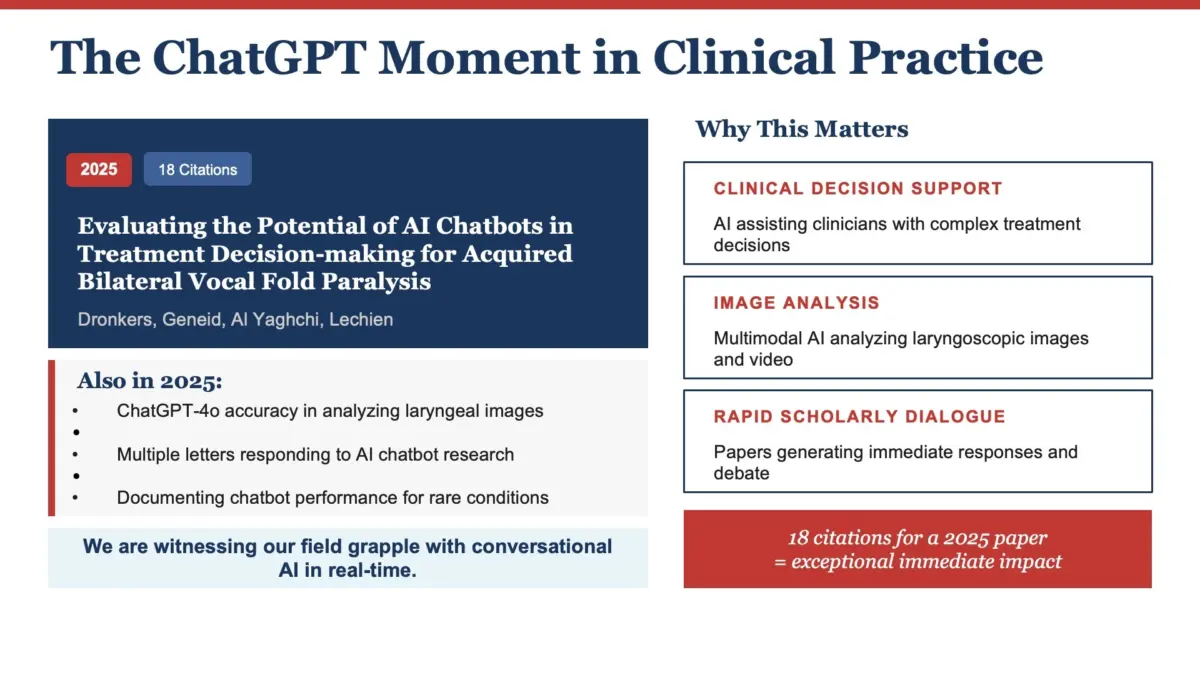
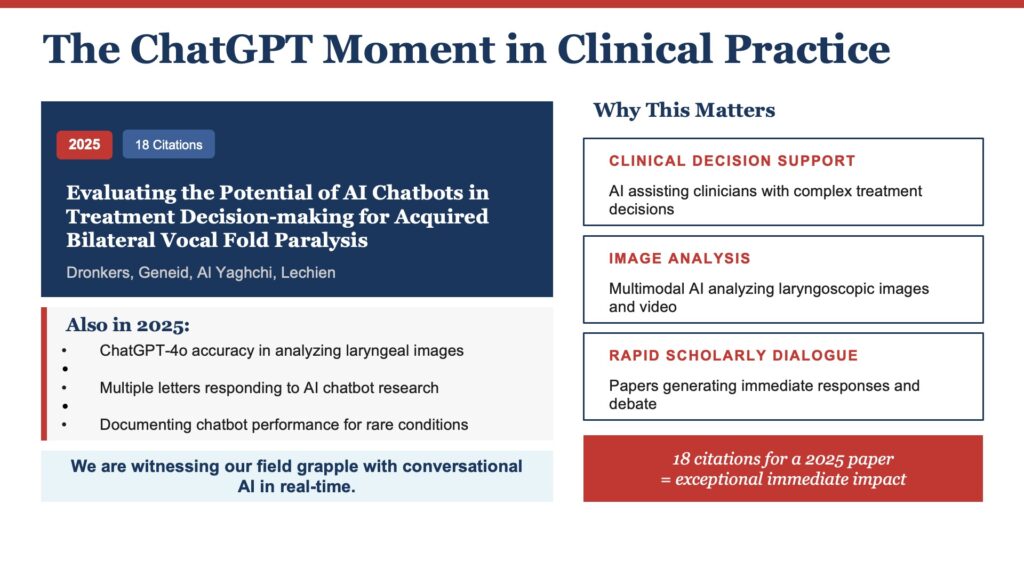
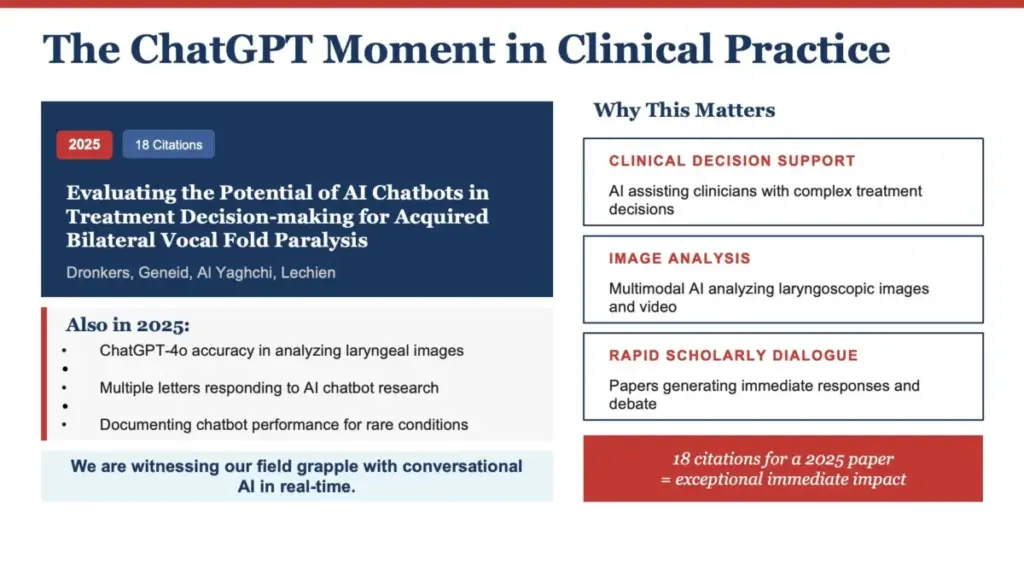
The year 2025 marked another milestone with the publication of specialized inquiries into the utility of AI chatbots and large language models (LLMs) in clinical decision-making. A notable paper by Dronkers and colleagues, "Evaluating the Potential of AI Chatbots in Treatment Decision-making for Acquired Bilateral Vocal Fold Paralysis," accumulated 18 citations immediately upon release.
Spurring energetic letters to the editor and peer-response papers—including empirical investigations into ChatGPT-4o’s precision in analyzing complex laryngeal imagery—these studies highlight a field actively and critically interrogating the limits and capabilities of conversational AI in medical settings.
Official Perspectives: Expert Insights on the AI Horizon
To navigate this rapidly evolving landscape, The Journal of Voice and The Foundation draw upon the insights of multidisciplinary leaders who bridge computational physics, clinical otolaryngology, and academic administration.
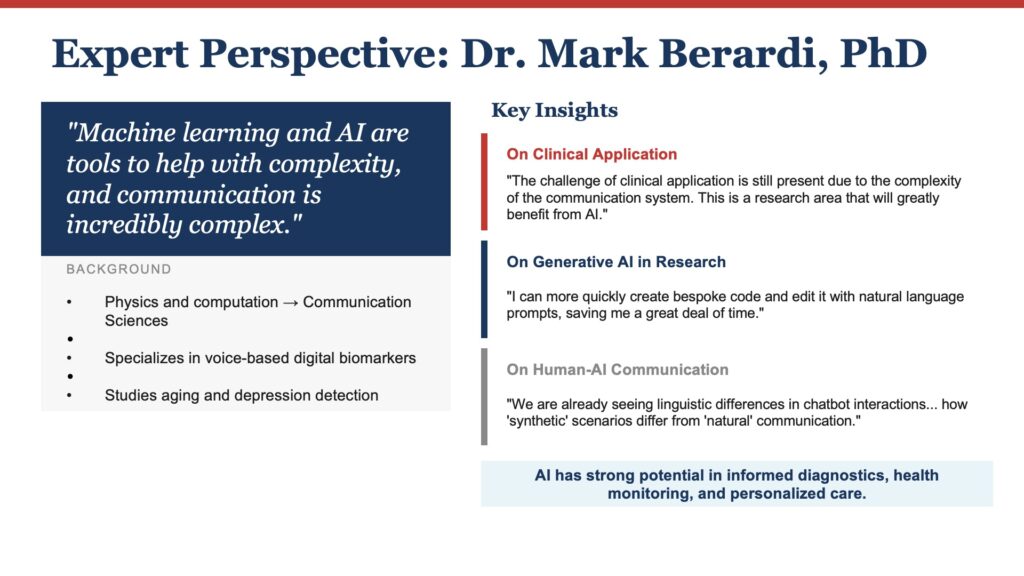
Dr. Mark Berardi: Managing Biological Complexity
Dr. Mark Berardi brings a rare dual perspective rooted in physics and computation to the study of human vocalization. For Dr. Berardi, artificial intelligence is, at its core, a sophisticated engine for managing high-dimensional complexity.
"Machine learning and AI are tools to help with complexity, and communication is incredibly complex in its neurobiological and physiological processes. So I think the application is warranted," Dr. Berardi observes.
His research focuses on extracting health insights from vocal biomarkers relating to aging and depression. While acquiring speech signals has become frictionless in the era of smartphones and digital microphones, the analytical bottleneck remains the sheer intricacy of human neuro-muscular coordination. This is precisely where machine learning excels.
On the subject of generative AI, Dr. Berardi maintains a pragmatic, measured stance. While generative models have not entirely rewritten the foundational rules of biological research, they have dramatically streamlined research workflows, particularly in coding and data processing.
"I can now quickly create bespoke code and edit it with natural language prompts," he notes.
Intriguingly, Dr. Berardi’s latest inquiries extend to human-AI communication itself. As humanity increasingly interacts with conversational agents and synthetic environments (such as video conferencing platforms), researchers are documenting measurable linguistic shifts. Understanding how the human voice adapts when addressing a machine rather than a biological peer has become an essential frontier for modern voice science.
Dr. Eric Hunter: Embracing Change with Ethical Clarity
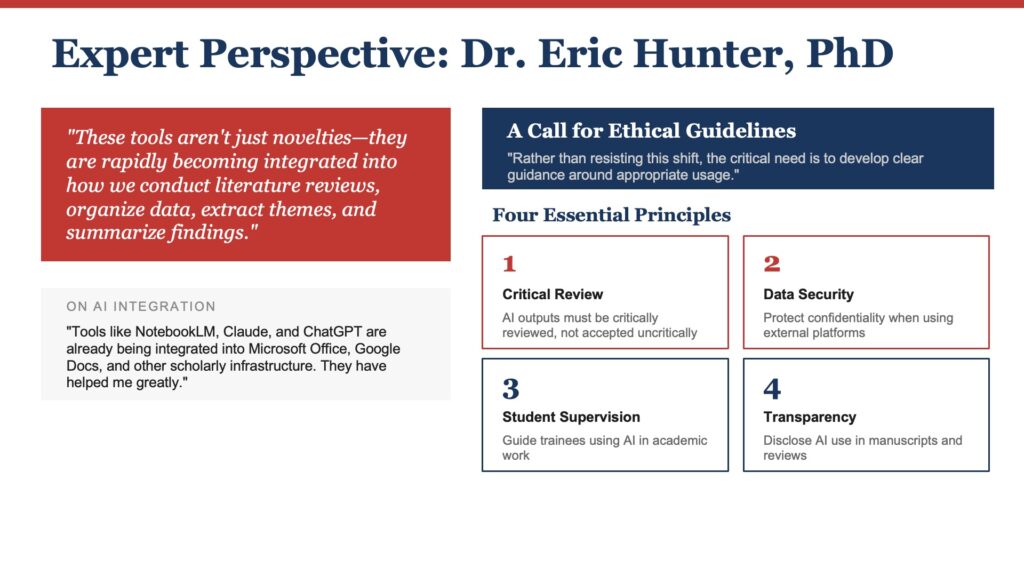
Dr. Eric Hunter focuses heavily on the structural and institutional implications of artificial intelligence within academia and clinical practice. For Dr. Hunter, AI tools are no longer transient novelties; they are permanent fixtures of the modern scholarly infrastructure.
"These tools aren’t just novelties," Dr. Hunter warns. "They are rapidly becoming integrated into how we conduct literature reviews, organize data, extract themes from large bodies of text, and even summarize findings."
Large language models and automated agents are quietly embedding themselves into word processors, reference managers, and statistical software suites. Rather than adopting an antagonistic posture toward this technological shift, Dr. Hunter advocates for proactive engagement coupled with rigorous ethical oversight. He outlines four essential principles for academic integrity in the age of AI:
Transparency: Openly disclosing the utilization of AI tools in literature synthesis, coding, and manuscript preparation.
Accountability: Ensuring that human authors retain absolute intellectual responsibility for the veracity of data and conclusions.
Data Privacy: Protecting sensitive patient health information (PHI) when deploying external machine learning models for acoustic or clinical analysis.
"Our field will benefit most," Dr. Hunter concludes, "if we embrace the productivity these tools offer while also building a shared ethical framework for their responsible use."
Future Outlook: The Path Forward for Voice Science
As The Journal of Voice looks toward the next decade of discovery, the roadmap for the discipline is defined by three imperative directives for collective action:
First, we must engage with AI tools thoughtfully as amplifiers of human expertise. Computational models are designed to process complex datasets at scale; they are not intended to replace clinical intuition, artistic empathy, or expert medical judgment. Voice professionals must educate themselves on both the immense capabilities and the inherent biases of algorithmic diagnostics.
Second, we must actively construct a unified ethical framework. As Dr. Hunter emphasizes, questions regarding data ownership, patient privacy, algorithmic transparency, and authorship attribution cannot be solved by isolated research labs. They require a concerted, community-wide consensus.
Third, we must maintain our commitment to open, rigorous scientific inquiry. The 161 AI-focused papers published in our journal represent merely the opening chapter of a much larger story. Every clinician, speech-language pathologist, otolaryngologist, and computational scientist holds unique empirical insights that can enrich our shared understanding.
Conclusion
The human voice has served as our primary instrument of connection, emotional expression, and personal identity for hundreds of millennia. It encodes our psychological state, our neurological health, and our biological vitality in a format more intimate and complex than any other physiological signal.
Now, for the first time in human history, we possess computational tools sophisticated enough to truly decode that complexity—to unmask what acoustic waves reveal about our brains, our bodies, and our overall well-being. We stand equipped with technologies that can extend the diagnostic reach of expert clinicians, catch pathological changes long before they become debilitating, and democratize access to elite voice care for populations across the globe.
This is an extraordinary, transformative moment in scientific history. As The Voice Foundation and The Journal of Voice enter their next half-century of innovation, we remain steadfastly at the center of this revolution. The next decade promises discoveries that will forever redefine our relationship with the human voice. We look forward to pioneering that future together.
About the Author
Ian DeNolfo is Executive Director of The Voice Foundation, which publishes The Journal of Voice. A graduate of The Juilliard School and The Curtis Institute of Music, he formerly performed as a leading tenor at major opera houses worldwide before transitioning his administrative and artistic expertise to the leadership of The Voice Foundation.