
Executive Overview
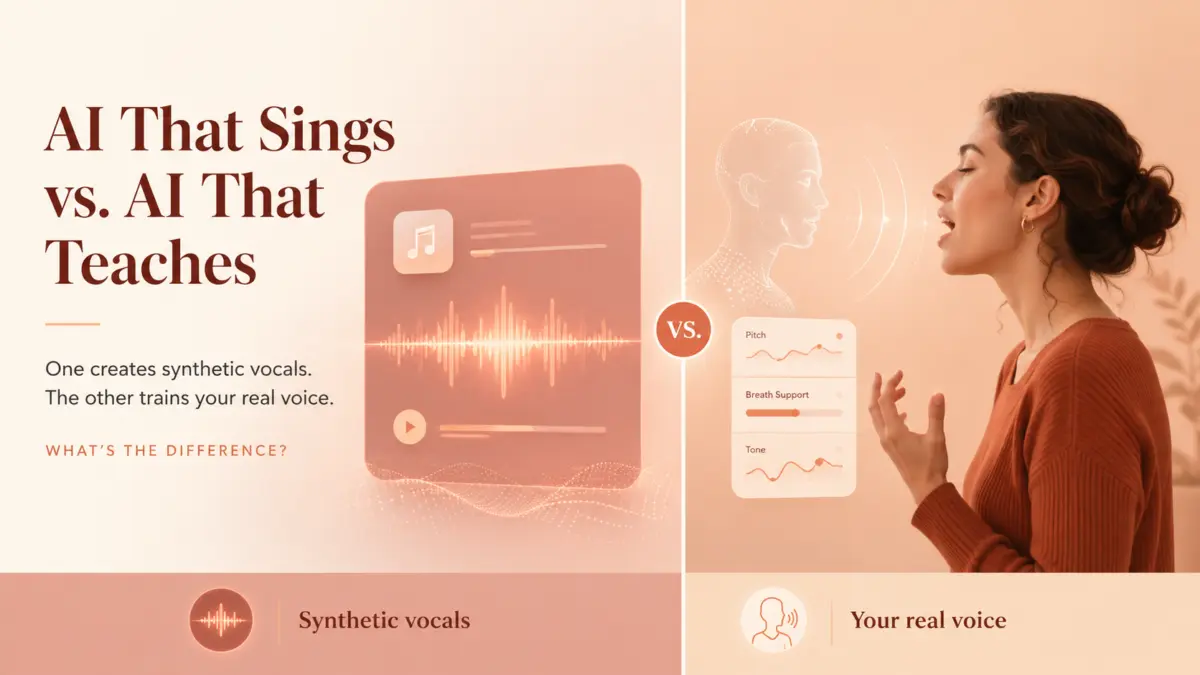
The rapid integration of artificial intelligence into the music and creative industries has sparked a profound semantic and technological division. Today, the phrase "AI singing" has come to represent two entirely opposite paradigms. On one side of this technological divide stands generative AI—epitomized by platforms such as Suno, Udio, and various voice-cloning technologies. These systems synthesize complete, studio-quality vocal tracks from text prompts and reference audio. The AI sings so the human does not have to, effectively decoupling the act of vocal performance from human physical effort.
On the opposing side stands pedagogical AI—exemplified by intelligent vocal training platforms like Singing Carrots. Instead of replacing the human voice, these tools leverage machine learning to analyze, evaluate, and train the user’s physical vocal apparatus. Here, the AI listens, diagnoses, and guides, acting as a highly accessible digital vocal coach to improve the user’s real-world abilities.
This investigative report explores this technological dichotomy. By analyzing the underlying technologies, historical developments, quantitative performance metrics, and industry perspectives, we examine how these parallel innovations are reshaping both the creator economy and the human relationship with song.
                    ┌──────────────────────────────────────────┐
                    │               "AI SINGING"               │
                    └────────────────────┬─────────────────────┘
                                         │
                    ┌────────────────────┴────────────────────┐
                    ▼                                         ▼
       ┌─────────────────────────┐               ┌─────────────────────────┐
       │   GENERATIVE SYSTEMS    │               │   PEDAGOGICAL SYSTEMS   │
       │      (Replacement)      │               │      (Development)      │
       ├─────────────────────────┤               ├─────────────────────────┤
       │ • Suno, Udio, Cloners   │               │ • Singing Carrots       │
       │ • Output: Synthetic file│               │ • Output: Human growth  │
       │ • Displaces performance │               │ • Empowers performer    │
       └─────────────────────────┘               └─────────────────────────┘
Detailed Chronology: From Auto-Tune to Generative Transformers
The evolution of vocal technology has transitioned from basic signal processing to sophisticated cognitive computing. Understanding this trajectory reveals how a single term came to encompass two divergent fields.
[Late 1990s] ─────────────────► [2010s] ──────────────────────► [2023 - Present]
Pitch Correction                Real-Time Analysis               Generative Explosion
(Auto-Tune, Melodyne)           (Mobile Pitch Trackers)          (Suno, Udio, Voice Cloning)
*Post-processing tools*         *Early pedagogical feedback*     *Synthetic vocal synthesis*
Phase 1: The Era of Digital Signal Processing (DSP) and Correction (Late 1990s–2010s)
The relationship between computers and the singing voice began in earnest with the release of Antares Auto-Tune in 1997, followed by Celemony Melodyne in 2001. These tools relied on digital signal processing (DSP) to detect pitch and pull it to the nearest semitone.
During this era, technology served strictly as a corrective post-processing tool. It did not generate new vocal attributes, nor did it teach the singer how to improve. It merely altered the recorded waveform.
Phase 2: The Emergence of Interactive Mobile Pedagogy (2010s–Early 2020s)
With the proliferation of smartphones and improved consumer microphones, developers began adapting DSP algorithms for educational purposes. Early singing apps could detect pitch in real time, displaying a visual line over a target melody—essentially translating the visual feedback mechanics of games like Guitar Hero or SingStar into educational tools.
These platforms gradually integrated basic machine learning models to classify vocal ranges and detect consistent errors. However, they remained passive measurement tools rather than active instructional systems.
Phase 3: The Generative AI Explosion and the Semantic Split (2023–Present)
The landscape changed dramatically with the introduction of deep learning transformer models and latent diffusion techniques optimized for audio. In late 2023 and early 2024, platforms like Suno and Udio emerged, demonstrating an ability to generate fully realized songs—complete with instrumentation, lyrics, and highly convincing synthetic vocals—from simple text descriptions.
Simultaneously, voice-cloning technologies (such as retrieval-based voice conversion, or RVC) made it possible to superimpose any singer’s vocal profile onto any melody.
This breakthrough created a semantic clash. The term "AI singing" was suddenly claimed by generative models that bypassed human vocal cords entirely, even as interactive training apps continued to use the term to describe the automated development of human vocal cords.
Supporting Context & Metrics: The Technical and Economic Divide
The divergence between generative and pedagogical AI is not merely conceptual; it is defined by distinct technical architectures, user demographics, and developmental outcomes.
Technical Architectures Compared
The back-end infrastructure of these two product categories reveals entirely different computational priorities:
- Generative Audio Engines: Utilize massive neural networks trained on millions of hours of copyrighted and licensed music. They predict audio waveforms sequentially, translating text tokens (lyrics and style prompts) into high-fidelity acoustic outputs. These systems require immense GPU infrastructure to run inference in the cloud.
- Pedagogical AI Coaches: Rely on real-time fundamental frequency ($f_0$) estimation algorithms (such as YIN or pYIN) and fast Fourier transforms (FFT) running locally on consumer devices. This is combined with heuristic decision trees or lightweight reinforcement learning models to adjust lesson plans dynamically based on user accuracy, latency, and vocal fatigue.
| Metric / Attribute | AI Voice Generators (e.g., Suno, Udio) | AI Vocal Coaches (e.g., Singing Carrots) |
|---|---|---|
| Primary Output | Synthesized audio file (.mp3, .wav) | Measurable neurological and muscular improvement |
| Core Technology | Latent diffusion, transformer models, neural vocoders | Real-time pitch tracking ($f_0$ estimation), DSP, conversational LLMs |
| Computational Footprint | Heavy cloud GPU dependency | Lightweight, optimized for local/edge mobile devices |
| User Input Required | Text prompts, lyrics, or reference melodies | Active, physical vocal performance into a microphone |
| Primary Value Proposition | Instantaneous content creation; zero skill barrier | Long-term skill acquisition; active personal development |
| Target Audience | Content creators, indie developers, songwriters | Amateur singers, karaoke enthusiasts, aspiring professionals |
Efficacy and Behavioral Metrics
While generative AI measures success through generation speed, fidelity, and user retention, pedagogical AI measures success through human physiological growth.
In a landmark seven-month study tracking beginner singers utilizing an AI-driven vocal coach, researchers recorded significant improvements in pitch accuracy:
Pitch Accuracy Improvement Over 4 Weeks (Beginner Singers)
──────────────────────────────────────────────────────────
Pre-Training:  ░░░░░░░░░░░░░░░░░░░░ Baseline
Post-Training: ░░░░░░░░░░░░░░░░░░░░░░░░░░░░ (+16.5% Accuracy)
──────────────────────────────────────────────────────────
This data demonstrates that while generative systems bypass the learning curve, pedagogical systems successfully flatten it. The study also revealed that the lowest-performing beginners experienced the most significant upward trajectory, indicating that automated real-time feedback is highly effective at correcting fundamental pitch-matching deficiencies.
Industry Perspectives & Expert Commentary
The dual nature of "AI singing" has drawn diverse reactions from vocal scientists, educators, and creative professionals.

The Pedagogical Viewpoint: Augmenting the Human Voice
Traditional vocal instructors view the rise of AI vocal coaches not as a threat, but as a vital tool to democratize music education.
Dr. Arnel Sancianco, a vocal researcher and performance consultant, emphasizes the accessibility aspect:
"Traditional, high-quality vocal coaching can cost anywhere from $80 to over $200 per hour, making it a luxury for a select few. An AI vocal coach cannot replace the nuanced physiological diagnostic capabilities of a master teacher in a studio, but it does something arguably just as important: it provides real-time, objective pitch and range feedback to millions of people who would otherwise never have access to any instruction. It turns practice from a guessing game into an objective, data-driven process."
The Generative Viewpoint: Redefining Production and IP
In contrast, the discussion surrounding generative AI singing is dominated by copyright debates, creative ethics, and production efficiencies.
In April 2024, the state of Tennessee enacted the ELVIS Act (Ensuring Likeness Voice and Image Security), a legislative milestone designed to protect artists from unauthorized voice cloning.
Music industry analyst Cheryl Vance explains the economic tension:
"Generative voice technology is a double-edged sword. For an indie game developer with a budget of $5,000, tools like Suno or Udio are a miracle—they can generate a fully voiced theme song for pennies. But for professional session singers, these tools represent a direct threat to their livelihood. We are seeing a rapid shift where the voice is treated no longer as a human attribute, but as a modular, synthesizable dataset."
The Hybrid Intersection: Generative Pedagogy
Interestingly, developers are beginning to find areas of convergence between these two technologies. Some advanced vocal coaching platforms have integrated generative conversational models (such as customized GPTs) to power interactive, persona-driven instruction.
This allows users to ask their AI coach to roleplay as historic singers or specific instructors—for example, asking the AI to explain breath support using the stylistic framing of Freddie Mercury or a classical opera director. In this scenario, generative AI is harnessed to guide the student’s physical practice rather than replace their voice.
Future Outlook: Coexistence or Cultural Displacement?
As both technologies mature, they are poised to shape two distinct cultural futures.
                  ┌───────────────────────────────┐
                  │   THE FUTURE OF "AI SINGING"  │
                  └───────────────┬───────────────┘
                                  │
         ┌────────────────────────┴────────────────────────┐
         ▼                                                 ▼
┌──────────────────────────────┐                  ┌──────────────────────────────┐
│    THE GENERATIVE FUTURE     │                  │    THE PEDAGOGICAL FUTURE    │
├──────────────────────────────┤                  ├──────────────────────────────┤
│ • Automated localization     │                  │ • Real-time biofeedback      │
│ • Custom, on-demand tracks   │                  │ • Democratic music education │
│ • Modular vocal marketplaces │                  │ • Preserving human performance│
└──────────────────────────────┘                  └──────────────────────────────┘
The Evolution of Generative Vocals
Generative vocal technology will continue to integrate into professional music production pipelines. We are moving toward a future of modular vocal marketplaces, where legendary artists may legally license their cloned voices for use by bedroom producers, collecting royalties automatically via smart contracts.
Additionally, real-time language localization will become standard; a singer will record a track in English, and generative systems will instantly translate and re-render the performance in perfect Japanese, Spanish, or French, retaining the original singer’s unique timber and emotional delivery.
The Evolution of Pedagogical AI
Conversely, pedagogical AI will become increasingly integrated with wearable technology and advanced biometric sensors. Future iterations of AI vocal coaches will likely analyze real-time data from smartwatches, chest straps, and even throat-contact microphones to measure muscle tension, lung capacity, and posture.
These platforms will offer hyper-personalized, physical training regimens that treat the singer’s body as an athletic instrument, combining vocal science with physical therapy concepts.
Conclusion: The Persistent Human Element
Ultimately, the coexistence of generative voice synthesis and automated vocal training reveals a fundamental truth about human nature. While generative systems satisfy the transactional need for content—providing instant, high-quality audio tracks for media, advertising, and passive consumption—they do not satisfy the human desire for expression.
The act of singing remains a deeply physical, emotional, and social experience. Whether preparing for a professional audition or simply trying to sing confidently at a local karaoke bar, humans will continue to seek out tools to develop their physical voices.
The dual trajectories of "AI singing" will therefore continue to expand in parallel: one optimizing the digital assets we listen to, and the other empowering the physical voices we use to express ourselves.