By Ian DeNolfo Executive Director, The Voice Foundation
Executive Overview
Voice science stands at a profound historical inflection point. Today, artificial intelligence (AI) and machine learning (ML) are fundamentally reshaping how researchers conduct investigations, how data is parsed, and how clinicians diagnose and care for patients. While the integration of automated analytics into medicine often feels like a modern phenomenon, the intersection of AI and human vocal assessment has a surprisingly deep and storied pedigree.
For over five decades, The Voice Foundation—founded in New York City in 1969 by Dr. Wilbur James Gould and guided since 1989 by world-renowned otolaryngologist Dr. Robert Thayer Sataloff—has served as the premier bridge between art and science, clinic and stage. Through its flagship publication, the Journal of Voice, the organization has chronicled the evolution of vocal health. Yet, few realize that this peer-reviewed journal has been publishing AI-related research for over thirty years.
What was once a niche computational pursuit using rudimentary neural networks in the mid-1990s has erupted into an exponential transformation. In the past three years alone, the volume of AI research published in the field has shattered historical benchmarks. Today, the human voice is no longer viewed merely as an acoustic vehicle for speech and song; it is increasingly recognized as a sophisticated digital biomarker—a non-invasive window into systemic health, neurological function, and psychological well-being. This article explores the historical trajectory, landmark studies, expert insights, and ethical imperatives steering the future of voice science.
Detailed Chronology: Three Decades of AI in Voice Science
The integration of computational intelligence into voice research did not begin with the modern generative AI boom. Its roots stretch back to an era when the public internet was still in its infancy.
The 1990s: Pioneering Neural Networks
In 1994—thirty-one years ago, and the exact same year the World Wide Web entered mainstream public consciousness—the Journal of Voice published a paper by Rihkanen and colleagues titled "Spectral Pattern Recognition of Improved Voice Quality." Utilizing nascent neural network architecture to analyze acoustic voice profiles, this study proved that computational models could identify subtle enhancements in vocal quality that standard metrics missed. At a time when most professionals had never sent an electronic mail message, voice scientists were already experimenting with machine learning.
The Slow Burn (1995–2015)
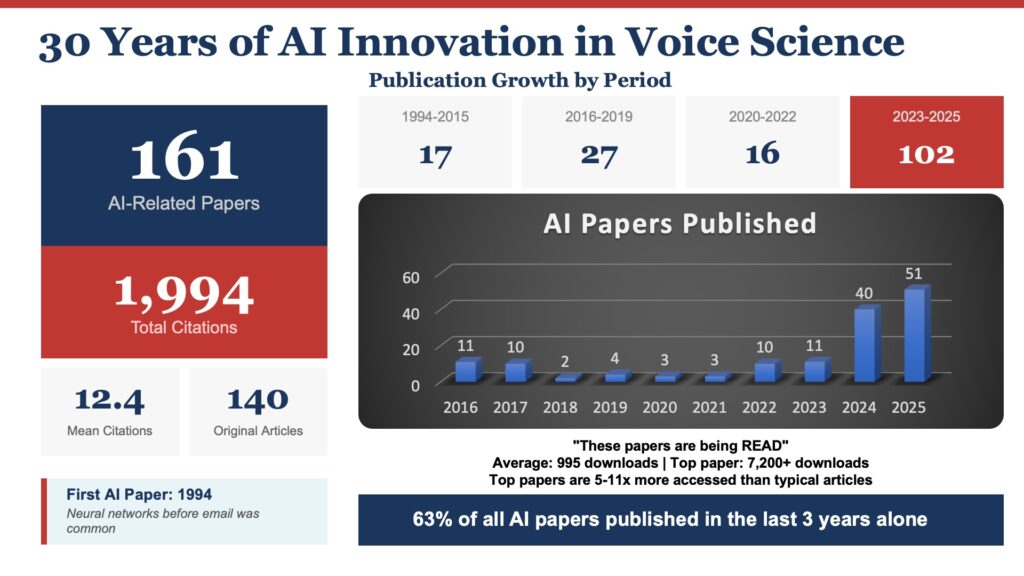
For the next two decades, AI research in voice science progressed steadily but incrementally. Between 1995 and 2015, a modest collection of 17 papers explored algorithmic approaches to vocal analysis. Researchers laid the groundwork by mapping acoustic parameters, refining signal processing, and testing early classification models.
The Acceleration (2016–2022)
As computational power surged and deep learning architectures matured, the pace quickened. Between 2016 and 2019, the Journal of Voice published 27 AI-related papers, followed by another 16 papers between 2020 and 2022. During this window, deep neural networks (DNNs) began outperforming traditional linear acoustic analyses, setting the stage for modern diagnostic tools.
The Exponential Explosion (2023–Present)
The landscape changed overnight entering the mid-2020s. Out of 161 total AI-related papers published in the journal’s history, an astounding 102 papers (63 percent) were published in just the last three years.
In the single year of 2025, the journal published 51 AI-related papers—surpassing the cumulative total of the field’s first twenty years combined. This is not gradual academic growth; it is an exponential transformation that is actively rewriting the boundaries of otolaryngology and speech-language pathology.
Supporting Context & Metrics: Beyond Citations to Real-World Impact
Academic metrics are often dismissed as ivory-tower statistics, but in the context of the Journal of Voice, download and citation figures tell a story of immediate, real-world clinical utility. Clinicians, researchers, and speech-language pathologists worldwide are actively downloading and applying these computational frameworks to solve complex patient care dilemmas.
High Engagement: The average AI-focused paper published in the journal has been downloaded nearly 1,000 times.
The COVID-19 Benchmark: The single most-accessed AI paper in the journal’s history—a pivotal study examining machine learning applications for COVID-19 detection via vocal tract characteristics—has surpassed 7,200 downloads, eclipsing the median issue article readership by a factor of eleven.
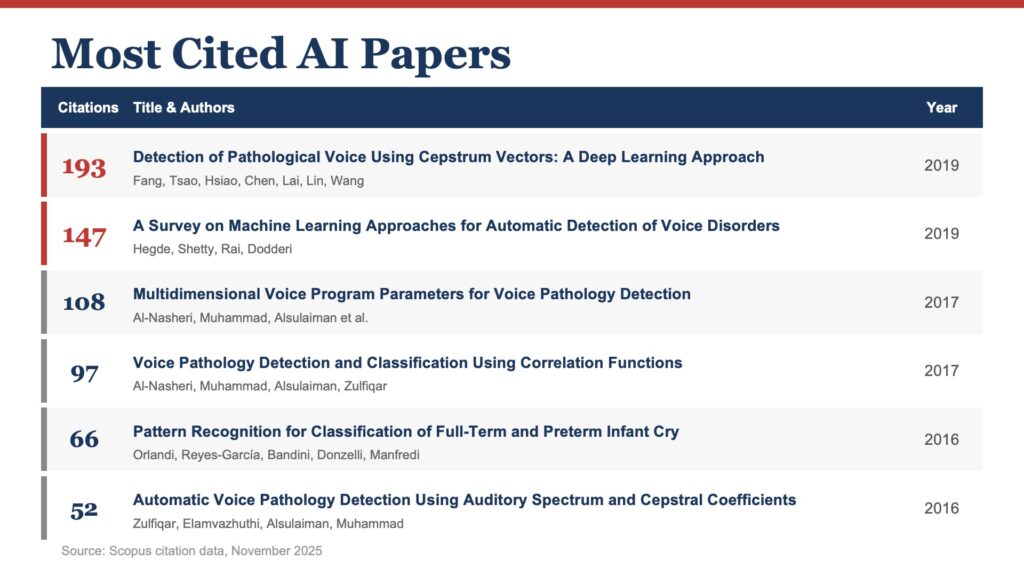
Foundational Literature: The two most-cited papers—Fang and colleagues’ 2019 deep learning study (193 citations) and Hegde’s comprehensive machine learning survey (147 citations)—have each been downloaded nearly 5,000 times, cementing their status as mandatory reading for modern clinicians.
Landmark Research Shaping the Field
Deep Learning for Voice Pathology Detection
Fang et al.’s 2019 landmark paper, "Detection of Pathological Voice Using Cepstrum Vectors: A Deep Learning Approach," demonstrated that deep neural networks could isolate vocal pathologies with remarkable precision by evaluating cepstral features entirely imperceptible to the human ear.
This work was complemented by Hegde’s systematic survey on automated detection methods, alongside multi-citation contributions from Al-Nasheri et al. (2017) examining multidimensional voice program parameters. Subsequent breakthroughs—such as Chen and Chen’s 2022 deep neural network classifiers, Fujimura’s work with one-dimensional convolutional neural networks (CNNs), and Cho and Choi’s comparative CNN models for laryngoscopic images—have systematically pushed the envelope of diagnostic accuracy.
Voice as a Digital Biomarker
Perhaps the most paradigm-shifting development in contemporary medicine is the conceptualization of the human voice as a digital biomarker. Because phonation requires the synchronized, highly complex coordination of neurological, respiratory, and musculoskeletal systems, microscopic alterations in voice production can serve as early warning signals for systemic disease.
Neurological Disorders: Groundbreaking research spearheaded by Hemmerling and Wójcik-Pędziwiatr (2022) has utilized advanced acoustic modeling to predict and monitor the severity of Parkinson’s disease from voice signals alone, garnering rapid citation velocity and moving closer to clinical integration.
Mental Health: Systematic reviews exploring voice quality as a digital biomarker for depression and bipolar disorder have opened astonishing new vistas. The prospect of tracking mental health fluctuations through routine voice analysis promises earlier interventions and lighter caseloads for overburdened psychiatric care systems.
Respiratory Sentinel: Machine learning models trained to assess COVID-19 and other respiratory infections from vocal signatures underscore the utility of voice analysis in public health surveillance.
AI Chatbots in Clinical Decision-Making
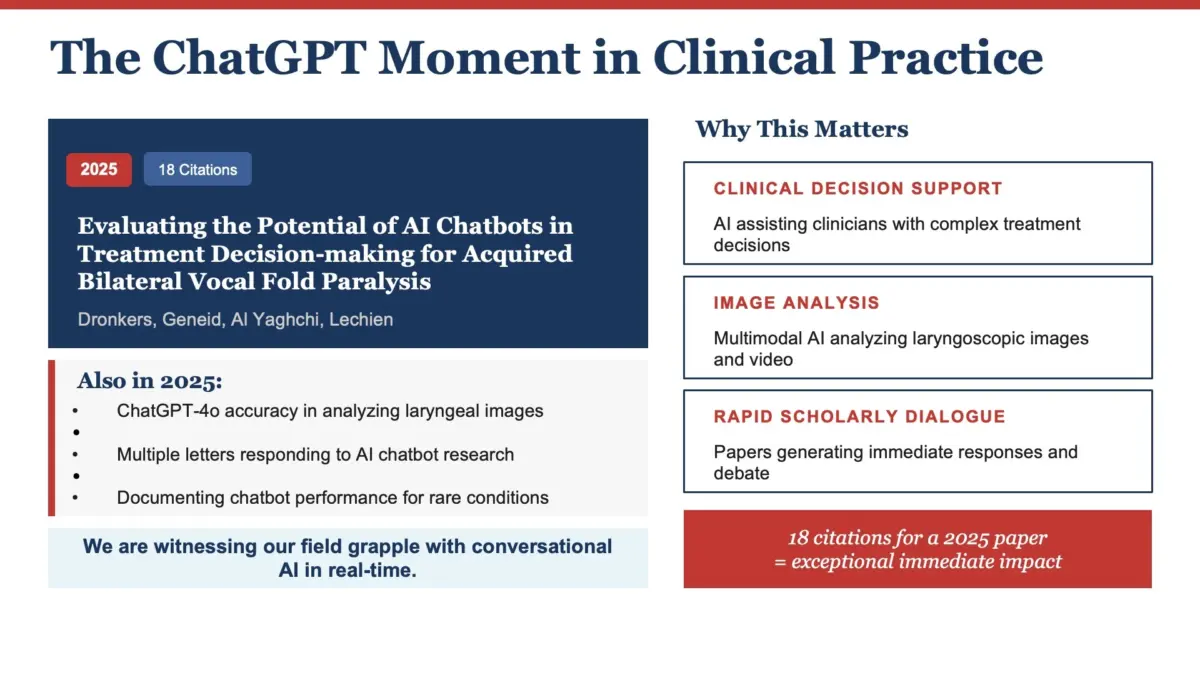
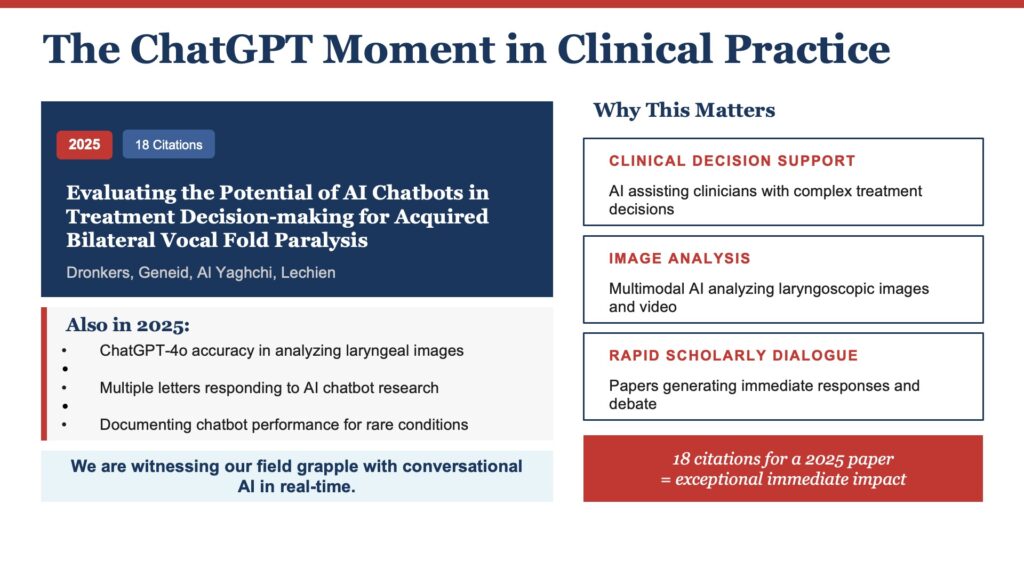
Reflecting the rapid pace of technological integration, the Journal of Voice published foundational work in 2025 examining conversational AI in medical settings. Dronkers and colleagues’ study, "Evaluating the Potential of AI Chatbots in Treatment Decision-making for Acquired Bilateral Vocal Fold Paralysis," captured immediate scholarly attention, accumulating 18 citations within months of release. This sparked vigorous academic discourse, including letters to the editor evaluating GPT-4o’s accuracy in analyzing complex laryngeal imaging, demonstrating a global medical community actively grappling with conversational intelligence in real-time.
Official Statements & Expert Perspectives
To understand how these technological leaps affect day-to-day research and institutional policy, we turn to leading voices within the global scientific community.
Dr. Mark Berardi: Managing Biological Complexity
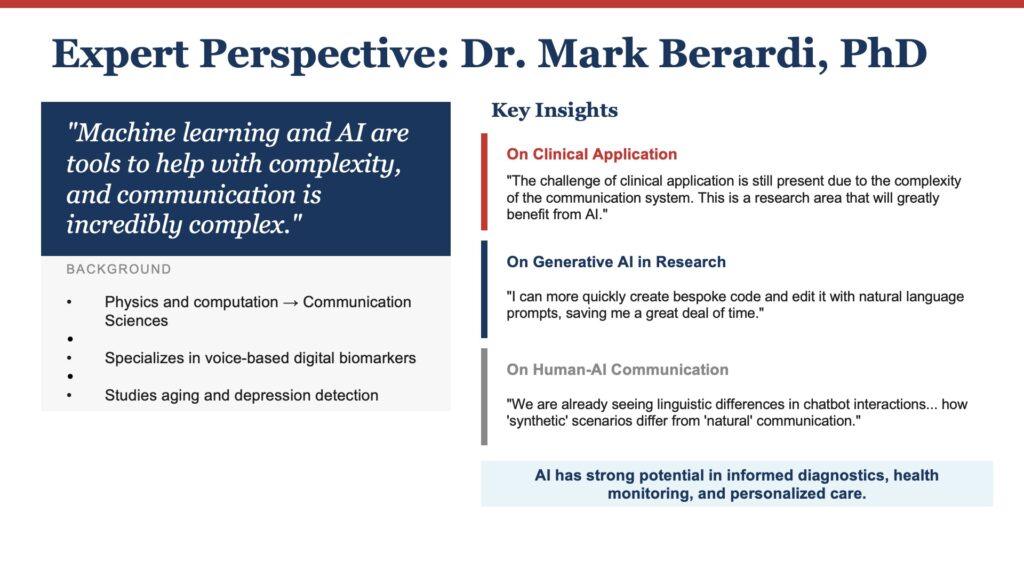
Transitioning from a background in physics and computation to voice science, Dr. Mark Berardi views artificial intelligence not as a replacement for human intellect, but as an essential engine for managing biological complexity.
"Machine learning and AI are tools to help with complexity, and communication is incredibly complex in its neurobiological and physiological processes. So I think the application is warranted."
Dr. Berardi’s research centers on voice-based digital biomarkers for aging and depression. While acquiring clean speech signals has become frictionless, he notes that the true bottleneck lies in decoding the multi-layered nature of human communication—a domain where machine learning excels. Furthermore, Dr. Berardi highlights how generative AI has streamlined his own workflow:
"We can now quickly create bespoke code and edit it with natural language prompts, addressing historical bottlenecks in data processing."
Intriguingly, Dr. Berardi’s lab is also investigating human-AI communication dynamics. By studying how humans adjust their vocal cadence, inflection, and linguistic patterns when speaking to chatbots or via synthetic Zoom environments versus face-to-face interaction, his work suggests that voice science must soon expand to decode human speech in conversation with machines.
Dr. Eric Hunter: Embracing Change with Ethical Clarity
Dr. Eric Hunter focuses heavily on the institutional and academic implications of AI integration. He warns against treating these emerging technologies as mere novelties.
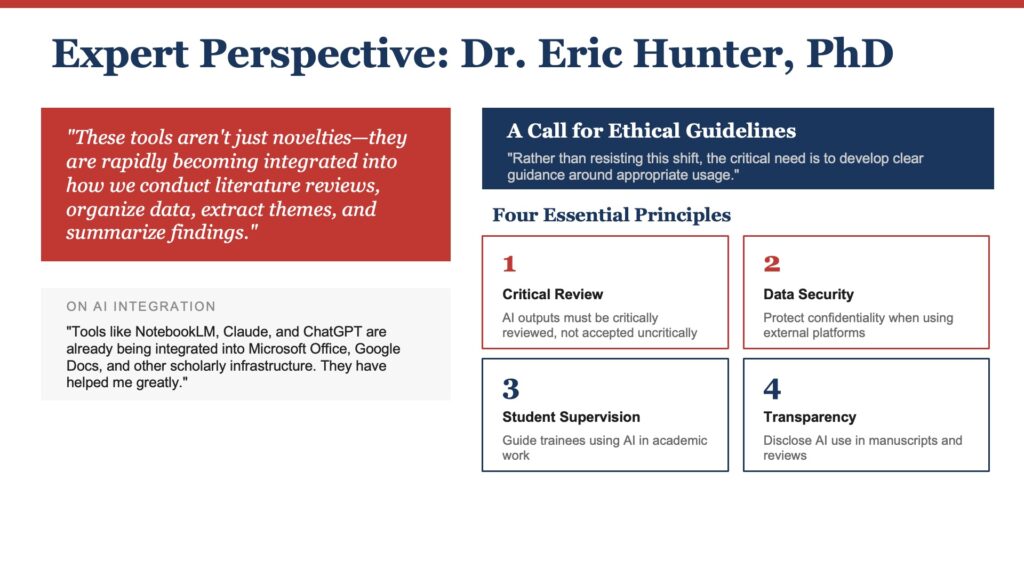
"These tools aren’t just novelties. They are rapidly becoming integrated into how we conduct literature reviews, organize data, extract themes from large bodies of text, and even summarize findings… Large language models and AI-driven platforms are not going away. In fact, we should expect them to become increasingly embedded within common academic workflows."
As platforms like NotebookLM, Claude, and ChatGPT integrate seamlessly into Microsoft Office, Google Docs, and academic publishing infrastructure, Dr. Hunter issues a vital call to action for the scientific community: rather than resisting the shift, researchers must establish robust, shared governance. He outlines four essential pillars for ethical academic AI integration:
Transparency: Clear disclosure of where and how AI tools were utilized in manuscript preparation and data sorting.
Accountability: Uncompromising human oversight ensuring that authors and reviewers retain ultimate responsibility for scientific validity.
Data Privacy: Rigorous protection of sensitive patient audio data and clinical records when interacting with third-party computational models.
Equitable Access: Ensuring that advancements in AI-driven voice tools benefit diverse global populations without algorithmic bias.
"Our field will benefit most," Dr. Hunter concludes, "if we embrace the productivity these tools offer while also building a shared ethical framework for their responsible use."
A Global Research Community
The momentum behind this scientific renaissance is powered by a diverse, international network of researchers. Key contributors driving AI research within the Journal of Voice include scholars such as Jérôme René Lechien, Dimitar Deliyski, Stephanie Zacharias, Ahmed Yousef, Paavo Alku, Leonardo Wanderley Lopes, and Maryam Naghibolhosseini. Representing institutions spanning every continent, this global collective demonstrates that the pivot toward computational voice science is a unified, borderless endeavor.
Future Outlook and the Path Forward
As The Voice Foundation and the Journal of Voice look toward the next fifty years, the trajectory is clear. AI will not replace the ear of the master clinician or the intuitive artistry of the vocal pedagogue; rather, it will act as an unprecedented microscope for the human voice.
The path forward requires a deliberate, three-pronged commitment from our global community:
First, Thoughtful Engagement: Practitioners must view AI tools as sophisticated aids for managing complexity. We must learn their capabilities, respect their algorithmic limitations, and use them to amplify—rather than substitute—clinical judgment.
Second, Collective Ethical Governance: Fulfilling Dr. Hunter’s vision of a shared ethical framework requires active cooperation across medical societies, academic institutions, and publishing houses to safeguard patient privacy and research integrity.
Third, Continued Collaboration: The 161 AI papers published to date represent merely the opening chapter. Every clinician, researcher, and educator harbors insights that can enrich our shared understanding of vocal health.
An Extraordinary Moment in Human History
For hundreds of thousands of years, the human voice has served as our primary instrument of emotional connection, artistic expression, and personal identity. It carries the weight of our histories, the nuances of our psychologies, and the subtle physiological signatures of our physical health in a manner matched by no other biological signal.
Now, for the first time in human history, we possess computational tools sophisticated enough to truly decode that complexity—tools capable of extending the reach of expert clinicians, detecting pathology long before symptoms manifest, and democratizing access to premier voice care across the globe.
We stand at the absolute center of this extraordinary transformation. The coming decade promises diagnostic and therapeutic discoveries that our founders in 1969 could only have imagined. The Journal of Voice remains proud to serve as the archival home and intellectual frontier for this vital science.
About the Author
Ian DeNolfo is Executive Director of The Voice Foundation, which publishes the peer-reviewed Journal of Voice. A graduate of The Juilliard School and The Curtis Institute of Music, he formerly performed as a leading tenor at major opera houses worldwide before transitioning his professional dedication to the advancement of voice science and interdisciplinary vocal care.