Broadway’s autumn slate is shaping up to be one of its most intellectually and emotionally challenging in recent memory. Tony Award-winning playwright Bruce Norris, celebrated for his razor-sharp social commentary and penchant for detonating theatrical landmines (best exemplified by his Pulitzer Prize-winning Clybourne Park), is officially returning to the Great White Way. This time, he brings with him Downstate, a deeply polarizing, fiercely debated drama that dares to stare unblinkingly into the abyss of human nature.
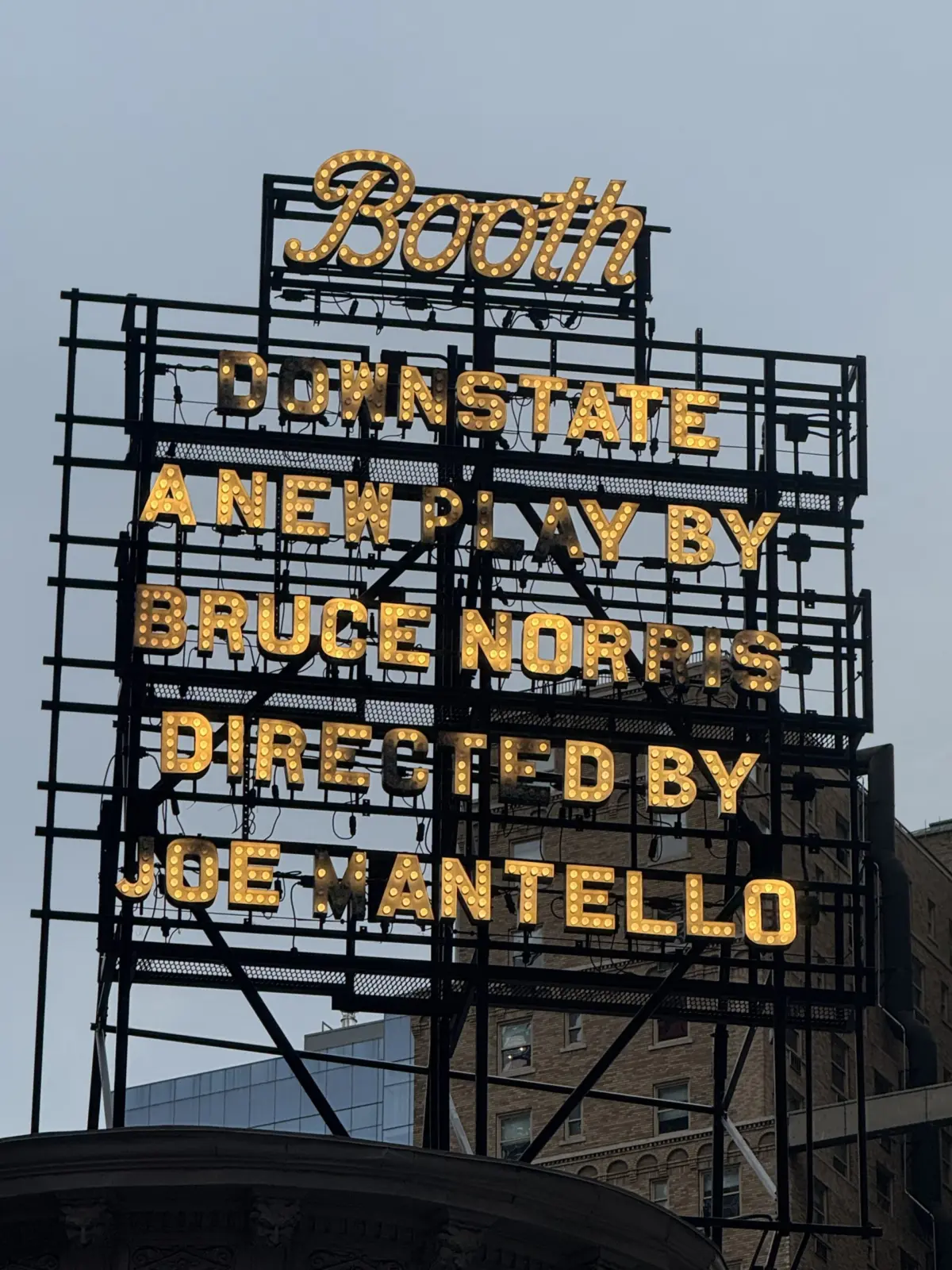
The production, which has just begun signaling its imminent arrival with the unexpected appearance of its marquee at the historic Booth Theatre, is set to test the limits of Broadway audiences. Directed by Broadway heavyweight Joe Mantello, Downstate tackles a subject matter that most commercial producers would instinctively flee from: the daily lives of four men residing in a group home for individuals convicted of sex crimes.
While specific performance dates and ticketing schedules have yet to be officially formalized by the production team, the mere hoisting of the marquee has sent tremors through the theatrical community. The Broadway run follows celebrated, albeit fiercely debated, engagements at the Steppenwolf Theatre Company in Chicago and Off-Broadway’s Playwrights Horizons.
Adding another layer of intense industry scrutiny to the project is its producer, Scott Rudin. Fresh off a high-profile triumph at the Tony Awards—where he captured the coveted Best Revival of a Play prize for Death of a Salesman—Rudin is continuing his calculated re-entry into the commercial theater ecosystem following a multi-year hiatus sparked by widespread workplace abuse allegations. Coupled with the play’s inherently incendiary subject matter, Downstate is primed to be the most scrutinized, hotly contested ticket of the season. As critics, conservative politicians, and theatergoers ready themselves for what promises to be an uncompromising night of drama, the central question remains: Is Broadway ready to sit in the dark with Bruce Norris’ most complex creation?
Detailed Chronology: From Steppenwolf to the Great White Way
The journey of Downstate from a regional developmental stage to the epicenter of American commercial theater has been long, winding, and marked by intense critical discourse.
The 2018 Steppenwolf World Premiere
The genesis of the play dates back to November 2018, when Downstate celebrated its world premiere at Chicago’s renowned Steppenwolf Theatre Company. Directed originally by Pam MacKinnon, the production immediately established itself as a critical lightning rod. Set in an unspecified American state, the play introduced audiences to a group home where four convicted sex offenders share space, daily chores, and the agonizing weight of their past actions.
Even in its earliest days, the production was praised for its refusal to offer easy moral comforting. The cast—featuring powerhouse performances from ensemble members including Francis Guinan and K. Todd Freeman—navigated Norris’ intricate, densely layered dialogue with unflinching precision. Critics lauded the production’s courage, noting that while the play dealt with monstrous actions, it steadfastly refused to present cartoonish monsters, opting instead for a portrait of broken, socially isolated human beings trapped in bureaucratic limbo.
The 2022 Off-Broadway Run at Playwrights Horizons
Following its Chicago debut, the play made the inevitable jump to New York City, landing an Off-Broadway engagement at Playwrights Horizons in the fall of 2022. Once again directed by MacKinnon, the New York premiere arrived amid a shifting cultural landscape increasingly sensitive to narratives surrounding sexual misconduct and societal accountability.
Despite the potential for immediate institutional pushback, Downstate captured the critical establishment by storm. Reviewers from major metropolitan publications praised the production’s intellectual rigor and emotional stamina. The accolades quickly piled up: Downstate was honored with the prestigious New York Drama Critics’ Circle Award for Best Play, alongside the Obie Award for Playwriting for Bruce Norris.
The 2026 Broadway Transition
The announcement that the play would make the leap to Broadway—first broken by the Chicago Tribune in late August 2026—revealed that this iteration would feature notable shifts. While the core creative DNA remains intact, the production will be helmed by a new director, Joe Mantello, marking a distinct artistic reimagining from the MacKinnon-directed stagings. Furthermore, original Chicago cast members Francis Guinan and K. Todd Freeman are slated to reprise their roles, anchoring the Broadway transfer with their deep-seated familiarity with Norris’ text. The recent erection of the Downstate marquee at the Booth Theatre serves as the physical manifestation of this transition, transforming a speculative rumor into an impending theatrical reality.
Supporting Context & Metrics: Navigating Controversy and Commerce
To understand the magnitude of Downstate heading to Broadway, one must examine the unique confluence of artistic ambition, political friction, and commercial machinery driving the production.
The Producing Force: Scott Rudin’s Calculated Resurgence
The involvement of producer Scott Rudin casts a long, complicated shadow over the production. Rudin, who stepped away from the commercial theater industry following severe allegations of workplace abuse, intimidation, and toxic management styles, has mounted a gradual, calculated return to prominence. His recent victory at the Tony Awards for Death of a Salesman proved that a segment of the theatrical establishment—and, crucially, ticket-buying audiences—remains willing to separate the art from the controversies of its maker when faced with undeniable artistic pedigree.
Rudin’s backing of Downstate speaks to his enduring reputation as a producer who is profoundly unspooked by difficult, contentious material. Where others see commercial suicide, Rudin evidently sees high-stakes, prestige theater capable of generating cultural capital and sparking fierce public debate.
The Political Backlash and Cultural Flashpoints
Downstate does not simply court controversy; it actively interrogates the discomforts of the judicial and social systems designed to handle offenses of a sexual nature. Unsurprisingly, this thematic ambition has drawn fierce external fire.
During its previous runs, the production became a flashpoint in the broader American culture wars. Conservative politicians and commentators launched blistering attacks against both the play and the critics who championed it, accusing them of generating sympathetic portraits of individuals who have committed unforgivable acts—with some extreme detractors going so far as to accuse supporters of "praising pedophilia."
The backlash even bled into media circles. Prominent Washington Post theater critic Peter Marks famously locked down his social media accounts following a barrage of conservative criticism directed at his favorable review of the Off-Broadway staging.
The Playwright’s Defense
Faced with accusations that the play acts as an apologist tract for monsters, Bruce Norris has been explicit and unyielding in his defense of the work’s moral framework. Prior to the New York premiere, Norris issued a statement that has since become the manifesto for understanding the play’s intent:
"A depiction of something is not an endorsement. But, I do think that witnessing the lives of characters on stage encourages identification, and if you spend two hours in the company of a group of sex offenders, do you emerge from the experience with your certainty about them momentarily disrupted? The goal is not to forgive, but rather to complicate an easy and casually cruel response."
Norris argues that modern discourse surrounding sex crimes has devolved into an arena of performative cruelty and black-and-white certainty, wherein art is expected to reaffirm societal biases rather than interrogate them. By forcing audiences to inhabit the mundane, squalid reality of these men’s post-prison lives—their struggles with housing, isolation, and psychological deterioration—Downstate demands an uncomfortable exercise in radical empathy, distinct entirely from absolution or sympathy.
Official Statements and Industry Reception
As the theatrical community digests the reality of Downstate planting its flag at the Booth Theatre, reactions from industry insiders have been a mixture of awe at the production’s sheer audacity and anxiety over how the broader public will react on a commercial Broadway scale.
In their initial report, the Chicago Tribune emphasized the continuity of the project, highlighting that the presence of seasoned veterans Francis Guinan and K. Todd Freeman will provide an emotional anchor for audiences navigating the play’s harrowing waters. "To watch these actors inhabit these skins is to witness masterclasses in theatrical empathy," noted one regional critic familiar with the Steppenwolf run.
Meanwhile, Joe Mantello’s attachment as director has been widely interpreted as a massive vote of confidence in the play’s commercial viability and intellectual weight. Mantello, known for his deft handling of high-tension dramas and blockbuster musicals alike (including Wicked, The Humans, and Assassins), brings a steady hand capable of balancing the play’s incendiary subject matter with structural theatricality.
However, box office analysts remain split on how Downstate will fare financially. While Off-Broadway audiences at Playwrights Horizons are naturally predisposed to avant-garde, challenging, and socially provocative work, the Broadway ecosystem relies heavily on tourists, corporate groups, and casual theatergoers who may balk at spending premium ticket prices on an evening spent inside a sex offender group home.
Future Outlook: What to Expect From the Broadway Engagement
As the industry awaits the official release of dates, ticket sales information, and the final casting roster, Downstate stands as a defining bellwether for the current health and courage of Broadway.
In an era where commercial theater is frequently dominated by nostalgic jukebox musicals, safe revivals of mid-century classics, and IP-driven adaptations designed to guarantee a return on investment, Bruce Norris’ play is an outlier of the highest order. It represents a throwback to a time when Broadway was viewed not merely as a tourist-friendly entertainment district, but as a cultural town square where the most painful, urgent, and divisive questions of contemporary life could be hashed out in real-time.
Whether Downstate will triumph commercially or flame out under the weight of its own notoriety remains to be seen. What is certain, however, is that nobody who steps foot inside the Booth Theatre this fall will walk out feeling indifferent. In an artistic landscape too often dominated by comforting consensus, Bruce Norris and his creative team are preparing to offer something far rarer, far more dangerous, and entirely unforgettable: an evening of theater that refuses to let you off the hook.