For centuries, classical and contemporary music education has held a foundational truth to be self-evident: to be a complete musician, one must be able to look at a brand-new piece of sheet music and play it accurately on the first or second attempt. Yet, across practice rooms, conservatories, and living rooms worldwide, a quiet crisis persists. Millions of pianists—many of whom have invested over a decade in formal weekly lessons, scale drills, and rigorous repertoire memorization—find themselves utterly paralyzed when confronted with a basic, entry-level sight-reading book.
This paradox has baffled students and educators alike. How is it possible that an individual can perform complex, multi-movement sonatas by Beethoven or Chopin from memory, yet stutter, stumble, and freeze when handed a rudimentary Level 1 children’s piece?
According to pianist, educator, and sight-reading specialist Lara Mirinjian, the root of the problem does not lie in a lack of musical talent, discipline, or intelligence. Instead, it stems from a systemic failure in traditional music pedagogy. For decades, sight-reading has been treated as a byproduct of learning repertoire rather than as an independent, foundational skill that requires dedicated, systematic training.
This investigative report explores the anatomy of the sight-reading crisis, examining academic research into piano instruction, the fundamental cognitive principles required to bridge the reading gap, and a step-by-step methodology that is transforming how intermediate and advanced pianists approach the musical page. By stripping away ego and returning to the absolute basics, musicians at any stage of their journey can unlock fluent literacy and permanently eliminate the fear of the blank score.
Detailed Chronology: The Evolution of a Personal and Pedagogical Awakening
To understand how traditional piano instruction fails to build reading fluency, one must trace the typical trajectory of a student’s musical upbringing—a path marked by frustration, compensation, and delayed realization.
Phase 1: The Illusion of Progress (Years 1–5)
When a student begins their piano journey, lessons are typically structured around a method book series. In these early stages, reading and learning happen concurrently. Because the pieces are short—often only four to eight measures long—the student quickly memorizes the music through a combination of visual cues, tactile memory, and auditory repetition.
The flaw in this early phase is insidious. Teachers often mistake memorization for reading. A student plays a piece brilliantly during a lesson, leading the instructor to advance them to the next book. In reality, the student is not decoding the symbols on the page in real-time; they are recalling a motor pattern they practiced relentlessly at home.
Phase 2: The Widening Gap (Years 5–10)
As the repertoire grows exponentially more complex, the cognitive load required to memorize pieces increases. The student begins spending weeks, months, or even a full year mastering a single recital piece. Because their technical execution outpaces their reading ability, a massive divergence occurs. The fingers learn to fly across the keyboard, but the eyes remain anchored to a slow, laborious crawl when faced with unfamiliar notation.
By year ten, the student may possess the technical dexterity of an intermediate or advanced player, but their reading eye is trapped at a kindergarten level. As Mirinjian reflects on her own decade-long struggle: "Over ten years of lessons and I still couldn’t read fluently from a level one book. It was ridiculous. How was this possible?"
Phase 3: The Search for Specialized Methodology
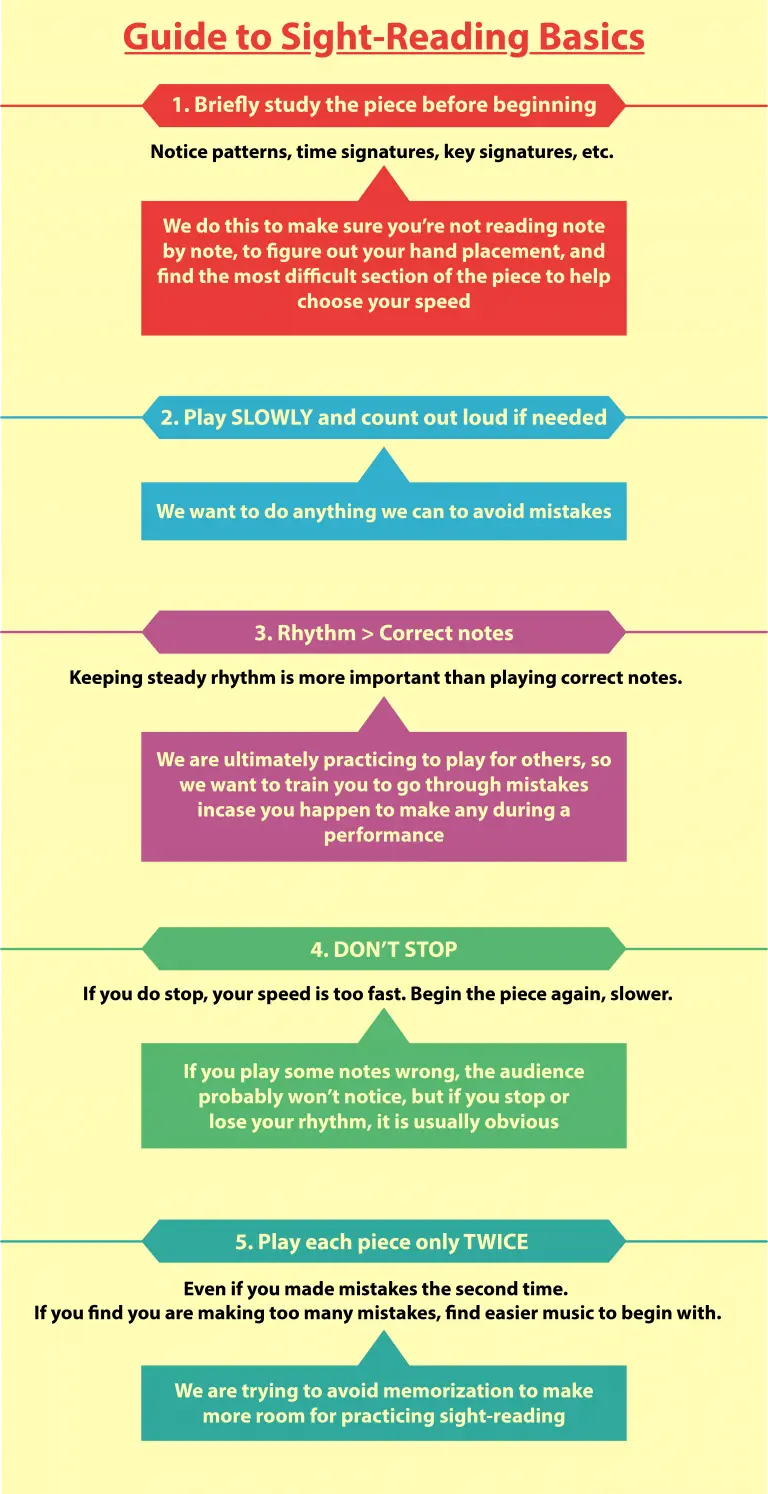
For Mirinjian and countless others, the breaking point arrives when they encounter the rare instructor who understands sight-reading not as an inherent trait, but as a teachable, mechanical skill. By shifting away from complex repertoire and returning to absolute foundational principles—such as strict time limits per piece, continuous motion, and extreme simplification—a breakthrough occurs.
Exponential growth replaces stagnation. Students who once suffered from performance anxiety and reading paralysis discover a newfound freedom. The score transforms from an intimidating maze of black dots into an accessible, living language.
Supporting Context & Metrics: What the Research Reveals
The anecdotal experiences of struggling pianists are heavily backed by academic research. The crisis is not an anomaly; it is a structural systemic issue deeply embedded in modern music education.
In a landmark study conducted by Dr. Dianne Hardy, Assistant Professor of Music Education and Piano at Dickinson State University, researchers investigated why formal sight-reading instruction remains largely absent from private and institutional music curricula. The findings exposed systemic vulnerabilities in how teachers are trained to teach:
Pedagogical Blind Spots: The vast majority of teachers surveyed admitted that sight-reading was omitted from their lesson plans simply because they were never taught how to teach it. Standard method book series often lack explicit, step-by-step frameworks for developing reading fluency independently of repertoire acquisition.
The "Osmosis" Fallacy: Many educators operate under the outdated assumption that sight-reading is not a discrete skill. They believe it will naturally improve over time simply as a byproduct of learning more and more music.
The Intergenerational Cycle of Incompetence: Perhaps most revealingly, a significant percentage of educators surveyed confessed that they actively avoided teaching sight-reading because they themselves were poor sight-readers. Consequently, a generation of piano teachers inadvertently passes down their own reading anxieties to their students.
+--------------------------------------------------------------------------+
                    THE SIGHT-READING PEDAGOGY GAP
+--------------------------------------------------------------------------+
 [Traditional Approach]                      [Principle-Based Approach]
  - Repertoire-Driven                         - Literacy-Driven
  - Memorization disguised as reading         - Strict two-play limit per piece
  - Stagnation at advanced levels             - Exponential fluency growth
  - High performance anxiety                  - Zero-fear relationship with score
+--------------------------------------------------------------------------+
Compounding these pedagogical hurdles are individual learning differences. Students managing neurodivergent conditions such as Attention Deficit Disorder (ADD) often report heightened frustration with traditional sight-reading methods, which demand sustained, hyper-focused visual decoding without immediate auditory gratification. However, when instruction is broken down into micro-principles—short bursts of engagement governed by strict rules—these barriers dissolve.
Official Statements & Core Principles
Addressing the sight-reading crisis requires a fundamental shift in philosophy. As educational psychologist and philosopher Ralph Waldo Emerson famously noted:
"As to methods there may be a million and then some, but principles are few. The man who grasps principles can successfully select his own methods. The man who tries methods, ignoring principles, is sure to have trouble."
Applying this wisdom to piano pedagogy means abandoning the search for "magic bullet" exercise books and instead embracing immutable mechanical laws of reading fluency. Mirinjian outlines the core pillars that govern effective sight-reading practice:
Radical Simplification: Regardless of your current playing level—whether you are an intermediate hobbyist or an advanced diploma holder—you must start with the absolute simplest music available. This often means returning to Level 1 primer books.
The Two-Play Rule: Every piece selected for sight-reading practice must be read a maximum of twice. Lingering on a piece turns sight-reading into piece-learning. Once the two attempts are exhausted, the student must move on, regardless of how many mistakes were made.
Rhythmic Imperative over Note Perfection: The primary objective of sight-reading is the preservation of a steady, unbroken pulse. A wrong note played in time is vastly superior to a correct note found after pausing the music.
What This Looks Like in Practice: A Step-by-Step Methodology
To bridge the gap between abstract theory and daily execution, let us examine how these principles operate in a real-world practice session. This exercise assumes basic visual recognition of quarter notes, half notes, and treble clef landmarks (Middle C, D, and E).
Step 1: Material Selection and Setup
Place a simple, single-line melody (such as a primer-level exercise titled "Middle C") on your music stand or digital tablet. Ensure there are no technical distractions; your hands should easily fall into position without shifting.
Step 2: Visual Panning and Pattern Recognition
Before pressing a single key, scan the entire piece from start to finish. Look for structural patterns rather than reading individual notes in isolation. For example, note whether the melody repeats a pitch, steps upward by adjacent degree, or leaps. In a typical beginner piece, you might observe: Middle C repeats twice, steps up to D, repeats five times, returns to C, and repeats three times.
Step 3: Establishing the Internal Pulse
Identify the time signature and prepare to count out loud. Establishing an externalized vocal or physical rhythm (counting "1, 2, 3, 4") anchors your nervous system and prevents the brain from freezing when visual processing slows down.
Step 4: Ergonomic Placement
Position your hands calmly on the keyboard with your thumb resting directly on Middle C. Relax your shoulders and wrists to eliminate physical tension, which is the primary enemy of fluid reading.
Step 5: The Non-Stop Rule Commitment
Prepare to play with the ironclad psychological rule: Do not stop. If you misread a note, play through it. If you lose your place entirely, do not freeze in place; drop your hands, slow your internal metronome down by half, return to the beginning, and restart at the new, glacial tempo.
Step 6: Execution—Attempt One
Begin playing at an exceptionally slow pace, matching your finger movements to your spoken count: "One… Two… Three… Four…" Keep your eyes moving slightly ahead of your fingers, anticipating the next note before your current key is released.
Step 7: Reflection and Attempt Two
Upon reaching the end of the piece, pause briefly for reflection. Acknowledge any tactical errors or rhythmic hesitations without emotional judgment. Now, play the exact same piece one final time. Incorporate the visual data gathered during the first run-through, smoothing out the rough edges while maintaining the strict, steady tempo.
Step 8: Progression
Advance immediately to the next piece in sequence (e.g., "Stepping Up and Down") and repeat the cycle.
Future Outlook: Redefining Musical Literacy
The future of piano education hinges on the democratization of sight-reading. As digital learning tools, interactive sheet music applications, and specialized pedagogical blogs continue to proliferate, the historical mystique surrounding sight-reading is beginning to fade.
Educators are realizing that true musical independence cannot be measured solely by the grandeur of a student’s recital repertoire, but by their agility in navigating uncharted musical waters. When a musician overcomes the psychological barrier of reading fear, the entire musical universe opens up. Chamber music becomes accessible on a whim, accompanying choirs transforms from a terrifying ordeal into a collaborative joy, and the sheer pleasure of exploring new literature is uninhibited by technical drag.
For those willing to swallow their pride, strip away their advanced repertoire, and spend ten minutes a day engaging in disciplined, principle-based sight-reading, the reward is permanent: an unbreakable foundation of musical literacy that lasts a lifetime.
Action Steps for Immediate Implementation
Information without execution is merely entertainment. To transform today’s insights into permanent musical growth, execute the following steps immediately:
Audit Your Library: Gather three to five method books or sight-reading anthologies that are at least two to three levels below your current performance capability. If you play intermediate Chopin, pull out beginner primer books.
Set a Daily Timer: Dedicate precisely 10 minutes at the very beginning of your practice session—before touching your repertoire—to sight-reading.
Enforce the Two-Play Limit: Use a physical bookmark or digital checklist to ensure you never play any sight-reading exercise more than twice. Move on ruthlessly, prioritizing steady rhythm over note perfection.
Count Out Loud: Commit to vocalizing your counts during every single exercise to anchor your internal pulse and eliminate micro-hesitations.