
Executive Overview
For centuries, classical and contemporary music education has held up a singular metric for instrumental proficiency: the ability to sit before an unfamiliar score and translate symbols on a page into fluid, expressive music in real time. Yet, a startling number of instrumentalists—ranging from hobbyists to advanced performers with years of rigorous training—suffer from a silent, deeply frustrating deficit known within pedagogic circles as the "sight-reading paradox."
Consider this scenario: A pianist logs over ten years of private lessons, masters complex repertoire by Chopin and Beethoven, and yet finds themselves paralyzed or stumbling when placed in front of a rudimentary, level-one sight-reading book. How is this systemic failure possible in an era of advanced pedagogical frameworks?
According to Lara Mirinjian, a seasoned pianist, piano teacher, and sight-reading specialist, the issue stems not from student apathy or lack of intelligence, but from a profound structural flaw in traditional music instruction. Most music educators acknowledge sight-reading as a cornerstone skill, yet few actively integrate it into daily curricula. Instead, teachers often conflate sight-reading with repertoire acquisition, assuming students will naturally absorb the skill through osmosis as they learn heavier pieces.
Recent educational studies, such as the seminal research conducted by Dr. Dianne Hardy at Dickinson State University, confirm that a vast majority of instructors bypass formal sight-reading instruction entirely simply because they were never taught how to teach it.
This article investigates the root causes of the sight-reading crisis, analyzes the core philosophical principles required to overcome it, outlines a step-by-step practical methodology for instantaneous musical literacy, and charts a transformative future outlook for piano pedagogy worldwide.
Detailed Chronology: From Years of Frustration to Pedagogical Breakthrough
The journey to overcoming sight-reading illiteracy is rarely linear. To understand how systemic changes occur in a student’s musical development, it is helpful to examine the evolutionary milestones of a learner shifting from rote memorization to true structural comprehension.
Phase One: The Decade of Illusion (Years 1–10)
For most students, early piano lessons prioritize the preparation of standard repertoire over fundamental reading mechanics. Under this model, a student spends months polishing a small handful of pieces. Because the music is practiced repeatedly, the student effectively memorizes the physical geography of the keyboard and the auditory trajectory of the song long before they fully process the visual notation.
To an outside observer—and even to the teacher—the student appears to be reading fluently. In reality, the student is relying on kinesthetic memory and rote repetition. When stripped of this extensive preparation time and handed an unstudied, elementary piece of music, the illusion shatters. The student freezes, counts laboriously, and stumbles over notes that should be effortless. This creates a psychological barrier marked by performance anxiety, avoidance behaviors, and a persistent belief that they lack a "natural gift" for reading.
Phase Two: The Turning Point and Methodological Awakening
The turning point typically arrives when a student encounters an instructor who treats sight-reading as an autonomous discipline governed by specific cognitive and mechanical principles. Mirinjian’s own breakthrough occurred only after years of struggle, when she found a mentor who stripped away complex pedagogical noise and returned to the absolute fundamentals of musical intake.
Rather than focusing on speed or advanced harmonic analysis, this methodology emphasizes micro-steps: starting with rudimentary material, enforcing strict time limits on each piece, and prioritizing an unbroken, steady pulse over absolute note-accuracy. Upon adopting this structured approach, Mirinjian observed exponential growth—not only in her own technical execution but in the accelerated learning curves of her students.
Phase Three: Conceptualizing the Universal Framework
Over time, educators who master this shift realize that sight-reading is not about memorizing a million different tactical tricks, but about internalizing a handful of immutable principles. As Ralph Waldo Emerson famously observed: "As to methods there may be a million and then some, but principles are few. The man who grasps principles can successfully select his own methods. The man who tries methods, ignoring principles, is sure to have trouble."
By isolating the core principles of visual processing, tactile mapping, and rhythm retention, advanced and intermediate players alike can systematically eradicate the "cracks" in their foundational training.
Supporting Context & Metrics: The Pedagogical Blind Spot
To contextualize the scale of this issue, one must look closely at empirical data regarding how music is taught in North American and European institutions.
The Hardy Study on Sight-Reading Instruction
In her comprehensive research paper on teaching sight-reading at the piano, Dr. Dianne Hardy surveyed numerous music educators to discover why sight-reading proficiency remains dismally low across the board. The findings revealed a troubling trio of systemic justifications:

- Pedagogical Ignorance: The majority of teachers surveyed confessed that sight-reading was omitted from their lesson plans because they simply did not possess the training to teach it. Standard method book series frequently lack explicit, step-by-step instructional modules dedicated entirely to visual-motor translation.
- The "Osmosis" Fallacy: A significant portion of instructors did not recognize sight-reading as a distinct, specialized skill separate from repertoire acquisition. They maintained the unsubstantiated belief that students would automatically become proficient readers simply by logging more years of general piano lessons.
- The Teacher’s Own Inadequacy: Perhaps most damningly, several educators admitted they avoided teaching sight-reading because they considered themselves "rotten sight-readers" and feared exposing their own vulnerabilities to their students.
The Cognitive Load of Music Reading
Neuroscientific research into musical sight-reading highlights why the brain struggles with this task when improperly trained. Sight-reading requires a complex, multi-sensory translation process executed in real time:
- Visual Decoding: The eyes must scan ahead of the hands (eye-hand span), recognizing visual patterns, intervals, and rhythmic groupings.
- Cognitive Processing: The brain must instantly translate spatial symbols on a staff into pitch names, metric values, and topographical keys on the instrument.
- Motor Execution: The central nervous system must fire precise neural pathways to coordinate fingers, wrists, and arms while maintaining a strict, unyielding tempo.
When any one of these cognitive links is underdeveloped—such as failing to recognize basic intervallic patterns instantly—the entire system experiences a bottleneck, resulting in the classic stop-and-start panic familiar to struggling readers.
Official Statements and Pedagogical Expert Insights
The movement to overhaul how sight-reading is approached has garnered support from prominent figures across the music education landscape.
"The majority of teachers in my study said that sight-reading was not included in their program because they didn’t know how to teach it… Some did not even recognize it as a skill apart from the acquisition of repertoire."
— Dr. Dianne Hardy, Assistant Professor of Music Education and Piano, Dickinson State University
Lara Mirinjian emphasizes that this method is not exclusionary; it serves learners at every tier of the instrument’s hierarchy.
"This method isn’t just for beginners. It is also for intermediates, some advanced players, and teachers who’d like a solid approach to teaching sight-reading. Once the principles are fully conceptualized, you won’t need to memorize a rigid process because you will naturally be led to practicing this way."
— Lara Mirinjian, Pianist, Teacher, and Sight-Reading Specialist
Evan, founder of SightReadingMastery, echoes this sentiment, noting that the journey from frustrated beginner to fluent reader is entirely navigable once the ego is checked at the door and the student is willing to return to the simplest foundational materials.

Step-by-Step Practical Application: The Method in Action
To bridge the gap between abstract theory and daily execution, Mirinjian outlines a rigorous, actionable framework that can be applied by any instrumentalist using elementary-level literature.
Before diving into the steps, ensure you have basic literacy regarding fundamental note values (quarter notes, half notes) and basic staff navigation (such as treble clef notes: Middle C, D, and E). If you are an absolute beginner, consult foundational beginner guides before attempting this sequence.
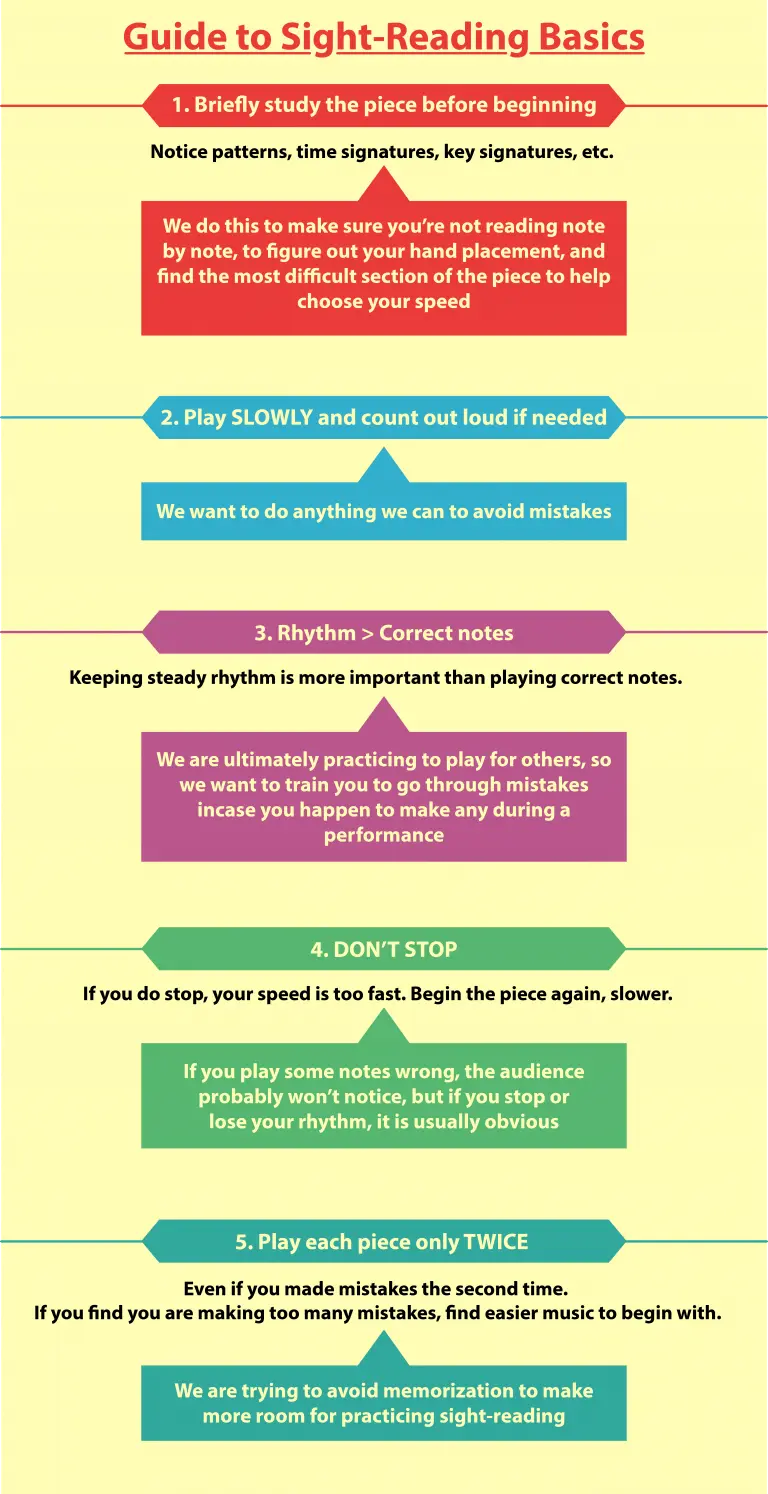
The 8-Step Sight-Reading Protocol
- Step 1: Environment and Material Selection
Print or pull up a very simple piece of music (e.g., a five-note exercise focusing on Middle C) and place it on your music stand or digital tablet. - Step 2: Visual Pattern Recognition
Before touching a single key, scan the score. Identify structural patterns. For instance, notice if a note repeats, steps up to an adjacent pitch, or leaps. Look for groupings rather than reading note-by-note in isolation. - Step 3: Metric and Temporal Analysis
Examine the time signature. Establish how you will vocalize the rhythm. Commit to counting out loud (1, 2, 3, 4, 1, 2, 3, 4…) as you play. - Step 4: Topographical Hand Placement
Position your hand over the keyboard with your thumb resting comfortably on Middle C (or the designated starting pitch for the exercise). - Step 5: Psychological and Physical Preparation
Internalize the cardinal rule of sight-reading: Never stop playing. Even if you strike an incorrect note, keep the internal clock ticking. If the mental processing lag forces you to stop, do not panic; simply return to the beginning of the piece and execute it at a significantly slower tempo. - Step 6: The First Read-Through (Slow and Steady)
Begin playing at an exceptionally slow, meditative pace. Sound out the notes while vocalizing the beat: "One… Two… Three… Four…" Maintain a continuous motion, prioritizing rhythm over perfection. - Step 7: The Second Read-Through (The Magic Window)
This is where cognitive transformation occurs. Play the exact same piece only one more time. Incorporate the visual and tactile lessons learned during your first pass. Identify minor errors made previously, adjust your pacing, and refine the execution. Crucial Rule: Never play a single sight-reading piece more than twice in one sitting, otherwise it transitions from a sight-reading exercise into a standard repertoire piece. - Step 8: Progression
Move immediately to the next piece in your elementary collection (e.g., a piece featuring "Stepping Up and Down") and repeat Step 2 through 7.
What Success Sounds Like
If your execution sounds slow, deliberate, steady, and completely devoid of mid-piece pauses, you are on the right track. By the second playthrough, the piece should sound reasonably complete.
If your output sounds chaotic or fragmented, your chosen material is too advanced. Drop back to simpler literature until your processing speed catches up. For advanced players, the challenge lies in choosing extremely easy music and forcing meticulous attention onto high-level nuances such as dynamic contrast, articulation, and phrasing.
Future Outlook: The Evolution of Musical Literacy
As we look toward the future of music education, the integration of structured sight-reading principles promises to revolutionize how students interact with their instruments.
- Digital Integration and Adaptive Software: Emerging digital platforms and tablet-based notation apps are beginning to incorporate automated sight-reading generators. By dynamically producing endless variations of elementary scores tailored to a student’s precise reading level, technology is making the "read-it-only-twice" rule easier to practice than ever before.
- Pedagogical Curriculum Reform: Music conservatories and university music education programs are slowly recognizing the gaps highlighted by researchers like Dr. Hardy. Future generations of piano teachers are increasingly likely to receive explicit, standardized training in how to teach sight-reading as a distinct cognitive discipline.
- Redefining Musical Mastery: The cultural shift away from elitist, rote-memorization-only models toward holistic musicianship means that the modern musician is expected to be versatile, collaborative, and adaptable. A fluent sight-reader is uniquely positioned to collaborate with other artists, pick up chamber music on short notice, and engage with a wider breadth of musical literature.
By stripping away intimidation, returning fearlessly to the simplest fundamentals, and respecting the immutable principles of visual-motor translation, the long-standing curse of the sight-reading paradox can finally be broken. Information without action is meaningless—take your first step to the keyboard today, open a level-one book, and begin your journey toward true musical fluency.