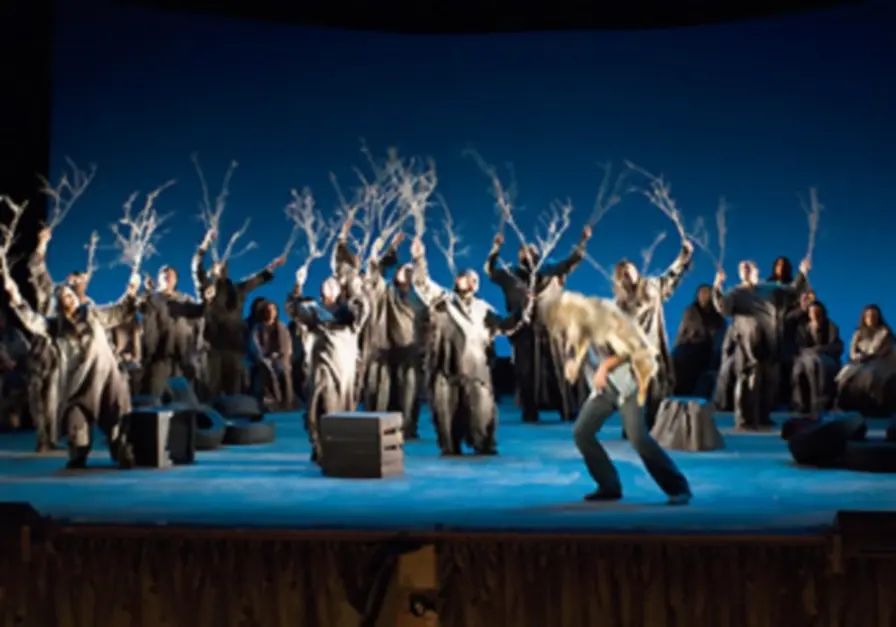

Throughout history, opera has functioned not merely as a high-art vehicle for vocal virtuosity and sweeping orchestral scores, but as a mirror reflecting the socio-political anxieties of its age. From the revolutionary strains of Giuseppe Verdi and Wolfgang Amadeus Mozart to the minimalist and contemporary idioms of Philip Glass and John Adams, the lyric stage has continually intersected with statecraft, revolution, and human rights. However, the contemporary era has introduced a vital evolution: the exploration of long-overlooked narratives concerning Indigenous sovereignty, ancestral lands, and systemic injustice.
This thematic expansion forms the cornerstone of a transformative three-part summer survey examining how the operatic medium provides a sanctuary for intersectional dialogue. While the first installment explored the racial complexities of early 20th-century American baseball through Daniel Sonenberg’s The Summer King (2017), and the second investigated the harrowing struggles of suffrage through Virgil Thomson’s The Mother of Us All (1947), this final installment confronts the legacy of Indigenous rights. At the center of this examination is Anthony Davis’s 2007 masterwork, Wakonda’s Dream.
Wakonda’s Dream tackles a painful, foundational chapter of American history: the 1879 Nebraska court case Standing Bear v. Crook, which challenged the forced removal of the Ponca tribe from their ancestral homelands. While the term "Wakonda" has achieved mainstream prominence through modern popular culture—such as Marvel Comics and Ryan Coogler’s cinematic universe—its true historical and linguistic roots trace back deep into Indigenous traditions. By examining Davis’s opera alongside the broader evolution of Indigenous storytelling in lyric theater, this report explores how the stage grapples with historical trauma, artistic synthesis, and the paradox of a brilliant work consigned to obscurity.
Detailed Chronology: From Historic Injustice to the Operatic Stage
To understand the weight of Wakonda’s Dream, one must trace the historical and creative timeline that birthed the production, alongside the broader trajectory of Indigenous representation in classical music and opera.
The Historical Catalyst: 1879 and Standing Bear v. Crook
The narrative foundation of Davis’s opera rests on a landmark moment in American civil rights history. In 1877, under the Indian Appropriations Act and federal pressure, the Ponca tribe was forcibly removed from their fertile homelands in Nebraska and marched to the barren wastes of Indian Territory in present-day Oklahoma. The relocation was catastrophic, marked by starvation, disease, and exposure—taking the life, among others, of Chief Standing Bear’s young son.
Refusing to leave his son’s remains in unhallowed, foreign soil, Chief Standing Bear led a small band of followers on an unauthorized 600-mile journey back to Nebraska to bury the boy. Upon their return, federal authorities arrested them under the orders of General George Crook. This set the stage for Standing Bear v. Crook in the U.S. District Court for the District of Nebraska.
During the trial, Chief Standing Bear delivered a profound, humanity-defining testimony that remains a cornerstone of American civil rights rhetoric:
"This hand is not the color of yours, but if I pierce it, I shall feel pain. If you pierce your hand, you also feel pain. The blood that will flow from mine will be of the same color as yours. I am a man. The same god made us both."
Judge Elmer S. Dundy handed down a historic ruling: a Native American was a "person" under the law within the meaning of the U.S. Constitution, and the federal government had no right to arbitrarily imprison or deport them. Yet, despite this legal victory, the broader pattern of broken treaties, unfulfilled federal promises, and institutionalized dispossession persisted largely unabated across the continent.
The Genesis of Wakonda’s Dream (2007)
Fast-forward over a century to the development of Anthony Davis’s operatic adaptation. Seeking to capture the psychological and historical depth of the Ponca experience rather than merely produce a dry, chronological reenactment, composer Anthony Davis and celebrated poet-librettist Yusef Komunyakaa immersed themselves in the living culture of the Ponca people. Davis traveled to Nebraska to attend the annual Ponca pow-wow, engaging directly with descendants of those who lived through the 1879 diaspora.
The resulting work, Wakonda’s Dream, premiered on March 7, 2007, at the Orpheum Theatre in Omaha, Nebraska, produced by Opera Omaha. The score was a deliberate sonic synthesis, blending Western classical orchestration with indigenous musical elements, jazz idioms, and African-American rhythmic traditions. Despite receiving praise for its poetic libretto and daring musical architecture, the production vanished from the repertoire almost as quickly as it arrived.
Supporting Context & Metrics: The Evolution of Indigenous Opera
The trajectory of Indigenous representation in opera has undergone a tortuous, necessary evolution. Early American and European operatic attempts to depict Native peoples—dating back centuries—were frequently marred by crude caricatures, exoticism, and cultural appropriation. Insensitive dramatizations were not unique to the United States; works such as Harry Somers’s 1967 Canadian opera Louis Riel wrestled similarly with the complex, often fraught celebration of minority leaders and colonized populations through a majority-culture lens.
The Quantitative and Qualitative Shift
In recent decades, however, the landscape has experienced a paradigm shift. According to data tracked by musicological surveys and organizations like OPERA America, the commissioning and development of works centering on First Nations, Native American, and Indigenous perspectives have accelerated significantly:
- Academic Integration: The establishment of university-level research initiatives dedicated to "Opera Indigene" has provided critical frameworks for analyzing how Indigenous performance traditions intersect with Western classical forms.
- New-Work Development: Programs supporting Native and Indigenous librettists, composers, and directors have grown by an estimated 40% over the last fifteen years.
- Interdisciplinary Boundaries: Contemporary projects are pushing the genre into unprecedented territory. Notable examples include Brent Michael Davids’s Interplanetary Opera, which reimagines Indigenous narratives through a speculative, futuristic, and extraterrestrial lens, and Ian Cusson’s acclaimed adaptation of Empire of Wild, which explores contemporary Indigenous life and myth.
Despite these advancements, the systemic under-representation of works like Wakonda’s Dream highlights a persistent structural fragility in the global opera ecosystem: breakthrough works dealing with marginalized histories often struggle to secure sustainable, multi-city repertoires.
Official Statements and Artistic Vision
The philosophy behind Wakonda’s Dream and its place in the modern canon is best understood through the artistic choices of its creators and the broader commentary of cultural historians.
Anthony Davis, renowned for tackling explosive historical and racial themes in works such as X: The Life and Times of Malcolm X (1985) and The Central Park Five (2019), emphasized that his goal was emotional and spiritual resonance over historical pedantry. In interviews surrounding the 2007 premiere, Davis noted that rhythm served as the connective tissue between disparate cultural musical traditions. By weaving jazz syncopation with the pulsing heartbeat of traditional Native percussion and the rich harmonic language of modern opera, Davis constructed a sonic bridge across historical divides.
Librettist Yusef Komunyakaa—a Pulitzer Prize-winning poet—brought a lyrical sensitivity to the text that elevated the courtroom drama into a universal meditation on human dignity. Komunyakaa’s verses captured the psychological weight carried by generations of displaced peoples, framing the historical struggle of Chief Standing Bear as a living, breathing contemporary reality.
Cultural critics and Indigenous scholars have consistently argued that these artistic efforts, while vital, must be accompanied by institutional accountability. The scarcity of productions dealing directly with Native American historical trauma points to an ongoing hesitancy within mainstream cultural institutions to confront the darkest chapters of colonial history head-on.
Future Outlook: The Paradox of Obscurity and Resilience
As the curtain closes on this comprehensive summer series examining race, feminism, and Indigenous rights in opera, the legacy of Wakonda’s Dream stands as a complex paradox.
On one hand, the opera is a ghost in the annals of contemporary music history. No official commercial recording was ever released, no professional video broadcast of the 2007 Orpheum Theatre premiere has been made publicly available, and photographic documentation remains sparse. Given the high financial and logistical hurdles of mounting contemporary grand opera, industry insiders suggest that a full theatrical revival of Wakonda’s Dream remains unlikely in the near term.
On the other hand, the opera’s conceptual DNA lives on. Anthony Davis’s continued success—highlighted by his 2020 Pulitzer Prize in Music for The Central Park Five—has brought renewed critical attention to his broader operatic oeuvre, sparking fresh academic inquiry into earlier, under-performed gems like Wakonda’s Dream.
Furthermore, the ground broken by Davis, Komunyakaa, and their contemporaries has fertilized the soil for a new generation of Indigenous creators. As modern institutions increasingly open their doors to works by First Nations and Native American artists—such as Ian Cusson’s Empire of Wild and forward-thinking speculative projects—the imperative for authentic storytelling has never been stronger.
Ultimately, Wakonda’s Dream serves as both a cautionary tale about the ephemerality of contemporary opera production and a beacon of artistic ambition. It reminds the cultural sector that opera can—and must—continue to serve as a vital town square where the most difficult, beautiful, and overlooked truths of human history are confronted, sung, and remembered.