

Executive Overview
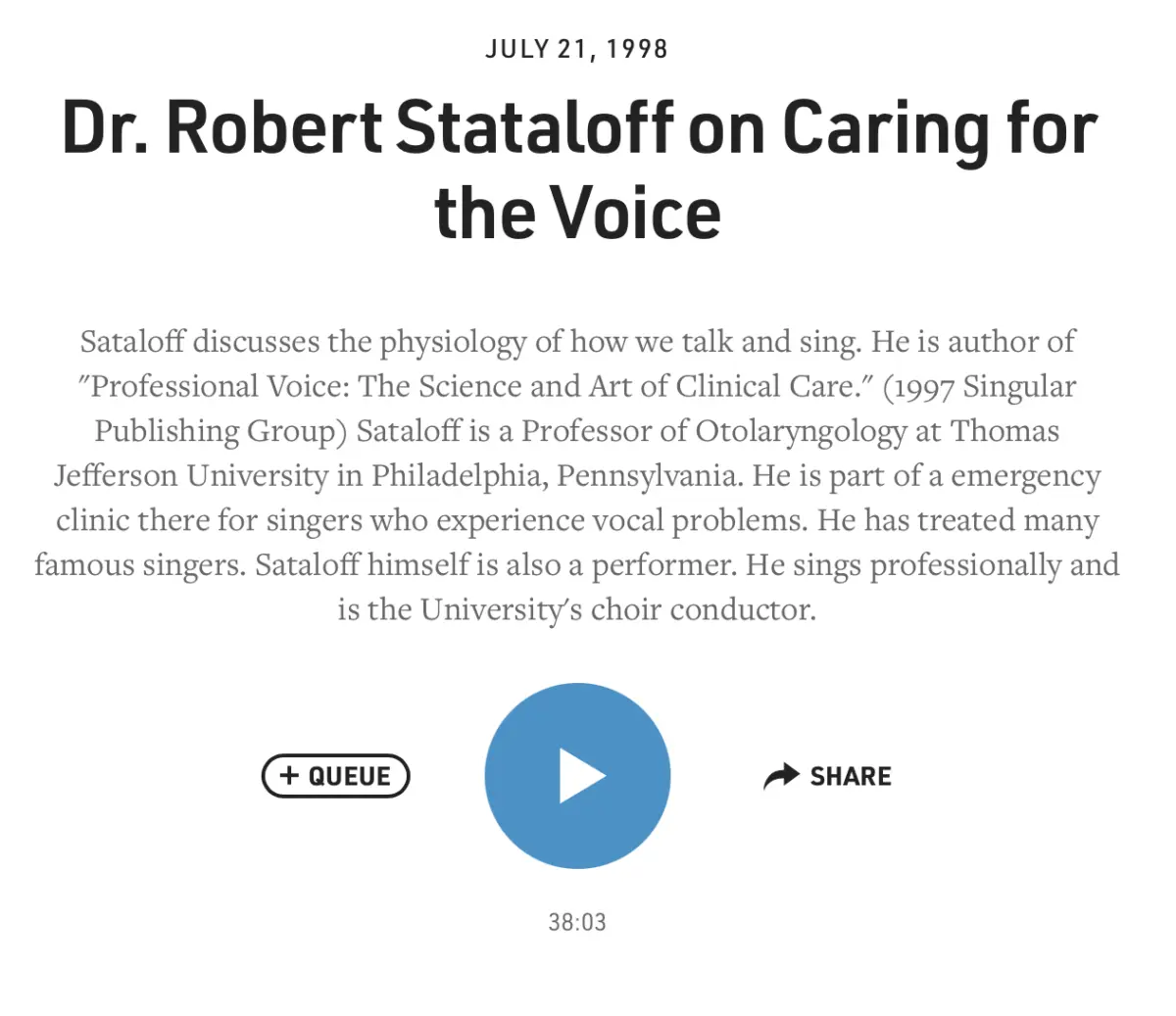
In the annals of modern otolaryngology and vocal arts medicine, few names resonate as profoundly as Dr. Robert Thayer Sataloff. A renowned otolaryngologist, conductor, author, and foundational figure in the science of the human voice, Dr. Sataloff’s contributions have permanently reshaped how the medical and artistic communities understand vocal health. While his extensive bibliography, clinical practice, and leadership roles—such as his tenure with The Voice Foundation—are widely documented, historical broadcasts offer a uniquely intimate window into the intersection of medical science and artistic performance.
Recently highlighted in archival retrospectives by Ian DeNolfo for The Voice Foundation, a defining artifact of this intersection is Dr. Sataloff’s 1998 appearance on NPR’s acclaimed cultural interview program, Fresh Air, hosted by Terry Gross. This comprehensive feature revisits that classic conversation, examining its enduring relevance to vocal pedagogy, the physiology of speech and song, and the psychological dimensions of voice disorders.
This article provides an in-depth exploration of that historic 1998 broadcast, contextualizing Dr. Sataloff’s insights within the broader evolution of voice science. By synthesizing the core themes of the interview—ranging from the extreme biomechanics of professional vocal cords to the societal stigma attached to voice changes—we illuminate why Dr. Sataloff’s dialogue with Terry Gross remains an essential masterclass for clinicians, singers, actors, and scholars alike.
Detailed Chronology: The Road to the 1998 Broadcast
To fully appreciate the significance of Dr. Sataloff’s appearance on Fresh Air in January 1998, it is necessary to examine the trajectory of his career and the state of voice medicine leading up to the turn of the millennium.
The Formative Years of Laryngology and Voice Care
For centuries, the human voice was treated as a black box. Singers and speakers who lost their voices, developed nodules, or experienced chronic hoarseness were often told to rest, or worse, subjected to crude treatments with little understanding of laryngeal physiology. The establishment of modern laryngology in the latter half of the 20th century changed this paradigm forever.
Dr. Sataloff emerged during a pivotal era when otolaryngology began intersecting deeply with performing arts medicine. Recognizing that professional voice users—opera singers, Broadway performers, politicians, trial lawyers, and broadcasters—demanded a level of precision far beyond conversational vocal health, Dr. Sataloff pioneered multidisciplinary approaches. He integrated laryngology with speech-language pathology, singing voice pedagogy, psychoacoustics, and pulmonary science.
The Rise of Fresh Air and Terry Gross
By 1998, NPR’s Fresh Air, hosted by Terry Gross from WHYY in Philadelphia, had cemented its status as one of the most intellectually rigorous and culturally influential interview programs in American broadcasting. Gross’s interviewing style—characterized by meticulous research, unhurried pacing, and a profound curiosity about the human condition—made her uniquely suited to unpack complex scientific topics for a general audience.
When Dr. Sataloff stepped into the studio in 1998, the field of vocology was gaining mainstream attention. Voice disorders were no longer viewed merely as physical ailments, but as complex conditions impacting identity, livelihood, and emotional well-being. The interview served as a bridge between the highly technical world of laryngeal microsurgery and the relatable, everyday experience of human communication.

Key Milestones in Dr. Sataloff’s Professional Journey
- Pioneering Multidisciplinary Care: Establishing frameworks where physicians, voice teachers, and speech therapists collaborate directly on patient treatment.
- Leadership at The Voice Foundation: Spearheading annual symposia and academic publications that set the global standard for voice research.
- Literary Contributions: Authoring seminal textbooks, including Professional Voice: The Science and Art of Clinical Care, which became the definitive encyclopedia for generations of medical professionals.
- The 1998 Fresh Air Interview: A defining public-facing moment that democratized voice science, translating intricate physiological concepts into accessible, engaging dialogue with Terry Gross.
Supporting Context & Metrics: The Anatomy of the Professional Voice
To understand the weight of the discussions between Dr. Sataloff and Terry Gross, one must examine the astonishing biomechanics of the human voice and the unique pressures faced by professional vocal athletes.
The Extreme Physics of Phonation
During normal speech, the vocal folds—two bands of smooth, muscular mucous membrane stretched horizontally across the larynx—vibrate at frequencies ranging from 100 to 250 cycles per second (Hertz). However, in professional singing, these numbers scale dramatically:
- Soprano High Notes: A soprano singing a high B-flat (B♭5) forces her vocal folds to vibrate at approximately 932 cycles per second.
- Collision Force: At high frequencies and intensities, the vocal folds strike each other hundreds of times per second. Over the course of a single opera performance or a multi-hour concert, the cumulative mechanical stress on the delicate tissues is immense.
Common Voice Pathologies Addressed in Clinical Practice
Dr. Sataloff’s work frequently deals with conditions that can derail a career overnight. During the 1998 interview, discussions touched upon how seemingly minor habits can lead to severe pathologies:
- Vocal Nodules ("Singer’s Nodes"): Benign, callus-like growths on the vocal folds caused by chronic trauma, such as shouting, excessive throat clearing, or improper vocal technique.
- Vocal Polyps: Fluid-filled lesions often resulting from a single traumatic event, such as yelling loudly at a sporting event or concert.
- Hemorrhage: The rupture of a blood vessel within the vocal fold lamina propria, requiring immediate and absolute vocal rest to prevent permanent scarring.
- Laryngopharyngeal Reflux (LPR): Stomach acid reaching the upper airway, causing chemical irritation, hoarseness, and chronic throat clearing.
Statistical Overview of Voice Disorders
- Prevalence: Up to 30% of the population experiences a voice disorder at some point in their lifetime.
- Occupational Risk: Professional voice users (teachers, singers, sales professionals, call center operators) account for a disproportionate percentage of clinical visits, with teachers being roughly two to three times more likely to suffer from chronic dysphonia compared to the general public.
- Economic Impact: Voice loss results in significant economic loss through missed workdays, decreased productivity, and, in severe cases, the premature termination of artistic careers.
Official Statements and Archival Insights: Unpacking the 1998 Dialogue
The conversation between Terry Gross and Dr. Robert Thayer Sataloff remains a masterclass in science communication. Below are thematic breakdowns and synthesized perspectives drawn from the archival record hosted by the Fresh Air Archive and The Voice Foundation.
The Fragility and Resilience of the Larynx
One of the primary themes Gross explored with Dr. Sataloff was the paradox of the human voice: it is simultaneously one of the most resilient biological instruments and one of the most fragile.
“People take their voices for granted,” Dr. Sataloff noted during the discussion, emphasizing that humans treat the larynx with a level of abuse they would never inflict upon a violin, piano, or brass instrument. “If a violinist chipped their instrument’s bridge, they would stop playing immediately. Yet, individuals will sing through laryngitis, smoke, consume excessive alcohol, and scream over loud music, expecting the vocal folds to recover effortlessly.”
Dr. Sataloff detailed how the layered structure of the vocal folds—consisting of the epithelium, the superficial, intermediate, and deep layers of the lamina propria (Reinke’s space), and the thyroarytenoid muscle—requires microscopic precision to maintain optimal vibration. Even a microscopic change in the viscosity of the mucosa can drastically alter a singer’s timbre or range.
The Psychological Impact of Vocal Loss
Gross, known for her empathetic and probing interviewing style, steered the conversation toward the profound psychological toll that voice disorders exact on patients. For a professional singer, loss of voice is not merely a physical inconvenience; it is an existential crisis.

Dr. Sataloff elaborated on the anxiety, depression, and identity loss experienced by performers whose livelihood is tied entirely to their vocal output. He stressed the importance of a compassionate, multidisciplinary medical team that treats not just the physical tissue of the larynx, but the psychological well-being of the artist. This holistic philosophy became a cornerstone of modern performing arts medicine.
Debunking Vocal Myths
Throughout the broadcast, Dr. Sataloff systematically dismantled common misconceptions regarding vocal care. Among the topics addressed:
- The Myth of Direct Hydration: Explaining why drinking water does not instantly "wash" or hydrate the vocal folds directly (since liquids pass down the esophagus, not the trachea), and why systemic hydration—drinking water to maintain overall bodily fluid balance—is what truly keeps the laryngeal mucosa supple.
- The Dangers of Whispering: A counterintuitive insight highlighted in clinical practice is that whispering can actually cause more muscle tension and vocal strain than speaking softly, as it forces the arytenoid cartilages together in an unnatural configuration.
- The Impact of Aging: Discussing presbylaryngis—the natural aging of the voice—and how vocal training, cardiovascular health, and proper breath support can preserve vocal quality well into later life.
Future Outlook: The Evolution of Voice Science Post-1998
As we look back at the 1998 interview from the vantage point of the present day, it is remarkable to observe how far the field of vocology has advanced, much of it built upon the foundations articulated by pioneers like Dr. Sataloff.
Technological Advancements in Laryngeal Imaging
In 1998, stroboscopy was the gold standard for visualizing vocal fold vibration in clinical settings. Today, diagnostic capabilities have expanded exponentially:
- High-Speed Digital Imaging (HSDI): Capturing thousands of frames per second to analyze irregular, aperiodic vocal fold vibrations that stroboscopy cannot accurately render.
- Advanced Optical Coherence Tomography (OCT): Providing cross-sectional, microscopic imaging of vocal fold tissue layers non-invasively.
- Narrow Band Imaging (NBI): Enhancing the visualization of mucosal microvascular changes to detect early dysplasia and laryngeal malignancies.
Regenerative Medicine and Tissue Engineering
Looking forward, the frontier of voice care lies in regenerative medicine. Researchers are actively exploring:
- Biomimetic Injectables: Developing advanced hydrogels and stem-cell-derived matrices to replace scarred or damaged lamina propria tissue without losing elasticity.
- Tissue-Engineered Vocal Folds: Cultivating functional vocal fold tissue in laboratories for transplantation in patients suffering from severe trauma or cancer resections.
The Enduring Legacy of Public Engagement
Interviews like Dr. Sataloff’s 1998 appearance on Fresh Air played a vital role in popularizing voice science, inspiring a new generation of medical students, speech-language pathologists, and vocal pedagogues to pursue careers in performing arts medicine. By making complex medical concepts accessible to millions of listeners, the broadcast helped destigmatize voice disorders and elevated public appreciation for the biological miracle of human speech and song.
Conclusion
The resurgence of interest in Dr. Robert Thayer Sataloff’s 1998 interview with Terry Gross—championed by archival efforts at institutions like The Voice Foundation—serves as a timely reminder of the power of bridging science and art. Dr. Sataloff’s ability to articulate the delicate mechanics of the larynx with clarity, empathy, and authority cemented his status as a titan of modern otolaryngology.
As vocal health continues to gain recognition as a critical component of overall human health and professional success, revisiting foundational dialogues like this one provides invaluable wisdom. Whether for a seasoned otolaryngologist, a speech pathologist, or a performing artist striving to protect their instrument, the insights shared across the airwaves in 1998 remain as vital, illuminating, and transformative today as they were over a quarter-century ago.