
Executive Overview
London’s vibrant theatrical landscape is set to welcome another juggernaut as the critically acclaimed musical adaptation of Pride prepares for its high-profile transfer to the prestigious Bridge Theatre. Following a phenomenal trajectory that includes a vociferous, sold-out premiere at Cardiff’s Sherman Theatre and an equally triumphant, emotion-charged run at the National Theatre, performances for this musical powerhouse are officially scheduled to begin on November 12.
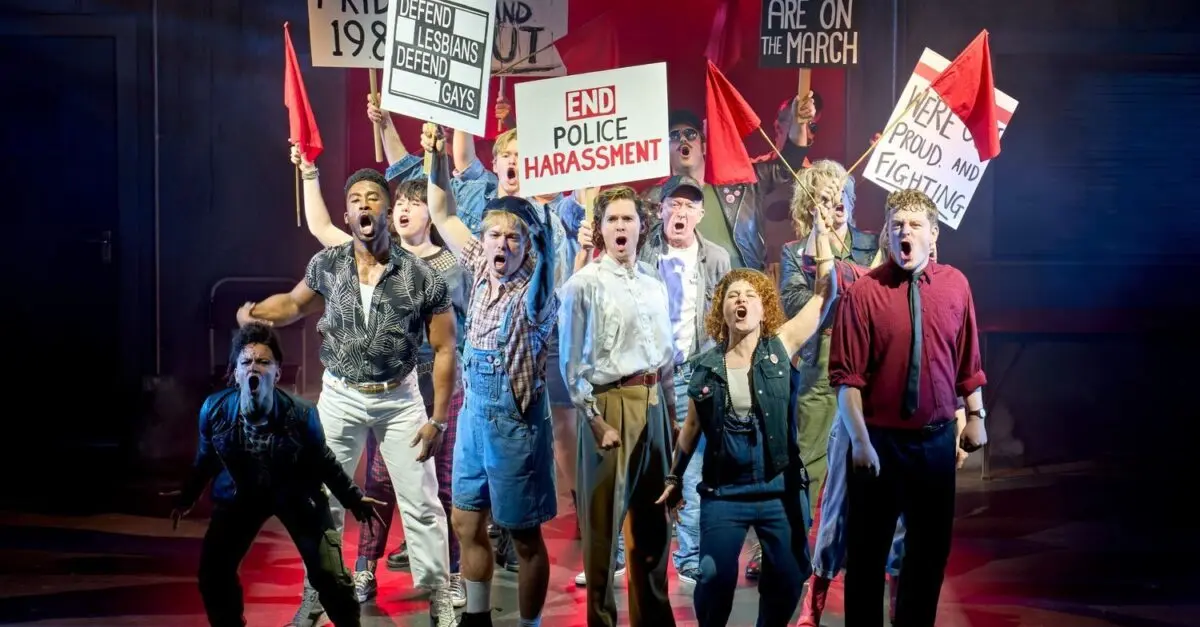
Based on the celebrated 2014 feature film—which itself dramatized a remarkable, overlooked chapter of British social history—Pride chronicles the unlikely and deeply moving alliance formed during the 1984–1985 British miners’ strike. The narrative centers on Lesbians and Gays Support the Miners (LGSM), a grassroots activist group that banded together to raise funds for a small, tight-knit mining village in South Wales. What began as a gesture of political and human solidarity evolved into an enduring cultural touchstone, now immortalized in a theatrical format that blends high-energy musical theatre with the raw power of historical documentary.
The production boasts an extraordinary creative pedigree. Written by Stephen Beresford (renowned for The Last of the Haussmans and the original screenplay of the film) and directed by Matthew Warchus (the Olivier and Tony Award-winning visionary behind Matilda The Musical), the show features an eclectic, genre-spanning original score. Composed by Christopher Nightingale (A Christmas Carol), Josh Cohen (Sylvia), and DJ Walde (Sylvia), the musical architecture of Pride draws inspiration from 1980s protest anthems, infectious pop, rock, disco, and the rich, resonant power of the Welsh choral tradition.
With a stellar principal cast locked in—featuring the return of acclaimed stage and screen actors including Samuel Barnett as Jonathan and Matthew Durkan as Mike—the Bridge Theatre engagement promises to be one of the hottest tickets of the autumn season. Produced by P&P Productions in association with the National Theatre, Pathé, Calamity Films, and David Binder Productions, this upcoming commercial transfer signals a profound recognition of the show’s universal themes: community, resilience, empathy, and the indomitable courage of ordinary people confronting systemic adversity.
Detailed Chronology: From the Coalfields of 1984 to the West End
To fully appreciate the cultural and theatrical weight of the Pride musical, one must trace its journey across decades—from the picket lines of Thatcher-era Britain to the silver screen, and finally, to the intimate yet grand acoustics of London’s live stages.
The Historical Genesis: 1984
In the spring of 1984, the National Union of Mineworkers (NUM) launched what would become one of the longest and most bitterly fought industrial disputes in British history. Pitting mining communities against Margaret Thatcher’s Conservative government—which was determined to close unprofitable pits—the strike polarized the nation.
Amidst this national turmoil, a small collective of gay and lesbian activists in London recognized a parallel between their own struggles against societal marginalization and police harassment, and the plight of the striking miners, whose communities were demonized by the mainstream press and starved of resources. Founding Lesbians and Gays Support the Miners (LGSM), this small band of friends began collecting donations in buckets during London Pride marches, ultimately driving vans filled with provisions down to the Dulais Valley in South Wales. Despite initial wariness from the conservative mining community, deep bonds were forged across demographic, geographic, and cultural divides, culminating in the miners’ historic contingent marching at the head of the 1985 London Gay Pride parade.
The Cinematic Breakthrough: 2014
Thirty years after these events transpired, screenwriter Stephen Beresford and director Matthew Warchus collaborated to bring this forgotten history to light. Released in 2014, the film Pride—starring an ensemble cast that included Bill Nighy, Imelda Staunton, Dominic West, and Andrew Scott—became an international critical darling. It won the Queer Palm at the Cannes Film Festival and captivated audiences worldwide with its delicate balance of humor, political fervor, and profound emotional resonance.
Yet, for Beresford, the story’s theatrical potential remained an untapped frontier. Following a research trip to Wales in 2013, the writer harbored a persistent ambition to see the narrative breathe in a live, communal space.
The Theatrical Evolution: 2024 and Beyond
That ambition materialized earlier this year with the world premiere of the stage musical at Cardiff’s Sherman Theatre. Playing to ecstatic, vociferous local crowds who saw their own heritage honored on stage, the production proved that the material possessed an electrifying theatrical pulse. This initial triumph was immediately followed by a sold-out, highly celebrated engagement at the National Theatre in London.
Now, stepping into the Bridge Theatre for its third and most prominent phase of live performance, Pride enters the commercial theatre capital of the United Kingdom, poised to touch a fresh wave of theatergoers as the dark nights of November draw in.
Supporting Context & Metrics: The Creative Engine and Ensemble
The artistic success of Pride relies heavily on a multidisciplinary approach to storytelling, where choreography, sound design, orchestrations, and set construction operate in absolute synergy to transport the audience back to mid-1980s Britain.
The Creative Collective
At the helm are creators who understand both large-scale commercial spectacle and intimate character-driven drama. Director Matthew Warchus brings the theatrical inventiveness that made Matilda a global phenomenon, ensuring that the sprawling political backdrop never overshadows the deeply human interpersonal dynamics. Meanwhile, Stephen Beresford’s libretto maintains the sharp wit and emotional honesty that characterized his screenplay, adapted specifically to capitalize on the immediacy of live performance.
The sonic landscape of the show is equally ambitious. Christopher Nightingale, Josh Cohen, and DJ Walde have crafted a score that acts as a historical time machine. By fusing the driving, synthetic beats of 1980s pop and disco with the defiant energy of punk-era protest anthems—and grounding it all with soaring Welsh choral arrangements—the music reflects the clash and subsequent harmony between London’s urban queer counterculture and rural Welsh working-class traditions.
Production Design and Technical Mastery
Transforming the Bridge Theatre into a canvas for the 1984 miners’ strike requires world-class design talent. The production features stunning set and costume designs by Bunny Christie, whose aesthetic captures the stark, industrial grit of the coalfields alongside the vibrant, expressive color palette of 1980s London activism.
The physical staging is galvanized by the choreography of Lizzi Gee, translating the energy of both strike-breaking rallies and London club scenes into fluid, dynamic movement. The auditory experience is meticulously shaped by sound designer Bobby Aitken and music supervisor Tom Kelly, working in tandem with orchestrators Nightingale, Kelly, Cohen, and Walde. Lighting designer Hugh Vanstone casts the production in a shifting spectrum of industrial gloom and warm, triumphant community spirit, while Campbell Young Associates handles hair, wig, and make-up design with period-authentic precision. Casting direction is spearheaded by David Grindrod.
The Cast of Characters
The ensemble transferring to the Bridge Theatre features a mix of seasoned stage performers who have helped shape these roles through their previous runs:
- Samuel Barnett as Jonathan
- Matthew Durkan as Mike
- Gillian Elisa as Gwen
- Chris Jenkins as Gethin
- Darren Lawrence as Cliff
- Kirsty Malpass as Hefina
- Madeleine Morgan in a yet-to-be-fully-specified ensemble/principal capacity
- Sarah Pugh as Siân
- Caroline Sheen as Maureen
- Courtney Stapleton as Steph
- Matthew Woodyatt as Dai
Producers have confirmed that further casting announcements will be made in the coming weeks, expanding an already formidable roster of British theatrical talent.
Official Statements: Voices from the Creative Frontline
The announcement of the West End transfer has elicited profound reflections from the creative team, underscoring the personal and cultural significance of the project.
Stephen Beresford, reflecting on the arduous yet rewarding journey of bringing the story from historical research to the West End stage, shared his thoughts in an official statement:
"Ever since my first research trip to Wales in 2013, it’s been one of the greatest honors of my career to tell the story of LGSM and the Dulais community, initially collaborating with Matthew Warchus on the 2014 film, and then again—in its most live and immediate form—as a stage musical."
Beresford continued, touching upon the visceral reactions of audiences during the regional and National Theatre runs:
"Starting the show at Cardiff’s Sherman Theatre earlier this year—to the most vociferous of welcomes—and then playing a joyful, sold-out run at London’s National Theatre, we have all been struck by what happens when a live audience encounters this true story of community, solidarity, and courage. I’m thrilled to see Pride take its onward journey to one of London’s best theatres, where I look forward to seeing more strangers passing tissues and hugging each other."
The collaborative framework supporting the production is robustly backed by P&P Productions, working in association with institutional and commercial heavyweights including the National Theatre, Pathé, Calamity Films, and David Binder Productions. Nia Janis serves as executive producer, while general management is overseen by Playful Productions—a structural guarantee that the commercial execution of the run will match its artistic ambitions.
Future Outlook: The Cultural Resonance of Pride Today
As Pride prepares to open its doors at the Bridge Theatre on November 12, the timing of its arrival carries a distinct resonance. In an era marked by deep political polarization, economic anxiety, and ongoing debates over civil rights and community fragmentation, the core thesis of Pride feels more urgent than ever.
The musical serves as a timely reminder that political solidarity is not born of homogenous ideology, but rather of radical empathy—the conscious choice to stand beside those fighting for their dignity, regardless of how unfamiliar their struggles might initially seem. By bridging the gap between urban queer communities and rural working-class laborers, the real-life historical figures of LGSM and the Dulais Valley demonstrated a blueprint for coalition-building that continues to inspire modern social movements.
For the West End, the arrival of Pride represents a rare theatrical commodity: a production that seamlessly marries entertainment value with profound socio-political historical education, wrapped in an infectious, crowd-pleasing musical score. As tickets go on sale via BridgeTheatre.co.uk, theatergoers are advised to secure their seats early. If the sold-out runs in Cardiff and at the National Theatre are any indication, London audiences will flock in droves to experience this celebration of human courage—and, as Beresford aptly predicted, they would do well to bring plenty of tissues.