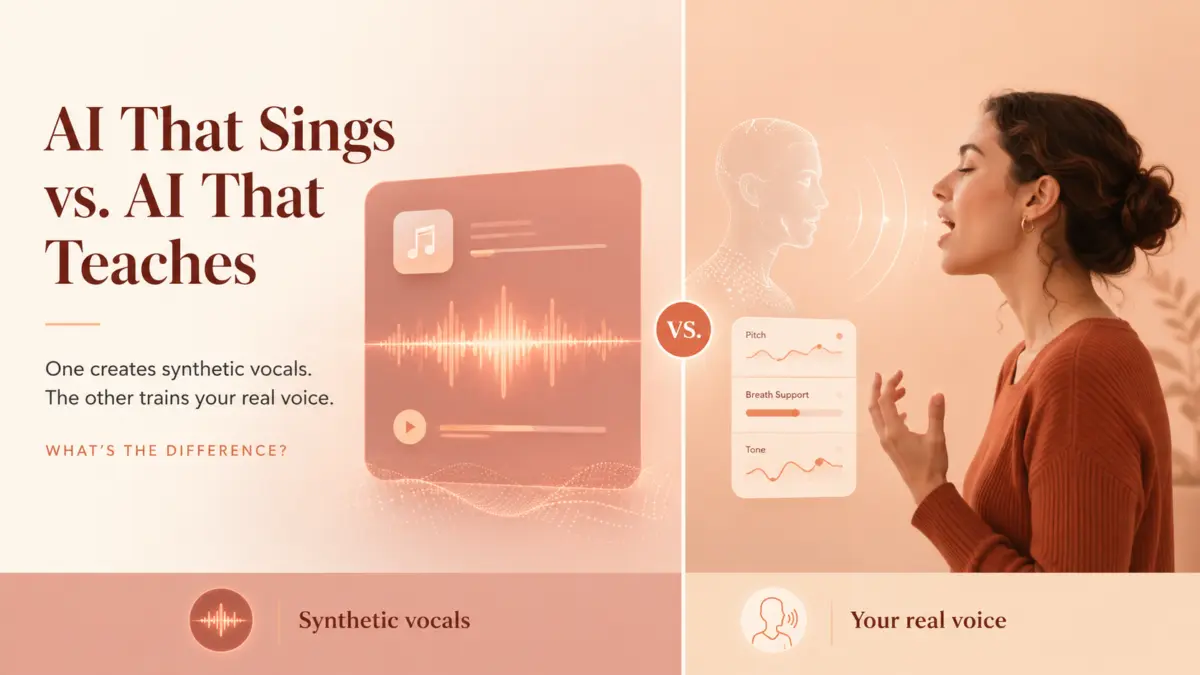
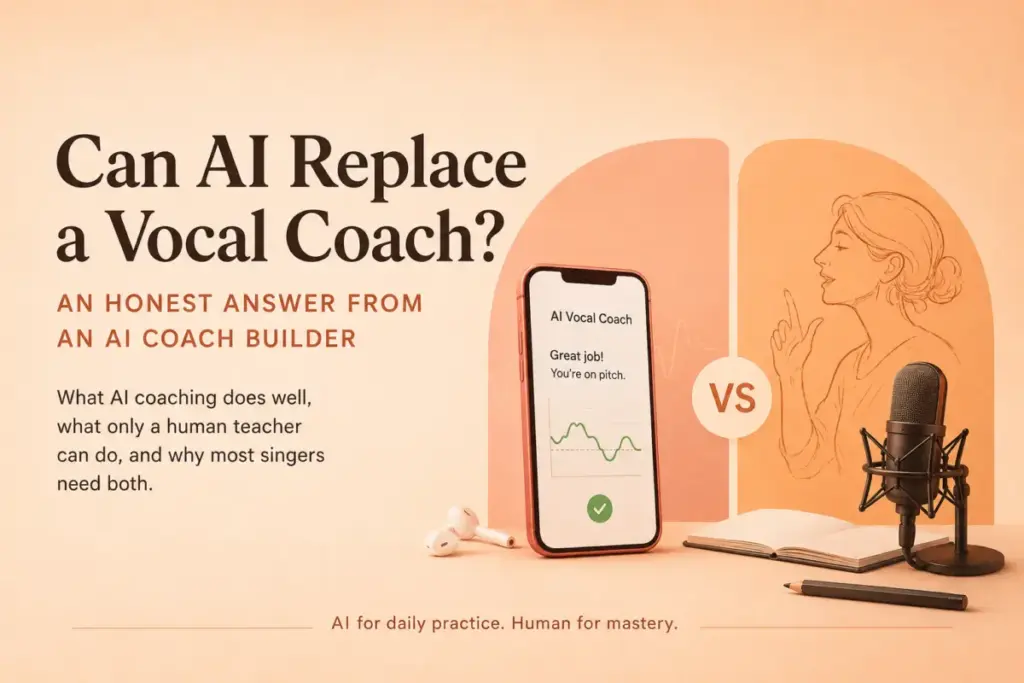
The intersection of artificial intelligence and vocal music has birthed a profound semantic and functional split. Today, the phrase "AI singing" is used to describe two entirely distinct—and functionally opposite—technological paradigms: Generative Voice Synthesis and Interactive Vocal Pedagogy.
On one side of this divide are generative platforms like Suno, Udio, and various retrieval-based voice conversion (RVC) systems. These tools represent automation. They bypass the human vocal apparatus entirely, generating polished, studio-ready synthetic vocals from text prompts or reference tracks. On the other side are AI-driven vocal coaches, such as Singing Carrots, which represent augmentation. Instead of replacing the human singer, these applications use machine learning, real-time digital signal processing (DSP), and large language models (LLMs) to analyze, train, and improve the user’s biological voice.
For consumers, musicians, and developers, conflating these two categories leads to mismatched expectations and misallocated resources. More broadly, this division highlights a deeper philosophical debate within the tech industry: should artificial intelligence be used to automate human artistic expression, or should it be designed to cultivate and refine human talent?
Detailed Chronology: The Evolution of Vocal Technology
To understand how "AI singing" came to mean two opposite things, it is necessary to trace the evolution of digital vocal technology. This journey spans more than a quarter-century, moving from simple pitch correction to real-time interactive feedback, and finally to the current generative boom.
  [Late 1990s - 2010s] ───► [2010s - Early 2020s] ───► [2023 - Present]
  Pitch Correction Era      Interactive Training       The Generative Boom
  (Auto-Tune, Melodyne)     (DSP Pitch Tracking)       (Suno, Udio, RVC)
Phase 1: The Pitch-Correction Era (Late 1990s–2010s)
Before artificial intelligence entered the mainstream, digital vocal manipulation was dominated by digital signal processing (DSP).
1997: Antares Audio Technology releases Auto-Tune, using phase vocoder technology to correct pitch in real time.
2001: Celemony introduces Melodyne, offering deeper, non-destructive editing of pitch, timing, and formants.
During this era, technology served as a post-production tool. It could polish a recorded human performance but could neither generate a voice from scratch nor offer real-time pedagogical guidance.
Phase 2: The Rise of Interactive Training (2010s–Early 2020s)
As consumer mobile devices and desktop computers gained processing power, developers began applying DSP algorithms to music education.
Mid-2010s: Applications like Singing Carrots and Simply Sing emerge. These platforms use real-time pitch detection algorithms (such as autocorrelation and YIN) to track a singer’s pitch against a target melody.
These tools introduced the first wave of "AI coaching," mapping user input to visual interfaces to help singers build muscle memory and pitch accuracy. At this point, "AI singing app" referred exclusively to software designed to help humans learn to sing.
Phase 3: The Generative Explosion (2023–Present)
The landscape changed dramatically with the rise of deep learning models trained on vast audio datasets.
Early 2023: Retrieval-Based Voice Conversion (RVC) and diffusion-based audio models gain popularity. The viral release of the AI-generated track "Heart on My Sleeve"—which realistically mimicked the voices of Drake and The Weeknd—demonstrates the power of voice cloning.
Late 2023–2024: Platforms like Suno and Udio launch, allowing users to generate complete, broadcast-quality songs with synthetic vocals from simple text prompts.
This technological leap created immediate semantic confusion. The term "AI singing" was quickly adopted by the tech press to describe these generative tools, overshadowing the established market of interactive vocal coaches.
Supporting Context & Metrics: Analyzing the Two Paradigms
The differences between generative AI and pedagogical AI are not just conceptual; they are reflected in their technical architectures, user demographics, and educational outcomes.
Technical Architecture and Data Processing
Generative Voice Systems rely on deep neural networks (such as diffusion models and transformers) trained on hundreds of thousands of hours of copyrighted and public-domain audio. These systems convert text and musical prompts into spectrograms, which are then turned into audio files using neural vocoders. The user is a passive director, providing inputs and receiving a finished product.
Interactive AI Vocal Coaches function through an active loop. The software captures live audio from the user’s microphone, applies noise-reduction filters, and uses pitch-tracking algorithms to calculate fundamental frequency ($F_0$) in real time. An intelligent system analyzes these metrics over time, dynamically adjusting lesson plans, identifying vocal range limits, and providing conversational guidance powered by large language models.
Speed, cost-efficiency, infinite scalability of content
Self-actualization, skill acquisition, physical health
Primary Target Audience
Content creators, game developers, ad agencies
Aspiring vocalists, karaoke enthusiasts, actors
Ethical/Legal Risk
High (Copyright infringement, voice theft)
Negligible (User-consented voice analysis)
Empirical Efficacy of Interactive Coaching
While generative AI focuses on creative output, pedagogical AI focuses on human skill acquisition. Data collected from beginners using interactive vocal coaching platforms shows significant improvement in pitch accuracy over relatively short periods.
According to published performance data tracking beginner singers over a multi-month period:
Users practicing with an AI vocal coach for just four weeks saw an average increase of +16.5 percentage points in pitch accuracy.
The rate of improvement was highest among users who initially scored in the lowest quartile for pitch accuracy, proving that real-time visual feedback is highly effective for untrained singers.
Longitudinal data shows that consistent engagement with visual pitch-tracking software helps build muscle memory in the larynx, leading to sustained improvements even when practicing without the app.
Official Statements and Industry Perspectives
The rise of these two technologies has sparked debate among artists, educators, legal experts, and tech developers.
The Pedagogical Perspective: Augmentation as Empowerment
Vocal coaches and music educators generally view interactive AI as a valuable tool rather than a threat.
"AI vocal coaches are not a replacement for high-level human instruction, but they democratize access to basic training," says Dr. Arnell Powell, a contemporary vocal pedagogue. "A beginner who cannot afford $100 an hour for a private coach can use an interactive app to learn pitch control and vocal health basics. It acts as an interactive mirror, showing singers exactly what their vocal cords are doing in real time."
The Creative and Legal Perspective: The Battle Over Voice Ownership
In contrast, generative voice cloning has met with fierce resistance from professional vocalists and industry groups. The unauthorized cloning of celebrity voices has led to calls for new laws protecting vocal likeness.
In a testimony regarding the NO FAKES Act—a proposed U.S. Senate bill aimed at protecting individuals from unauthorized generative AI replicas—the Screen Actors Guild-American Federation of Television and Radio Artists (SAG-AFTRA) stated:
"An individual’s voice is a deeply personal part of their identity and livelihood. Generative AI tools that clone voices without consent or compensation threaten the careers of professional performers and mislead the public. We must distinguish between technology that helps humans create and technology that plagiarizes their identity."
The Developer Perspective: Integrating the Two Worlds
Some developers are exploring ways to combine these technologies ethically. Gregory Feinberg, a software architect specializing in music education apps, believes the future lies in conversational coaching.
"The next step for AI vocal coaches is integrating generative conversational models. We aren’t using AI to sing for the student. Instead, we are using LLMs to act as a supportive, knowledgeable teacher that can explain vocal anatomy, design custom warm-ups, and offer encouragement based on the user’s pitch data. The AI generates the guidance, but the singing remains entirely human."
Future Outlook: Coexistence and the Human Element
As both generative and pedagogical AI technologies mature, they are likely to carve out distinct, non-competing niches based on different human needs.
Generative voice synthesis will continue to disrupt commercial media production. For low-budget video games, indie films, corporate videos, and advertising, generative platforms offer a fast, affordable way to create custom music.
Additionally, we may see the rise of licensed voice models, where professional singers lease their cloned voices for synthetic projects, generating passive income while protecting their legal rights.
The Somatic Value of Human Singing
Despite the rise of perfect synthetic vocals, the human desire to sing remains unchanged. Singing is a physical, emotional, and social experience. It releases endorphins, reduces cortisol, and fosters community through choirs, bands, and karaoke. Generative AI cannot satisfy this human need.
Consequently, interactive AI vocal coaches will continue to grow in popularity. These tools will become more sophisticated, using advanced mobile sensors to analyze posture, breathing, and jaw tension alongside pitch.
Conclusion
The term "AI singing" covers two very different technologies: one designed to replace the singer, and one designed to train them. Generative tools are changing how recorded music is produced, but they do not replace the joy of physical performance.
For those who want to create a track quickly, generative tools are the clear choice. But for those who want to improve their own voice, step onto a stage, and experience the physical joy of singing, the AI vocal coach is the true path forward. Technology can generate a song, but only humans can truly sing.