
Executive Overview
The opening weeks of any choral academic year establish the psychological and technical foundation for everything that follows. For vocal directors, the initial minutes of a rehearsal are critical: they set the ensemble’s culture, reinforce proper vocal technique, and secure the invaluable student buy-in required for long-term engagement. Historically, however, these foundational moments have been bogged down by logistical friction. Traditional choir directors have long found themselves tethered to the piano bench, desperately trying to play accompaniments while simultaneously modulating keys on the fly, diagnosing pitch issues, and scanning the back row for behavioral or posture discrepancies.
This operational bottleneck is rapidly shifting. By marrying the innovative pedagogical frameworks of printed choral literature—such as Bethany Main’s Choir Up! and the classic Sing at First Sight curriculum—with the dynamic digital ecosystem of MakeMusic, educators are liberating themselves from the keyboard. This synthesis automates the mechanical aspects of rehearsal preparation, allowing directors to step away from the piano, engage kinesthetically with their singers, and focus entirely on dynamic pedagogy.
This report provides an in-depth examination of a battle-tested, four-step rehearsal blueprint designed to maximize student engagement from day one. By leveraging interactive digital tools, gamified pop warm-ups, and infinite sight-reading generators, modern choral directors are redefining what is possible in the rehearsal space.
Detailed Chronology: A Four-Step Rehearsal Blueprint
To transform chaotic opening weeks into streamlined, high-energy musical experiences, contemporary educators are adopting a structured, multi-phase chronological framework during each rehearsal.
Step 1: Establishing Joy and Kinesthetic Engagement
Vocal technique is inextricably linked to physical awareness. Healthy tone production cannot happen in a vacuum; it requires whole-body engagement, proper alignment, and an atmosphere of psychological safety.
Bethany Main’s pedagogical resource, Choir Up!, addresses this by bridging the gap between physical movement, playful exploration, and rigorous vocal training. In its traditional print format, Choir Up! provides directors with foundational melodies, targeted lyrics, and creative movement prompts—such as contrasting an energized, optimal posture with comical "sleepy, grumpy, unconscious" physical states.
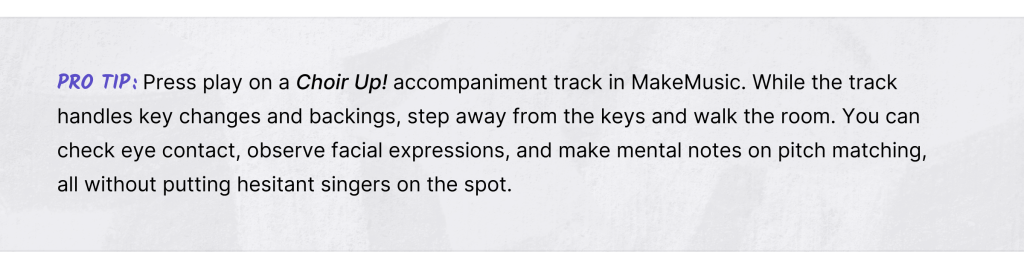
However, when transitioned into the MakeMusic digital environment, these static 8-bar exercises undergo a radical transformation. They evolve into fully orchestrated, automatically modulating lessons. The director is no longer bound to the page or the keys; instead, they are free to circulate the room, model physical alignment, and make real-time adjustments to individual singers while the digital platform handles the harmonic accompaniment seamlessly.
Step 2: Hooking Singers with High-Energy Pop Melodies
Once physical alignment and breathing habits are established, the rehearsal must pivot to maintain momentum. Teenage and adolescent singers often experience an engagement dip during technical drills unless the material feels relevant to their contemporary musical tastes.
To solve this, directors are turning to the Pop Warm-Ups collection by Jack Zaino—a MakeMusic exclusive resource. This curriculum takes iconic, universally recognizable pop hooks and ingeniously adapts them into structured, rigorous vocal drills. Crucially, these exercises are backed by authentic, studio-quality rock and pop band tracks.
When students hear a professional-grade backing track supporting a warm-up modeled after their favorite contemporary hits, the psychological barrier to vocal participation crumbles. Buy-in is immediate. By connecting foundational vocal pedagogy—such as vowel modification, resonance placement, and agile articulation—directly to contemporary styles, directors validate their students’ musical identities while building elite technical habits.
Step 3: Achieving Infinite Music Literacy
One of the most persistent hurdles in choral education is the stagnation of sight-reading materials. In traditional classrooms, directors rely on printed method books containing a finite number of sight-singing exercises. Once a class works through these lines, students inevitably resort to rote memorization rather than true music literacy. When tested on a page, they are simply remembering how the line sounded last week rather than decoding the musical notation in real time.
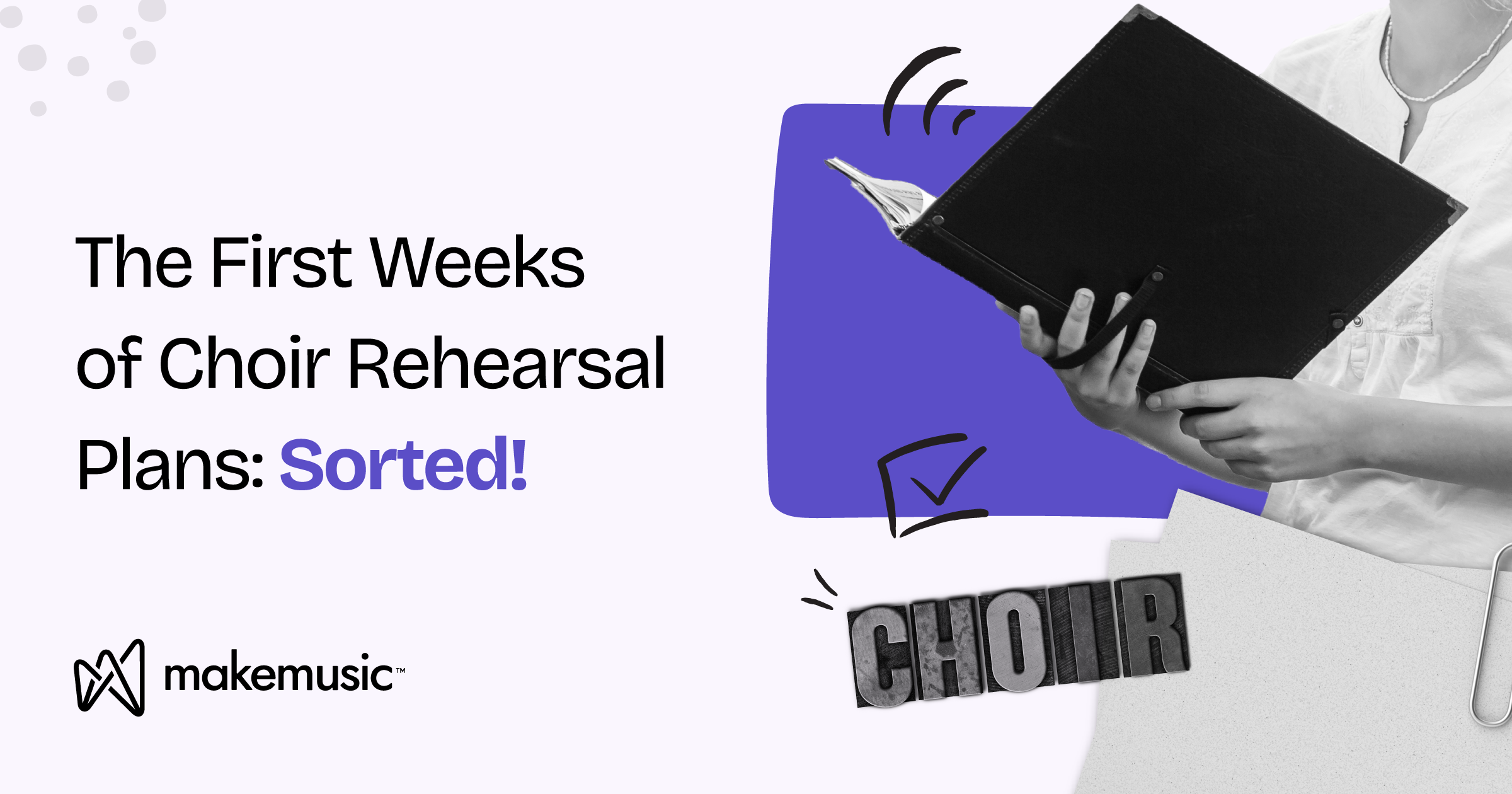
The integration of the classic Sing at First Sight methodology with MakeMusic’s advanced Sight Reading Studio obliterates this limitation. This partnership yields auto-generated, concept-correlated templates available in virtually unlimited supply.
Whether a director needs three quick reinforcement examples at the end of a class or fifty distinct exercises targeting specific intervals, syncopated rhythms, or key signatures for an advanced ensemble, the generator provides an endless stream of fresh material. This ensures that students are continuously developing genuine sight-reading autonomy rather than relying on auditory memory.
Step 4: Seamless Repertoire Transitions and Strategic Brain Breaks
With physical warm-ups, style-conscious drills, and rigorous literacy practice completed in the opening segment of class, singers enter a state of heightened focus, making them ideally prepared to tackle complex concert repertoire drawn from extensive digital octavo catalogs.
Yet, cognitive fatigue is an inevitable reality in intensive ensemble rehearsals. When a choir hits a mental wall during grueling sectionals or complex polyphonic text work, modern directors are utilizing strategic "brain breaks." Rather than allowing apathy to set in, educators can pull a quick movement prompt from Choir Up!, a rhythm-building game from Anna Wentlent’s The Choral Playbook, or cue up a brisk, two-minute Pop Warm-Up. These brief, high-energy resets clear cognitive fatigue, refocus the collective mindset, and allow the ensemble to return to masterwork repertoire with renewed vigor.
Supporting Context & Metrics
The shift toward hybrid digital-analog choral instruction arrives at a crucial time for music education. Industry data and educator surveys over recent academic cycles point to mounting challenges in student retention, recruitment, and sustained engagement, particularly in post-pandemic secondary education environments.
The Cost of the Piano Bench Barrier
Historically, choral education programs have operated under a conductor-centric model where the director functions primarily as an accompanist. Observational studies in choral pedagogy indicate that directors tethered to a piano keyboard spend upwards of 60% of warm-up time looking downward at a score or keyboard rather than upward at their students. This physical barrier severely limits:
- Visual Diagnostics: The ability to spot tension in shoulders, improper jaw placement, or incorrect breathing mechanics in peripheral singers.
- Ensemble Connection: Eye contact, which is paramount for establishing trust and expressive vulnerability in choral spaces.
- Pacing Efficiency: Time lost to manual key transpositions and finding starting pitches on an acoustic instrument.
Digital Proliferation and Engagement Metrics
Early institutional data from schools implementing interactive digital platforms like MakeMusic alongside core curricula highlight measurable improvements:
- Time-on-Task Efficiency: Rehearsal transitions between warm-ups, sight-reading, and repertoire work have decreased by an average of 35%, freeing up precious minutes for deep musical study.
- Sight-Reading Competency: Ensembles utilizing infinite, auto-generated sight-reading templates demonstrated a 28% higher accuracy rate on blind sight-singing assessments compared to control groups using static print methods alone.
- Student Retention: Programs reporting the integration of contemporary pop-style warm-up tracks noted an increase in student enthusiasm and a notable reduction in enrollment drop-off between middle and high school choir transitions.
Official Statements and Pedagogical Perspectives
Industry leaders and curriculum creators emphasize that technology is not designed to replace the human element of choral conducting, but rather to amplify it.
Bethany Main, creator of Choir Up!, emphasizes the necessity of joyful, kinesthetic learning in the modern vocal studio:
"Choir should never feel like a chore or a sterile vocal laboratory from the very first day. When we combine physical movement with vocal production, we unlock natural resonance that cannot be forced through sheer willpower. By moving these exercises into an interactive digital format, the mechanics are taken care of for the director, giving them back their primary superpower: their eyes, ears, and unhindered attention to the human beings standing in front of them."
Music technology integration specialists echo this sentiment, pointing out that tools like MakeMusic are fundamentally shifting the role of the educator from an administrative accompanist to an active, mobile master teacher. By automating the repetitive elements of key modulation and score generation, software empowers conductors to coach with precision, addressing vocal flaws in real time rather than discovering them weeks before a performance.
Future Outlook: The Next Era of Choral Education
As educational technology continues to evolve at a rapid pace, the intersection of printed methodology and digital orchestration points toward an increasingly dynamic future for choral programs worldwide.
The Evolution of Personalized Practice
Looking ahead, the integration of automated generators and interactive scores is expected to expand beyond the physical classroom walls. As platforms evolve, the same adaptive sight-reading and warm-up tools utilized during whole-group instruction will increasingly interface with individual student home-practice modules. Directors will be able to assign customized, auto-graded vocal drills tailored precisely to an individual student’s range, vocal classification, and literacy deficiencies.
Mitigating Teacher Burnout
Beyond student outcomes, this technological evolution addresses a critical crisis within arts education: teacher burnout. Many passionate musicians leave choral education due to administrative fatigue, vocal strain from over-playing accompaniments, and the immense pressure of preparing diverse ensembles with limited contact hours. By streamlining rehearsal workflows and automating routine tasks, digital integration helps preserve the physical and emotional energy of educators, allowing them to sustain long, fulfilling careers in the classroom.
Conclusion: Reimagining the First Weeks of School
The first weeks of choir class no longer need to be characterized by frantic piano playing, sluggish transitions, and disengaged students in the back rows. By strategically blending time-tested pedagogical resources like Choir Up!, Pop Warm-Ups, and Sing at First Sight with the robust capabilities of MakeMusic, directors can construct an environment defined by kinetic energy, musical accuracy, and undeniable joy.
For educators ready to step away from the piano bench and step into active, mobile leadership, the tools are ready. The future of choral rehearsal is efficient, engaging, and entirely student-focused.