
Executive Overview
The rapid integration of artificial intelligence into creative disciplines has sparked intense debate across the global arts and education sectors. In the field of vocal pedagogy, this tension has reached a critical inflection point. As algorithmic platforms emerge promising to train the human voice, vocal coaches and students alike are left grappling with a fundamental question: Can software truly teach an art form as deeply physical, emotional, and subjective as singing?
An investigative analysis of the current technological landscape—anchored by data and developmental insights from the creators of the Singing Carrots AI Vocal Coach—reveals a surprising consensus. The rise of AI in vocal training does not represent an existential threat to human teachers. Instead, it exposes a massive, previously unaddressed gap in music education.
                                 THE SINGING PRACTICE GAP

      Traditional Model                             AI-Human Hybrid Model
 ┌─────────────────────────┐                     ┌─────────────────────────┐
 │  Weekly Human Lesson    │                     │  Weekly Human Lesson    │
 │  ($60 - $150 / hour)    │                     │  - Sets technique       │
 └────────────┬────────────┘                     │  - Guides artistry      │
              │                                  └────────────┬────────────┘
              │ 6 Days of                                     │
              │ Unmonitored Practice                          │ 6 Days of
              ▼                                               ▼ Guided Practice
 ┌─────────────────────────┐                     ┌─────────────────────────┐
 │   Unstructured Singing  │                     │   AI Coach Sessions     │
 │   - Risk of bad habits  │                     │   - Instant feedback    │
 │   - No real-time data   │                     │   - Safe pitch range    │
 └─────────────────────────┘                     └─────────────────────────┘
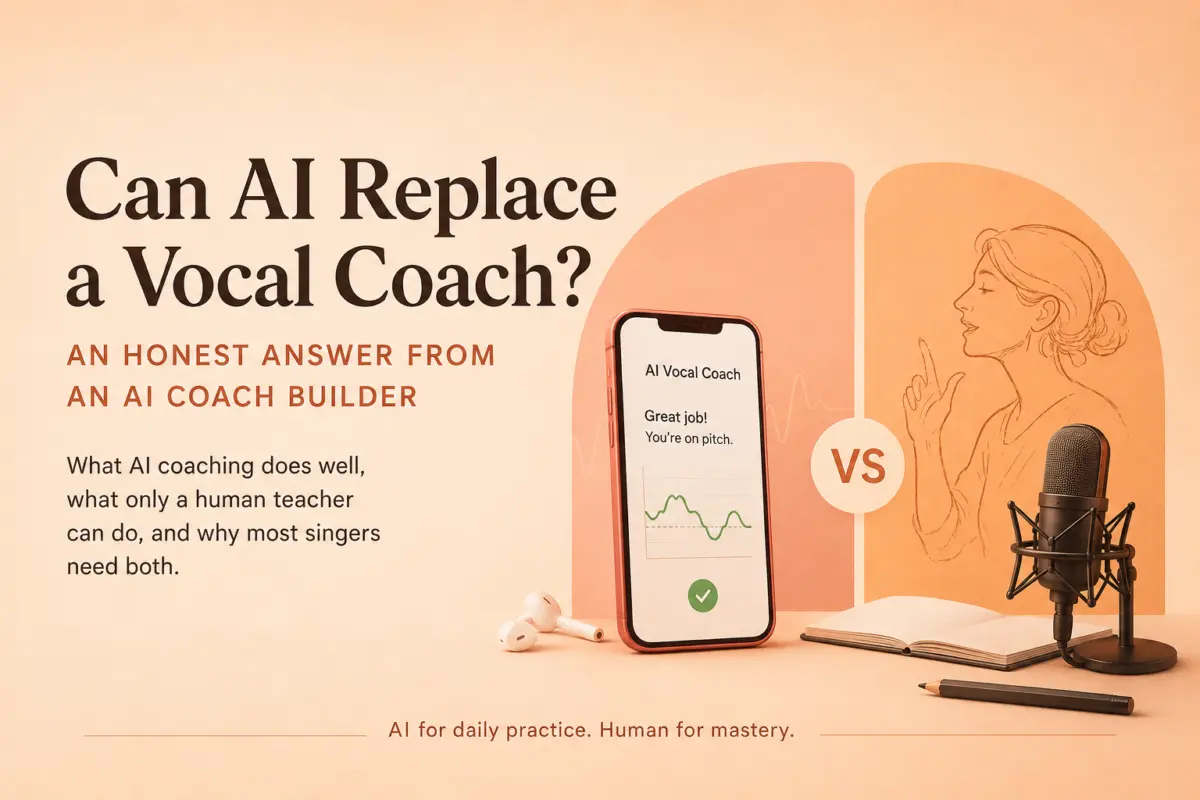
For decades, the high cost of private voice lessons (ranging from $60 to $150 per hour) has functioned as a barrier to entry, leaving millions of aspiring singers with no guidance at all. The data indicates that the primary choice facing most modern singers is not "AI versus a human teacher," but rather "AI versus nothing." While an algorithm cannot perceive the nuance of tone color, detect physical tension, or safeguard long-term vocal health, it can provide real-time visual pitch feedback, structured daily practice, and unprecedented accessibility.
This report examines the technological boundaries of AI vocal coaching, the empirical data behind its efficacy, the perspective of pedagogical professionals, and the emerging hybrid model that is redefining how the world learns to sing.
Detailed Chronology: The Evolution of Vocal Pedagogy and the Rise of Algorithmic Practice
To understand the current intersection of artificial intelligence and vocal pedagogy, one must examine how the transmission of vocal knowledge has evolved over the centuries.
                  CHRONOLOGY OF VOCAL PEDAGOGY

   17th-19th Century         Late 20th Century         Early 21st Century             Present Day
 ┌───────────────────┐     ┌───────────────────┐     ┌───────────────────┐      ┌────────────────────┐
 │    Bel Canto      │     │  Analog & Digital │     │ Interactive Apps  │      │ Adaptive AI Coach  │
 │  Master-Apprentice│     │     Recording     │     │ & Visual Pitch    │      │ - Dynamic ranges   │
 │   Physical touch, │     │ - Metronomes      │     │ - Static software │      │ - Biofeedback      │
 │   vocal modeling  │     │ - Tuners, tape    │     │ - Linear paths    │      │ - Multi-day data   │
 └───────────────────┘     └───────────────────┘     └───────────────────┘      └────────────────────┘
1. The Classical Era: The Master-Apprentice Model
For centuries, vocal training relied entirely on the Bel Canto tradition and the master-apprentice model. Knowledge was passed down through direct human interaction. A master teacher relied on sensory observation:
- Acoustic analysis via the trained human ear.
- Visual observation of a student’s posture, chest expansion, jaw tension, and facial expressions.
- Tactile feedback, sometimes requiring physical touch to verify diaphragmatic breathing or laryngeal relaxation.
This model, while highly effective, was inherently exclusive, expensive, and limited by geography.
2. The Mid-to-Late 20th Century: The Introduction of Assistive Tools
The mid-1900s introduced technologies that began to assist the practice room. The piano remained the primary tool, but the introduction of:
- Magnetic tape recorders allowed singers to hear their voices objectively for the first time.
- Analog metronomes and pitch pipes provided basic reference points.
- Early speech therapy tools began exploring visual representations of sound waves, though these remained confined to clinical laboratory settings.
3. The Digital Turn and Early Software (2000s–2010s)
With the rise of personal computing and mobile devices, developers began creating consumer-facing singing software. These early applications were highly linear, relying on pre-recorded audio tracks and static MIDI visualizations. They could tell a singer if they hit a note after the fact, but they lacked the processing power to adapt to the individual singer’s vocal anatomy in real time.
4. The Modern AI Inflection Point (2020s)
The current era of AI vocal coaching was born from advancements in real-time pitch detection algorithms, digital signal processing (DSP), and machine learning. When developers at Singing Carrots set out to build their AI vocal coach, they aimed to move beyond static training.
By utilizing advanced pitch-tracking algorithms capable of measuring frequencies down to the exact cent, developers created a system that could dynamically adjust to a singer’s range in real time. Over a seven-month developmental testing cycle, the platform collected behavioral data, analyzed user progression, and confronted the hard physical limits of what software can—and cannot—do.
Supporting Context & Metrics: Analyzing the Data Behind Algorithmic Vocal Training
To evaluate the true impact of AI on vocal development, we must look at the empirical evidence. In a comprehensive seven-month study published by Singing Carrots, researchers tracked the progress of singers utilizing real-time visual biofeedback. The results challenge long-held assumptions about the limits of self-directed practice.
The Power of Visual Biofeedback
One of the most difficult aspects of singing is that individuals cannot hear their own voices accurately while performing. Sound travels to the singer’s inner ear both through the air (air conduction) and through the bones of the skull (bone conduction), distorting their perception of pitch and tone. Real-time visual feedback bypasses this sensory distortion by providing an objective, instantaneous visual representation of the pitch.
The data shows that this closed-loop feedback system yields rapid, measurable improvements in intonation:
                  PITCH ACCURACY IMPROVEMENT (4 WEEKS)

  20% ─────────────────────────────────────────────────── +16.5%
      │                                                   (Beginners)
  15% ───────────────────────────────────┐
      │                                  │
  10% ───────────────────────────────────┤
      │                                  │
   5% ────────────── +5.9%               │
      │              (All Singers)       │
   0% ───────────────┴───────────────────┴───────────────────
Average Beginners- General Singer Population: Users across all skill levels demonstrated an average pitch accuracy improvement of +5.9 percentage points within just four weeks of daily training.
- Beginner Singers: The impact was most pronounced among absolute beginners, who saw a massive +16.5 percentage point increase in pitch accuracy over the same period.
Algorithmic Safety and Range Calibration
A major concern among vocal health professionals is the risk of vocal strain or damage when students practice without supervision. To mitigate this, developers engineered safety boundaries directly into the AI’s core logic.
According to mechanism analyses of the Singing Carrots platform, the AI coach dynamically restricts exercises based on the user’s active performance:
- 91.5% of all exercises are algorithmically locked within the singer’s demonstrated "comfortable range."
- The system actively monitors for pitch instability and sudden octave drops—frequent indicators of vocal fatigue—and automatically scales back the difficulty or range of the subsequent exercises.
Economic and Accessibility Metrics
The democratization of vocal training becomes clear when comparing the financial commitments required for traditional vs. digital training models:
| Metric | Traditional Human Vocal Teacher | AI Vocal Coach |
|---|---|---|
| Average Cost | $60 to $150 per hour | Fraction of a single lesson’s cost per month |
| Availability | Scheduled weekly sessions (typically 1 hour) | 24/7, on-demand availability |
| Target Audience | Intermediate to advanced; performance-focused | Beginners; daily practitioners; supplementers |
| Primary Feedback Loop | Holistic (artistry, physical posture, strain) | Granular (exact pitch accuracy, range tracking) |
| Vocal Health Protection | Direct observation of physical strain and fatigue | Algorithmic boundaries (91.5% safe-range restriction) |
Official Statements and Pedagogical Perspectives
The dialogue surrounding AI in music education has shifted from mutual suspicion to a nuanced understanding of collaborative utility. Here, we examine the perspectives of developers, vocal pedagogues, and educational scientists.
The Developer’s Perspective: A Stance of Self-Limitation
The creators of the Singing Carrots AI vocal coach have taken an unusual stance in the tech industry by openly publishing the limitations of their product. In an official statement, the development team remarked:
"An AI vocal coach cannot replace a good human teacher. A human hears nuance no algorithm measures, watches your posture and jaw, and protects your vocal health. Our coach measures pitch to the cent; it does not hear beauty. We did not design this tool to empty the teacher’s chair, but to fill the empty room where no teacher was ever going to be."
This philosophy acknowledges that while machine learning can solve the objective mechanics of pitch, it cannot replicate the subjective, relational elements of artistic expression.
The Vocal Teacher’s Perspective: The Digital Metronome
Historically, instrumental teachers have had a distinct advantage over voice teachers: they could send their students home with a metronome, a tuner, or finger-placement guides. Voice teachers, however, have long struggled to monitor what happens during the six days between weekly lessons.
                      THE INTER-LESSON PRACTICE GAP

   Day 1          Day 2          Day 3          Day 4          Day 5          Day 6
 ┌────────┐     ┌────────┐     ┌────────┐     ┌────────┐     ┌────────┐     ┌────────┐
 │ Human  │     │ Unmon- │     │ Unmon- │     │ Unmon- │     │ Unmon- │     │ Human  │
 │ Lesson │────>│ itored │────>│ itored │────>│ itored │────>│ itored │────>│ Lesson │
 │        │     │Practice│     │Practice│     │Practice│     │Practice│     │        │
 └────────┘     └────────┘     └────────┘     └────────┘     └────────┘     └────────┘
                 ▲              ▲              ▲              ▲
                 └──────────────┴──────────────┴──────────────┘
                    Risk of reinforcing bad physical habits
                    and pitch inaccuracies without feedback
Many contemporary voice instructors have begun adopting AI tools as a solution to this "inter-lesson gap." Dr. Helena Vester, a contemporary vocal coach and researcher, explains:
"My biggest challenge has never been what happens in my studio; it’s what happens when the student goes home and practices their mistakes for six days straight. If an app can keep my students singing on pitch and practicing inside their safe vocal range between our sessions, they return to me much more prepared. It frees up my lesson time to focus on artistry, interpretation, and posture, rather than basic pitch matching."
The Scientific Consensus on Visual Biofeedback
Vocal scientists and speech-language pathologists have long utilized visual biofeedback in clinical settings to treat speech disorders and rehabilitate injured singers. Academic studies confirm that when a subject receives immediate visual confirmation of an acoustic event (such as hitting a target frequency), the neural pathways responsible for motor learning are reinforced more rapidly than through auditory feedback alone.
Future Outlook: The Hybrid Model of Vocal Mastery
As artificial intelligence continues to advance, the relationship between technology and human instruction will likely solidify into a highly integrated, hybrid pedagogical model.
                           THE HYBRID PEDAGOGY LOOP

                          ┌────────────────────────┐
                          │  Human Vocal Teacher   │
                          │  - Diagnoses posture   │
                          │  - Directs artistry    │
                          │  - Monitors health     │
                          └───────────┬────────────┘
                                      │
                         Instructs    │   Assigns targeted
                         technique    │   drill parameters
                                      ▼
                          ┌────────────────────────┐
                          │     AI Vocal Coach     │
                          │  - Daily pitch drills  │
                          │  - Safe range lock     │
                          │  - Objective metrics   │
                          └───────────┬────────────┘
                                      │
                         Sends progress data /
                         Highlights friction points
                                      ▼
                          ┌────────────────────────┐
                          │     Active Singer      │
                          │  - Rapid skill growth  │
                          │  - Safe development    │
                          └────────────────────────┘
The Division of Labor in Vocal Training
The future of music education lies in a clear division of labor between biological and digital instructors:
- The Algorithmic Domain (The AI): Will handle repetitive, objective, and quantitative tasks. This includes scale drilling, interval training, pitch accuracy tracking, range quantification, and maintaining daily practice consistency.
- The Human Domain (The Teacher): Will retain absolute authority over qualitative, physical, and emotional training. This includes identifying subglottic pressure issues, correcting laryngeal tilt, assessing emotional delivery, resolving performance anxiety, and diagnosing vocal fatigue or pathology.
A Roadmap for Aspiring Singers
For singers navigating this new landscape, the optimal path depends heavily on their current development stage, financial resources, and physical health:
- The Budget-Constrained Beginner: Start with an AI vocal coach. The data demonstrates that absolute beginners stand to gain the most rapid initial improvements in pitch and confidence through structured, low-risk digital practice. This builds a foundation before investing in premium human coaching.
- The Active Student: Maintain weekly or bi-weekly lessons with a human teacher to establish correct physical technique and artistic goals. Utilize the AI coach for 10 to 20 minutes daily between lessons to reinforce those concepts, acting as an interactive practice journal.
- The Advanced Performer: Rely on a human teacher for elite artistry, style refinement, and performance preparation. Use the AI coach as a convenient, objective warm-up tool and pitch-maintenance utility while traveling or touring.
- Singers Experiencing Pain or Strain: Avoid relying solely on software. Any persistent vocal discomfort, hoarseness, or loss of range requires immediate diagnostic evaluation by a human vocal pedagogue or a laryngologist.
Ultimately, the integration of artificial intelligence into vocal pedagogy does not diminish the value of human instruction. By lowering the financial barrier to entry and providing structure to the lonely hours of daily practice, AI is expanding the global community of singers. In doing so, it is creating a pipeline of more capable, confident, and pitch-accurate students for the human teachers of tomorrow.