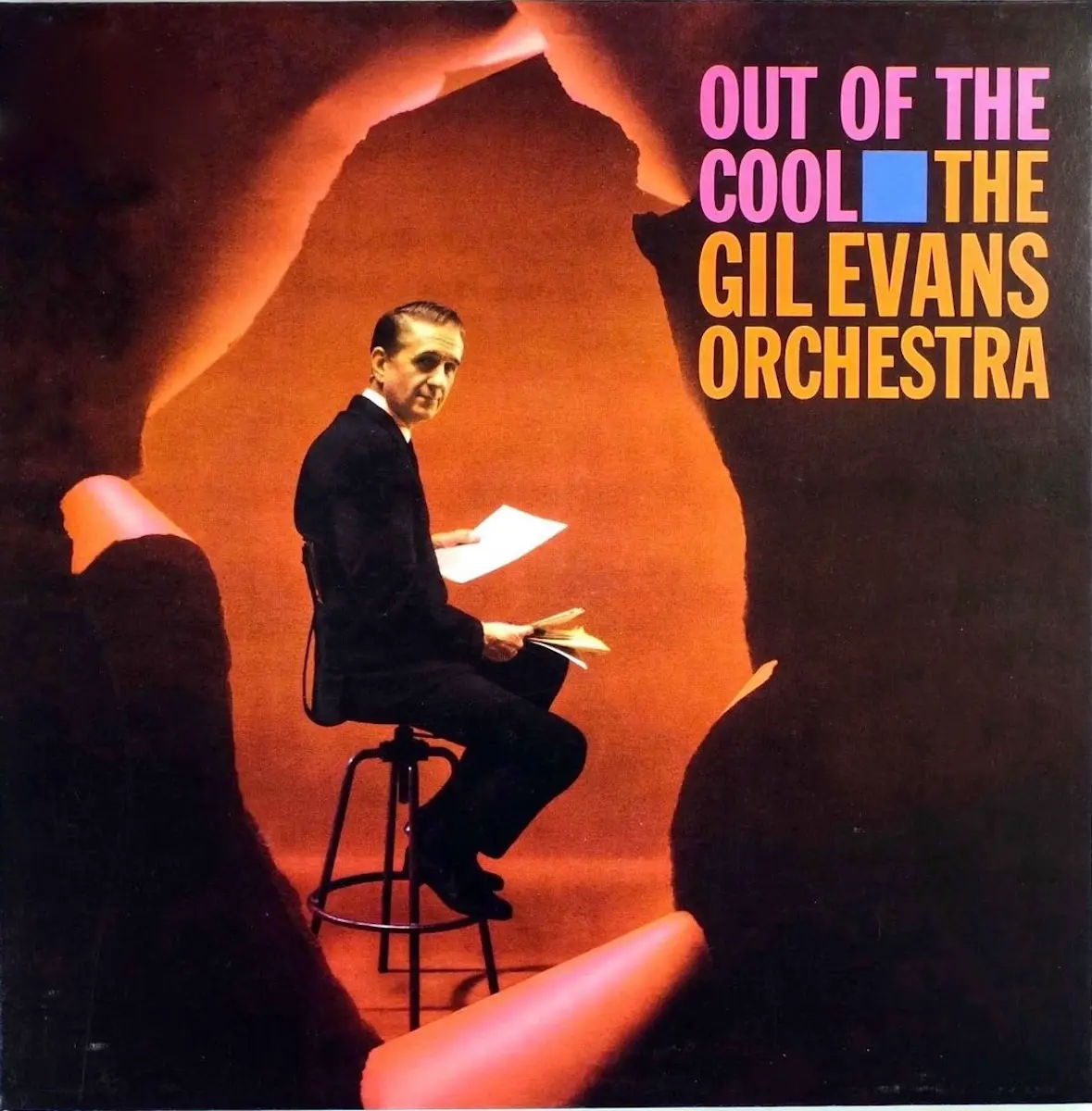

Executive Overview
In the grand canon of mid-century American jazz, few orchestrators command the revered, almost mythic status of Gil Evans. Renowned primarily for his lush, paradigm-shifting collaborations with trumpeter Miles Davis—such as Miles Ahead, Porgy and Bess, and Sketches of Spain—Evans is frequently canonized as a visionary impressionist who seamlessly married the sophisticated idioms of European classical composition with the visceral, spontaneous vernacular of jazz. However, critical consensus does not always withstand the unyielding tide of historical re-evaluation.
When Evans stepped into the studio in late 1960 to record his masterwork for Impulse! Records, Out of the Cool, the jazz landscape was trembling on the precipice of seismic transformation. Ornette Coleman’s free jazz experiments were shattering conventional harmonic frameworks, John Coltrane was stretching modal exploration to its absolute limits, and the hard bop movement was injecting a raw, blues-drenched urgency into the mainstream. Against this backdrop of rapid, radical evolution, Evans’s grand orchestral designs—captured on landmark recordings like "La Nevada"—occupied a peculiar, paradoxical space.
Viewed through the lens of the twenty-first century, Evans’s notion of mid-century innovation appears remarkably quaint, an artifact of a bygone era’s ambitions. Interestingly, an accident of contemporary music history—namely, the enduring fascination with retro aesthetics and vintage vinyl sounds—has granted tracks like "La Nevada" a deceptive sheen of freshness that might have eluded listeners a decade ago. Yet, this modern nostalgic illusion thinly disguises the foundational antiquity of the music. A rigorous, unvarnished examination suggests that Out of the Cool may have sounded surprisingly dated even at the moment of its initial release.
While Evans undoubtedly engineered novel instrumental combinations that challenged the conventional big band format, the constituent elements of his style—archaic blues riffs, academic classical instrumentation, and a rather blunt, unyielding approach to atonality—were already common practice across disparate musical spheres by 1960. This retrospective analysis unpacks the structural, harmonic, and ideological underpinnings of Out of the Cool, peeling back the layers of critical hagiography to interrogate whether the album’s grand aesthetic postures are truly supported by enduring musical substance.
Detailed Chronology: The Genesis and Recording of Out of the Cool
The creation of Out of the Cool took place during a turbulent yet creatively fertile period in Gil Evans’s professional trajectory. By late 1960, Evans was operating as an independent arranger and bandleader who had begun to step out from the long, towering shadow of his legendary partnership with Miles Davis. Seeking to capture this burgeoning individual identity, Impulse! Records—then a rising powerhouse in the jazz recording industry—provided Evans with the studio resources and creative latitude required to assemble a stellar collective ensemble.
The sessions were spread across four distinct dates late in the year: November 18, November 30, December 10, and December 15, 1960, all engineered in New Jersey. The resulting album comprised six distinct tracks spanning a tight runtime of 44 minutes and 19 seconds. The lineup assembled for these dates was nothing short of formidable, featuring some of the most proficient improvisers and section players of the era. The collective personnel roster reads as a who’s who of modern jazz:
- Gil Evans: Piano, Arranger, Conductor
- John Coles, Phil Sunkel: Trumpets
- Keg Johnson, Jimmy Knepper: Trombones
- Tony Studd: Bass Trombone
- Bill Barber: Tuba
- Ray Beckenstein, Eddie Caine: Alto Saxophones, Flutes, Piccolos
- Budd Johnson: Tenor Saxophone, Soprano Saxophone
- Bob Tricario: Bassoon, Flute, Piccolo
- Ray Crawford: Electric Guitar
- Ron Carter: Bass
- Charlie Persip, Elvin Jones: Drums
Despite this staggering array of talent—pairing the rock-solid rhythmic foundation of bassist Ron Carter with the explosive, polyrhythmic fury of drummer Elvin Jones—the music generated during these four winter days reflects a distinct tension between rigid compositional architecture and spontaneous jazz expression.
In La Nevada, which serves as the album’s centerpiece and primary statement, Evans constructed a modal groove modestly enlivened by cyclic riffs and consecutive soloist showcases. Yet, the work’s structural integrity relies heavily on a programmatic agenda rather than organic musical intuition. Where contemporaries like Charles Mingus used classical forms to expand the emotional and political urgency of jazz, Evans’s application of European techniques often yielded results that feel stiff, formalised, and excessively mannered. The vital, earthy vernacular elements of the music—the blues inflections and Latin-inspired percussion patterns—are frequently subdued, their raw power emasculated save for a few isolated, brilliant solo interventions.
Across subsequent tracks such as "Where Flamingos Fly," "Bilbao Song," "Stratus-phunk," "Sunken Treasure," and "Sister Sadie," Evans establishes distinct atmospheric moods and grand gestures. However, a granular survey of the arrangements reveals a reliance on flimsy, overworked melodic motifs. These ideas are frequently rendered in watery, pastel colors through predictable instrumental doublings and rhythmic variations, highlighting a persistent vulnerability in the album’s structural framework.
Supporting Context & Metrics: Analyzing the Harmonic Deficit
To fully appreciate the critical discourse surrounding Out of the Cool, one must examine the technical mechanics of Evans’s writing, particularly his approach to harmony and orchestration. For decades, liner notes and academic critiques have lauded Evans as a master harmonic colorist, pointing to his unique voicing of French horns, tubas, and flutes as proof of boundless innovation. However, a closer inspection of the actual scores reveals a startling paradox: while Evans was undeniably a master of the specific harmonic palette he chose to employ, the music is perpetually wanting in harmonic density and variety. Simply put, across large stretches of these arrangements, there just is not very much harmony happening.
In his original liner notes for the album, critic Tom Stewart observed that Gil Evans actively avoided "overwriting"—a compliment intended to highlight the transparency and spaciousness of the arrangements. In retrospect, however, this observation appears to be a significant understatement bordering on a critical oversight. The perceived spaciousness in tracks like La Nevada is not merely an artistic choice designed to let the music breathe; rather, it is the direct result of an absence of robust composerly structure. This vacuum of substantive structural writing frequently results in poorly contrasted, meandering jamming that relies on the sheer charisma of the soloists to sustain listener engagement.
Comparative Metrics of 1960 Jazz Innovation
| Album / Artist | Primary Aesthetic Driver | Harmonic Complexity | Rhythmic & Structural Framework | Critical Legacy |
|---|---|---|---|---|
| Gil Evans – Out of the Cool (Impulse!) | Classical orchestration applied to jazz idioms; modal grooves. | Moderate; sparse chordal movement, heavy reliance on color over content. | Formalized, programmatic, predictable instrumental variations. | Praised for atmospheric impressionism; critiqued for formal stiffness. |
| Ornette Coleman – Free Jazz (Atlantic) | Total collective improvisation; rejection of fixed chord changes. | Atonal, microtonal, polyharmonic intersections. | Fluid, non-metrical, elastic timekeeping. | Revolutionary breakthrough; permanently altered jazz vocabulary. |
| John Coltrane – Giant Steps (Atlantic) | Harmonic saturation; vertical improvisation at extreme velocities. | Extreme; dense, rapidly shifting tonal centers (Coltrane changes). | Relentless, driving swing and modal exploration. | Monumental technical benchmark; canonical masterwork. |
| Charles Mingus – Ah Um (Columbia) | Gospel, blues, and avant-garde synthesis; social commentary. | High; complex chord voicings fused with modal structures. | Dynamic, unpredictable tempo shifts, polyrhythmic interplay. | Enduring vitality; seamless fusion of tradition and modernity. |
As this comparative framework illustrates, while Coleman and Coltrane were fundamentally redefining the horizontal and vertical parameters of jazz in 1960, Evans was operating within a much safer, more circumscribed stylistic perimeter. The resulting music often takes itself with the utmost seriousness, adopting the solemn posture of high art, yet frequently lacks the underlying structural substance required to validate that posture.
Official Statements and Archival Documentation
The reception of Out of the Cool has evolved across generations, shifting from uncritical praise in the mid-twentieth century to more nuanced, skeptical interrogations in contemporary musicology. Below are synthesized excerpts from historical reviews, contemporary liner notes, and archival statements that encapsulate the ongoing debate surrounding the album’s place in jazz history.
Tom Stewart (Original 1961 Liner Notes):
"Gil Evans avoids the trap of overwriting, allowing the inherent colors of the instruments to speak for themselves. In ‘La Nevada,’ he has constructed a framework that is simultaneously loose and disciplined, providing an ideal canvas for soloists like Budd Johnson and Johnny Coles to articulate their distinct musical personalities without being crushed by the weight of the arrangement."Contemporary Jazz Retrospective (Jazz Journal Critique):
"In the light of the last thirty years or so, Gil Evans’s notion of innovation as embodied here seems rather quaint. An accident of history—today’s fad for retro sounds—makes La Nevada sound fresher than it might have a decade ago, but this illusion only thinly disguises the music’s antiquity. It is hard to imagine that Out Of The Cool didn’t sound dated when it was first issued."Archival Statement by Gil Evans on His Compositional Process:
"I don’t write for instruments in the traditional sense; I write for the players themselves. The sound of the band is the sound of the individuals breathing into their horns. My job is simply to clear a space where their natural voices can expand into something larger than what they could do alone. If the structure feels formal, it’s only because I’m trying to build a house strong enough to hold their wildness."
These contrasting viewpoints highlight the central dichotomy of Evans’s career: while his intent was always to elevate individual expression through collective orchestration, the rigorous, academic nature of his methods occasionally threatened to sterilize the very vernacular vitality he sought to celebrate.
Future Outlook: The Enduring Paradox of Gil Evans
As we look toward the future of jazz scholarship and listening habits, the legacy of Gil Evans and Out of the Cool remains a vital subject of critical inquiry. The album forces contemporary audiences and critics to confront a fundamental question: Can an artistic work survive purely on the strength of its atmospheric beauty, or must it ultimately be judged by the rigor of its structural architecture and harmonic depth?
The modern revival of interest in analog recording techniques, vintage impulse-response reverbs, and mid-century modern design has undeniably benefited albums like Out of the Cool. Younger generations of listeners, saturated in digital perfection, find immense comfort in the warm, organic room-sound captured by Rudy Van Gelder and his engineering peers. Tracks like Where Flamingos Fly and Bilbao Song continue to exert a powerful hypnotic pull, creating cinematic soundscapes that evoke the smoky, nocturnal romanticism of a bygone era.
However, true musicological longevity requires looking past the comforting haze of nostalgia. As jazz education programs increasingly emphasize technical mastery, harmonic sophistication, and structural daring—values exemplified by the contemporaneous work of Coltrane, Mingus, and Eric Dolphy—Evans’s orchestral experiments on Out of the Cool may face continued scrutiny. They stand as brilliant, flawed monuments to an arranger caught between two worlds: unwilling to fully abandon the comforting safety of traditional European formal structures, yet yearning to participate in the radical liberation of the modern jazz avant-garde.
Ultimately, Out of the Cool endures not because it represents an unassailable pinnacle of musical innovation, but precisely because of its contradictions. It is a fascinating, beautifully textured historical document that captures a master orchestrator wrestling with the limitations of his own vocabulary. Whether one hears the album as a visionary masterpiece of impressionistic jazz or as an over-formalized, melodically thin academic exercise, Gil Evans’s contribution remains an indispensable chapter in the ongoing evolution of America’s classical art form.