
Executive Overview
For generations, the traditional paradigm of music education has been defined by isolation. Across school districts worldwide, the archetype of the music teacher has often been that of an exhausted, singular figure battling an unyielding tide of rehearsal planning, instrument maintenance, sheet music cataloging, and administrative burden. While directing student ensembles remains one of the most creatively fulfilling professions in education, the systemic operational friction has pushed many dedicated educators to the brink of burnout.
Enter the era of connected pedagogy. Recognizing that modern music programs demand more than just artistic passion—they require sophisticated logistical management—platforms like MakeMusic are fundamentally transforming how educators build, share, and execute their curricula. By rolling out robust collaborative ecosystems designed specifically for music classrooms, the platform is dismantling the traditional "siloed" teacher model.
Through innovative features such as direct platform co-teaching and seamless institutional assignment sharing, educators are no longer forced to reinvent the wheel in isolation. Whether managing a massive, multi-director marching band program, mentoring a novice student teacher, or simply collaborating with a colleague across the hallway on music theory assessments, music educators are discovering a renewed sense of sustainability. This report explores the evolving landscape of music education technology, detailing how strategic collaboration tools are easing administrative fatigue, elevating instructional standards, and fostering a truly connected community of conductors and teachers.
Detailed Chronology: The Evolution of Classroom Collaboration
To understand the significance of modern ed-tech collaboration tools, one must examine how the workflow of a music educator has evolved over the past two decades.
Phase One: The Analog and Fragmented Era (Pre-2010s)
For decades, collaboration among music teachers relied on physical proximity and analog methods. Lesson plans were jotted down in paper binders; physical copies of theory quizzes were painstakingly duplicated on school copy machines; and co-teaching usually meant squeezing two directors into a podium space, trying to trade whispered notes while a brass section blared through a warm-up. If a teacher changed schools or districts, their carefully curated curriculum often stayed behind, forcing them to start entirely from scratch.
Phase Two: The Digital Migration (2010s–Early 2020s)
As digital notation software and early cloud-based learning management systems (LMS) emerged, music educators began digitizing their content. While this reduced physical clutter, it created a new set of digital bottlenecks. Teachers routinely found themselves wrestling with multiple disparate accounts, sharing passwords to single login profiles, or emailing digital files back and forth across fragmented platforms. Collaboration was technically possible, but it was clunky, unsecure, and inefficient, often requiring more administrative overhead than it saved.
Phase Three: The Integrated Ecosystem (Present Day)
The current landscape represents a paradigm shift toward purpose-built, highly integrated collaborative ecosystems. Platforms have moved beyond simple document storage to offer live, permission-based operational access.
The recent rollout of advanced features within digital music suites—such as direct, multi-user co-teaching frameworks and cross-organizational resource sharing—marks a watershed moment. Educators can now securely grant peers, student teachers, and specialized support staff real-time access to digital classes. Furthermore, the introduction of structured assessment sharing allows entire music departments to synchronize their theoretical benchmarks instantly. This chronological shift from physical isolation to frictionless digital synergy is rewriting the operational standards of contemporary music education.
Supporting Context & Metrics: The Reality of Music Educator Burnout
To contextualize the urgency behind these technological advancements, one must examine the operational pressures facing modern music educators. Data from educational research bodies consistently highlights that workload intensity, administrative bloat, and professional isolation are primary drivers of teacher attrition.
The Anatomy of a Music Educator’s Workload
Unlike standard classroom teachers who may grade essays or tests asynchronously, music educators operate in high-tempo, public-facing environments. A typical high school band or choir director’s day often encompasses:
- Direct Ensemble Instruction: Leading morning, class-period, and after-school rehearsals for groups ranging from 30 to over 150 students.
- Individualized Progress Tracking: Listening to and evaluating individual student recordings, checking intonation, rhythm accuracy, and tone production.
- Logistical Management: Coordinating sheet music libraries, instrument inventories, uniform fittings, travel itineraries, and concert venue bookings.
- Curriculum Development: Designing progressive theory quizzes, aural skill exams, and repertoire-specific assignments.
When these responsibilities rest on the shoulders of a single educator—a reality for many rural or underfunded school districts—burnout is an ever-present threat.
The Multiplier Effect of Collaboration
Psychological and pedagogical studies confirm that professional collaboration directly correlates with increased teacher retention and higher student achievement. When educators share the load:
- Preparation Time is Halved: By pooling resources (such as multiple-choice assessments or specialized listening quizzes), departments can divide curriculum creation among multiple staff members.
- Student Support is Amplified: In inclusive classrooms where students with diverse learning needs are integrated into ensembles, having synchronized access for special education co-teachers ensures no student falls through the cracks.
- Professional Growth is Accelerated: Mentorship ceases to be an observational chore and becomes a hands-on, collaborative partnership, easing new educators into the profession with confidence.
Official Features & Operational Breakdown
Modern platforms are addressing these systemic pain points through targeted, highly practical feature sets designed for the realities of the music room. Two core innovations stand out in this new wave of collaborative technology: Co-Teaching Architecture and Intra-Organizational Assignment Sharing.
1. Two Conductors, One Vision: The Mechanics of Co-Teaching
Large ensemble programs—such as high school marching bands, symphonic orchestras, and massive concert choirs—frequently utilize multi-director models. Historically, managing these programs digitally meant sharing a single master login or attempting to reconcile conflicting grade books and assignment lists manually.
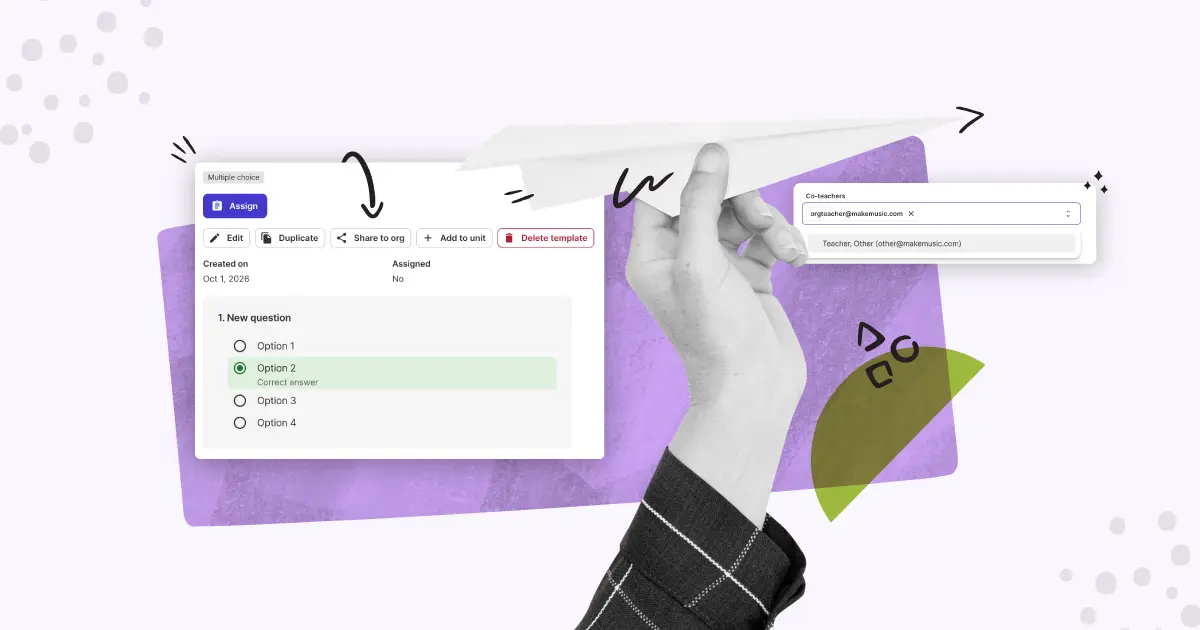
The introduction of dedicated co-teaching functionality resolves this friction by allowing primary educators to invite secondary teachers directly into their digital classes via email authentication. Once accepted, co-teachers gain legitimate, secure, and transparent access to the classroom ecosystem.
- Eliminating Administrative Redundancy: Co-directors no longer need to compare notes after rehearsals or debate who graded which student submission. Both educators operate from a single, unified source of truth in real-time.
- Reinventing Student Teacher Mentorship: Rather than relegating a student teacher to a passive observer taking notes from the back of the room, modern co-teaching frameworks grant them active pedagogical participation. They can design assignments, review submissions, and interact with the class infrastructure under the guidance of a master teacher.
- Empowering Special Education Integration: In modern inclusive schools, special education paras and co-teachers often support students directly within the arts. Providing these specialists with direct platform access equips them with the exact same musical and assignment context as the primary conductor, ensuring targeted, effective student support.
2. Sharing Is Caring: Cross-Departmental Resource Distribution
Building rigorous, scaffolded assessments—such as multiple-choice theory tests, rhythm-reading quizzes, and aural identification exercises—requires a significant investment of time. Recognizing that educators shouldn’t have to duplicate efforts across parallel courses, platforms have introduced streamlined resource-sharing workflows.
With the advent of advanced multiple-choice assessment features, educators can design robust evaluation modules and instantly share them within their institutional organization.
- Streamlined Departmental Alignment: If a high school has three parallel freshman band sections taught by different instructors, one teacher can craft a comprehensive rhythm notation quiz and distribute it instantly to their colleagues.
- Eliminating the Reinvention Cycle: Colleagues within the same organizational network can locate shared assignments in their library and save a direct copy to their own accounts with a single click.
- Seamless Onboarding for New Faculty: When a new music director joins a school district mid-year, they are no longer forced to build a curriculum from scratch. They can immediately tap into a rich, pre-existing repository of departmental resources, allowing them to hit the ground running and maintain educational continuity for students.
Beyond formal institutional tools, the digital age has also democratized peer support through expansive online communities. Dedicated digital spaces—such as specialized educator networks and active online forums—serve as vital sounding boards where teachers can trade troubleshooting tips, swap repertoire recommendations, and find professional camaraderie.
Future Outlook: The Connected Music Room of Tomorrow
As educational technology continues to mature, the trajectory of music instruction points firmly toward deeper integration, intelligence, and community-driven design. The days of the isolated music educator working in a vacuum are steadily drawing to a close.
Looking ahead, we can anticipate several key trends shaping the future of collaborative music education:
- AI-Enhanced Collaborative Planning: Future iterations of educational platforms will likely leverage intelligent algorithms to recommend shared assignments and repertoire based on regional or national curriculum standards, further reducing preparation fatigue.
- Cross-District Professional Learning Networks: As cloud-based institutional sharing expands beyond individual schools, educators may soon form macro-collaboratives, sharing specialized composition units and jazz improvisation modules across entire state networks.
- Holistic Student-Teacher-Parent Triads: Collaboration will increasingly extend beyond the teaching staff, integrating parents and guardians deeper into the practice loop through automated, transparent progress-sharing features.
Ultimately, the core mission of music education remains unchanged: to inspire students, foster creativity, and cultivate a lifelong love for the sonic arts. However, the methods by which educators achieve this mission are undergoing a renaissance. By embracing tools that champion collaboration, platforms are proving a vital truth for the modern maestro: You don’t have to do this alone, and you shouldn’t have to.
For music educators eager to reclaim their time, streamline their administrative workflows, and connect more deeply with their peers and students, the path forward is clear. Exploring modern collaborative platforms through risk-free pathways, such as structured software trials, offers a glimpse into a smarter, more connected, and sustainable future for music classrooms everywhere.