
Executive Overview
In the mid-1990s, the landscape of contemporary jazz was a fractured terrain. Navigating the tension between smooth commercial accessibility and avant-garde abstraction, a rare breed of instrumentalists sought to unearth a middle ground—one rooted in the visceral, sweat-drenched traditions of funk, soul-jazz, and blues. Enter Charlie Hunter, a virtuoso whose weapon of choice was not a standard six-string guitar, but a customized, low-end-rumbling eight-string monster.
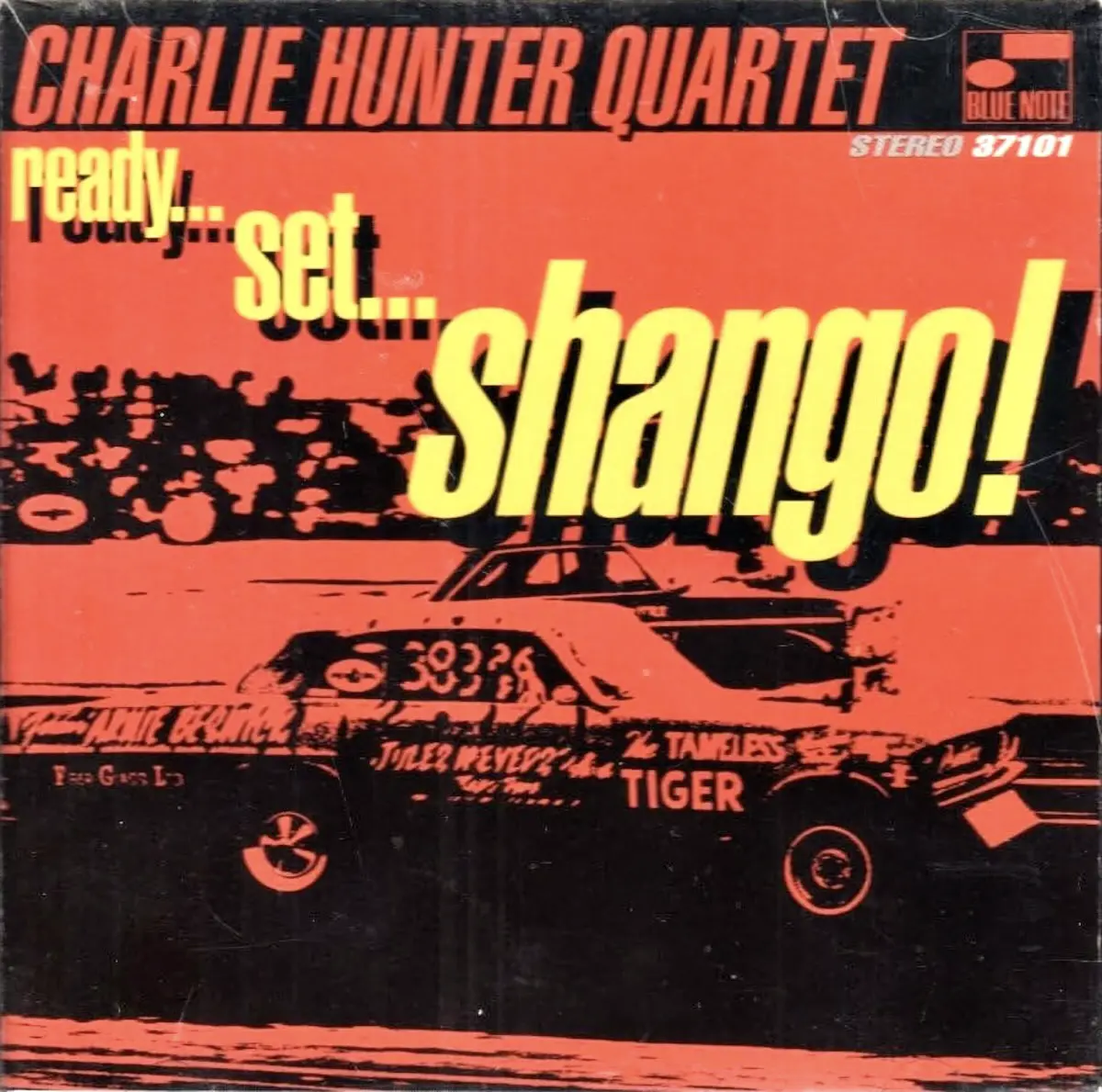
Following the critical success of his 1995 Blue Note breakthrough, Bing, Bing, Bing!, Hunter returned to the studio with producer Lee Townsend to craft his sophomore outing for the venerable label, Ready. Set. Shango!. Released in 1996, the album doubles down on the John Scofield-styled swamp boogie and moody, cinematic ballads that first turned heads, while pushing the ensemble sound further by adding a second frontline horn player.
Yet, beneath the surface of critical acclaim lies a fascinating dialogue regarding influence, innovation, and industry packaging. While Hunter’s technical mastery—simultaneously functioning as a bassist, rhythm guitarist, and keyboardist via his unique instrument—is undeniable, his stylistic lineage points heavily toward the post-bop funk architectures pioneered by John Scofield and Paul Motian. This in-depth retrospective examines the anatomy of Ready. Set. Shango!, exploring its recording lineage, its musical lineage, the aesthetic tension of its 1960s organ-trio revivalism, and its lasting impact on the trajectory of modern jazz-funk fusion.
Detailed Chronology: The Road to Ready. Set. Shango!
To fully understand the artistic weight of Charlie Hunter Quartet’s Ready. Set. Shango!, one must trace the rapid ascent of its creator through the San Francisco Bay Area underground and into the upper echelons of Blue Note Records.
The Genesis of an Eight-String Maverick
Before cementing his reputation as a solo bandleader, Charlie Hunter cut his teeth in the fertile, eclectic Bay Area music scene. Influenced heavily by the hip-hop, punk, and jazz cross-pollination of the early 1990s, Hunter recognized the limitations of standard guitar configurations. Partnering with instrument maker Ralph Novak, Hunter commissioned an eight-string guitar featuring three bass strings and five guitar strings, configured in a way that allowed him to play independent basslines and chordal/melodic improvisations simultaneously.
This wasn’t merely a novelty; it was a fundamental reinvention of the classic organ trio format. Traditionally, an organist like Jimmy Smith or Larry Young would cover the bass duties via the foot pedals while laying down comping chords and solos. Hunter streamlined this into a single human being, creating an illusion of a much larger ensemble that caught the ear of legendary jazz producer Lee Townsend.
The Blue Note Transition
Townsend, renowned for his work shaping the atmospheric, roots-conscious jazz of guitar icon John Scofield and drummer Paul Motian, immediately recognized Hunter’s potential. Signing to Blue Note Records—a label undergoing a vibrant mid-90s renaissance under the stewardship of Bruce Lundvall—elevated Hunter from a regional cult favorite to a national jazz commodity.
His debut for the label, Bing, Bing, Bing! (released in early 1995), established his template: greasy, pocket-heavy grooves, driving tenor saxophone lines (courtesy of Dave Ellis), and dynamic, multi-textured drumming (provided by Scott Amendola). The album was widely praised for bridging the gap between jazz purists and younger, groove-hungry audiences reared on alternative rock and funk-jam bands.
Entering the Studio: Marin County, 1996
Buoyed by the warm reception of his debut, Hunter reconvened his core working unit—Ellis on tenor saxophone and Amendola on drums—at a studio in Marin County, California, circa 1996. Crucially, for Ready. Set. Shango!, the lineup was expanded to include alto saxophonist Calder Spanier.
The inclusion of a second horn player transformed the dynamic of the group. Rather than relying solely on the counterpoint between Hunter’s hybrid guitar and Ellis’s tenor, the addition of Spanier allowed for rich, two-horn harmonies, blistering counter-melodies, and a thicker, more aggressive front-line attack. The sessions yielded a dynamic 52-minute journey across nine distinct tracks, capturing a live-in-the-studio energy that prioritized raw groove over clinical perfection.
Supporting Context & Metrics: Deconstructing the Sound
The Tracklist & Compositional Architecture
The structural flow of Ready. Set. Shango! demonstrates a sophisticated understanding of dynamics, alternating between floor-shaking funk workouts and contemplative, shadow-drenched ballads.
- Ashby Man
- Teabaggin’
- Let’s Get Medieval
- The Shango Pt III
- Dersu
- 911
- Shango … The Ballad
- Thursday The 12th
- Sutton
(Total Runtime: 52:45)
Tracks like Teabaggin’ and Let’s Get Medieval showcase the quartet’s signature swamp boogie aesthetic—a greasy, down-home fusion of New Orleans second-line rhythms, deep-pocket funk, and modal jazz improvisation. Conversely, compositions such as Shango … The Ballad and Dersu offer moments of spacious introspection, highlighting the subtle interplay between Amendola’s brushwork and the dual-horn arrangements.
The Scofield Shadow and the Influence Debate
A critical evaluation of Ready. Set. Shango! inevitably leads to a discussion of artistic lineage. Musicologists and jazz critics of the era were quick to note the striking parallels between Hunter’s compositional voice and that of John Scofield—specifically Scofield’s mid-90s output, which leaned heavily into greasy, blues-inflected grooves heavily inspired by saxophonist Eddie Harris.
The connections run deeper than mere stylistic coincidence:
- Production Continuity: Both artists were championed and guided by producer Lee Townsend, whose distinctive aesthetic—warm, organic, earthy, and spacious—permeated both men’s catalogues.
- Nods and Intertextuality: Just as Scofield’s acclaimed 1992 album What We Do featured a track titled Call 911, Hunter’s Ready. Set. Shango! cheekily features a track simply named 911.
- The British Connection: Critics also drew lines of stylistic inheritance stretching across the Atlantic, comparing Hunter’s approach to British guitarist Jim Mullen’s Scofield-esque stylings, as well as the textural, spacious group dynamics found in Paul Motian’s contemporaneous electric-bop ensembles.
Interestingly, contemporary press releases surrounding the album’s launch painted a slightly different picture, citing traditional guitar icons Charlie Christian and Joe Pass as Hunter’s primary inspirations. While Christian and Pass undoubtedly formed the bedrock of any modern jazz guitarist’s vocabulary, the connection felt somewhat disingenuous to seasoned listeners; the kinetic, bent-note swagger and blues-drenched phrasing of Hunter pointed far more directly to Scofield and Harris than to the cool, pristine swing of the bebop era.
The 1960s Organ Fad and Retromania
Ready. Set. Shango! arrived at the height of a major 1960s soul-jazz and Hammond organ revival. Throughout the mid-90s, listeners and labels developed an insatiable appetite for retro grooves, Leslie-speaker simulations, and vintage gear aesthetics.
While Hunter’s eight-string setup brilliantly circumvented the need for a physical organist—allowing him to walk basslines that mimicked the heavy bass pedals of a B3 while simultaneously comping—the broader cultural wave of retro-fetishism occasionally threatened to wear thin. As critics noted at the time, while the writing and soloing on Ready. Set. Shango! remained of the absolute highest caliber, the 1960s organ-fad pastiche ran the risk of locking progressive artists into a stylistic box. Hunter, however, avoided total stagnation by injecting modern rhythmic syncopation, rock-inflected drumming sensibilities from Amendola, and post-bop harmonic extensions into his arrangements.
Official Statements & Industry Reception
Upon its release via Blue Note Records in 1996, Ready. Set. Shango! was met with a largely positive reception from jazz critics who celebrated the group’s unrelenting energy and compositional growth.
Lee Townsend, reflecting on his production philosophy during this era, emphasized the importance of capturing organic ensemble chemistry over technical sterile perfection:
"When you put musicians like Charlie, Dave, Scott, and Calder in a room together, the goal isn’t to micro-manage every note. It’s to capture lightning in a bottle—the way they breathe together, the way the groove locks and swings. Charlie’s technical feat with the eight-string is remarkable, but what makes the music endure is the emotional weight and the sheer joy of the collective groove."
Critical reviews in publications such as Jazz Journal praised the elevated musicianship:
"The writing and soloing are of the highest quality… Hunter manages to expand his sonic palette by augmenting the core trio with altoist Calder Spanier, giving the frontline a sharper, more aggressive textural bite that cuts straight through the swamp-boogie haze."
However, industry insiders also debated the commercial positioning of the record. Blue Note’s marketing team faced the delicate task of balancing jazz purist expectations with the crossover appeal of jam-band and funk audiences. By leaning into the lineage of Blue Note’s storied soul-jazz history (evoked by artists like Jimmy Smith and Grant Green), the label successfully positioned Hunter as a torchbearer for the future of instrumental groove music.
Future Outlook: The Legacy of Ready. Set. Shango!
Looking back from the vantage point of contemporary music history, Ready. Set. Shango! occupies a crucial pivot point in Charlie Hunter’s career and the broader evolution of groove-jazz.
Breaking the Mold of the Traditional Trio
By proving that an eight-string guitar could successfully anchor a dynamic, horn-driven quartet without the need for a traditional bass player or keyboardist, Hunter unlocked new possibilities for minimalist ensemble configurations. The formula perfected on Ready. Set. Shango! laid the groundwork for decades of future experimentation, inspiring a generation of hybrid-instrumentalists to blur the lines between rhythm and melody, bass and treble.
Influence on the Modern Jazz-Funk Landscape
The stylistic blueprint established by Hunter, Townsend, and their contemporaries in the mid-90s directly anticipated the explosion of modern progressive funk, instrumental hip-hop, and genre-fluid jazz seen in the 21st century. Artists operating at the intersection of jazz improvisation and heavy-groove beat science—from modern jam-scene luminaries to the underground D.C. go-go and Brooklyn jazz-loft scenes—owe a debt to the unapologetic, mud-soaked funk pioneered on records like Ready. Set. Shango!.
Conclusion
While the 1960s retro-organ fad that provided the backdrop for its release has long since evolved into other cultural cycles, Ready. Set. Shango! remains a high-water mark of 1990s instrumental groove-jazz. Powered by razor-sharp compositions, telepathic ensemble interplay, and Charlie Hunter’s peerless multi-instrumental wizardry, the album stands as an authoritative testament to the enduring power of the pocket—proving that when groove meets virtuosity, timeless music is born.