The holiday season is intrinsically tied to the evocative, timeless beauty of traditional carols, none more so than "The First Noel" (alternatively spelled "The First Nowell"). Hailing from Cornwall as a deeply rooted traditional English Christmas carol, this historic piece has transcended its humble regional origins to become a global holiday staple. Over the centuries, its narrative of the Nativity—tracing the journey of the shepherds, the guiding star, and the three wise men—has captured the imaginations of theologians, historians, and musicians alike.
In response to the perennial demand for high-quality, accessible holiday sheet music, seasoned educator, composer, and pianist Ben Dunnett, LRSM—founder of the Music Theory Academy—has curated a comprehensive, multi-tiered learning package. Boasting over twenty years of experience in music education as a teacher, examiner, and composer, Dunnett has designed three distinct piano arrangements of "The First Noel" tailored specifically to varying levels of technical proficiency: an Easy version for beginners, an Intermediate version for developing players, and a Challenging Advanced version pulled directly from his celebrated Christmas piano album, 10 Christmas Carols.
This exhaustive guide explores the pedagogical framework behind Dunnett’s arrangements, provides historical context on the carol’s lyrical and musical evolution, and breaks down the technical nuances required to master each version. Whether you are a novice discovering the joy of the keys for the first time or an advanced virtuoso looking to add a refined seasonal masterpiece to your repertoire, this guide serves as your definitive roadmap.
Detailed Chronology: The Origins, Evolution, and Cultural Footprint of "The First Noel"
To truly understand how to interpret "The First Noel" at the piano, a pianist must first appreciate the rich history embedded within its notes and stanzas. The carol’s journey from a localized Cornish folk tradition to a globally recognized masterpiece is a fascinating study in ethnomusicology.
Roots in Cornish Tradition
Etymologically and historically, "The First Noel" is classified as a traditional English carol, with the earliest written records pointing strongly toward its development in the West Country of England, particularly Cornwall. Unlike many hymns penned by formal classical composers, traditional carols evolved organically through oral transmission. Local communities would sing these tunes during winter celebrations, often accompanying them with regional folk instruments and communal dancing.
The word "Noel" itself derives from the French noël, originating from the Latin natalis (meaning "birthday"). Its adoption into English vernacular signaled the intersection of French linguistic influence and native British folk culture. For generations, the song existed purely in the memories and voices of rural populations before finding its way onto paper.
Publication and Formalization
The first major milestone in preserving the carol came in 1833, when it was published in Christmas Carols Ancient and Modern, edited by William Sandys. This pivotal collection sought to rescue fading English holiday traditions from obscurity. Sandys’s transcription captured the characteristic melodic contour of the tune—specifically its famous ascending and descending phrases—and fixed the lyrics in print.
Subsequent hymnals, most notably Christmas Carols New and Old (compiled by Henry Ramsden Bramley and John Stainer in 1871), further standardized the musical arrangement. It was during the Victorian era that "The First Noel" transitioned from a folk song sung by street carolers into a sacred fixture of formal church services and choral performances worldwide.
Modern Interpretations and Global Reach
In the 20th and 21st centuries, "The First Noel" broke away from strictly traditional ecclesiastical settings to become a favorite of mainstream recording artists. Its soaring, majestic chorus ("Born is the King of Israel!") has been interpreted by an eclectic array of vocal powerhouses. Iconic renditions by artists such as Whitney Houston, Mariah Carey, and the cast of the hit television series Glee have introduced the centuries-old Cornish melody to younger generations, cementing its status as an immutable pillar of global holiday culture.
When designing holiday arrangements for piano students, educators often face a dilemma: how to make a piece accessible to beginners while keeping it interesting for advanced players, without losing the core identity of the melody. Ben Dunnett solves this challenge by implementing a structural triad based on progressive skill acquisition. Below is a comparative overview of the three versions available through the Music Theory Academy:
Arrangement Level
Target Skill Level
Primary Technical Focus
Unique Pedagogical Feature
Easy Version
Absolute Beginners / Early Grade
Right-hand melody, simple bass notes, basic scale work
Sourced from 10 Christmas Carols; expressive rubato
Official Statements & Pedagogical Breakdown: Mastering the Sheet Music
To achieve a professional sound, pianists must approach each of Dunnett’s three arrangements with an understanding of their distinct mechanical and artistic demands.
1. The Easy Version: Building Foundational Mechanics
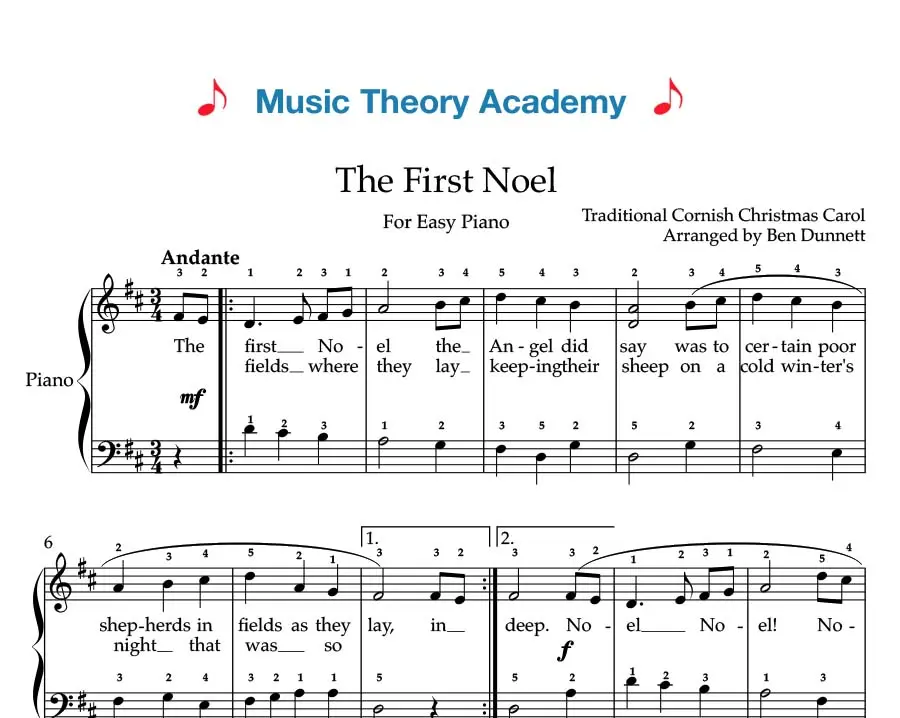
Designed for players who are still mastering the geography of the keyboard, the easy arrangement focuses heavily on clarity, hand independence, and foundational finger dexterity.
The Right-Hand Melody: The primary tune is carried cleanly in the upper register, allowing beginners to focus on phrasing without the distraction of complex chord clusters underneath.
The Left-Hand Accompaniment: A sparse, highly accessible bass line anchors the harmonic progression, ensuring the student does not feel overwhelmed by simultaneous multi-note reading.
Fingering Guidance: Dunnett intentionally includes explicit fingering annotations throughout this tier. As he notes, “It is worth closely following the fingering I have added (particularly when to tuck the thumb under) as there are some quite long scalic passages to play.” Mastering these thumb tucks early prevents tension and builds the fluid motion required for advanced scale-playing later on.
2. The Intermediate Version: Expanding Harmonic Awareness
For players who have graduated beyond basic five-finger patterns, the intermediate arrangement introduces richer textures and requires greater tactile awareness.
Enhanced Right-Hand Voicing: Instead of a bare single-note melody, intermediate players must navigate extra notes woven into the right-hand part. These additions actively enrich the harmony, giving the carol a fuller, warmer acoustic profile.
Technical Challenges in the Left Hand: Near the conclusion of the piece, students encounter a spread chord. Executing this smoothly without sacrificing tempo requires a relaxed wrist and accurate lateral hand-shifting.
Independent Problem Solving: Unlike the easy version, Dunnett leaves the fingering entirely blank on the intermediate score. This is a deliberate pedagogical choice. As Dunnett advises, leaving the score un-fingered serves as “good practice for an intermediate player to work out which fingers are most appropriate to use,” fostering critical thinking and customized hand-mapping.
3. The Advanced Version: Professional Performance Artistry
Pulled directly from Ben Dunnett’s critically acclaimed professional collection, 10 Christmas Carols, the advanced sheet music transforms "The First Noel" into a sophisticated concert piece.
Virtuosic Texture and Counterpoint: This arrangement features intricate internal voices, sophisticated chord inversions, and dynamic contrasts that elevate the music far beyond standard hymnal harmonizations.
Listening as a Learning Tool: Because of the dense arrangement, Dunnett strongly recommends a multimedia approach to studying the score. Pianists are encouraged to watch his performance video or stream the track on platforms like Spotify while simultaneously tracking the notes on the page. Listening to the nuances of articulation, pedaling, and rubato in a professional recording provides a vital blueprint for physical execution.
The Complete Lyrics of "The First Noel"
To deliver a truly expressive performance, a pianist must understand the narrative arc of the lyrics. Music and text are inextricably linked in vocal and instrumental storytelling alike; knowing where the phrases rise and fall helps dictate dynamic shaping at the piano.
Verse 1
The first Noel the angel did say
Was to certain poor shepherds in fields as they lay;
In fields where they lay, keeping their sheep,
On a cold winter’s night that was so deep:
Refrain Nowell, Nowell, Nowell, Nowell, Born is the King of Israel.
Verse 2
They looked up and saw a star
Shining in the east beyond them far;
And to the earth it gave great light,
And so it continued both day and night.
Refrain Nowell, Nowell, Nowell, Nowell, Born is the King of Israel.
Verse 3
And by the light of that same star
Three wise men came from country far;
To seek for a king was their intent,
And to follow the star wherever it went.
Refrain Nowell, Nowell, Nowell, Nowell, Born is the King of Israel.
Verse 4
This star drew nigh to the northwest;
O’er Bethlehem it took its rest,
And there it did both stop and stay,
Right over the place where Jesus lay.
Refrain Nowell, Nowell, Nowell, Nowell, Born is the King of Israel.
Verse 5
Then entered in those wise men three,
Full reverently upon their knee,
And offered there in his presence
Their gold, and myrrh, and frankincense.
Refrain Nowell, Nowell, Nowell, Nowell, Born is the King of Israel.
Verse 6
Then let us all with one accord
Sing praises to our heavenly Lord,
That hath made heaven and earth of nought,
And with his blood our life hath bought.
Refrain Nowell, Nowell, Nowell, Nowell, Born is the King of Israel.
Future Outlook: The Ongoing Evolution of Music Education in the Digital Age
The release of Ben Dunnett’s tiered piano arrangements for "The First Noel" highlights a broader, positive shift in contemporary music education. Today’s students no longer rely solely on static, one-size-fits-all method books purchased at local music shops. Instead, the integration of high-definition video demonstrations, embedded audio streaming links, and downloadable PDF scores creates an immersive, multi-sensory learning ecosystem.
As digital platforms continue to evolve, resources provided by organizations like the Music Theory Academy democratize access to high-tier pedagogy. Pianists across the globe—regardless of their geographic location or local access to private conservatory instruction—can now download professional-grade arrangements tailored precisely to their current technical abilities.
Looking forward, we can expect master composers and educators to increasingly leverage digital publishing to provide flexible, modular learning materials. By bridging the gap between historical tradition and modern digital accessibility, arrangements like Dunnett’s ensure that timeless cultural artifacts such as "The First Noel" will continue to be played, studied, and cherished by generations of musicians to come.
To view the performance video, listen to the embedded audio tracks, and download your free sheet music for the Easy, Intermediate, or Advanced versions of "The First Noel," visit the official Music Theory Academy portal.