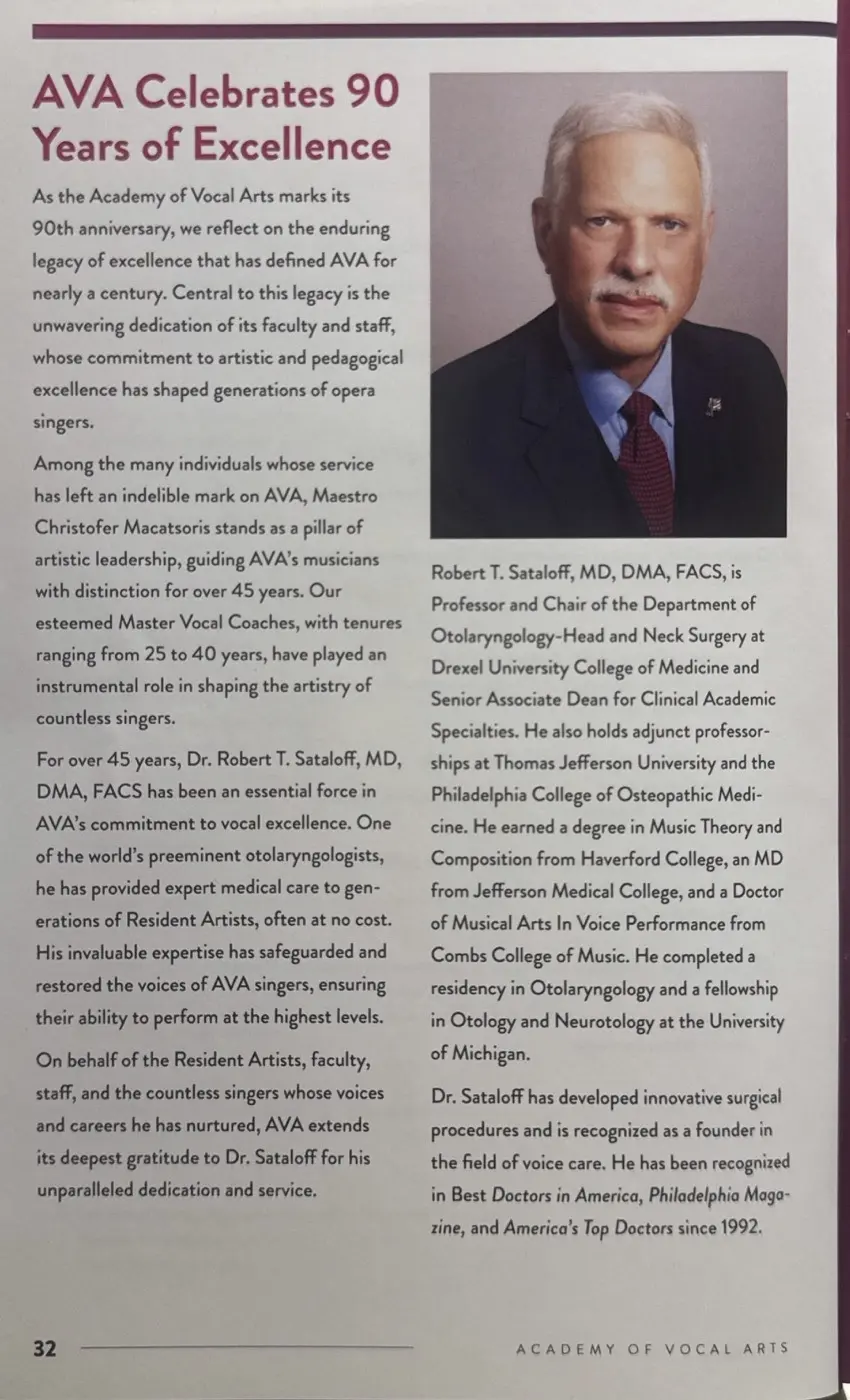
In the world of classical music and opera, the spotlight invariably falls upon the performer—the soaring soprano holding a crystalline high note, the booming baritone commanding the stage, the dazzling tenor bringing an opera house to its feet. Yet, behind every legendary vocal performance lies a complex intersection of physiology, medicine, and tireless mentorship. Last Friday evening, at the prestigious Kimmel Center in Philadelphia, the classical music community paused to honor one of the most vital, yet often unsung, pillars of the vocal arts: Dr. Robert Sataloff.
As the Chairman of The Voice Foundation, Dr. Sataloff was formally recognized at the Academy of Vocal Arts (AVA) Gala for a staggering milestone—over four decades of dedicated medical care, vocal preservation, and mentorship provided to generations of young, aspiring opera singers. For more than forty years, Dr. Sataloff has served as a guardian of the human instrument, treating the delicate vocal cords of performers who pass through the rigorous halls of the AVA. Many of these artists have subsequently launched illustrious international careers, gracing the stages of renowned venues such as the Metropolitan Opera, La Scala, the Vienna State Opera, and beyond, thereby bringing joy, drama, and transcendent beauty to countless audiences across the globe.
This comprehensive report examines the profound impact of Dr. Sataloff’s career, the historic significance of the Academy of Vocal Arts, the physiological marvels and vulnerabilities of the operatic voice, and the ripple effects of a lifetime dedicated to the intersection of medicine and high-art performance.
Detailed Chronology: A Lifelong Dedication to the Voice
To understand the magnitude of Dr. Sataloff’s recognition at the Kimmel Center, one must trace a career defined by pioneering advancements in otolaryngology, vocal science, and arts advocacy. While last Friday’s gala served as a joyous public celebration, it was built upon a foundation of decades of meticulous, behind-the-scenes medical intervention and academic leadership.
The Early Decades: Merging Medicine and Music
Dr. Sataloff’s journey began at a time when the medical treatment of professional voice users—particularly classical singers and opera performers—was in its relative infancy. Historically, if a singer experienced vocal fatigue, nodules, hemorrhage, or sudden loss of range, the diagnostic tools available to physicians were crude, and the treatment regimens frequently relied on rest alone, or worse, aggressive surgical interventions that could permanently alter or ruin a delicate voice.
Recognizing a profound gap in the medical establishment, Dr. Sataloff dedicated his professional life to mastering the intricate anatomy of the larynx while nurturing a deep, appreciative understanding of musical performance. He understood that a singer is not merely a patient with a sore throat; they are elite athletes of the vocal tract, requiring specialized, highly nuanced care that takes into account repertoire, technique, psychological stress, and performance schedules.
Partnership with the Academy of Vocal Arts
More than forty years ago, Dr. Sataloff established a vital, enduring relationship with the Academy of Vocal Arts in Philadelphia. Founded in 1934, AVA is nationally and internationally renowned as one of the premier tuition-free training institutions for young opera singers. The competition to enter AVA is fierce, attracting top-tier talent from around the world. However, the rigorous training required to master operatic repertoire places immense physical strain on young, developing vocal cords.
Over the past four decades, Dr. Sataloff became the trusted medical safety net for AVA’s residents. Whether managing routine seasonal allergies that threatened an upcoming audition, performing delicate laryngological procedures, or providing psychological reassurance to a panicked young artist facing vocal fatigue, Dr. Sataloff’s clinic became a sanctuary. His ability to diagnose subtle mucosal changes or muscular imbalances saved countless careers before they even had the chance to fully blossom.
The Kimmel Center Gala: A Night of Celebration
Last Friday’s gala at the Kimmel Center brought together patrons of the arts, distinguished alumni, current AVA resident artists, and medical professionals to celebrate this extraordinary partnership. The evening was marked by breathtaking performances from AVA’s current roster of singers—living testaments to the health and vitality of the training and medical support they receive.
Tributes poured in from international opera stars who credited Dr. Sataloff not only with saving their voices during critical junctures in their training, but also with educating them on how to maintain lifelong vocal health. The event served as a powerful reminder that the magnificent sounds echoing through the grand opera houses of the world are often the result of quiet, dedicated collaboration in medical consultation rooms years prior.
Supporting Context & Metrics: The Science and Stakes of Operatic Performance
The human voice is an acoustic marvel. During professional opera singing, the vocal folds—two bands of smooth, muscular mucous membrane—vibrate hundreds to over a thousand times per second. To project unamplified over a full symphony orchestra in a 3,000-seat auditorium, an opera singer must harness immense subglottic air pressure, optimize vocal tract resonance (the "singer’s formant"), and coordinate complex respiratory and articulatory muscles with microscopic precision.
The Vulnerability of the Elite Voice
Despite their incredible training, opera singers operate at the absolute limits of human physiology. Several key metrics and medical realities underscore the precarious nature of the profession:
Staggeringly High Frequencies of Use: A professional opera singer may rehearse for four to six hours a day, several days a week, in addition to performing demanding full-length operas that require sustained vocal projection over three to four hours.
Tissue Impact: During high-intensity phonation, the vocal folds collide against one another thousands of times per minute. Over time, improper technique, illness, environmental irritants, or overuse can lead to pathological conditions such as vocal fold nodules, polyps, cysts, hemorrhages, and chronic laryngitis.
The Economic and Artistic Stakes: For a young artist at the Academy of Vocal Arts, a single episode of vocal hemorrhage or untreated scarring can derail an audition season, jeopardize a prestigious contract, or effectively end a career before it begins. Dr. Sataloff’s interventions have historically mitigated these catastrophic risks, providing precise, cutting-edge therapies that preserve vocal flexibility and tonal purity.
The Legacy of The Voice Foundation
Beyond his clinical work with AVA singers, Dr. Sataloff’s influence radiates globally through his leadership as Chairman of The Voice Foundation. Founded in 1969, The Voice Foundation is the world’s oldest and foremost organization dedicated to the care, training, and science of the human voice. Under Dr. Sataloff’s stewardship, the organization has spearheaded annual symposia, funded critical research grants, and bridged the gap between laryngologists, speech-language pathologists, singing teachers, and performing artists.
The metrics of his academic output are equally staggering: Dr. Sataloff has authored hundreds of peer-reviewed scientific publications, written or edited dozens of seminal textbooks on voice science and otolaryngology, and trained generations of medical fellows who now carry his philosophy of compassionate, specialized care to institutions across the globe.
Official Statements and Tributes
The gala at the Kimmel Center was filled with emotional reflections from leaders in the arts and medical communities, highlighting Dr. Sataloff’s unique blend of scientific brilliance and genuine empathy for artists.
"Dr. Robert Sataloff has been the guardian angel of the Academy of Vocal Arts for over forty years. When our young artists walk through his doors, they are not just patients; they are cherished artists whose dreams and talents are fragile and precious. His dedication has ensured that generations of singers could share their gifts with the world without fear. We are infinitely grateful for his unwavering commitment to our students and to the art form of opera."
— Representative Spokesperson, Academy of Vocal Arts
Alumni of the program, many of whom now command international stages, echoed these sentiments, emphasizing the profound psychological and physical relief that came from knowing Dr. Sataloff was in their corner.
"In the high-stakes world of opera, experiencing vocal trouble can feel like the end of the world. Dr. Sataloff brought an unmatched level of clinical expertise, but more importantly, he brought calm, understanding, and profound reassurance. He understands the soul of a singer. We owe the longevity of our careers, in large part, to his watchful care."
— Anonymous International Opera Star and AVA Alum
Dr. Sataloff himself, characteristically humble amidst the accolades, reflected on the deep relationships he has forged with singers over the decades. He noted that the true reward lies in sitting in a darkened opera house, listening to a breathtaking aria, and knowing that he played a small part in keeping the artist healthy enough to deliver it.
Future Outlook: Preserving the Future of Vocal Arts
As we look toward the future of classical music and vocal performance, the intersection of medicine, technology, and art remains more critical than ever. The landscape of opera is evolving rapidly, with modern composers demanding new expressive ranges, extended vocal techniques, and intense dramatic delivery that push the boundaries of physical endurance.
Technological Advancements in Voice Care
The standards of care pioneered by physicians like Dr. Sataloff are paving the way for even more sophisticated treatments in the twenty-first century. High-speed digital imaging, strobovideolaryngology, regenerative medicine involving stem cell therapy for vocal fold scarring, and advanced acoustic analysis allow medical professionals to diagnose and treat laryngeal pathology with unprecedented precision.
Ensuring Institutional Longevity
The partnership between institutions like the Academy of Vocal Arts and specialized medical leaders sets a gold standard for arts education worldwide. As music education faces shifting economic landscapes, the holistic support of student artists—encompassing mental health, physical conditioning, nutritional guidance, and elite medical care—remains non-negotiable for the survival of the art form.
Dr. Sataloff’s recognition at the Kimmel Center is not merely a retrospective celebration of a remarkable four-decade tenure; it is a blueprint for the future. It serves as an enduring reminder that artistic greatness cannot exist in a vacuum. It requires a village of passionate educators, visionary administrators, dedicated patrons, and brilliant, empathetic medical professionals who safeguard the physical instruments through which human emotion is translated into sublime, unforgettable art.
As the echoes of the applause fade from the Kimmel Center, the legacy of Dr. Robert Sataloff continues to resonate—not only in the medical journals and lecture halls where he has taught, but in every soaring, uninhibited high note delivered by an AVA artist on the world’s greatest stages.