
LONDON — In a milestone development for the capital’s classical music landscape, Sinfonia Smith Square has been awarded a prestigious £200,000 grant from the Wolfson Foundation. The significant funding will directly underwrite Doors Open: Transforming Lives Through Music, an ambitious and long-overdue capital redevelopment project aimed at restoring and modernizing its historic Grade I listed home in the heart of Westminster.
This historic venue, widely celebrated for its architectural grandeur and acoustic intimacy, is set to undergo the most substantial physical transformation in its modern history. Since transitioning from a consecrated church into a dedicated concert hall in 1969, Smith Square Hall has remained a beloved cultural anchor. However, decades of continuous use have taken their toll on the fabric of the building. The upcoming restoration project not only seeks to secure the architectural integrity of the eighteenth-century masterpiece but also aims to radically expand its social utility, transforming it into a modern, accessible, and community-focused hub for the performing arts.
With construction slated to begin in late 2027 and a grand reopening projected for 2029, this initiative represents a vital investment in the future of British musical life, promising to safeguard an invaluable heritage asset while opening its doors wider than ever before to audiences, students, and early-career artists.
Executive Overview: Preserving Heritage While Powering the Future
The £200,000 grant from the Wolfson Foundation serves as a critical catalyst for Doors Open: Transforming Lives Through Music. For decades, Smith Square Hall—housed within the historic church of St John the Evangelist, designed by Thomas Archer and consecrated in 1728—has punched well above its weight, serving as a vital London stage for orchestral performances, chamber music, and choral masterpieces.
Despite its cultural prominence, the building faces mounting structural and logistical challenges. The core objective of the redevelopment is twofold: conservation and modernization. Architecturally, the project aims to address long-standing maintenance issues, upgrade environmental systems, and crucially, remove the building from Historic England’s Heritage at Risk Register. In an era where cultural institutions face unprecedented financial and operational pressures, rescuing a Grade I listed monument from potential decay is an act of cultural preservation of the highest order.
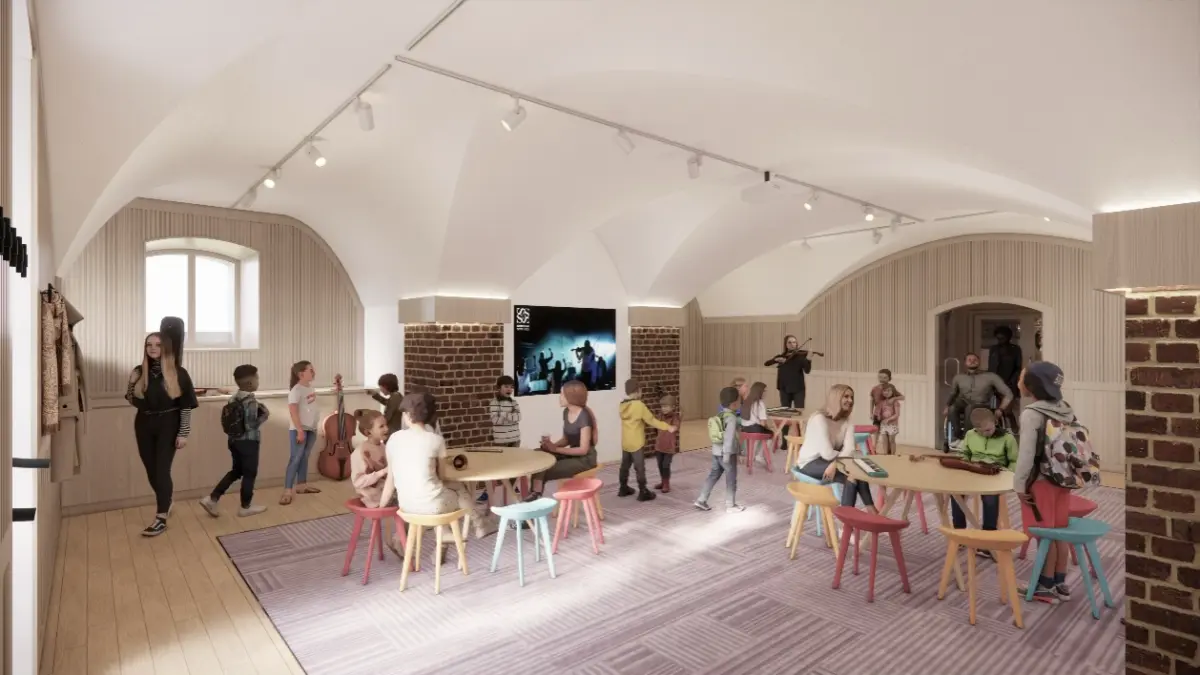
Simultaneously, the project is designed to dismantle physical and social barriers. By reimagining underutilized spaces within the building—most notably the atmospheric crypt—Sinfonia Smith Square intends to turn the venue into a multi-functional campus. The redesigned space will house dedicated educational facilities for local schools, specialized spaces for community music-making, state-of-the-art rehearsal rooms for the orchestra’s renowned Fellowship programme, and vastly improved accessibility infrastructure for disabled patrons and performers alike.
When the doors reopen in 2029, the transformed Smith Square Hall is projected to welcome upwards of 90,000 visitors annually, marking a transformative leap forward in how a historic London concert hall can serve its community in the twenty-first century.
Detailed Chronology: From Baroque Masterpiece to Modern Concert Hall
To fully understand the magnitude of the Doors Open project, one must trace the extraordinary history of the building that houses Sinfonia Smith Square. The timeline of this iconic Westminster landmark spans nearly three centuries of architectural reinvention, wartime destruction, and cultural rebirth.
1713–1728: Construction and Consecration
The story of the building begins in the early eighteenth century. Following the Fifty New Churches Act passed by Parliament in 1711, architect Thomas Archer was commissioned to design a new church in the growing Westminster district. Consecrated in 1728 as the church of St John the Evangelist, Archer’s design was a masterpiece of English Baroque architecture. Distinguished by its four iconic corner towers—often colloquially compared to an upside-down table—the building was an audacious, sculptural statement that quickly became a landmark of the London skyline.
1941: The Flames of the Blitz
The building’s fortunes changed dramatically during the Second World War. On the night of May 10, 1941, during the height of the Blitz, an incendiary bomb struck the church, gutting the interior and leaving only the monumental stone shell standing. For decades, the blackened ruins stood as a poignant reminder of the wartime devastation inflicted upon the capital, seemingly destined for demolition.
1960–1969: The Resurrection as a Concert Hall
In the late 1960s, a visionary rescue effort led by Lady Parker of Waddington and a dedicated group of classical music enthusiasts breathed new life into the derelict structure. Recognizing the building’s exceptional acoustic potential—largely owing to its unique spatial proportions and vaulted timber ceiling—architects Gelder and Kitchin were enlisted to rebuild the interior. Stripped of its religious fittings and converted into a clear-span auditorium, the building reopened in 1969 as St John’s Smith Square, quickly establishing itself as one of London’s premier chamber music and orchestral venues.
2023–Present: Sinfonia Smith Square and the Doors Open Era
In recent years, the venue entered a new chapter when it merged identities with the orchestra formerly known as the Southbank Sinfonia, officially becoming Sinfonia Smith Square. This integration of orchestra and venue created a unique artistic ecosystem: a professional ensemble with its own permanent home. However, the physical infrastructure lagged behind the artistic ambitions of the organization.
This realization catalyzed the Doors Open initiative. Following years of meticulous planning, feasibility studies, and fundraising efforts—bolstered significantly by the newly announced Wolfson Foundation grant—the timeline now points toward late 2027 for the commencement of major construction works, paving the way for a triumphant reopening in 2029 that will secure the building’s legacy for generations to come.
Supporting Context & Metrics: Economic, Educational, and Architectural Impact
The redevelopment of Smith Square Hall is not merely an exercise in heritage conservation; it is a calculated investment in social infrastructure, cultural education, and urban regeneration. A close examination of the project’s metrics reveals the far-reaching scope of the transformation.
1. Rescuing Heritage at Risk
Being listed as Grade I places Smith Square Hall in the upper echelon of England’s architectural heritage—reserved for buildings of exceptional national, architectural, or historical interest. However, aging masonry, outdated environmental controls, and deteriorating internal fabric landed the building on Historic England’s Heritage at Risk Register. The Doors Open project provides the comprehensive capital investment required to repair stonework, stabilize historic elements, and implement modern climate-control systems, ensuring the physical survival of Thomas Archer’s baroque masterpiece.
2. Empowering the Next Generation: The Fellowship Programme
At the heart of Sinfonia Smith Square’s identity is its orchestral Fellowship programme. Founded in 2002, this prestigious initiative has supported more than 700 early-career musicians, bridging the notoriously difficult gap between conservatoire graduation and professional orchestral employment.
Until now, the orchestra has operated without bespoke, on-site facilities tailored to the rigorous demands of the Fellowship. The redevelopment will carve out dedicated rehearsal spaces within the complex, providing young musicians with world-class amenities to hone their craft, collaborate, and interact directly with visiting international artists.
3. Democratizing Access: The Crypt Transformation
Perhaps the most socially impactful element of the capital project is the complete conversion of the building’s crypt. Historically underutilized or restricted in access, the sprawling subterranean spaces will be entirely modernized and fitted out as a dedicated learning and community hub.
The new facilities will enable Sinfonia Smith Square to scale up its engagement with local schools, offering interactive music workshops, creative composition classes, and open rehearsals for children who might otherwise never experience live classical music. Furthermore, the project addresses long-standing accessibility deficits throughout the venue, installing modern lifts, improved seating layouts, and accessible facilities to ensure that disabled performers and audience members can navigate the historic building with dignity and ease.
4. Economic and Cultural Projections
Upon its reopening in 2029, the renewed Smith Square Hall is projected to welcome over 90,000 visitors annually. This influx of foot traffic will not only sustain the venue’s internal programming but will also provide a welcome economic boost to local businesses, cafes, and hospitality providers in the surrounding Westminster neighborhood, cementing the area’s status as a vibrant cultural quarter.
Official Statements and Industry Perspectives
The announcement of the £200,000 Wolfson Foundation grant has drawn widespread acclaim from leaders across the arts, heritage, and philanthropic sectors, underscoring the national significance of the project.
Representatives for the Wolfson Foundation highlighted the alignment between the charity’s mission and the core objectives of Doors Open. Known for funding high-impact capital projects in fields such as science, health, education, and heritage, the Foundation’s backing signals a profound vote of confidence in Sinfonia Smith Square’s vision. By supporting capital works that enhance public engagement and preserve historic structures, the grant exemplifies strategic philanthropy designed to yield long-term dividends for society.
Artistic leadership at Sinfonia Smith Square has similarly emphasized that the redevelopment is fundamentally about people as much as it is about bricks and mortar. In public briefings regarding the capital campaign, executive leadership noted that while the restoration of a Grade I listed building is an immense technical challenge, the true measure of the project’s success will be found in the lives touched by the music created within its walls.
The integration of educational spaces in the crypt directly addresses a growing national concern over the accessibility of arts education in state schools. By opening the doors of a prestigious central London concert hall to local communities and school groups, the institution is actively redefining the social contract of the classical music venue, proving that historic heritage spaces can—and must—serve as dynamic community assets.
Future Outlook: The Road to 2029
As Sinfonia Smith Square looks toward the commencement of construction in late 2027, the organization faces a period of both intense operational planning and continued fundraising. While the £200,000 grant from the Wolfson Foundation represents a monumental milestone, the broader Doors Open campaign remains an ongoing effort, requiring sustained support from public bodies, private donors, trusts, and foundations to meet its full financial targets.
In the intervening years leading up to the 2029 reopening, Sinfonia Smith Square will continue its core artistic programming, staging concerts, supporting its Fellowship cohorts, and delivering community outreach initiatives while finalizing architectural blueprints, securing necessary planning permissions, and coordinating with conservation specialists from Historic England.
When the dust finally settles and the restored Smith Square Hall flings open its grand doors in 2029, the transformation will stand as a testament to what can be achieved when architectural heritage, philanthropic vision, and artistic ambition converge. By marrying the grandeur of the eighteenth-century past with the inclusive, dynamic needs of the twenty-first century, Sinfonia Smith Square is not merely repairing a building—it is securing a vibrant, enduring future for music in the heart of London.