
Executive Overview
Contemporary European jazz continues to position itself at the bleeding edge of cross-cultural experimentation, temporal exploration, and geographic reinvention. In an era marked by shifting cultural landscapes and an increasingly unpredictable global climate, recent releases from Norwegian-American sound artist John Derek Bishop, Swiss trombonist Samuel Blaser, and the powerhouse Scandinavian super-trio Rymden demonstrate how modern improvisers draw deeply upon memory to converse with the present and project into the future.
This survey examines three defining releases of the current cycle: John Derek Bishop and Khaled Habeeb’s Ekkofremtid, Samuel Blaser’s Rosina, and Rymden’s Today May Be Tomorrow. While each project employs distinct methodologies—spanning live digital sampling, archival genealogical discovery, and sophisticated trio interplay—they share a unified conceptual core. Each record serves as a sonic examination of how the past reverberates within modern composition. Together, these albums solidify Europe’s standing as a vibrant crucible for boundary-pushing improvised music, where ancestral heritage, electronic manipulation, and rhythmic dynamism converge.
Detailed Chronology and Artistic Evolution
John Derek Bishop & Khaled Habeeb: Ekkofremtid (Nortusa NOFXZ2601)
The conceptual thread linking these modern works is the complex, fluid relationship between memory and the contemporary moment. For Norwegian-American sound artist John Derek Bishop—performing under the moniker Tortusa—this inquiry is explicitly embedded in the title of his latest collaborative venture: Ekkofremtid, which translates from Norwegian as "echo future."
The Philosophy of the "Echo Future"
At the heart of Bishop’s artistry is the belief that the past continues to actively resonate inside the future. Memory shapes his living compositions as they unfold in real time. A master of live sampling and a fixture at Jan Bang and Erik Honoré’s annual Punkt Festival, Bishop constructs sonically rich soundscapes from diverse acoustic materials. This ability places him firmly at the vanguard of new Nordic ambient jazz.
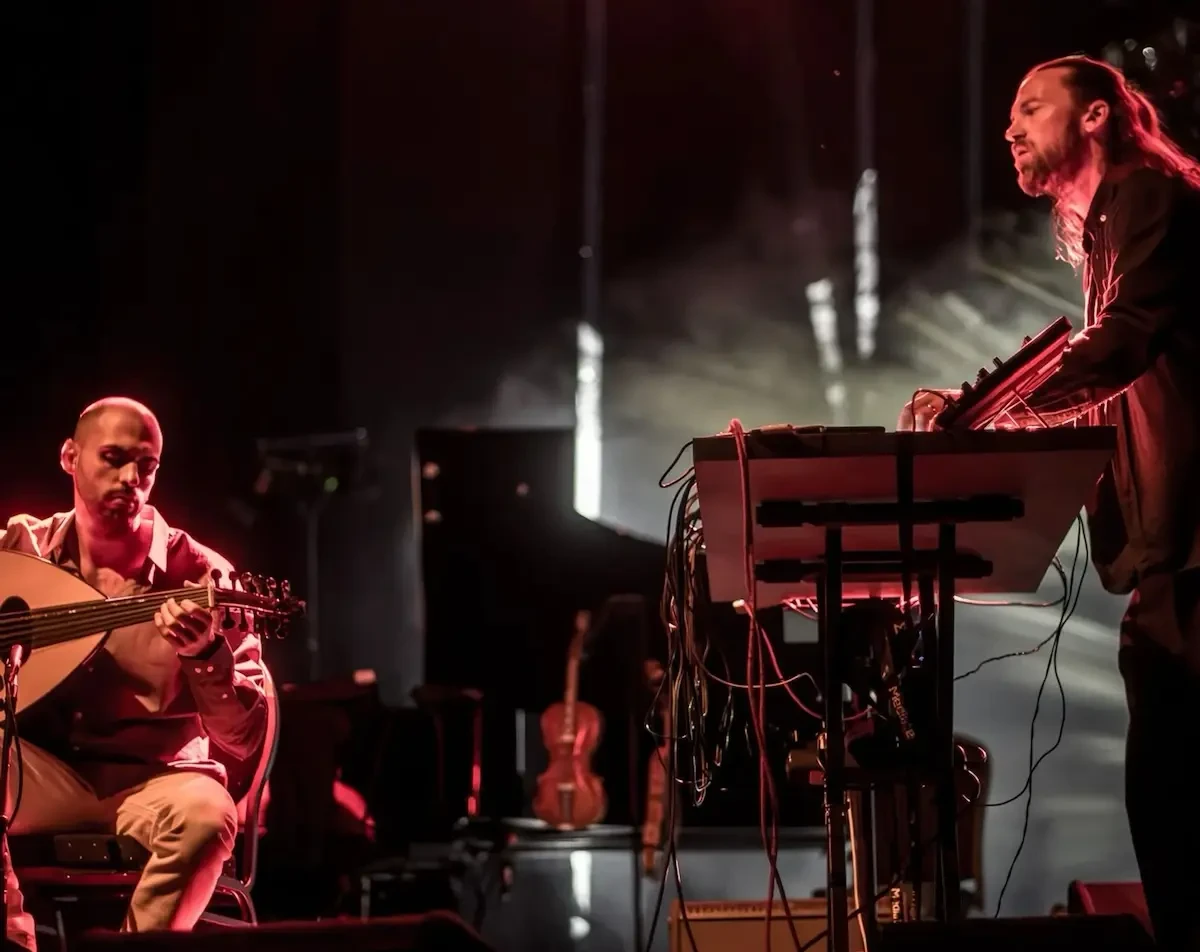
For Ekkofremtid, Bishop steps away from his familiar collaborations with luminaries like Nils Petter Molvær, Eivind Aarset, and Inge Weatherhead Breistein. Instead, he pairs his electronic wizardry with the ancient, resonant voice of Syrian oud player Khaled Habeeb.
Sonic Architecture and Contrast
The high contrast between the protagonists’ respective sound worlds immediately sets this project apart. Listeners can readily distinguish between source audio, recycled motifs, and recomposed sound masses. For the most part, Habeeb’s lute-like instrument speaks in its natural, traditional voice. However, it is endlessly fascinating to hear that voice fed back into Bishop’s evolving soundscapes, where small rhythmic cells are isolated and entire passages are dynamically reharmonized.
Evocative field recordings are woven into the background layers with a cinematic flourish. The abiding impression is a striking duality between traditional Arabic modal structures and contemporary European electronica.
- The Title Track & "Uncomfortable Current": The stark contrast between Habeeb’s precise, grounded phrasing and Bishop’s barren, windswept electronic landscapes is immediately clear on the title track. Meanwhile, the more abstract "Uncomfortable Current" (Ubehagelig Strømning) oscillates between folk-inflected melody and ambient drift, introducing a profound sense of temporal and geographical displacement.
- "Nordlys Fra Østen": Spanning 13 minutes, this piece witnesses Nordic tropes brushing against Eastern timbres. As the two musicians combine to sustain a unified mood, it becomes clear that continental divides are rendered meaningless; they speak with a single, harmonious voice.
Ekkofremtid is an instantly engaging set that is reassuringly slow to reveal its full charms, cementing Bishop’s reputation as a trail-blazing improvising sound artist.
Samuel Blaser: Rosina (Blaser Music BM019)
While Bishop stands at the intersection of past, present, and future, Swiss trombonist Samuel Blaser looks backward, seeking creative inspiration from a personal history he never directly experienced.
Tracing the Italian Diaspora
Born in the French-speaking region of Romandie, Blaser recently discovered a previously unknown Italian branch of his family tree. Many members of this family had fled financial ruin in the aftermath of World War I, riding a wave of European emigration to the United States. A newly discovered Italian-American cousin entrusted Blaser with a black-and-white photograph of Rosina—a grandmother he had never met—taken in Emilia-Romagna in 1925. This artifact ignited an intense desire to reconnect with his Italian roots.
Studio Sessions and Folk Adaptation
True to Blaser’s values as a fearless improviser, the resulting music is unabashedly warm and nostalgic. Fittingly, it was recorded close to his New York cousins by his longstanding US quartet, operating effectively as an extension of his own family. The quartet had convened in Paul Wickliffe’s New Jersey studio to record an album of Russ Lossing’s compositions. With an extra day booked, Blaser seized the opportunity to explore Italian-themed pieces, and a cohesive program rapidly took shape.
- Field Recordings Reimagined: Two of the eight tracks are drawn from Alan Lomax’s legendary 1954–55 Italian field recordings originating in Emilia-Romagna. The opening track, "Boara," features an endearingly simple folk-blues theme, with Blaser and pianist Russ Lossing sharing a sublime call-and-response sequence. Meanwhile, "Rosina" serves as a loving aural counterpart to the sepia portrait that inspired the entire endeavor.
- Mini-Suites and Nodding Honors: The explosive "Elgnij"—a variant of "Jingle" from Blaser’s Triple Dip trio—interlocks with "Adagio" and "Scherzo" to form a compelling mini-suite. Here, the quartet deftly varies the pace, intensity, and attack of their improvisations. "Mysteriously" offers an oblique nod to Thelonious Monk’s "Misterioso," while Lossing’s dark undertow on the four-square "Amaaka" (a favorite song of Blaser’s two sons) evokes the brooding atmosphere of Mal Waldron.
- The Grand Finale: The album closes with "Serenata," based on a 1957 song by Italian tenor Renato Carosone. Utilizing a heavily muted horn, Blaser makes his trombone sing with a singular lyricism, allowing the voices of old Italy to echo powerfully into the present.
Rymden: Today May Be Tomorrow (Jazzland 3779830)
Up until now, each release from the Scandinavian super-trio Rymden—comprising keyboardist Bugge Wesseltoft, bassist Dan Berglund, and drummer Magnus Öström—has followed a clear line of progression.
The Evolution of a Super-Trio
Their remarkable debut, Reflections And Odysseys (2019), established their foundational template: combining instrumental virtuosity with turbo-charged rhythms and atmospheric compositions. Space Sailors (2020) pushed boundaries further by integrating heavier, rock-oriented rhythms and expanded electronics. Meanwhile, 2023’s Rymden + Kork and Valleys And Mountains introduced external voices, collaborating with a symphony orchestra and guest soloist John Scofield, respectively.
Conceptual Maturity
While Today May Be Tomorrow may not represent a radical stylistic leap, it possesses profound qualities, marking the trio’s first fully mature album. Consolidating their strengths and honing their methodology, the program ventures into conceptual territory akin to Bishop’s work.
Underlying the album’s title is a sobering, philosophical premise: the trio invites listeners to consider whether, in an increasingly unstable and unpredictable world, we can blindly assume that tomorrow is guaranteed. Posing fundamental questions about the nature of time, the elastic music toys with listener perceptions in subtle, disorienting ways, leaving behind a lingering sense of uneasy satisfaction.
Reinterpretation and Reimagining
- "Valiant Revisited": Perhaps the most explicit collision of past and present is found in the group’s reworking of Dan Berglund’s "Valiant Revisited," a piece he originally recorded with Wesseltoft and Henrik Schwarz on the 2014 album Trialogue. Less pensive and significantly more polished, Rymden transforms it into an e.s.t.-style ballad that feels definitive.
- Dynamic Range: Magnus Öström’s 10-minute title track is renewed and reimagined as it unfolds, with traces of the opening theme resurfacing across contrasting sections. Bugge Wesseltoft’s "Nightfall" is a rhythmic tour-de-force, where dubby echoes amplify its elasticity. In contrast, the driving post-rock energy of Berglund’s "Undercover Lover" stands out for its laser-like precision and relative extroversion.
- Elegiac Foundations: Wesseltoft’s "Here Now" and "Em" impart a classic sense of permanence—elegiac pieces built on rock-solid foundations. Finally, the fuzzy outlines of Öström’s wonderful finale restore the album’s prevailing mood of temporal ambiguity.
Supporting Context & Metrics
To fully appreciate the weight of these releases, one must examine the broader cultural and economic metrics driving the contemporary European jazz sector.
| Album Title | Artists Involved | Primary Label | Release Year / Window | Core Conceptual Theme |
|---|---|---|---|---|
| Ekkofremtid | John Derek Bishop & Khaled Habeeb | Nortusa | Current Cycle | Memory shaping the future; Nordic jazz meets Arabic oud |
| Rosina | Samuel Blaser Quartet | Blaser Music | March 2024 Sessions | Italian diaspora, archival field recordings, and ancestry |
| Today May Be Tomorrow | Bugge Wesseltoft, Dan Berglund, Magnus Öström | Jazzland | January 2026 Sessions | Temporal fragility, mature synthesis, and post-rock momentum |
Economic and Distribution Shifts
Independent European jazz labels—such as Jazzland, Nortusa, and artist-run imprints like Blaser Music—are increasingly relying on hybrid distribution models. Physical vinyl and high-resolution digital downloads continue to anchor revenue streams, driven by dedicated audiophile communities in Scandinavia, Switzerland, and Germany.
Furthermore, cross-border artistic collaborations (such as Bishop/Habeeb) are heavily supported by regional arts councils and European cultural funds. These grants enable musicians to transcend logistical and geographic barriers, fostering an environment where traditional acoustic instruments (the oud, the trombone, the acoustic piano) can merge seamlessly with real-time digital signal processing (DSP) and live sampling.
Official Statements and Critical Reception
Industry response to this recent wave of releases has been overwhelmingly positive, highlighting a collective maturity among European improvisers.
In a recent press statement regarding the conceptual framework of Today May Be Tomorrow, keyboardist Bugge Wesseltoft noted:
"We live in a time where assumptions are dangerous. When we step onto the stage or into the studio, we are not just playing notes for the present moment; we are testing whether our musical conversations can hold weight against an uncertain horizon. Time is no longer linear in our music—it loops, it fractures, and it demands attention."
Similarly, sound artist John Derek Bishop reflected on the collaborative dynamic behind Ekkofremtid:
"Working with Khaled [Habeeb] forced me to look outside the digital box. When you take an instrument born centuries ago in the Middle East and feed its acoustic truths through modern sampling algorithms, you aren’t destroying tradition—you are giving it a vehicle to travel into spaces the original creators could never have imagined."
Prominent European jazz critics have heralded these releases as proof that the genre’s avant-garde wing remains fiercely vital. Reviewers have particularly praised the technical precision of the Blaser Quartet’s New Jersey sessions and Rymden’s ability to balance stadium-sized dynamic peaks with intimate, chamber-like introspection.
Future Outlook
As the European jazz community looks toward the remainder of the decade, several key trajectories are coming into sharp focus:
- The Deepening Integration of Archival Materials: As demonstrated by Samuel Blaser’s genealogical excavation and use of Alan Lomax field recordings, modern jazz musicians are increasingly acting as sonic historians. Expect more artists to unearth family histories, regional folk traditions, and forgotten repertoires, filtering them through modern improvisational lenses.
- Cross-Cultural Hybrids as Standard Practice: The success of Bishop and Habeeb’s cross-continental dialogue signals that genre boundaries between Nordic ambient jazz, Middle Eastern modal traditions, and Western electronic music are permanently dissolving. The future of European jazz is inherently global, polyglot, and decentralized.
- Conceptual Urgency: As evidenced by Rymden’s meditations on the fragility of tomorrow, instrumental music is increasingly adopting socio-political and philosophical narratives. Jazz is asserting its role not merely as entertainment, but as a reflective medium capable of addressing collective anxieties regarding time, displacement, and environmental uncertainty.
Ultimately, these three releases—Ekkofremtid, Rosina, and Today May Be Tomorrow—prove that European jazz is in an intellectual and aesthetic golden age. By honoring the echoes of the past while boldly confronting the uncertainties of the future, these artists ensure that the music remains a living, breathing, and endlessly evolving art form.