
Executive Overview
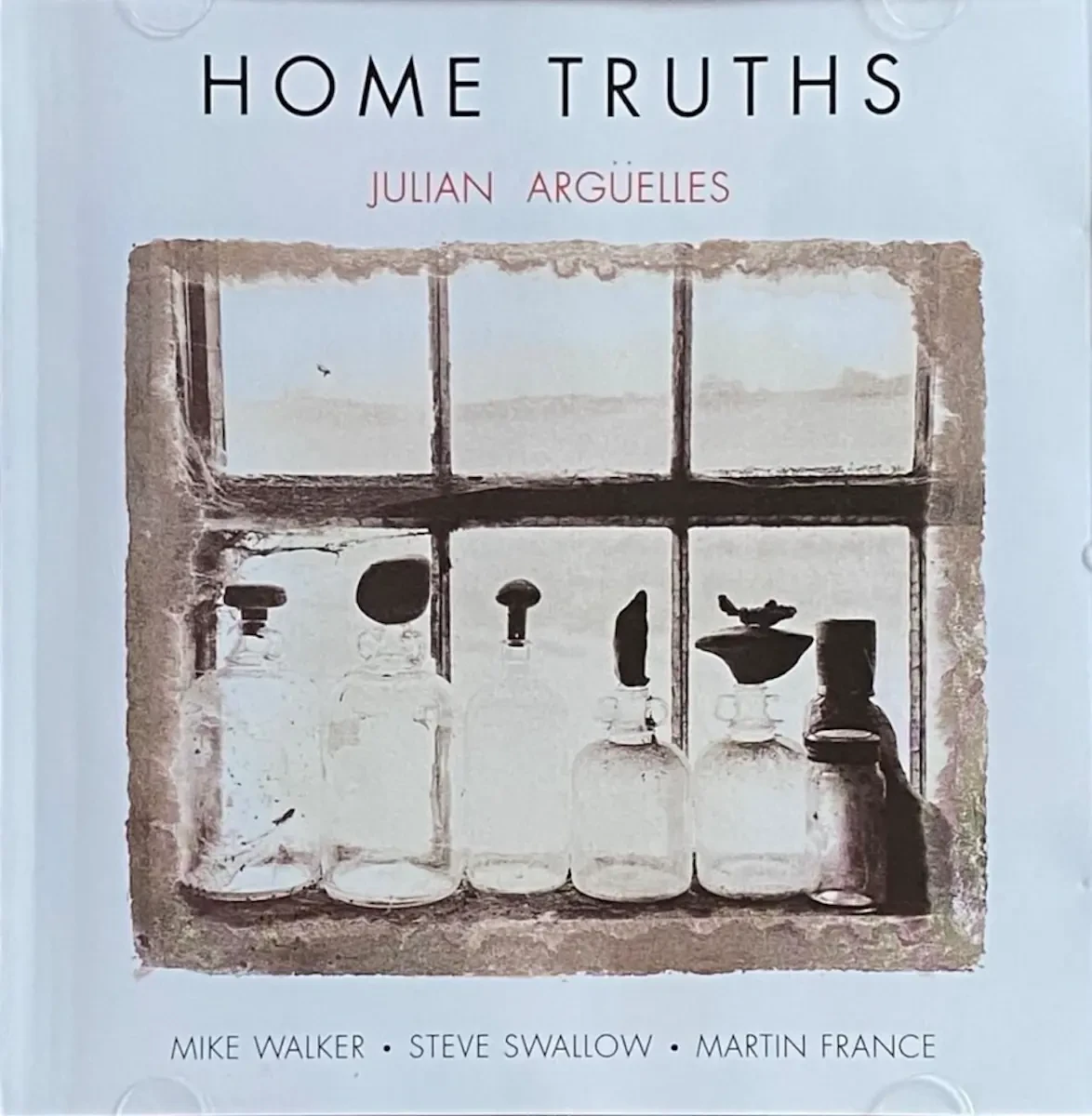
In the landscape of modern European jazz, certain recordings transcend their initial contemporary reception to become touchstones for artistic ambition, technical mastery, and aesthetic risk-taking. Among these is British saxophonist and composer Julian Arguelles’ critically acclaimed 1995 studio album, Home Truths (released on the Babel label, catalog BDV 9503). Recorded over two intensive days in London on May 13 and 14, 1995, the album captured a transcendent alignment of improvisational heavyweights: Arguelles on soprano saxophone, tenor saxophone, and bass clarinet; the brilliant guitarist Mike Walker; legendary American electric bassist Steve Swallow; and visionary contemporary drummer Martin France.
Two decades and a half after its initial release, Home Truths stands as a defining document of a transitional era in British jazz. During the mid-1990s, a vanguard of UK musicians was actively shedding the derivative post-bop conventions of earlier decades, choosing instead to chart an idiosyncratic path informed by contemporary chamber music, free improvisation, and highly abstracted interpretations of folk and blues idioms. Arguelles, alongside peers such as Tommy Smith, emerged during the 1980s and 1990s as a formidable voice reshaping the European sonic palette.
This retrospective analysis explores the genesis, musical anatomy, personnel dynamics, and enduring legacy of Home Truths. By examining the intricate arrangements, the Paul Motian-inspired percussion of Martin France, the foundational pulse of Steve Swallow, and the telepathic interplay between Arguelles and Walker, this review unpacks why this stimulating, uncompromising record remains a masterclass in converting abstruse form and complex harmony into profound musical narrative.
Detailed Chronology: The Genesis and Recording of Home Truths
The Spring Sessions of 1995
The creation of Home Truths was not a hasty affair, but rather the culmination of years of rigorous compositional development by Julian Arguelles. By May 1995, Arguelles had already established himself as an indispensable creative force within the British and European jazz scenes, known both for his work with loose collective ensembles and his formidable output as a bandleader and composer.
Entering the London recording studio on Saturday, May 13, and Sunday, May 14, 1995, the quartet assembled with a rare degree of mutual artistic understanding. While Arguelles masterminded the compositional framework—delivering an eclectic, demanding repertoire that included tracks such as Third Escapade, A Month In Tunisia, Sintra, Hix, Mr Mc, Which Way Out, First Escapade, 500 Broadway, Quietly Peeping Around Corners, and the expansive title-adjacent closer Wessex (totaling a brisk 61 minutes and 16 seconds of music)—the execution relied heavily on real-time spontaneity.
Capturing the Abstract
The recording sessions prioritized live interaction over multitrack manipulation. Capturing the dynamic range of Arguelles’ multi-reed approach—shifting fluidly between the piercing clarity of the soprano saxophone, the robust warmth of the tenor, and the woody, cavernous resonance of the bass clarinet—required a delicate engineering approach.
Mike Walker’s electric guitar was dialed in to provide a textural bridge between the rhythm section and the frontline horns, while Steve Swallow’s distinctive five-string electric bass anchored the frequency spectrum with a melodic clarity unique to his playing style. Behind the kit, Martin France approached the rhythm not as a rigid timekeeper, but as a reactive, atmospheric colorist. The resulting sixty-one minutes of music documented over those two May days captured a band operating at the absolute pinnacle of their creative powers, balancing structural abstraction with visceral emotional release.
Musical Anatomy & Aesthetic Framework
The Folk-Jazz-Gospel Amalgam
At the core of Home Truths is a conscious departure from standard jazz-standard formats. Although every member of the quartet possesses the technical capacity to swing with absolute authority, Arguelles deliberately sidesteps predictable harmonic trajectories. Instead, he pursues an abstract, deconstructed reading of folk and blues idioms.
This approach bears striking aesthetic parallels to Keith Jarrett’s highly strung folk-jazz-gospel amalgams of the late 1960s and early seventies—specifically projects where Jarrett balanced jagged, angular modernism with deep-seated, rustic emotional undertones. The compositions on Home Truths do not immediately court the listener with easy hooks or predictable resolutions. Instead, they demand active engagement, drawing the audience into a labyrinth of shifting meters, modal ambiguities, and microtonal inflections.
Repertoire and Compositional Architecture
The album’s tracklist reads like a roadmap of modern European jazz innovation:
- The Escapade Suite (Third Escapade, First Escapade): These tracks showcase Arguelles’ penchant for recurring motifs treated with developmental variation, allowing the quartet to stretch harmonic boundaries before snapping back to taut melodic focal points.
- Geographic and Conceptual Vignettes (A Month In Tunisia, Sintra, Hix, Wessex): These compositions reflect a deep engagement with geographic and cultural spaces translated into pure sound, where folk-like melodies are filtered through contemporary chamber-jazz aesthetics.
- Dynamic Explorations (Mr Mc, Which Way Out, 500 Broadway, Quietly Peeping Around Corners): Ranging from dizzying uptempo sprints to spacious, contemplative tone poems, these pieces highlight the ensemble’s ability to maintain structural integrity across vastly different tempos and moods.
Personnel Dynamics & Supporting Context
Julian Arguelles: The Architect
As a saxophonist and composer, Julian Arguelles represents the zenith of the generation of British horn players who emerged during the 1980s. Alongside contemporaries like Tommy Smith, Arguelles redefined what it meant to be a modern improviser in the UK, absorbing the lessons of American post-bop while remaining fiercely committed to European classical and folk traditions. On Home Truths, his facility across soprano saxophone, tenor saxophone, and bass clarinet allows him to constantly reinvent the textural landscape of his compositions. Whether cutting through the mix with the razor-sharp soprano lines on Mix or plumbing the dark, resonant depths of the bass clarinet, Arguelles proves himself to be a master of architectural improvisation.
Mike Walker: The Remarkable Foil
No discussion of Home Truths is complete without highlighting the extraordinary contribution of guitarist Mike Walker. Serving as Arguelles’ primary soloist sparring partner, Walker delivers performances of breathtaking inventiveness throughout the album. His work on tracks like Mix is particularly revelatory, utilizing a fluid, harmonically sophisticated guitar vocabulary that dissolves the boundaries between rhythm and lead playing. Walker possesses a rare gift: the ability to navigate abstruse chord structures and dense polyphonic forms with an organic, singing lyricism that makes even the most complex avant-garde passages feel natural and inevitable.
Steve Swallow: The Unshakable Foundation
The inclusion of American jazz royalty Steve Swallow as a guest star adds an invaluable layer of depth to the session. Swallow’s role on Home Truths is almost entirely supportive, yet his presence dictates the gravitational pull of the entire ensemble. Playing his signature custom electric bass guitar, Swallow provides an utterly reliable, melodic bass foundation that eschews traditional walking-bass cliches in favor of counterpoint and spacious harmonic support. His long-standing mastery of modern jazz harmony anchors the more abstract excursions of Arguelles and Walker, grounding the music without ever boxing it in.
Martin France: The Motian-Inspired Pulse
Completing the quartet is drummer Martin France, whose playing on Home Truths is characterized by a loose, clattering, highly reactive style clearly indebted to the revolutionary approach of jazz legend Paul Motian. Rather than locking into a rigid, metronomic pulse, France treats the drum kit as an orchestral palette. His cymbal work is shimmering and decentralized; his snare accents are conversational and unpredictable. This approach typifies the modernist British jazz style of the nineties, providing the rhythmic elasticity necessary for Arguelles’ abstract compositions to breathe and mutate in real-time.
Critical Reception & Metrics
Analyzing the Reception
Upon its release on the Babel label (BDV 9503), Home Truths received critical acclaim within specialist jazz publications, though reviewers universally noted that the record was not designed for casual listening.
- Accessibility vs. Artistic Integrity: Critics pointed out that the record’s abstract nature meant it was not always immediately attractive or approachable to mainstream jazz audiences. The rejection of easy swing beats in favor of fragmented, folk-infused modernism required patience.
- Technical Proficiency as a Counterweight: Reviewers consistently emphasized that any potential shortfalls in immediate mainstream accessibility were thoroughly offset by the sheer instrumental strength of the players. The consensus was clear: so musical and technically adept were Arguelles and Walker that they made fine, compelling sense of the most abstruse forms and harmonies.
- Historical Validation: In retrospect, Home Truths is viewed as a vital bridge connecting the fiery modal explorations of the 1970s with the contemporary, genre-agnostic European jazz of the 21st century.
Album Metrics Overview
- Artist: Julian Arguelles Quartet
- Title: Home Truths
- Label: Babel (Catalog No. BDV 9503)
- Recording Dates: May 13 & 14, 1995
- Recording Location: London, United Kingdom
- Total Running Time: 61 minutes, 16 seconds
- Personnel:
- Julian Arguelles (Soprano Saxophone, Tenor Saxophone, Bass Clarinet)
- Mike Walker (Electric Guitar)
- Steve Swallow (Electric Bass Guitar)
- Martin France (Drums)
Future Outlook: The Enduring Legacy of Home Truths
Looking back from the vantage point of contemporary jazz history, Home Truths has graduated from a celebrated 1990s release to a masterclass reference point for modern composers and improvisers.
Influence on the Contemporary UK Scene
The stylistic blueprint laid down by Arguelles, Walker, Swallow, and France—combining compositional rigor, folk abstraction, and spontaneous rhythmic interaction—has profoundly influenced subsequent generations of British jazz musicians. Today’s thriving London jazz scene, renowned for its fearless cross-pollination of genres, owes a direct debt to the groundwork laid by trailblazers like Arguelles who insisted that jazz could be both intellectually rigorous and deeply expressive.
Archival and Pedagogical Value
As vinyl and CD reissues continue to circulate among collectors and jazz students, Home Truths is increasingly analyzed in conservatories and academic music programs. Young saxophonists and guitarists study tracks like Mix and Wessex not merely as historical artifacts, but as advanced studies in group telepathy, harmonic interpretation, and textural balance.
Ultimately, Home Truths remains a shining example of what happens when uncompromising artistic vision meets world-class execution. It is a stimulating, bracing, and perpetually rewarding record that confirms Julian Arguelles’ status as one of the most innovative and enduring musical voices to emerge from the British jazz tradition.